2-color spiral baby blanket
This baby blanket uses 2 colors travelling continuously around the same starting ring. Its double crochet groups become wider as the spiral grows, creating a broad fabric without closing every color section into a separate round. The reference example measures approximately 81 × 81 cm.

By Emma & EllaUpdated
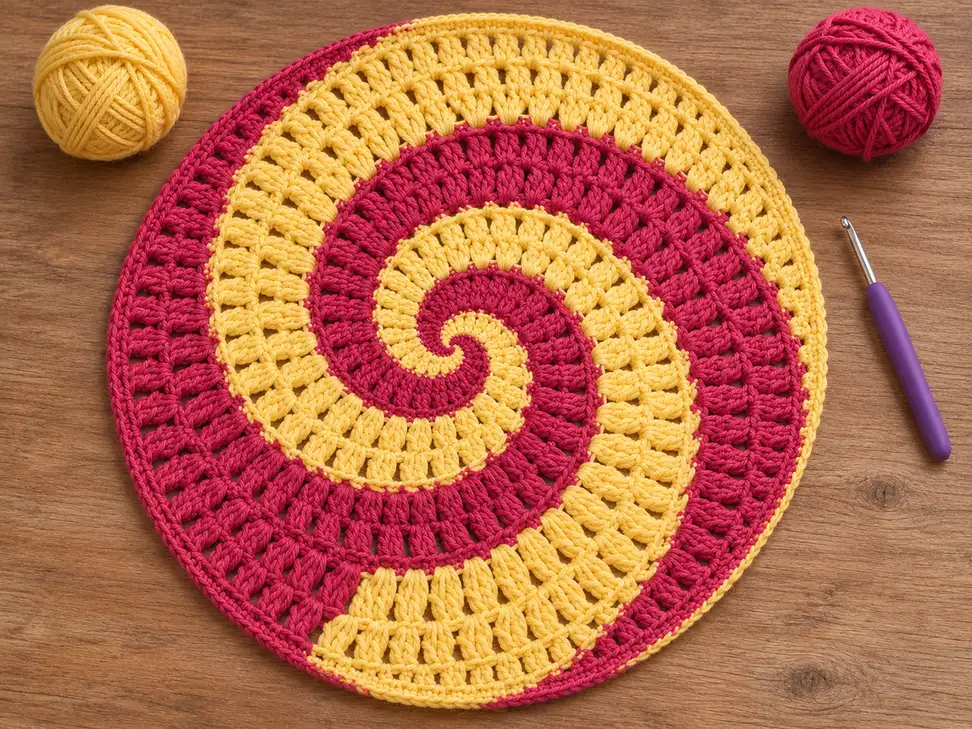
This baby blanket uses 2 colors travelling continuously around the same starting ring. Its double crochet groups become wider as the spiral grows, creating a broad fabric without closing every color section into a separate round. The reference example measures approximately 81 × 81 cm.
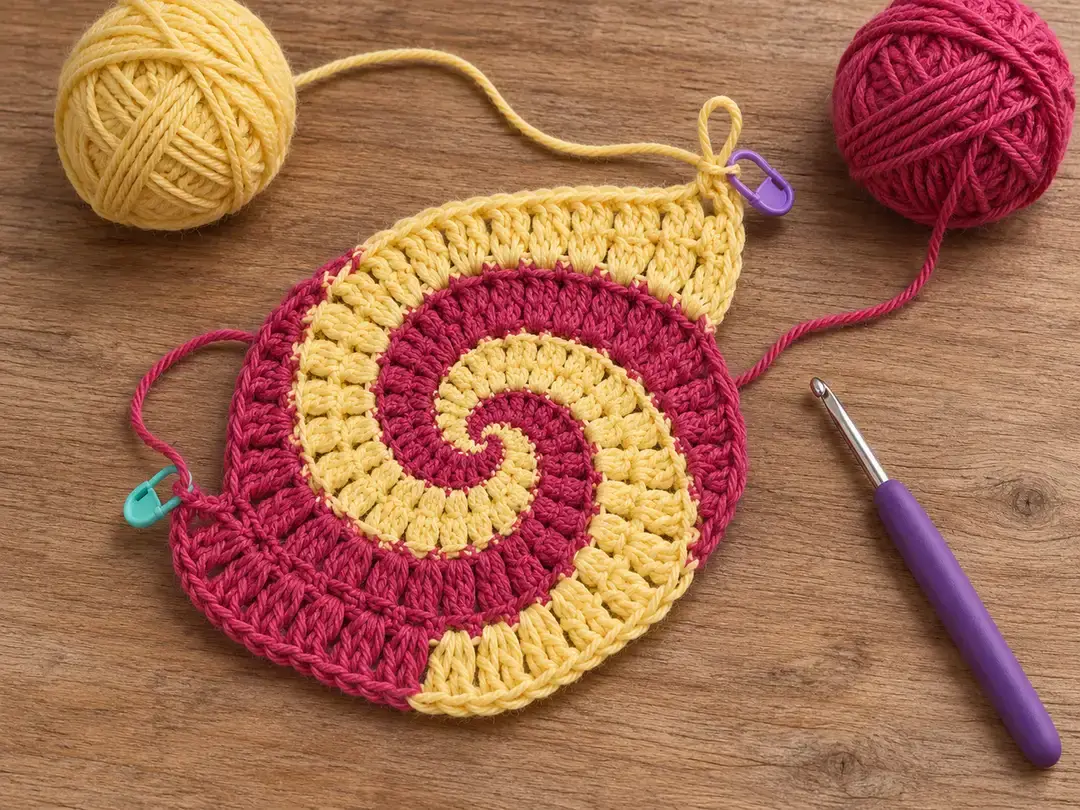
Both yarns remain attached during the construction. Work part of an arm, secure its live loop, then take up the other arm. The stated stopping points allow the colors to build over each other. Read the early stages carefully: their repeat quantities differ before the regular widening method is established.
Materials, US stitches and live-loop preparation
Yarn and equipment
Use approximately 325 m of medium-weight worsted yarn in each of 2 colors, together with a 5.5 mm hook. You also need 2 locking stitch markers, scissors and a yarn needle. Label the colors A and B before beginning so that the early construction stages remain easy to follow.
The reference measurement describes the example rather than a fixed gauge formula. No specific stitch-and-row gauge is supplied here. Measure the growing blanket without stretching its groups, and keep both yarns at a similar working tension so the spiral develops evenly.
US crochet glossary
| Abbreviation | US meaning |
|---|---|
| ch | Chain |
| sl st | Slip stitch |
| sc | Single crochet, equivalent to US single crochet |
| hdc | Half double crochet, equivalent to US half double crochet |
| dc | Double crochet, equivalent to US double crochet |
The initial 4 chains represent the first dc and a 1-chain space. Later groups widen by skipping their first old dc, working across the remaining double crochet tops and adding 2 dc into the following space. Keep the separate chain after each group, since that space provides the next stage’s increase point.
Park the yarn securely
The working rounds remain open. Whenever changing yarns, lengthen the last loop and secure it with a locking marker before putting the hook into the other loop. Let the resting strand hang freely. Do not cut it or carry it through the fabric as though it were a loose end.
Reduce a parked loop to a normal working size when taking it up again. Pull only on its working strand and avoid drawing neighboring stitches tight. The 4-color spiral square uses a similar way of managing several live loops, although its corner construction differs.
Stages 1–2: begin both colors in the same ring
Stage 1 with A
- Stage 1: With A, make 4 ch and join with sl st into a ring.
- Make 4 ch as the first dc and a 1-chain space.
- Work 1 dc and 1 ch into the ring 5 times.
- Lengthen and secure A’s live loop.
Check 6 double crochet positions, including the starting chain. All these stitches belong to A’s initial section. Keep the chain spaces accessible rather than pulling the stitches tightly together around the ring.
Stage 2 with B
- Stage 2: Join B with sl st into the same ring.
- Make 4 ch.
- Work 1 dc and 1 ch into the ring 5 times.
- Continue working with B for the next stage.
B also has 6 double crochet positions. The 2 starting sections share a ring; do not make a second separate ring for B. Keep A’s parked loop secure while B begins to work over A’s stitches.
The initial ring is a construction point rather than a closed color round. The sections are not joined to each other at their outer ends here. Keeping those ends open allows the next stages to advance along the neighboring color.
Stages 3 onwards: build and widen the double crochet groups
Stage 3 with B
- Stage 3: Work over A.
- Skip the next dc, work 2 dc into the following 1-chain space and make 1 ch.
- Work that sequence 5 times in total.
- Secure B’s live loop.
Each completed group has 2 dc. The skipped old double crochet and the space are separate locations: skip the stitch top, then place both new double crochets around the following chain space. Do not put 1 double crochet into the skipped stitch and another into the space.
Stage 4 with A
- Stage 4: Take up A and work over B.
- Skip the next dc, work 2 dc in the following 1-chain space and make 1 ch.
- Work that sequence 6 times in total.
- Then skip the first dc of a group, work 1 dc in its next dc, work 2 dc in the following space and make 1 ch.
- Work that widening sequence 4 times in total.
- Secure A’s live loop.
The initial part of this stage uses 6 repeats, not the 5 used by B in the previous stage. The following 4 repeats begin widening the groups. Keep these quantities distinct rather than treating the whole stage as a single repeated round.
Stage 5 with B
- Stage 5: Take up B.
- Skip the next dc, work 2 dc in the following space and make 1 ch.
- For every further group, skip its first dc.
- Work 1 dc in each remaining dc of that group.
- Work 2 dc in its following 1-chain space and make 1 ch.
- Continue until just before the final group, then secure B.
The first group of this stage has its own instruction before the general widening method. Find the parked loop and the next available stitches before continuing so that the first group is not accidentally worked twice.
Stage 6 and continuing alternation
- Stage 6 with the next yarn: Skip the first dc of each group.
- Work 1 dc in every remaining dc of that group.
- Work 2 dc in the following 1-chain space.
- Make 1 ch.
- Repeat until just before the final group, then secure the loop and take up the other color.
- Continue alternating A and B using the same widening method.
On larger blankets, you may work nearer to the waiting loop. When that yarn is taken up again, complete the missing double crochets of its partially worked group, then finish the group with 2 dc in the space and 1 ch. Do not abandon the unfinished group and begin a fresh repeat at its midpoint.
Understand how a group widens
Each regular widening pass omits the first old double crochet, retains the remaining stitch positions and places 2 new double crochets into the following space. Relative to that old group, the new group therefore gains 1 double crochet. The chain after the group stays a separate working space and is not counted as a double crochet.
Follow a group from its first skipped stitch to its following arch before beginning it. This is more reliable than relying only on the visual color boundary, especially when the spiral arms have grown long. An incorrectly placed skip can move the whole group sideways even when the new double crochet quantity seems plausible.
Taper both spiral arms and finish the blanket
Check the stopping arrangement
Compare the double crochet quantities before beginning the finish. The source calls for 11 complete groups of equal width and a final group worked until 4 stitches remain before the last arch. These 4 old stitches receive the descending-height finish. Do not confuse the number of complete groups with the number of stitches in each group.
The stopping arrangement is more important than reaching a convenient yarn change point. Keep both loops secured while checking the groups, and correct a misplaced skip or unfinished group before cutting either yarn. Blocking cannot replace a missing section of the spiral.
Check the working spaces without changing the pattern
Spread a short section flat and identify a complete group followed by its chain space. The stitch immediately after that space begins the next group and is the stitch to skip on its next widening pass. Work across the remaining tops in order, then place the 2 additional double crochets around the space. This keeps the growing fabric organized even when the groups become wide.
If a group seems shorter than its neighbors, inspect its start before adding a stitch. It may have been left partially worked at an earlier color change, in which case the missing portion belongs to the continuation described above. Alternatively, a double crochet may have been skipped accidentally within the group. Those situations require different corrections, so do not assume that every apparent gap needs another increase.
Keep the parked yarns clear of the hook’s insertion path. Catching a resting strand beneath a new double crochet can tether the colors together at an unintended position. If that happens, undo the affected stitch while the strand is still accessible rather than trying to pull the trapped yarn free through several later stitches.
When putting the project aside, secure both live loops, even if a particular color has not been used during the latest section. Store the balls so the strands can be separated easily when resuming. On return, identify the current group and its next working position before removing either marker.
After fastening off both colors, lay the blanket flat and inspect the tapering points. Their sequence should descend from double crochets to half double crochets, then a sc and slip stitch. Gentle shaping suitable for the fiber can settle the fabric, but avoid stretching an uneven group into alignment before its stitch placement has been checked.
Check the final yarn tails on the reverse and weave them through compatible stitch paths without gathering the center or the tapered edge. The yarn’s own care instructions determine washing and drying. Let the blanket dry fully before folding it so the spiral can rest in its finished shape.
Finish A
- Finish A: Work to the final 4 stitches before the last arch.
- Work 1 hdc in the next stitch.
- Work 1 hdc in the following stitch.
- Work 1 sc in the next stitch.
- Work 1 sl st in the final stitch.
- Cut and secure A.
Finish B
- Finish B: Repeat the same stopping arrangement with B.
- Across its final 4 stitches, work 1 hdc, 1 hdc, 1 sc and 1 sl st in order.
- Cut and secure B.
- Weave in the ends.
The decreasing stitch heights let each arm settle into the edge rather than ending abruptly at full double crochet height. Work them into successive old stitches, not together into a single space. Keep the final slip stitch relaxed enough to avoid pulling the preceding sc sideways.
For a square construction with clearly defined corners, see the V-stitch baby blanket. If you prefer color progression in rows, the color-gradient double crochet blanket offers a different structure.
Emma & Ella
More crochet projects from The Cooking Twins Yarn.
More from Emma & Ella