Colorful hat with double crochet groups
This hat combines a closed brown crown with yellow, red and marled double crochet groups. The reference circumference is approximately 53.3 cm, with a crown diameter of approximately 15.2 cm. A count discrepancy at the transition from the solid crown to the grouped sides is explained below.

By Emma & EllaUpdated
This hat combines a closed brown crown with yellow, red and marled double crochet groups. The reference circumference is approximately 53.3 cm, with a crown diameter of approximately 15.2 cm. A count discrepancy at the transition from the solid crown to the grouped sides is explained below.
The pattern uses 17 groups around the sides and brim. Those groups widen in stages while the spaces between them also change. Keep the color labels and starting-chain convention consistent throughout the joined rounds.
DK yarn, color roles and US gauge guidance
Materials
Use DK yarn in dark brown, approximately 50 g, yellow, approximately 20 g, and red, approximately 20 g. Prepare a 3.5 mm hook, tape measure and yarn needle. The source does not give a complete meter amount or an alternative graded size table.
| Label | Working color |
|---|---|
| A | Brown |
| B | Yellow |
| C | Yellow and red strands held together |
| D | Red |
C is made by holding 2 colored strands together. It is not another separately specified marled ball. Catch both strands during every stitch so the effect stays consistent and no loose single strand remains outside the fabric.
US terminology
Dc means US double crochet. Sc means US single crochet. Ch means chain and sl st means slip stitch. An increase is 2 stitches in the same old position.
Work ordinary stitches beneath both upper loops unless a space is named. Every round closes with sl st into its first actual dc and is not turned. The first 2 ch never count as a stitch.
Gauge reference
The source gives the first 5 crown rounds as approximately 10 cm in diameter. Check that circular sample rather than treating it as a stitch-and-row swatch. The reference finished crown is approximately 15.2 cm after its full shaping.
For another width-checking approach, see the made-to-measure double crochet-rib hat. Keep this grouped hat’s own gauge and uncounted-chain convention.
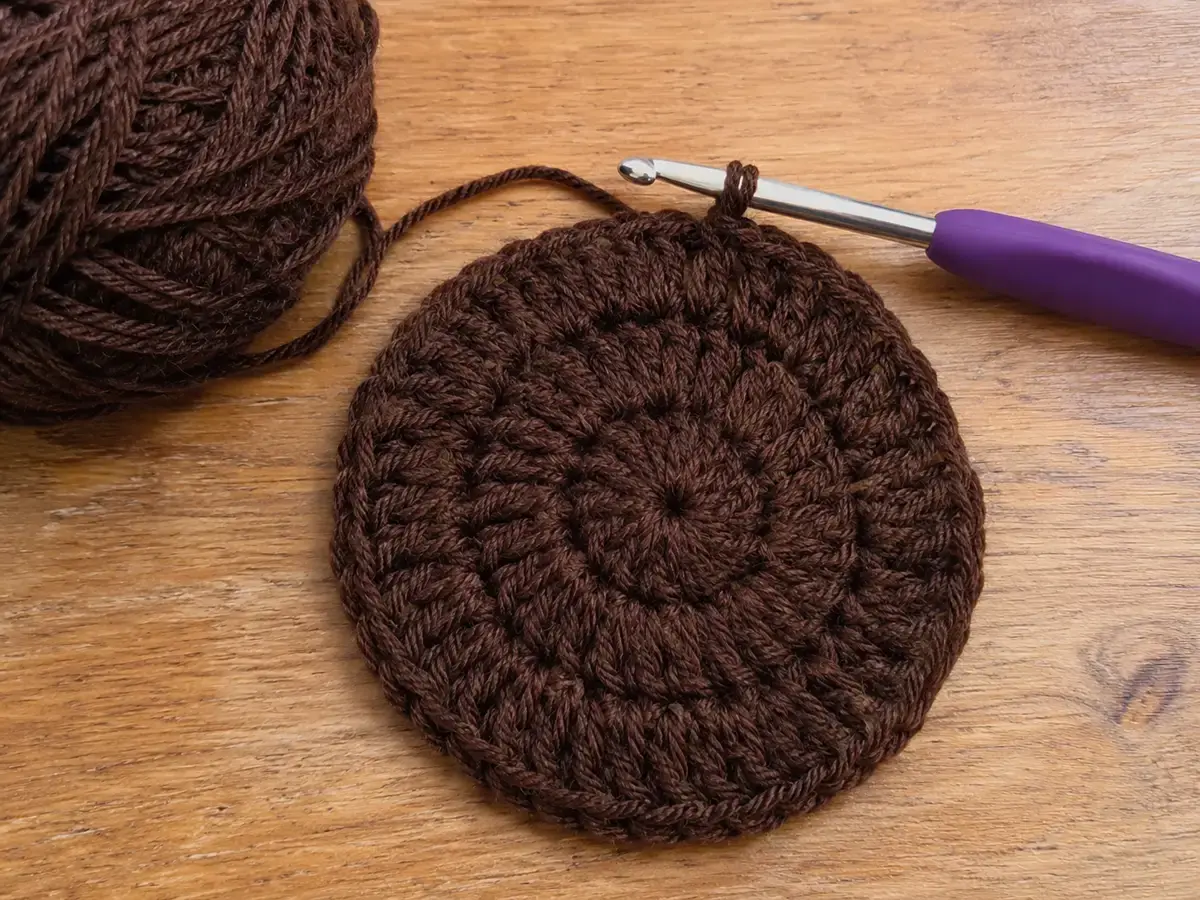
Rounds 1–7: closed brown crown
- Round 1: With A,make 2 ch and 12 dc in a magic ring (12). Join with sl st into the first dc; do not turn.
- Round 2: make 2 ch;increase in every stitch (24). Join with sl st into the first dc; do not turn.
- Round 3: make 2 ch;repeat increase and 1 dc 12 times (36). Join with sl st into the first dc; do not turn.
- Round 4: make 2 ch;repeat increase and 2 dc 12 times (48). Join with sl st into the first dc; do not turn.
- Round 5: make 2 ch;repeat increase and 3 dc 12 times (60). Join with sl st into the first dc; do not turn.
- Round 6: make 2 ch;repeat increase and 4 dc 12 times (72). Join with sl st into the first dc; do not turn.
- Round 7: make 2 ch;repeat increase and 5 dc 12 times (84). Join with sl st into the first dc; do not turn.
Explicit transition adjustment
Round 7’s ordinary increase sequence gives 84 dc. The source then calls for 17 repeats of 4 dc and a skipped stitch in round 8, which needs 85 old positions rather than 84.
To make all 17 groups, work the final crown position as an additional increase and finish the crown with 85 dc. This is a calculated transition adjustment, not an unchanged source count. It provides 17 sections of 5 old positions for the following grouped round.
Check the solid crown
The early crown increases add 12 positions per round. The starting 2 chains do not replace a double crochet, so work every actual stitch stated after them. Counting those chains would make the total wrong before the separate 84-to-85 adjustment is reached.
Lay the crown down without stretching and compare the circular gauge reference. Its solid fabric should be complete before the grouped section begins. Another crown construction is the 6-square granny hat.
Rounds 8–15: colored wall groups
Begin every grouped round with 2 uncounted ch. Make the stated chains between groups and join into the first actual dc without turning.
- Round 8: A:repeat 4 dc,1 ch and skip 1 stitch 17 times:68 dc/17single-chainarches.
- Round 9: A:work 4 dc and 1 ch in each single-chainarch, skipping the old 4-dc groups:17 groups. Make 1 ch and secure.
- Round 10: B:repeat round 9 in every arch; secure.
- Round 11: C:work 5 dc and 2 ch in every arch:85 dc/17 arches; secure.
- Round 12: D:work 5 dc and 2 ch in every 2-chainarch; secure.
- Round 13: C:work 5 dc and 2 ch in every 2-chainarch:17 groups.
- Round 14: C:repeat round 13, keeping C attached if working continuously.
- Round 15: C:repeat round 13.
Chain spaces retained from the source totals
The source omits the written chains between 4-dc groups in rounds 9 and 10, but its stated result includes 17 arches. Those single chains are therefore written explicitly above. They provide the working spaces for the next grouped round.
In round 8, the groups are worked across the crown positions with a skip between them. In later rounds, the whole new group enters a chain arch while the old double crochet group is passed over. Do not continue working into every old dc after the first grouped round.
Keep the color changes distinct
A continues through round 9, B works round 10, C works round 11, D works round 12 and C returns for rounds 13–15. The repeated color in rounds 14 and 15 is C as given in the source. It is not silently replaced by another color to create a different stripe arrangement.
The C rounds use yellow and red together, so they may feel thicker than single-color groups. Keep an even working tension at those transitions and compare the 17 groups around the whole circumference.
Rounds 16–22: widen and finish the brim
- Round 16: D:work 6 dc and 2 ch in every arch:102 dc/17 arches; secure.
- Round 17: C:repeat round 16; secure.
- Round 18: B:work 7 dc and 2 ch in every arch:119 dc/17 arches; secure.
- Round 19: A:repeat round 18.
- Round 20: A:repeat round 19.
- Round 21: A:repeat round 19.
- Round 22: Work 1 sc in every dc and 2 sc around each 2-chainarch:153 sc. Join with sl st and secure.
Understand the widening groups
The 6-dc stage has 17 × 6 = 102 dc. The following 7-dc stage has 17 × 7 = 119. Both use 2-chain spaces between groups. The final sc round adds 2 stitches around each of the 17 spaces, so 119 + 34 = 153 sc.
Work those 2 sc around each complete arch rather than looking for an extra group to fill. Every old dc also receives its own sc. The starting chain is not added as a 154th position.
Read a complete side repeat
The first grouped round uses 4 actual double crochets followed by a chain and an old position that is skipped. The chain forms a new space above that skip. These actions account for a 5-position crown section, which is why the 17-repeat version needs the adjusted 85-position crown.
On the following round, all 4 new double crochets enter the old chain space. The previous group lies between the new working spaces and is not crocheted into individually. Keeping that shift of insertion point creates the stacked open pattern rather than a continuous solid double crochet wall.
When the groups enlarge to 5, 6 and 7 double crochets, they still share a single arch per group. Do not spread an enlarged group across adjacent stitch tops to make room. Ease the previous arch with your fingers and work the complete group around it.
Check the group and arch counts separately
There are 17 groups throughout the colored section. Round 11 contains 85 double crochets because 17 groups each have 5; it also has 17 arches of 2 chains. Those chain stitches are not part of the 85-double crochet total. Keep the same distinction when checking the 102- and 119-double crochet stages.
A missing arch can make the next round seem to need an extra group, but adding one elsewhere would change the design. Trace the working spaces around the previous round and inspect the join before deciding that the source repeat quantity is wrong.
The explicit missing-chain clarification applies to rounds 9 and 10. It is supported by the stated arch quantity and the need for a working space in the following round. Keep that clarification separate from the crown’s extra-stitch adaptation, which addresses a different count mismatch.
Manage the held-together color
For C, let both the yellow and red strands feed freely. If one strand tightens while the other remains loose, the stitch can show an uneven loop or alter the group’s width. Adjust the working strands before completing the next stitch rather than pulling a loose strand sharply through several finished groups.
After a C round, inspect the join for an accidentally separated strand. Both strands belong to the counted stitch, not to separate stitch positions. Counting them individually would double the apparent quantity without representing the crochet structure.
Try the hat’s depth and circumference with the colored section complete before hiding every color-change tail. The reference measurements belong to the described yarn and gauge. A different double-strand thickness in C may affect the actual fabric even when all 17 groups are present.
Finish the edge evenly without using a tight sc round to force the entire hat to a different width. The final 153 count is a structural check for this version, while the actual fit depends on the crown and earlier working tension.
Keep the round join visible until the following round has been established. The slip stitch closes the circuit and should not be worked as another ordinary double crochet base beside the first group.
Retain every plain grouped round
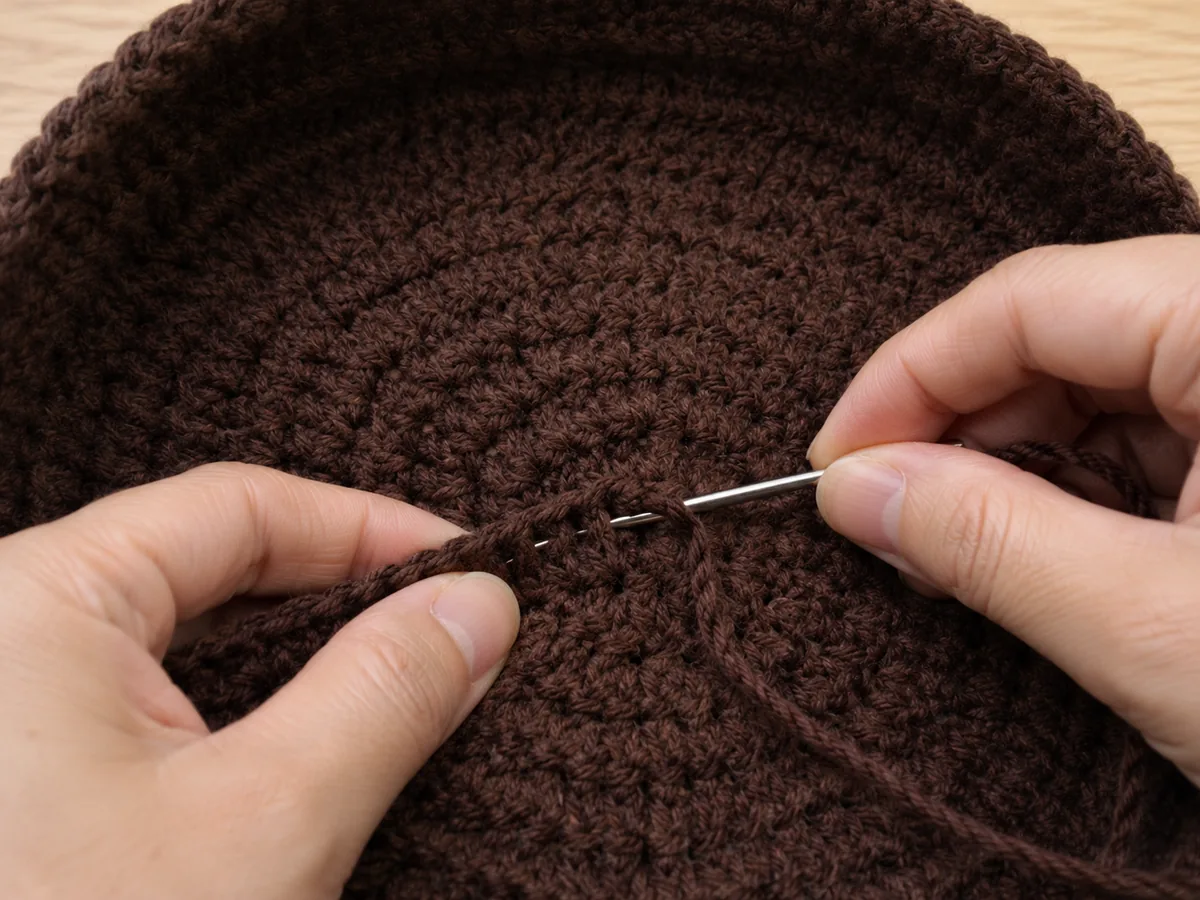
Rounds 19, 20 and 21 all use A with the same 7-dc groups and 2-chain spaces. They are 3 complete rounds, not a single stage to work once. The final edge begins only after the full repeated section.
Weave every end on the inside without tightening the arches or drawing neighboring groups together. Check the paired strands in C and the single-color transitions before hiding the last tails.
For another hat with a defined edge, see the turn-up fisherman hat. This grouped version finishes with its 153-sc edge and the explicit transition adjustment recorded above.
Emma & Ella
More crochet projects from The Cooking Twins Yarn.
More from Emma & Ella