Crochet daisy keychain with 12 white petals
This flat daisy has a textured yellow center, 12 white petals and an outer chain border joining their pointed tips. It is not stuffed. The final chain bridge incorporates the keychain directly, so have the fitting ready before closing the last round.

By Emma & EllaUpdated
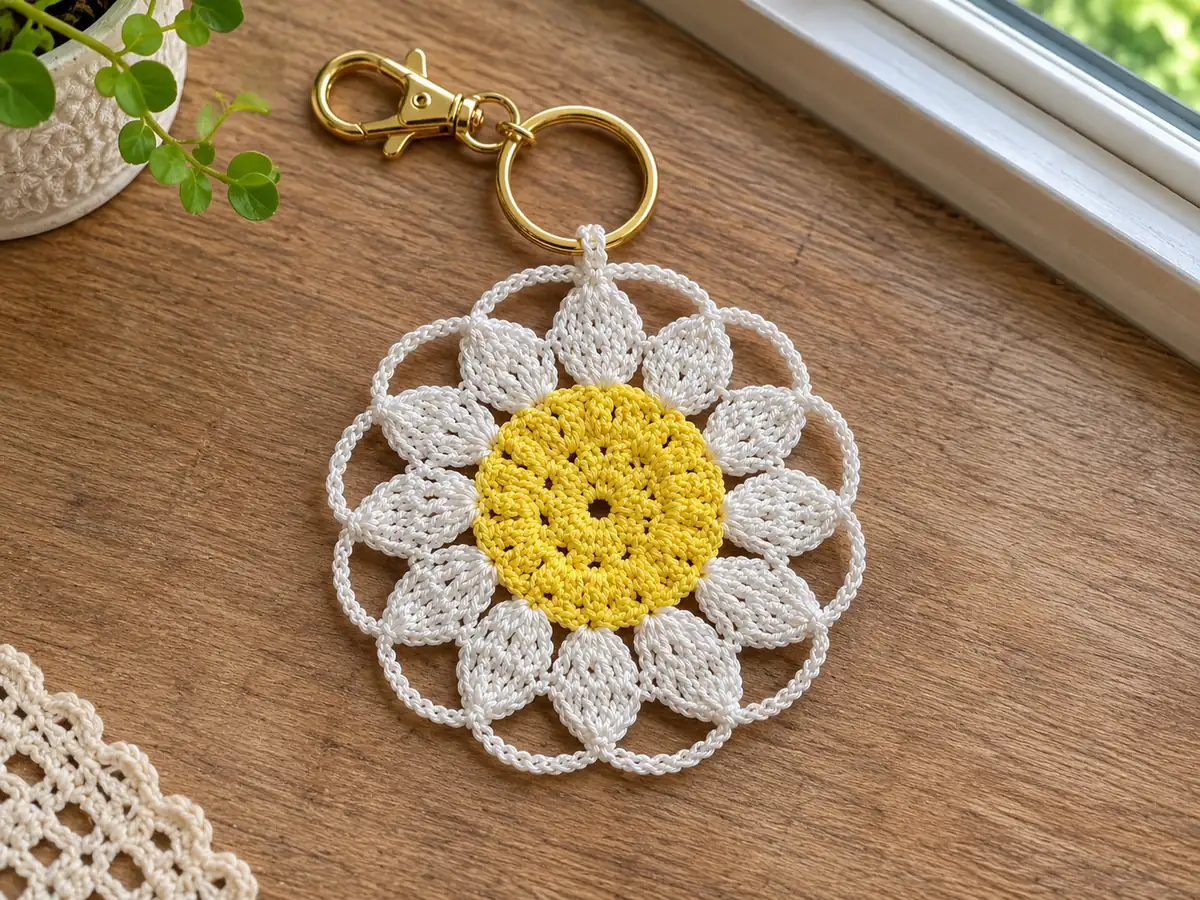
This flat daisy has a textured yellow center, 12 white petals and an outer chain border joining their pointed tips. It is not stuffed. The final chain bridge incorporates the keychain directly, so have the fitting ready before closing the last round.
Choose fine thread and understand the clusters
Materials and size information
Use yellow and white size 10 crochet thread, a 2.5 mm crochet hook and a keychain or suitable charm fitting. A 2 mm hook is also given as an alternative and may produce a smaller flower. No finished diameter, tension or yarn length is supplied.
The actual dimensions depend on the thread, hook and working tension. Keep the same stitch counts if choosing the smaller hook; the source does not provide a separate smaller-size pattern. Prepare a needle for securing ends within the solid stitch areas rather than across the open border.
Read the US stitch key
Ch means chain and sl st means slip stitch. Sc means US single crochet. Dc means US double crochet. Tr means US treble crochet, also called US triple crochet. These US terms apply throughout the written instructions.
For a tr, yarn over 2 times before inserting. Collect a loop, then yarn over and draw through 2 loops 3 times to finish. The white petals use tr, not the shorter US dc.
2-dc and 3-dc clusters in the yellow center
For a 2-dc cluster, start a dc in the indicated place but draw through only the first 2 loops. Retain its final loop. Start another dc in the same place and again complete only the first draw-through. There are now 3 loops on the hook; draw yarn through all of them.
For a 3-dc cluster, start 3 dc in the same place in this manner. After the partial stages, 4 loops remain; close them together. These are shared-top clusters, not groups of separately completed dc.
The starting 3 ch and the initial 2-dc cluster together substitute for the first 3-dc group in the relevant yellow rounds. Do not add another full 3-dc cluster on top of that opening group.
White petal decreases use separate positions
The white tips later gather 5 tr together across the 5 existing tops of a petal. Unlike the yellow clusters, their partial stitches do not all enter the same base position. Keep these methods distinct.
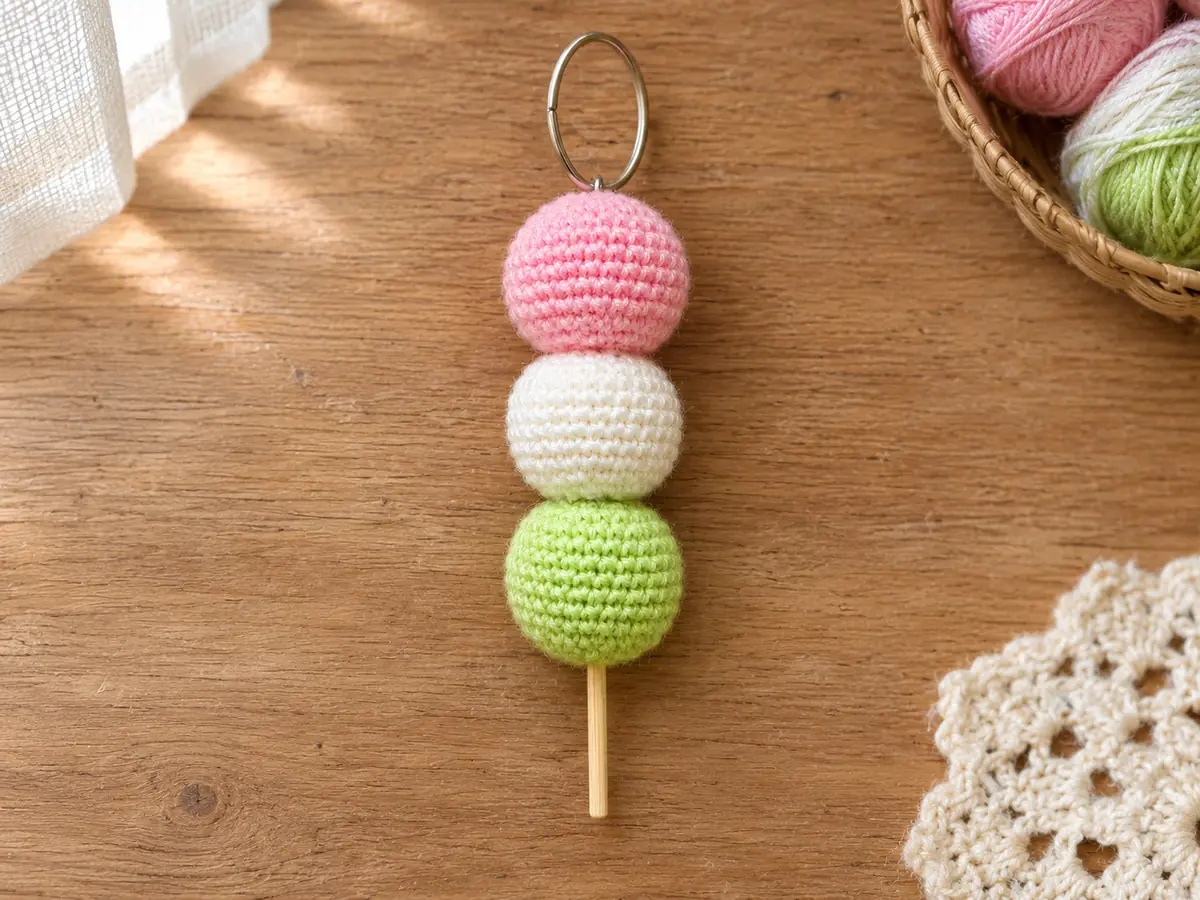
The donut keychain makes a filled ring. This flower instead relies on an open, unstuffed thread structure.
Crochet the yellow center in 5 rounds
Round-by-round instructions
- Round 1: with yellow, 2 ch; work 10 sc in the 2nd ch from the hook. Sl st to the first sc: 10 sc.
- Round 2: 3 ch and a 2-dc cluster in the same place. Continue with 1 ch and a 3-dc cluster in the next sc around. Sl st to the 3rd starting ch: 10 clusters.
- Round 3: sl st onto the top of the first cluster. Work 4 sc in that top and 4 sc in each further cluster top. Sl st to the first sc: 40 sc.
- Round 4: 3 ch and a 2-dc cluster in the closing slip-stitch position. Repeat 1 ch, skip 1 sc, 3-dc cluster in the next sc around. Sl st to the 3rd starting ch: 20 clusters.
- Round 5: sl st onto the first cluster top. Work 3 sc in that top and 3 sc in every further cluster top. Sl st to the first sc and change to white: 60 sc.
Identify cluster tops rather than spaces
Rounds 3 and 5 place their sc in the shared tops. They do not distribute those stitches into the small chain spaces between clusters. Find each closed top clearly before working its group of sc.
The opening chain and 2-dc cluster constitute the first group of rounds 2 and 4. Count that group once, even though its starting chain looks different from the later shared-top stitches.
Check the center's arithmetic
| Stage | Calculation | Result |
|---|---|---|
| Round 3 | 10 cluster tops × 4 sc | 40 sc |
| Round 4 | 40 old stitches in pairs of 1 worked and 1 skipped | 20 clusters |
| Round 5 | 20 cluster tops × 3 sc | 60 sc |
Count actual tops rather than visible holes. An extra opening chain or a sc accidentally placed in a space can leave the surface looking quite regular while changing the number of positions available for the white petals.
Prepare a flat color change
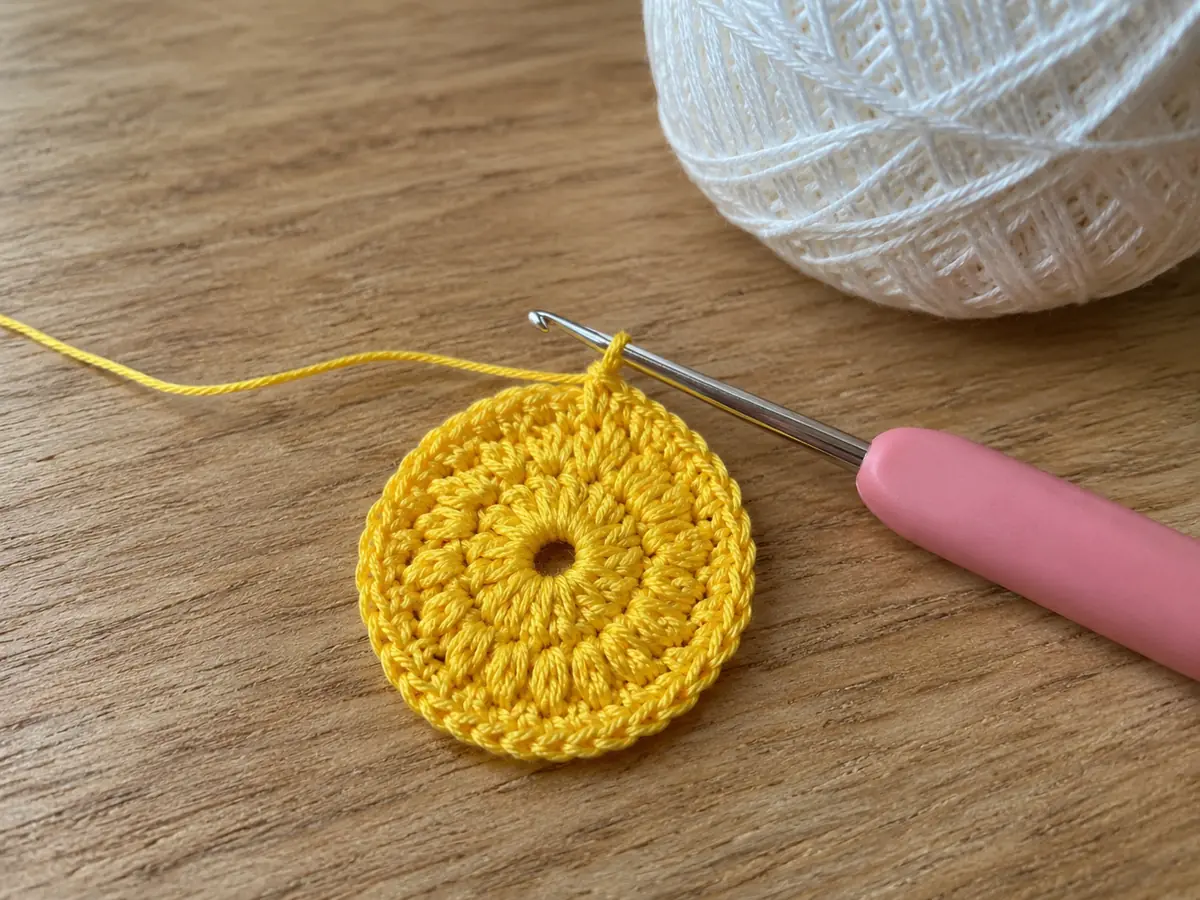
Lay out the center after round 5. Its concentric textured areas remain flat and unfilled. A small central opening belongs to the 2-ch start; do not conceal it with an invented stuffed insert.
Keep the yellow and white ends on the reverse without obstructing the stitch tops. Secure them later within solid areas. An end stretched across the entire yellow center or an open space would remain visible.
Make 12 tall white petals and gathered tips
Round 6: complete the tall groups
- Round 6, first petal: 4 ch, counting as the first tr, then 4 tr in the same base stitch.
- Round 6, following petals: skip 4 sc and work 5 tr in the next sc; repeat around.
- Round 6, join: sl st to the top of the 4th starting ch: 12 petals, each with 5 tall positions.
Each group occupies 1 yellow stitch and crosses the next 4. It therefore uses 5 old positions. Twelve groups use all 60 sc of the center. Complete every tr separately in this round; their tops are gathered only in round 7.
Do not confuse 5 tr in 1 base stitch with the later 5-tr-together operation. The first spreads the petal from a narrow base; the second draws its upper edge into a point.
Round 7: first tip
- Round 7, first petal: 4 ch, then work 4 unfinished tr across the remaining 4 tops of the first petal and close them together. The starting chain stands for its first tall position.
Round 7: following tips and ordinary bridges
- Round 7, following petals: 5 ch, then 5 tr together across the 5 tr tops of the next petal. Continue to the final tip, stopping before closing the last gap.
For each unfinished tr, yarn over 2 times, insert into its own old stitch top and collect a loop. Draw yarn through 2 loops 2 times, leaving the last loop on the hook. Repeat across the petal's positions.
After 5 unfinished tr, the original working loop and 5 retained loops remain. Draw through all of them to form 1 shared tip. The first tip is exceptional because its 4-ch start supplies the first tall position.
Keep each group within its own petal. Taking a stitch from the neighboring group changes the outline and leaves a mismatch later, even if the border can still be pulled into a rough circle.
The 5-ch bridges run between tips. They are not another row of petals, and the tip itself receives no additional sc. Reserve the final gap for the special keychain bridge below.
The small heart charm provides another compact outline, formed with a different stitch distribution.
Attach the ring through the final chain bridge
Replace the last ordinary bridge
- Final bridge: after the final gathered tip, 4 ch, then work 1 chain through the loop of the keychain or fitting; work another 4 ch.
- Final join: sl st to the first petal tip.
This attachment replaces the final ordinary 5-ch bridge. Do not work a standard bridge first and then add the keychain chain as another outer section. The ring belongs at the explicitly described last connection.
Hold the fitting so the yarn passes securely through its intended loop. Once the chain is closed, the fitting cannot simply be pulled through the crochet to change its position. All other chain bridges remain free.
Secure ends within solid stitches
Fasten off and weave the loose ends on the reverse through clusters and closed stitch areas. Avoid carrying a finishing strand across the open white chain arches, where it would be clearly visible.
Keep enough slack that securing an end does not drag a petal point toward the center. The 12 tips should sit reasonably evenly around the yellow disc without being held in place by excessively tight hidden yarn.
Inspect the 3 structural zones
First inspect the yellow cluster center, then the 12 high white petals, then the chains connecting their tips. The outer chain border is a connection between the existing petals, not a second layer of extra petals.
Count 12 pointed tops and trace their bridges around the whole flower. Check the special ring bridge separately from the ordinary 5-ch bridges. The single fitting should sit only at its intended connection.
Lay the flower flat and spread the petals gently with the fingers. Each has a wider 5-stitch upper group before gathering, and a shared pointed top afterwards. A slightly uneven chain can be arranged gently; a missing tr position needs correcting before the ends are finally secured.
Before putting away the hook, compare a yellow cluster with a white gathered tip. The yellow cluster's partial dc all begin in the same underlying stitch, creating 1 raised shared head. The white partial tr begin in separate old tops, drawing an existing 5-position petal together. The similar final draw-through should not obscure that different entry method. Keeping the base positions distinct preserves both the 20-cluster outer yellow round and the 12-petal white outline without needing extra compensating stitches at either join.
Size notes and use
The choice between 2 mm and 2.5 mm changes density and size, but not the stated 12-petal count. Neither the hardware's appearance nor a photograph gives a reliable finished diameter. Record the actual thread and hook with your measured flower if making a matching second piece.
No separate backing, second flower circle or stuffing is included. The complete daisy consists of 5 yellow rounds and 2 white rounds. Its fine, flat appearance comes from crochet thread and the open chain bridges.
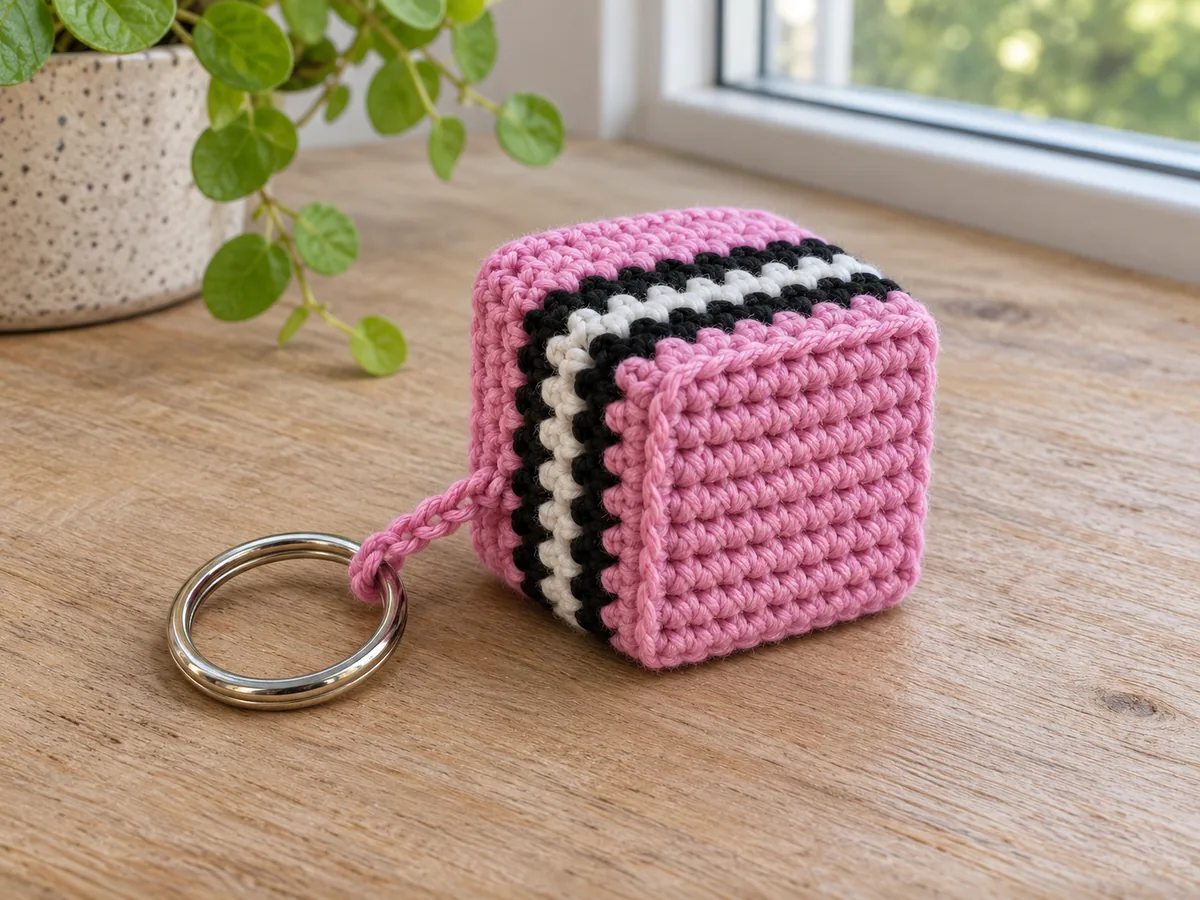
The liquorice keychain offers a contrasting filled cube. This daisy can hang from keys or a bag with its open threadwork kept clear of rough catches.
Follow the thread and fitting care instructions. After cleaning, let the flower dry flat and check the final chain passing through the ring. Look for loose ends on the reverse without pulling the open arches out of shape.
Emma & Ella
More crochet projects from The Cooking Twins Yarn.
More from Emma & Ella