Crochet safari animals: elephant, hippo, lion and giraffe
These 4 safari animals share a soft chenille style: elephant, hippo, lion and giraffe. Each grows from its face or trunk toward its body, with bobbles forming the feet directly in the body rounds. The elephant’s ears are prepared separately, while most other head details are added as the rounds

By Emma & EllaUpdated
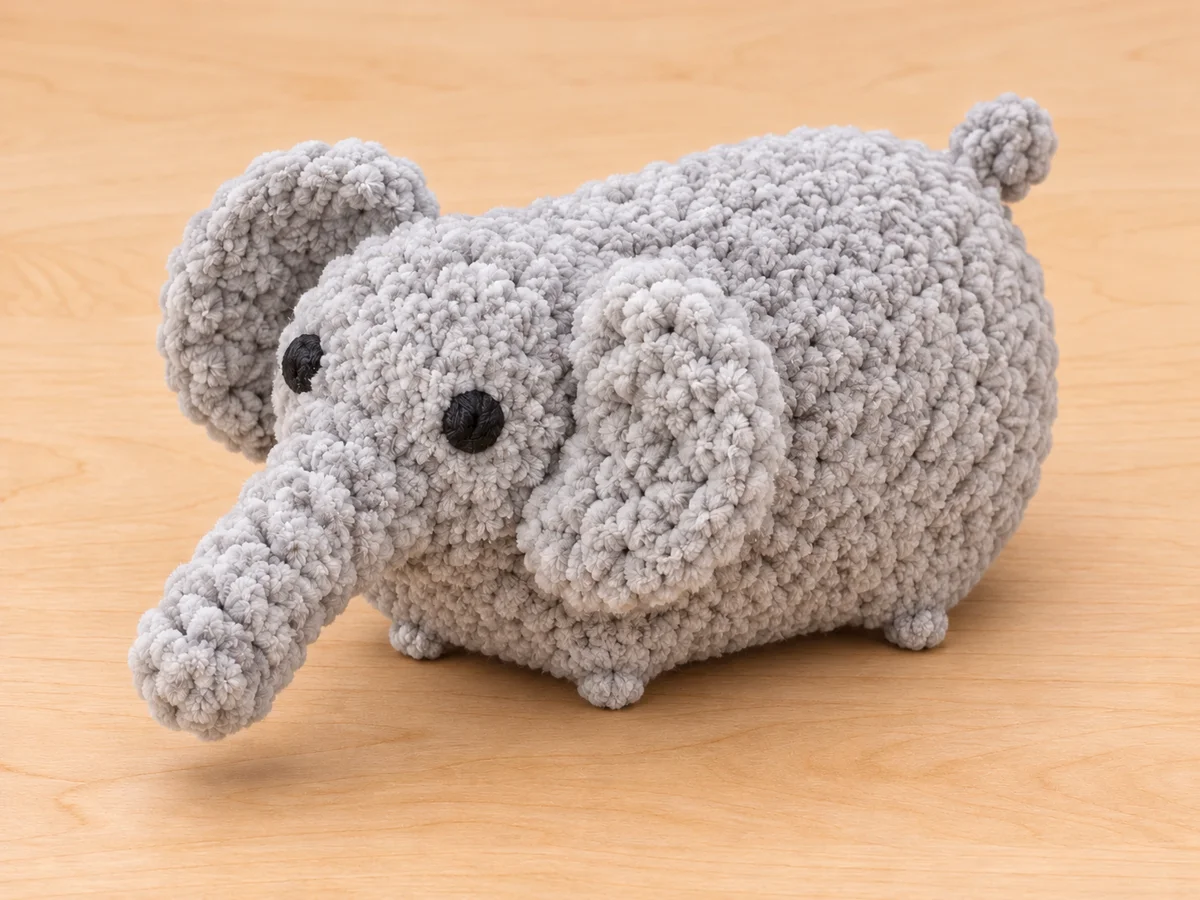
These 4 safari animals share a soft chenille style: elephant, hippo, lion and giraffe. Each grows from its face or trunk toward its body, with bobbles forming the feet directly in the body rounds. The elephant’s ears are prepared separately, while most other head details are added as the rounds progress.
The reference uses thick chenille and a 6 mm hook, with an indicative length of 18–23 cm. The stated tension is 12 stitches and 8 rows over approximately 10 cm. Check your yarn rather than assuming the same hook produces identical dimensions.
Prepare gray for the elephant and hippo, mustard yellow for the lion and giraffe, rust brown for mane and markings, and black yarn for the eyes and lion nose. You also need stuffing, a yarn needle, scissors and a round marker.
| US abbreviation | Meaning |
|---|---|
| sc / hdc / dc | Single crochet / half double crochet / double crochet |
| ch / sl st / MR | Chain / slip stitch / magic ring |
| inc / dec | 2 sc into 1 stitch / combine 2 stitches into 1 sc |
| FLO / BLO | Front loop only / back loop only |
| Picot | 2 ch, sl st in 2nd chain from hook |
For a bobble, begin 4 unfinished US double crochets in the same stitch: yarn over, insert, draw up yarn and pull through 2 loops each time. Draw through the 5 accumulated loops together. A bobble counts as 1 body stitch.
Mark every round. Projecting chains, ears and horns do not become extra body stitches in the following round. The magic-ring guide explains the circular start.
Elephant with a soft trunk and attached ears
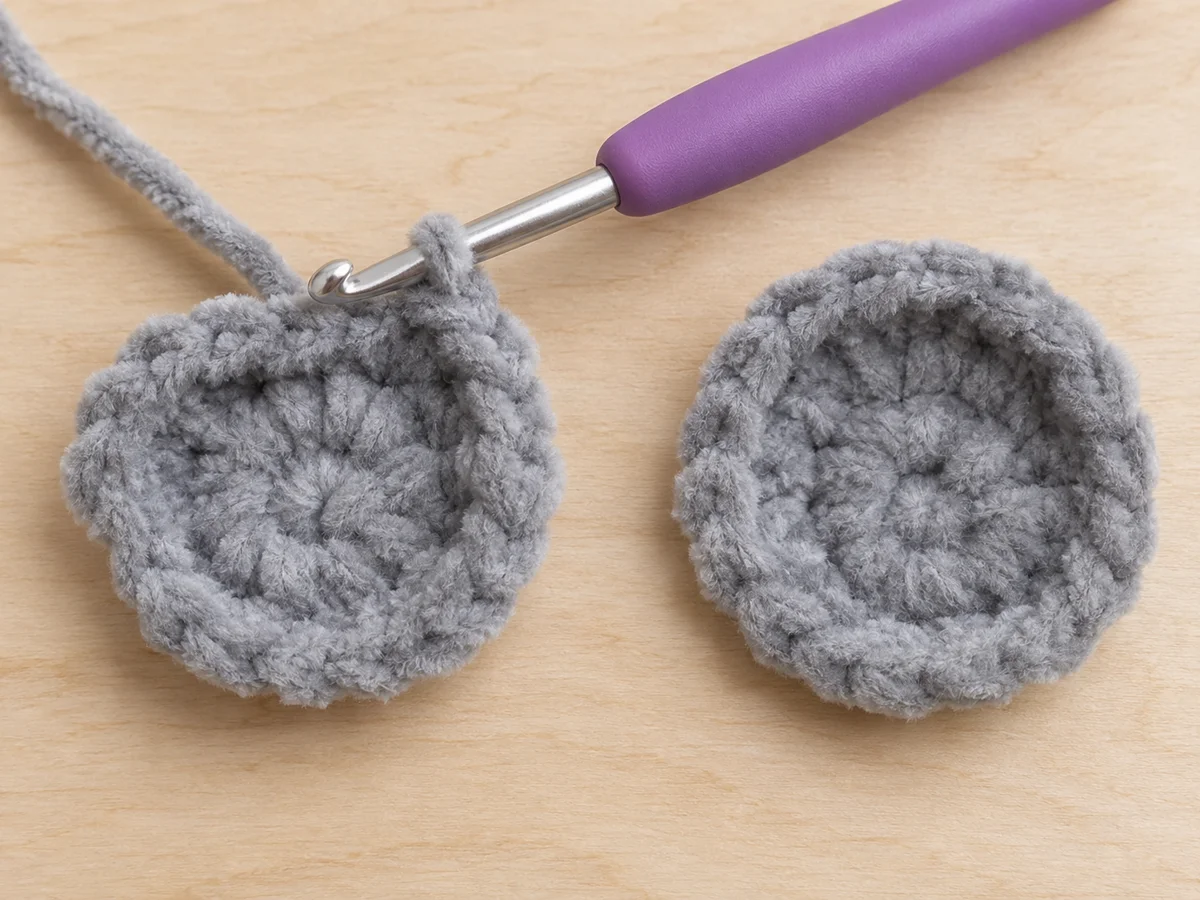
Prepare 2 gray ears
- Round 1: 6 sc in MR. (6)
- Round 2: Inc in every stitch. (12) Make 1 ch and turn.
- Round 3: 12 sc. Finish and secure ends.
Flatten and compare the lower ear edges. Each is later attached across 5 positions together with the head stitches, so keep that area easy to identify.
Trunk, head and body
- Round 1: Gray: 4 sc in MR. (4)
- Round 2: [Inc, 1 sc] 2 times. (6)
- Round 3: 6 sc.
- Round 4: 6 sc.
- Round 5: 6 sc.
- Round 6: 6 sc.
- Round 7: 6 sc.
- Round 8: 6 sc.
- Round 9: 4 inc, 2 sc. (10)
- Round 10: [Inc, 1 sc] 5 times. (15)
- Round 11: [Inc, 2 sc] 5 times. (20)
- Round 12: 20 sc.
- Round 13: 20 sc.
- Round 14: 1 sc; hold first ear wrong side up and attach through ear and head together with 5 sc; 5 sc on head; attach second ear with 5 sc; 4 sc. (20)
- Round 15: 20 sc.
- Round 16: [Dec, 2 sc] 5 times. (15)
- Round 17: [Dec, 1 sc] 5 times. (10) Stuff head, leaving trunk unfilled.
- Round 18: Inc in every stitch. (20)
- Round 19: 4 sc, [inc, 2 sc] 4 times, 4 sc. (24)
- Round 20: 1 sc, bobble, 19 sc, bobble, 2 sc. (24)
- Round 21: 24 sc.
- Round 22: 24 sc.
- Round 23: 24 sc.
- Round 24: 24 sc.
- Round 25: 2 sc, bobble, 19 sc, bobble, 1 sc. (24)
- Round 26: 13 sc; make 3 ch and work 2 sc back from 2nd chain. Join the last body sc before the tail branch together with the next body stitch; 10 sc on body. (24 body positions)
- Round 27: [Dec, 2 sc] 6 times. (18) Stuff body.
- Round 28: [Dec, 1 sc] 6 times. (12)
- Round 29: 6 dec. (6) Close.
Place the eyes between rounds 10 and 11, about 7 stitches apart. Leave the long narrow trunk unfilled. Do not gather the ear bases so tightly that their shapes collapse.
The tail anchor reuses the final body sc made before the branch together with the next body stitch. It does not refer to the last stitch of the tail chain. This overlapping connection counts as a body position; the tail stitches do not add to the circumference.
Hippo with an oval muzzle and small ears
Head-to-body rounds
The bobbles near the beginning form the nostril area. Work the ear groups in front loops, reserving the corresponding back loops for the following head round.
- Round 1: Make 5 ch; from 2nd chain, 3 sc, 3 sc in end chain; opposite side 2 sc, inc. (10)
- Round 2: Bobble, 2 sc, bobble, 6 sc. (10)
- Round 3: 10 sc.
- Round 4: 5 inc, 5 sc. (15)
- Round 5: [1 sc, inc] 5 times, 5 sc. (20)
- Round 6: 20 sc.
- Round 7: 20 sc.
- Round 8: 5 sc; FLO in next base stitch: [1 sc, 1 hdc, 1 dc, 1 hdc, 1 sc]; 5 sc normally; second identical ear group in FLO of next base stitch; 8 sc normally. (20 base positions)
- Round 9: 5 sc, 1 sc in reserved back loop behind first ear, 5 sc, 1 sc in reserved back loop behind second ear, 8 sc. (20)
- Round 10: [Dec, 2 sc] 5 times. (15)
- Round 11: [Dec, 1 sc] 5 times. (10) Stuff head.
- Round 12: Inc in every stitch. (20)
- Round 13: 4 sc, [inc, 2 sc] 4 times, 4 sc. (24)
- Round 14: 1 sc, bobble, 19 sc, bobble, 2 sc. (24)
- Round 15: 24 sc.
- Round 16: 24 sc.
- Round 17: 24 sc.
- Round 18: 24 sc.
- Round 19: 2 sc, bobble, 19 sc, bobble, 1 sc. (24)
- Round 20: 13 sc; 3 ch, work 2 sc back from 2nd chain; join last body sc before branch together with next body stitch; 10 sc on body. (24)
- Round 21: [Dec, 2 sc] 6 times. (18) Stuff body.
- Round 22: [Dec, 1 sc] 6 times. (12)
- Round 23: 6 dec. (6) Close.
Place the eyes between rounds 4 and 5, approximately 4 stitches apart, checking their relationship to the muzzle bobbles. The ears remain unfilled; the double crochet supplies their higher center.
In round 9, work behind each ear into its original reserved back loop, not through all 5 new ear stitches. Counting those projections would widen the head and make the later decreases incompatible.
Lion with a picot mane and yellow ears
Head-to-body rounds
Use yellow for head and body, brown for the mane. Every mane or ear group occupies 1 base position in front loops. The back loops remain available for the normal head circumference.
- Round 1: Yellow: 5 sc in MR. (5)
- Round 2: 5 inc. (10)
- Round 3: 10 sc.
- Round 4: 5 inc, 5 sc. (15)
- Round 5: [Inc, 1 sc] 5 times, 5 sc. (20)
- Round 6: 20 sc.
- Round 7: 20 sc.
- Round 8: FLO: brown [1 sc, picot] 3 times, 1 sc; yellow ear group [1 sc, 1 hdc, 1 dc, 1 hdc, 1 sc] in next base stitch; brown [1 sc, picot] 5 times, 1 sc; yellow ear group in next base stitch; brown [1 sc, picot] 7 times, 1 sc. (20 base positions)
- Round 9: Brown: 20 sc in reserved back base loops behind mane and ears.
- Round 10: Brown: 20 sc.
- Round 11: [Dec, 2 sc] 5 times. (15)
- Round 12: [Dec, 1 sc] 5 times. (10) Stuff head; change to yellow.
- Round 13: Inc in every stitch. (20)
- Round 14: 4 sc, [inc, 2 sc] 4 times, 4 sc. (24)
- Round 15: 1 sc, bobble, 19 sc, bobble, 2 sc. (24)
- Round 16: 24 sc.
- Round 17: 24 sc.
- Round 18: 24 sc.
- Round 19: 24 sc.
- Round 20: 2 sc, bobble, 19 sc, bobble, 1 sc. (24)
- Round 21: 13 sc; make 6 ch, work 5 sc back from 2nd chain; continue 11 sc on body. (24 body stitches)
- Round 22: [Dec, 2 sc] 6 times. (18) Stuff body.
- Round 23: [Dec, 1 sc] 6 times. (12)
- Round 24: 6 dec. (6) Close.
Place the eyes between rounds 4 and 5, about 7 stitches apart. Embroider the nose centrally over the starting ring. Check the face before securing the final ends.
Small brown tail tuft
Join brown at the side of the tail tip. Work 2 sc along its upper edge, then an sl st toward the lower area of the final stitch. Finish and secure. This remains a small finishing detail rather than another stuffed part.
Giraffe with a long neck, spots and horns
Head, neck and body rounds
Y means mustard yellow and B means rust brown. Fill the narrow neck gradually instead of trying to push a dense ball of stuffing through its opening later.
- Round 1: Y: 5 sc in MR. (5)
- Round 2: 5 inc. (10)
- Round 3: 10 sc.
- Round 4: [Inc, 1 sc] 5 times. (15)
- Round 5: [Inc, 2 sc] 5 times. (20)
- Round 6: 20 sc.
- Round 7: 20 sc.
- Round 8: 3 sc. First ear at next base stitch in FLO: sl st, 2 ch, 1 dc, picot, 2 ch, sl st to ear base. 1 sc normally. First horn: 4 ch, work 3 sl st back from 2nd chain. 3 sc on head. Second horn identically. 1 sc normally. Second ear in next base stitch FLO: sl st, 4 ch, sl st in 2nd chain for small picot, 1 dc, 2 ch, sl st to base. 10 sc normally. (20 base positions)
- Round 9: 20 sc around the normal head edge, using reserved back base loops behind ears and horn attachments; keep projections outside.
- Round 10: [Dec, 2 sc] 5 times. (15)
- Round 11: [Dec, 1 sc] 5 times. (10) Stuff head.
- Round 12: 10 sc; add light neck stuffing gradually.
- Round 13: 10 sc; add light neck stuffing gradually.
- Round 14: 10 sc; add light neck stuffing gradually.
- Round 15: 10 sc; add light neck stuffing gradually.
- Round 16: 10 sc; add light neck stuffing gradually.
- Round 17: 10 sc; add light neck stuffing gradually.
- Round 18: Inc in every stitch. (20)
- Round 19: 3 sc, [inc, 2 sc] 4 times, 5 sc. (24)
- Round 20: Bobble, 19 sc, bobble, 3 sc. (24)
- Round 21: Y: 6 sc; B: 4 sc; Y: 14 sc. (24)
- Round 22: Y: 5 sc; B: 5 sc; Y: 4 sc; B: 3 sc; Y: 7 sc. (24)
- Round 23: Y: 5 sc, 2 sc BLO; B: 2 sc; Y: 1 sc BLO, 4 sc normally; B: 4 sc; Y: 6 sc. (24)
- Round 24: Y: 7 sc normally, 2 sc BLO, 5 sc normally, 2 sc BLO; B: 2 sc; Y: 6 sc. (24)
- Round 25: Y: 1 sc, bobble, 14 sc, 2 sc BLO, 3 sc, bobble, 2 sc. (24)
- Round 26: Y only: 12 sc; 5 ch, work 4 sl st back from 2nd chain; join last body sc before branch together with next body stitch; 11 sc on body. (24)
- Round 27: [Dec, 2 sc] 6 times. (18) Stuff body.
- Round 28: [Dec, 1 sc] 6 times. (12)
- Round 29: 6 dec. (6) Close.
Eyes and brown tips
Place the eyes between rounds 5 and 6 with approximately 9 stitches between them. Add brown tips to both horns by joining at the side, working 2 sc along the upper edge and an sl st toward the lower part of the last stitch. Finish the tail tip in the same way.
Preserved giraffe arithmetic corrections
Round 10 uses 20 stitches in 5 groups of [dec, 2 sc], producing 15 rather than 10. Round 11 then reduces those 15 to 10. The correct totals are written explicitly above.
At round 20, an additional printed ending of another bobble and sc would raise the circumference to 26. It is omitted here, preserving 2 feet and 24 body stitches in that round.
At round 26, after 12 sc and the overlapping tail-anchor position, 11 body sc remain rather than 12. The stated version keeps the circumference at 24 without including the projecting chain as extra body stitches.
Filling, care and the completed group
All 4 animals build the head and body together. Their 4 feet appear over 2 bobble rounds. Count each bobble as 1 stitch and push it gently outward before closing the final opening.
Leave the trunk, ears and most projecting details unfilled. Only the stated head, neck and body areas receive stuffing. Excess filling can draw the feet inward or turn the body into a ball.
Draw the final 6 stitches closed slowly and secure the end inside. Avoid jerking chenille sewing tails; if the yarn breaks easily, use an appropriate stronger matching thread to secure attachments without leaving loose loops.
For smaller companions, try the baby crab and mini fish. The cube animals form another coordinated group, while the beginner guide supports the techniques.
Clean according to the actual yarn and stuffing instructions, letting the inside dry fully. Assess attachments and intended use separately; a handmade chenille animal is not automatically suitable as a baby toy.
Emma & Ella
More crochet projects from The Cooking Twins Yarn.
More from Emma & Ella