Raspberry popcorn crochet shoulder bag
Raised popcorns give this shoulder bag its raspberry-like surface. The base travels around both sides of a foundation chain, then grows directly into the bag body. A smooth upper band finishes the opening, and 2 D-rings hold a detachable shoulder strap.

By Emma & EllaUpdated
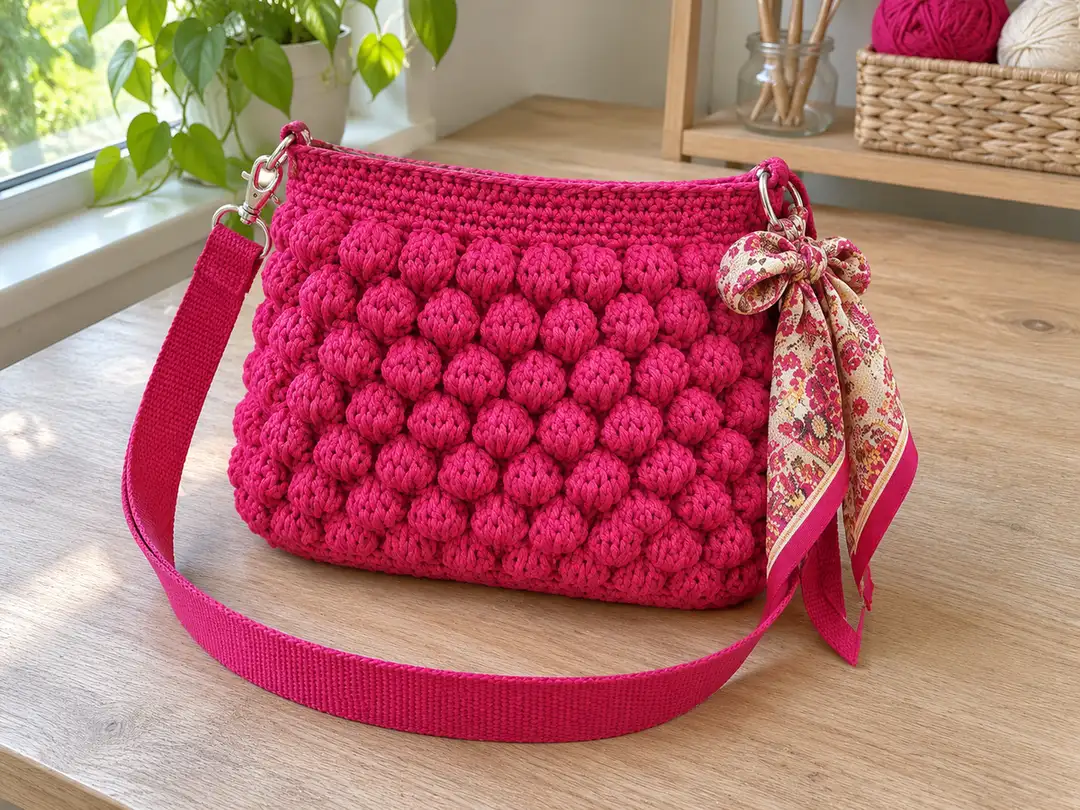
Raised popcorns give this shoulder bag its raspberry-like surface. The base travels around both sides of a foundation chain, then grows directly into the bag body. A smooth upper band finishes the opening, and 2 D-rings hold a detachable shoulder strap.
Hold 2 strands together throughout the crochet. The instructions use US stitch names and keep the popcorn body separate from the plain half-double-crochet and single-crochet upper rounds.
Prepare the doubled yarn and 4-double crochet popcorns
Materials and sizing limits
- 2 balls of DK yarn, 100 g each.
- A 6.5 mm crochet hook.
- 2 D-rings and 2 swivel clasps.
- Yarn needle and scissors.
- Optional fabric lining and a small scarf for a decorative bow.
No fixed finished bag dimensions are supplied. The 2 strands behave together as the working yarn, so check that both are caught in every stitch. Using only 1 strand in part of a popcorn changes its thickness and can leave an uneven loop.
Keep both yarn sources feeding freely rather than pulling one strand more tightly. Make a small practice popcorn if you are unfamiliar with the doubled yarn. The chosen hook is the reference size, while your tension controls the actual fabric.
US crochet glossary
| Term | Meaning |
|---|---|
| sc | US single crochet |
| hdc | US half double crochet |
| dc | US double crochet |
| ch / sl st | Chain / slip stitch |
| Hdc decrease | Combine 2 neighboring half double crochets into 1 |
Popcorn method
- Work 4 dc into the same position.
- Remove the hook from the last working loop.
- Insert from front to back through the first double crochet’s top.
- Catch the working loop and draw it through.
For the first popcorn of a round, 3 starting chains replace its first double crochet. Work 3 more double crochets and draw the working loop through the 3rd starting chain. The following chain creates the space used by the next round.
This is a popcorn made from completed double crochets, not a cluster of unfinished double crochets pulled together. Keep the 4 double crochets similarly sized so their gathered surface is even.
For a different raised motif, the sunflower drawstring bag uses puff and cluster rounds rather than this all-over popcorn body.
Work the oval base and 10 popcorn rounds
Round 1 around both sides of the chain
- Make 28 ch.
- Round 1: In the 4th chain from the hook, work 3 dc and close the first popcorn through the starting chain.
- Along the chain, skip 1 chain and work a popcorn followed by 1 ch in the next.
- When 2 chains remain, skip the first.
- In the final chain, work [popcorn, 1 ch] 3 times, rotating around the end.
- Continue along the underside: skip 1 chain, then popcorn and 1 ch in the next.
- At the starting end, work 2 additional popcorns, each followed by 1 ch, into the first popcorn’s insertion point.
- Join with sl st into the first popcorn.
The count is 3 popcorns at each end and 11 along each long side, giving 28 overall. Keep the chain spaces accessible because the following rounds work into them rather than the popcorn tops.
Rotate around the chain end without twisting the foundation along its length. Before joining, check that both long sides are present and the extra end groups sit at the ends rather than along a side.
Rounds 2–10 separately
- Round 2: Sl st into next 1-chain space. Work the starting popcorn and 1 ch, then [popcorn, 1 ch] in every following 1-chain space. Join into first popcorn. Total: 28 popcorns.
- Round 3: Sl st into next 1-chain space. Work the starting popcorn and 1 ch, then [popcorn, 1 ch] in every following 1-chain space. Join into first popcorn. Total: 28 popcorns.
- Round 4: Sl st into next 1-chain space. Work the starting popcorn and 1 ch, then [popcorn, 1 ch] in every following 1-chain space. Join into first popcorn. Total: 28 popcorns.
- Round 5: Sl st into next 1-chain space. Work the starting popcorn and 1 ch, then [popcorn, 1 ch] in every following 1-chain space. Join into first popcorn. Total: 28 popcorns.
- Round 6: Sl st into next 1-chain space. Work the starting popcorn and 1 ch, then [popcorn, 1 ch] in every following 1-chain space. Join into first popcorn. Total: 28 popcorns.
- Round 7: Sl st into next 1-chain space. Work the starting popcorn and 1 ch, then [popcorn, 1 ch] in every following 1-chain space. Join into first popcorn. Total: 28 popcorns.
- Round 8: Sl st into next 1-chain space. Work the starting popcorn and 1 ch, then [popcorn, 1 ch] in every following 1-chain space. Join into first popcorn. Total: 28 popcorns.
- Round 9: Sl st into next 1-chain space. Work the starting popcorn and 1 ch, then [popcorn, 1 ch] in every following 1-chain space. Join into first popcorn. Total: 28 popcorns.
- Round 10: Sl st into next 1-chain space. Work the starting popcorn and 1 ch, then [popcorn, 1 ch] in every following 1-chain space. Join into first popcorn. Total: 28 popcorns.
The body height comes from completing through round 10. Count 28 popcorns on each circuit. A missing group cannot be corrected simply by placing an extra popcorn in a later top stitch, since the pattern depends on the spaces.
Check both strands at the join. A loose loop from only 1 strand can remain visible even if the popcorn count is correct. Correct it before building the next round over the same area.
Make the smooth upper band and 5-stitch strap
Upper rounds 11–16
- Round 11: Sl st into next 1-chain space. Make 2 ch as first hdc and 1 further hdc in that space. Work 2 hdc in every remaining space. Join into 2nd starting chain. Total: 56.
- Round 12: Work hdc around, distributing 2 hdc decreases. Total: 54.
- Round 13: Work 54 hdc without decreases.
- Round 14: Repeat the decrease round with 2 distributed hdc decreases. Total: 52.
- Round 15: Make 1 ch, not counted. Work sc in every hdc and join into first sc. Total: 52.
- Round 16: Work sc in every sc. Join with sl st and secure. Total: 52.
The starting 2 ch count as the first stitch in hdc rounds. Do not add another half double crochet in their place. No exact decrease positions are specified, so distribute the 2 decreases rather than claiming a prescribed stitch-by-stitch placement.
The arithmetic helps check the transition: 2 hdc in each of 28 spaces gives 56. Each round with 2 ordinary decreases removes 2 positions, giving 54 and then 52.
Shoulder strap
- Make 6 ch.
- Strap row 1: Starting in the 3rd chain, work hdc to the end. The 2 skipped chains count as first hdc, giving 5 positions.
- Each following strap row: Turn with 2 ch and work 4 further hdc. Total: 5 including the turning chain.
- Continue to the desired length and secure the ends.
No fixed strap length or row total is supplied. Check the relaxed strip against the intended shoulder position, remembering that its clasps also contribute to the finished carrying arrangement.
Count the turning-chain position when checking width. Adding 5 real hdc after it would make the strap wider than stated; omitting its far-end position can narrow the strip.
Attach the hardware, optional lining and finish
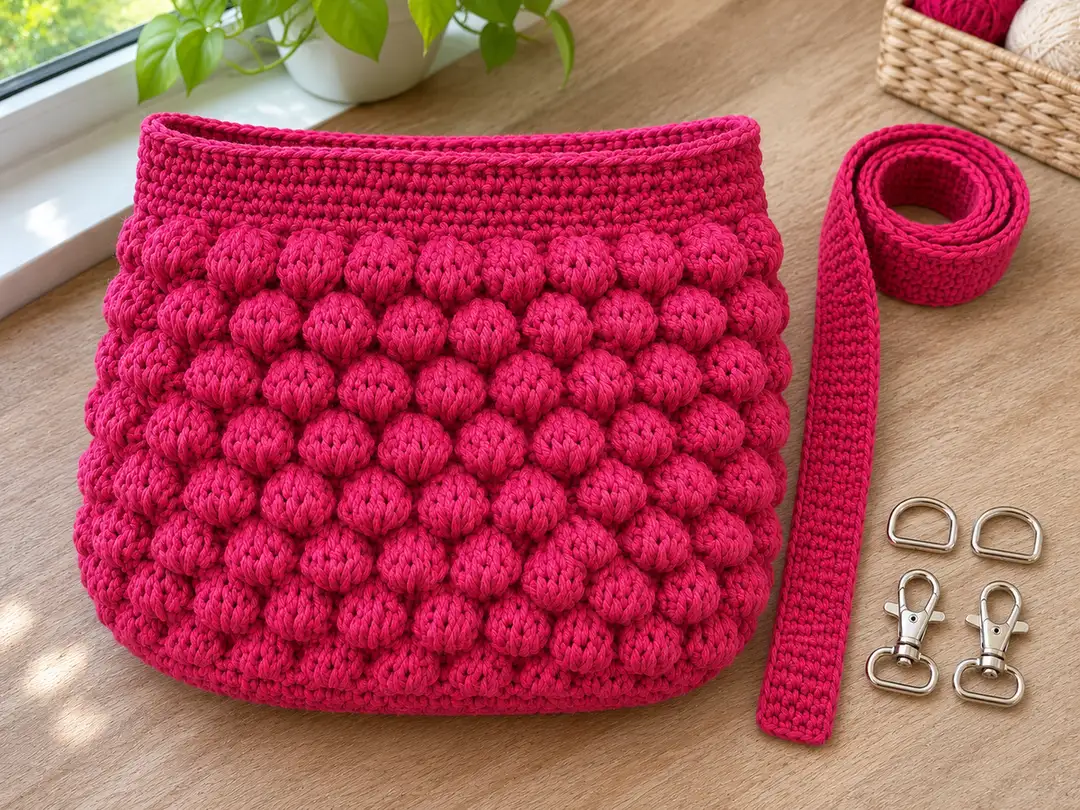
D-rings and swivel clasps
Sew a D-ring centrally at each short side of the bag. Attach a swivel clasp to each strap end and clip them onto the rings. Compare both ring heights before fastening permanently.
Check that the strap ends lie flat at the clasps and that the rings are held by secure stitching rather than a single loose strand. Test the finished construction gently for the intended use; no load rating is supplied by the pattern.
Optional lining and scarf
Fit a suitable fabric lining inside if wanted, sewing it just below the upper edge from the inside. A lining can help keep small items from catching in the textured fabric. No separate cutting measurements are supplied, so fit it to the actual crocheted bag.
A small scarf can be tied as a bow at a ring. Keep it separate from the structural strap attachment. The bag should remain securely connected when that optional decorative piece is removed.
During body counting, separate the popcorn and its following chain space. Each round has 28 of the raised groups, and the spaces between them provide the next insertion points. A slip stitch used only to reach the next space is not an additional popcorn.
The oval base has more groups at its ends because it turns around the foundation. Those end groups belong to the same 28-count circuit. Do not repeat the 3-at-each-end expansion in later body rounds: rounds 2–10 work only 1 popcorn in each existing space.
When the strap reaches the intended length, compare its 2 attachment ends before sewing on the clasps. Keep the 5-position width intact and weave the yarn securely without drawing the strip into a narrow gathered neck.
Inspect the lining with the bag open. It should sit beneath the top edge without obstructing the rings or pulling the smooth band inward. Since its dimensions are fitted to the finished crochet, check the actual interior rather than treating the unspecified bag size as a fixed fabric template.
Keep the remaining doubled yarn available until the hardware is secure. A matching remnant allows an attachment to be reinforced neatly without changing the visible color of the upper band.
Shape checks and care
Lay the finished bag flat and compare the long sides, end groups and top band. The raised body and smooth opening intentionally have different surfaces, while the decreases gently reduce the upper circumference.
If the upper edge looks uneven, check the 56, 54 and 52 counts and whether starting chains were counted consistently. Do not gather the opening with tight sewing stitches to hide an incorrect crochet total.
For a modular project, see the classic granny square. For another 2-handle form, the mushroom square bag uses a different assembly.
Follow the yarn and lining care instructions, taking account of the removable hardware. Let the bag and strap dry completely, then inspect the D-ring stitching and woven ends before using it again.
Emma & Ella
More crochet projects from The Cooking Twins Yarn.
More from Emma & Ella