Sunburst granny square with puffs and clustered petals
A Sunburst granny square starts as a circle and gains its 4 corners only in the final round. Raised puffs surround the center, while clustered petals provide the foundation for the square frame.

By Emma & EllaUpdated
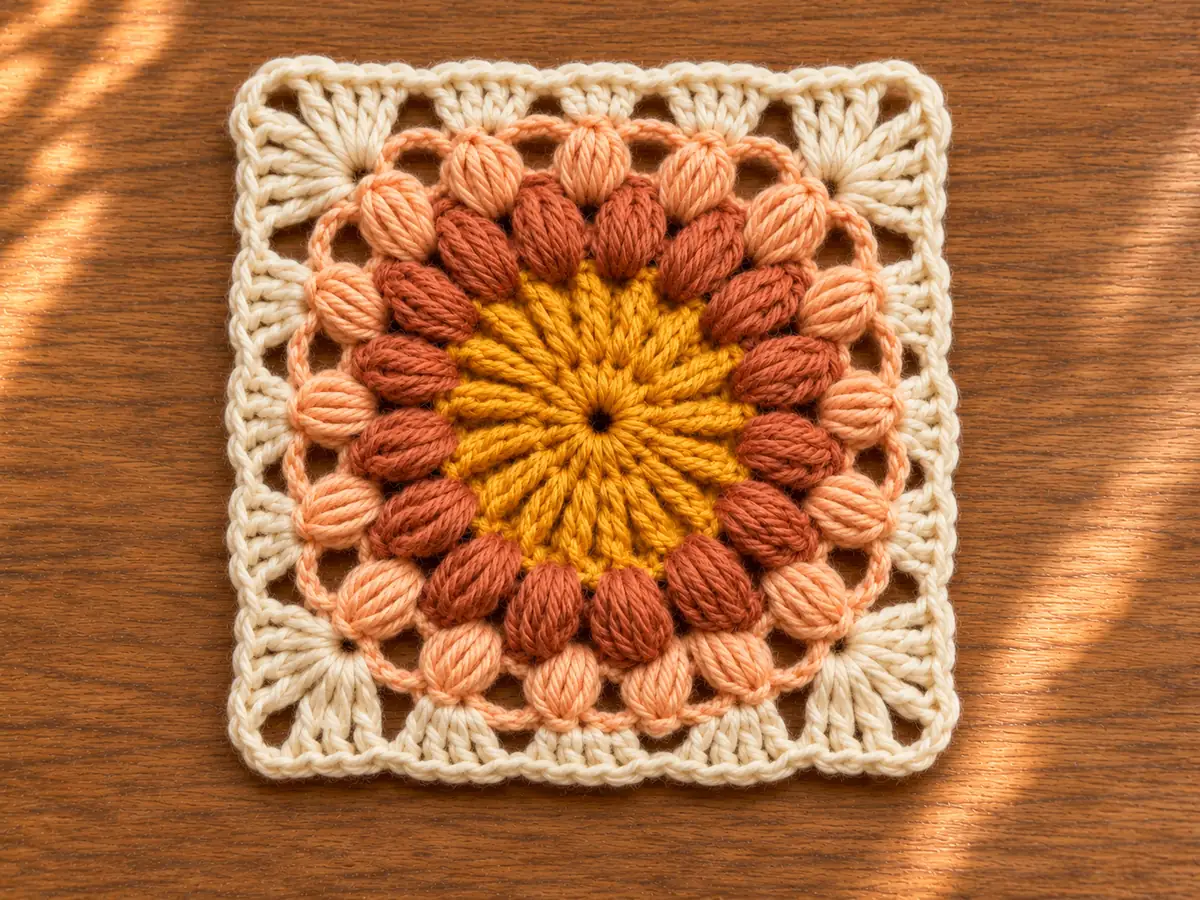
A Sunburst granny square starts as a circle and gains its 4 corners only in the final round. Raised puffs surround the center, while clustered petals provide the foundation for the square frame.
Use 4 colors to emphasise each round, or choose related shades for a quieter result. Make a sample before planning a blanket or bag, because the finished motif size depends on the yarn and tension rather than a fixed measurement supplied here.
Prepare compatible colors and the US stitches
Materials and sample planning
- 4 colors of yarn of similar thickness, labelled A, B, C and D.
- A suitable hook; the reference uses medium-weight yarn and 5.5 mm.
- Scissors and yarn needle.
- Optional markers for the 4 corner spaces.
No fixed yarn quantity or finished square size is supplied. Measure the completed motif after appropriate relaxing or blocking if you intend to combine several. Equal round counts do not guarantee equal dimensions when different yarns are used.
Keep the 4 yarn thicknesses compatible. A much thicker petal color can affect the shape before the frame is added, while a thinner frame may pull around a heavier circular center.
US glossary
| Term | Meaning |
|---|---|
| ch / sl st | Chain / slip stitch |
| hdc | US half double crochet |
| dc | US double crochet |
| tr | US treble |
| Puff | 3 yarn-over-and-drawn-up-loop movements in the same position, closed through 7 loops |
| Cluster | 4 unfinished dc in the same space, closed through 5 loops |
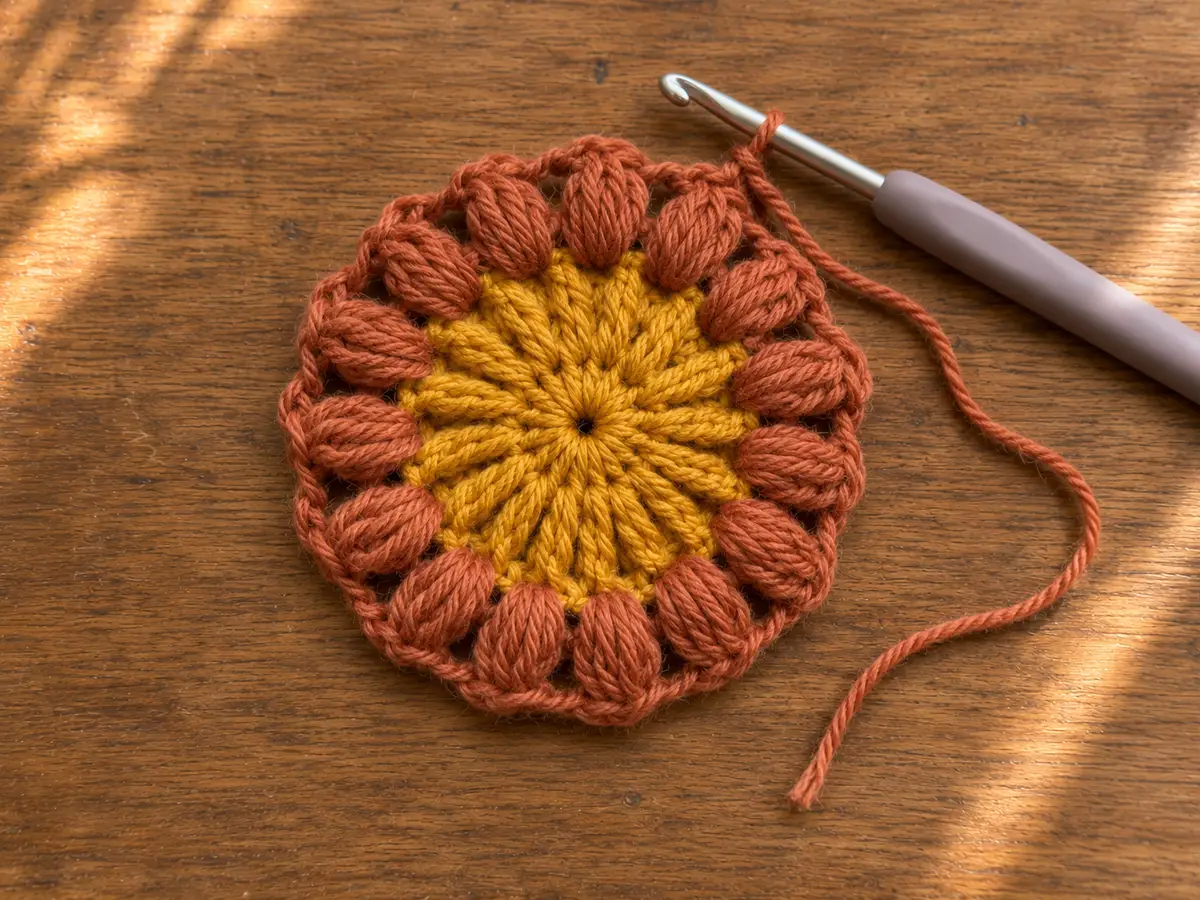
For the puff, repeat yarn over, insert and draw up a long loop 3 times. Keep the loops similarly long, then pull through all 7. The following chain creates the space between puffs.
For the cluster, work each double crochet only as far as its last pull-through, leaving its final loop on the hook. After 4 partial double crochets, draw through all 5 loops. This differs from both a puff and a group of 4 completed double crochets.
The classic granny square uses more uniform stitch heights for its corners. Here, hdc, dc and tr provide the transition from a circle to a square.
Work the center and all 16 puffs
Round 1 in A
- Make a yarn ring.
- Round 1: Make 3 ch as the first dc.
- Work 15 further dc into the ring.
- Join with an sl st into the 3rd starting chain.
- Cut the yarn. Total: 16 double crochet positions including the chain.
Close the ring neatly without gathering the whole round into a hard knot. Count the 15 real double crochets and the chain replacement separately to confirm 16 positions for the next round.
The starting chain is not an extra position beside another full double crochet. If a 17th position appears at the join, inspect whether the chain was counted twice before continuing.
Round 2 in B
- Round 2: Join B in any dc and make 2 ch as a height aid.
- Work a puff into the same stitch, followed by 1 ch.
- Work puff and 1 ch into each of the other 15 double crochets.
- Join into the top of the first puff.
- Check 16 puffs and 16 single-chain spaces, including the transition at the join.
The 2 starting chains are a height aid rather than another puff. The first puff still uses the stated 3 drawn-up-loop movements in its own insertion point.
Keep each puff closed before moving to the next double crochet. The 1-chain spaces remain the next round’s insertion points, so do not omit the final space just because it lies beside the beginning join.
Lay the circle down after the round and compare the puffs. A visibly shorter group may have lost a drawn-up loop or been pulled much tighter. Correct it before the cluster round makes access less convenient.
Make the clusters and square the flower
Round 3 in C
- Round 3: Join C in any 1-chain space.
- Make 2 ch as a height aid.
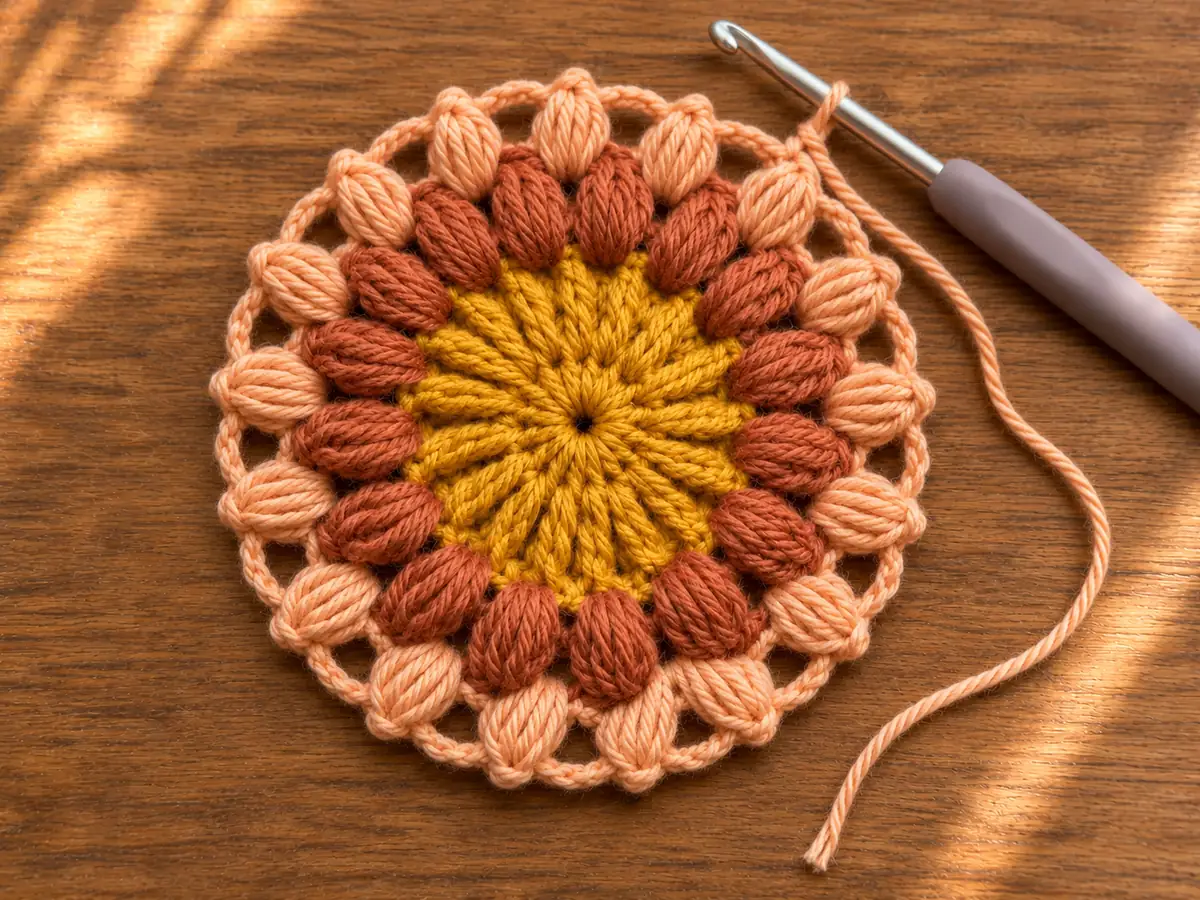
- Work a 4-dc cluster into the same space, then 2 ch.
- Work a cluster and 2 ch in every remaining space.
- Join into the first cluster.
- Check 16 clusters and 16 arches of 2 ch.
The clusters enter the chain spaces rather than the puff tops. Keep all 4 partial double crochets in the same space. Splitting them across neighboring spaces would be a different construction.
The 2-chain arch after each cluster supplies the frame’s insertion area. Count those arches before changing color; an omitted arch can make the final square’s group placement unclear.
Round 4 in D
- Round 4: Begin in any 2-chain arch with 4 ch as first tr.
- Work 2 tr, 3 ch and 3 tr into that same arch to complete the first corner.
- Across the next 3 arches, work 3 dc, then 3 hdc, then 3 dc.
- In the next arch, work 3 tr, 3 ch and 3 tr for the next corner.
- Continue until there are 4 corners and 4 sides.
- After the final side, join into the 4th starting chain.
There are 3 side groups between every pair of corners. The hdc group sits in the middle of the side, while the taller tr groups provide the extra height at the corners.
The 16 arches divide into 4 corner arches and 12 side arches. Each side uses 3 of the latter, providing a clear check on the final round’s allocation.
Do not add an extra side group after returning to the beginning corner. That corner was already fully worked at the start of the circuit.
Finish the square and compare motifs before joining
Weave and shape
Secure all color ends on the reverse. Follow suitable stitch paths in more than 1 direction rather than relying only on a short knot. Avoid pulling an end so firmly that it gathers a puff or corner group.
Lay the motif flat and align its 4 corners first when shaping. Follow the fiber’s care instructions and do not stretch the center forcefully to reach a measurement chosen from another yarn.
When joining several squares, compare their edge lengths before sewing. Mark matching corner arches so the pairs meet. A difference caused by stitch count should be corrected in the crochet rather than hidden by an unusually tight seam.
Read the height changes correctly
A US hdc begins with 1 yarn over and finishes through all 3 loops together. A dc also begins with 1 yarn over but finishes through pairs twice. A tr begins with 2 yarn overs and finishes through pairs 3 times.
Those differences are central to the squaring round. Replacing every group with double crochets would remove the shorter side middle and taller corners, even if the same number of groups remained.
Keep the 3-chain corner arches in this version. The related sunflower drawstring bag has its own border sequence and corner-chain instructions.
Checkpoints for a matching set
Compare each motif after the circular rounds as well as after the final frame. The counts should remain 16 center positions, 16 puffs, 16 clusters and 16 frame arches used. Catching a difference before the last round avoids unnecessary reworking.
Use the same tension for the drawn-up puff loops across the set. A puff can contain the correct number of loops yet stand lower when pulled tightly, changing how the petal round sits around it.
Record the yarn colors, hook and relaxed motif measurement. If a later remnant is a different thickness, make a comparison motif before adding it to a carefully matched collection.
At every color change, identify the precise starting target before making the new loop. Round 2 begins in a double crochet top, round 3 in a single-chain space and round 4 in a 2-chain arch. These are different structures, even when they appear close together in a compact motif.
For the puff, retain the working loop already on the hook when counting the gathered loops. Each yarn over and drawn-up loop adds 2, so the starting loop plus 3 pairs gives 7. Drawing through too early produces a smaller raised stitch.
For the cluster, each unfinished double crochet leaves an additional loop after its partial pull-through. Starting with the working loop, 4 partial double crochets therefore leave 5. This count explains why the final movement differs from the puff’s 7-loop closure.
Look at the joins as part of the circular pattern. The first puff and first cluster are real pattern groups; their height-aid chains do not replace a group. By contrast, the 3 chains in round 1 replace a double crochet and the 4 chains in round 4 replace a tr.
When checking a completed side, follow the arches from one corner to the next. The first and third side groups use dc, with hdc between them. If the shorter group sits beside a corner, the pattern has shifted even though the total number of groups may still look right.
Keep a partially completed frame relaxed on the table while checking it. Holding the motif tightly in the palm can fold the corners inward and make the circle appear poorly squared before the whole round is finished.
For a large collection, count and label finished motifs before planning the final layout. This pattern supplies the square itself, not a fixed blanket assembly or bag size. Choosing a later project means measuring the actual squares and selecting a compatible joining method rather than assuming another motif’s dimensions.
Inspect the reverse before setting a square aside. Loose color ends can catch during later joining, while a tightly woven end may gather the center. Correct these small finishing issues when the motif is still easy to handle individually.
After shaping, measure between corresponding outer edges with the motif resting flat. Record that relaxed dimension rather than measuring from a stretched corner in your hand. It is the useful figure when comparing squares for a later seam.
Care and further learning
Follow the chosen yarn’s washing instructions and let the square dry completely. Keep the raised center supported rather than pressing it flat under a hot iron.
For reminders of even chains and taller stitches, see the crochet learning collection. The sample remains the best reference for planning the amount and dimensions of a larger project.
Emma & Ella
More crochet projects from The Cooking Twins Yarn.
More from Emma & Ella