Christmas crochet hat with popcorns, raised motifs and pompom
Red popcorns, green raised motifs and white stripes make this adult Christmas hat resemble a festive sweater. Try the hat on before the brim, because its width varies with the yarn and working tension. If it is too small, the source suggests a heavier DK or worsted yarn, or a larger hook. No fixed

By Emma & EllaUpdated
Prepare the 3 colors and special stitches
Red popcorns, green raised motifs and white stripes make this adult Christmas hat resemble a festive sweater. Try the hat on before the brim, because its width varies with the yarn and working tension. If it is too small, the source suggests a heavier DK or worsted yarn, or a larger hook. No fixed finished head circumference or tension is supplied.
Materials and quantities
Use a 4 mm crochet hook, a yarn needle and a pompom maker. The DK acrylic quantities below include the hat and pompom together. Reserve the pompom portion rather than using the entire amount in the hat.
| Color | Total for hat and pompom | Included pompom allowance |
|---|---|---|
| Red | 28 g / 66 m | 5 g / 12 m |
| White | 29 g / 68 m | 5 g / 12 m |
| Emerald green | 37 g / 87 m | 5 g / 12 m |
US terminology
Ch means chain, sl st means slip stitch, sc means single crochet, hdc means half double crochet, dc means double crochet and tr means treble. US sc is US single crochet, US hdc is US half double crochet, US dc is US double crochet and US tr is US treble. FP means front post and BP means back post. Post stitches go around the upright body of the named stitch rather than through its top loops.
For a 2-tr or 3-tr cluster, make that many unfinished tr into the same insertion point. Begin each tr with 2 yarn overs and draw through 2 loops twice, leaving its final loop on the hook. Draw through all the remaining loops together to close the cluster. The stitches share 1 base position; they are not adjacent-stitch decreases.
For 2 FP tr worked together, make 2 unfinished tr around the specified posts from the front, then draw through the 3 remaining loops together. Keep this operation distinct from the same-base clusters above. The 2 post anchors are named in the relevant round.
Popcorn, V and long double crochet
A popcorn contains 5 dc in the same stitch. Remove the hook from the working loop, insert from the front through both loops of the first dc, pick up the working loop and draw it through. Secure with 1 ch; that chain does not count as a separate stitch. When working into a popcorn later, insert into its double crochet portion.
A V is dc, 1 ch and dc in the same insertion point. For a long double crochet worked into a lower round, draw the loop from the specified earlier round up to the current working height, then finish the dc normally. When inserting into the back loop of a hdc, also catch the additional strand behind it to reduce stretching at that position.
Round rules
Close each round with a sl st into its first counted stitch. A beginning 1 ch never counts as a sc. Beginning 2 ch count as the first dc or hdc where the round starts with that stitch. Secure and cut the yarn after every round unless the instructions explicitly say to leave it attached. A standing stitch starts with the named stitch rather than an extra counted chain.
Build the crown and first popcorn band
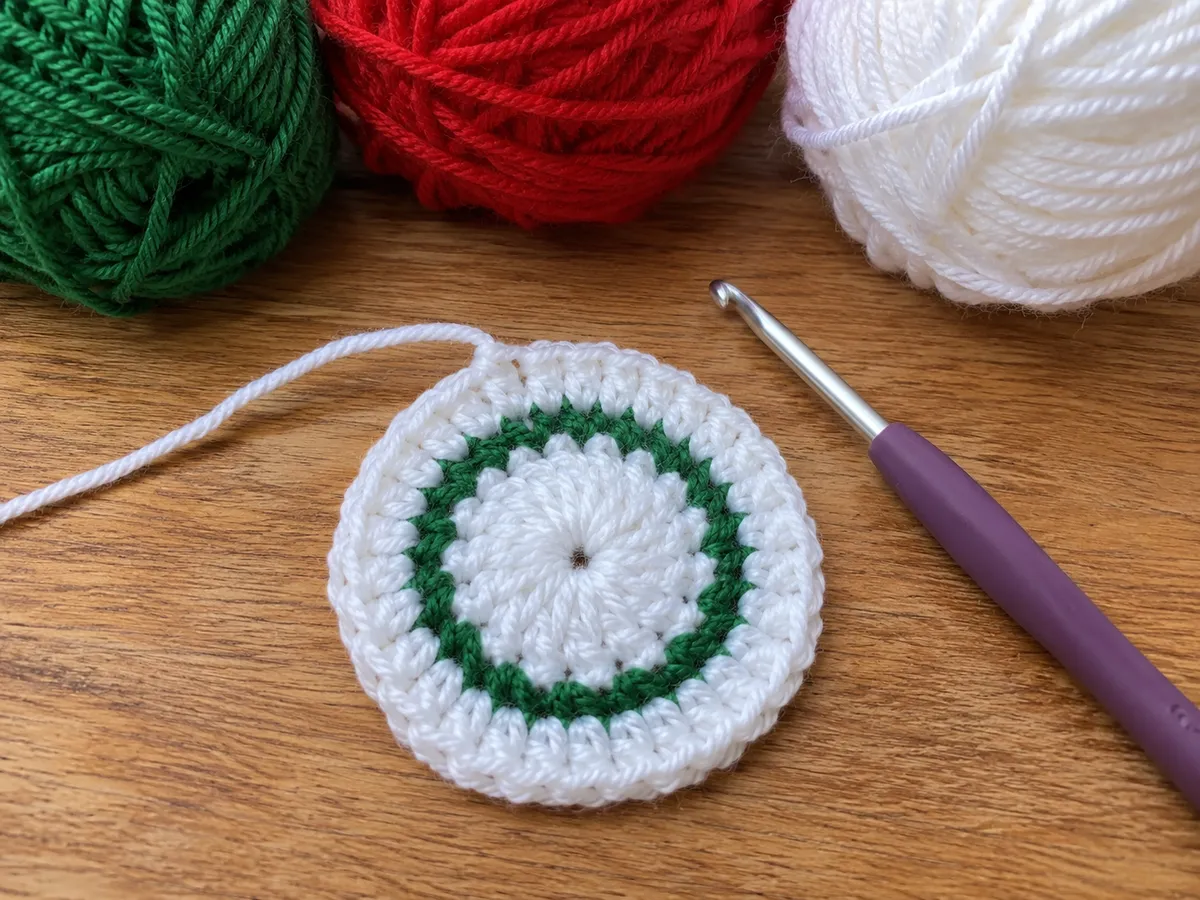
- Round 1, white: Make a magic ring, or work 2 ch and use the 2nd chain from the hook. Work 2 ch and 11 dc into the ring. Total: 12 dc.
- Round 2, green: Join at any stitch, work 1 ch, then 2 sc into every stitch. Total: 24 sc.
- Round 3, white: Work 2 ch and 1 hdc in every remaining stitch. Total: 24 hdc.
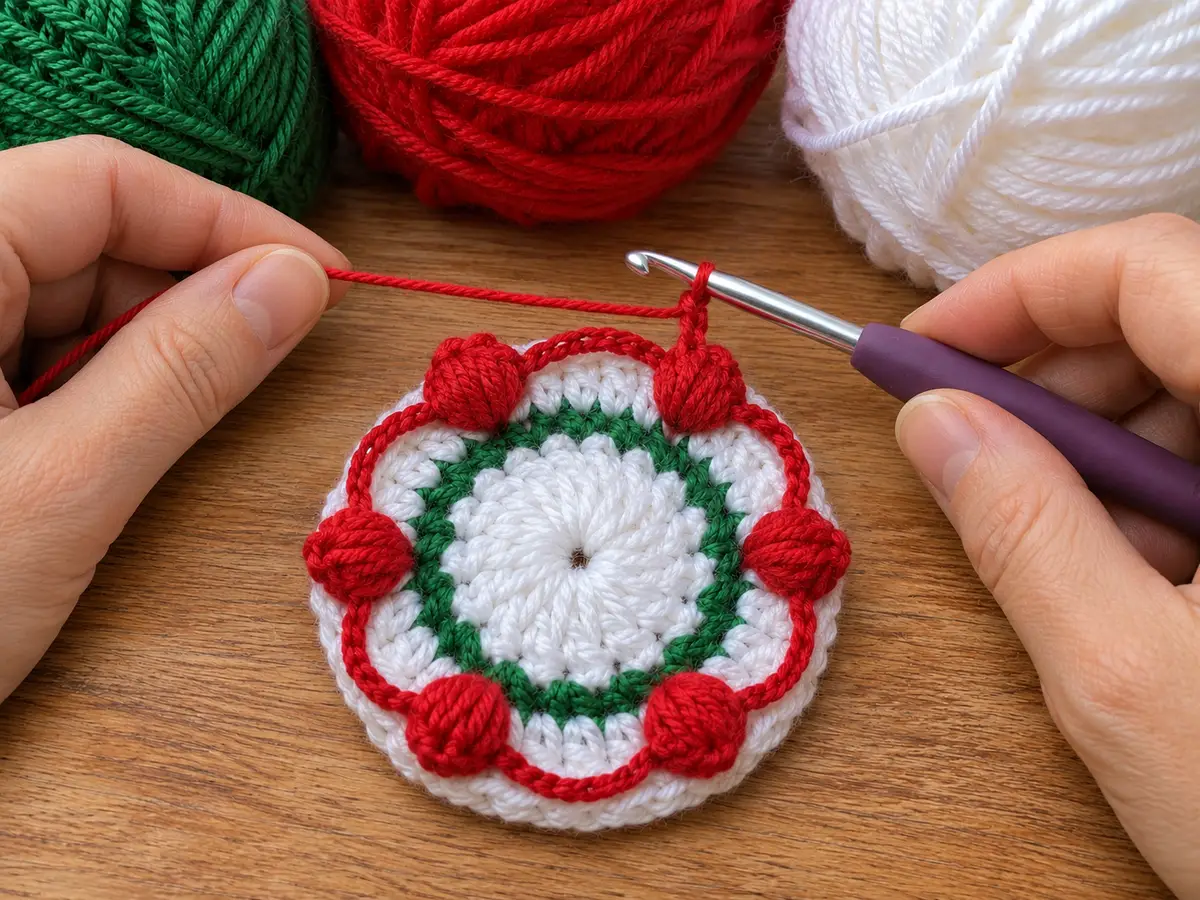
- Round 4, red: Make the first popcorn with a standing dc and 4 further dc in the same stitch. Work 5 ch and skip 3 stitches. Make 5 more popcorns the same way, each followed by 5 ch and 3 skipped stitches. Total: 6 popcorns and 6 arches.
- Round 5, green: Work 1 ch and 2 sc into the first popcorn. For each arch, work a 2-tr cluster into the middle of the 3 skipped stitches of Round 3, in front of the red arch; work 3 sc around the red arch; work a second 2-tr cluster into the same white stitch; work 2 sc into the following popcorn. Omit the already completed 2 sc in the final repeat. Total: 12 clusters and 30 sc.
- Round 6, white: Work 2 ch and 1 hdc in the same stitch. Continue with 6 hdc and an increase in the next stitch until 6 increases have been made. After the final increase, work the remaining 6 single hdc to the join. Total: 48 hdc.
- Round 7, red: Join with a standing sc through the back loop and work 1 more sc there. Alternate 3 single sc and 2 sc in the next stitch, using back loops throughout. There are 12 increases and the round ends with 3 single sc. Total: 60 sc.
- Round 8, white: Find the second of the 2 green sc worked into a Round 4 popcorn in Round 5, and follow its stitch column through Rounds 6 and 7. Join 1 stitch to its left. Work 1 ch and 4 sc, beginning in that joining stitch. Work the pair of Round 5 clusters together as 2 FP tr, skip the stitch behind them and work 9 sc. Work this over all 6 pairs, using only 5 sc instead of 9 at the end. Total: 6 joined post pairs and 54 sc. Leave white attached.
- Round 9, white: Work 2 ch and 1 hdc in every remaining stitch. Total: 60 hdc.
- Round 10, green: Make a standing FP tr around a joined post pair from Round 8. Beginning in the stitch directly behind it, work 10 back-loop sc. Repeat at all 6 post pairs. Total: 6 FP tr and 60 sc. Leave green attached.
- Round 11, green: Work 3 ch and 1 dc in the same position to make the first V. Repeat skip 2 stitches and work a V in the next stitch 21 times. Join into the 2nd beginning chain. Total: 22 V groups.
- Round 12, white: Work 1 ch and 1 sc into the first dc of a V. Around the round, work 1 sc into each dc and around the chain of every V. Total: 66 sc.
The lower clusters in Round 5 reach into the skipped white stitches in front of the red arches. They are not made into the arches themselves. In Round 8, the 2 clusters become the named post anchors. Follow the earlier round number carefully so that the raised motif connects to the intended structure rather than a nearby ordinary stitch.
Round 10 adds its post stitches while beginning the sc in the stitch directly behind, giving 66 total working elements. Round 11 then divides those positions into 22 V groups, and Round 12 fills each V with 3 sc. Retain these round-specific rules; not every post stitch in this design uses the same skip convention.
Work the staggered popcorns and raised motifs
- Round 13, red: Make a standing FP tr around a green FP tr from Round 10. Beginning in the stitch directly behind it, work 11 sc. Repeat 6 times. Total: 6 FP tr and 66 sc. Leave red attached.
- Round 14, red: Make the first popcorn with 2 ch and 4 dc. Between popcorns, work 6 ch and skip 5 stitches. After the 12th popcorn, join with the final arch. Total: 12 popcorns and 12 arches.
- Round 15, green: Work 1 ch and 1 sc into the first popcorn. For every arch, work a 3-tr cluster into the middle of the 5 skipped stitches of Round 13, in front of the arch; work 3 sc around the arch; work a 3-tr cluster into that same red stitch; work 1 sc into the next popcorn. Omit the already completed first sc in the last repeat. Total: 24 clusters and 48 sc.
- Round 16, red: Begin the first popcorn with a standing dc in the middle of the 3 sc around an arch in the preceding round. Add 4 dc to complete it. Continue as Round 14, with 6 ch and 5 skipped stitches between popcorns. Total: 12 popcorns and 12 arches.
- Round 17, green: Repeat the Round 15 construction, now using the middle skipped stitch from Round 15. Total: 24 clusters and 48 sc.
- Round 18, white: Join in a sc that was worked directly into a popcorn. Work 2 ch and 1 hdc in every remaining stitch. Total: 72 hdc. Leave white attached.
- Round 19, white: Work 1 ch and 1 sc in the same stitch. Work the 2 clusters on either side of a popcorn together as FP tr, beginning with the right cluster. Skip the next stitch and work 5 sc. Work across all 12 pairs, using only 4 sc in the last repeat. Total: 12 joined post pairs and 60 sc.
- Round 20, red: Work 2 ch and 1 hdc in every remaining stitch. Total: 72 hdc.
- Round 21, white: Make a standing FP tr around a joined pair from Round 19. Skip the stitch immediately behind it and work 5 hdc through back loops. Repeat 12 times. Total: 12 FP tr and 60 hdc.
- Round 22, green: Work 1 ch and 1 sc through both loops of a FP tr. Work the following 5 sc through back loops. Repeat the 6-position sequence 12 times. Total: 72 sc.
- Round 23, white: Join in a sc above a FP tr, work 1 ch and 2 sc. Work a FP tr backward around the FP tr to the right from Round 21; skip 1 stitch; work 2 sc; work a FP tr forward around the FP tr to the left from Round 21; skip 1 stitch; work 2 sc. Repeat across all 12 motifs, omitting the final 2 sc. Total: 24 FP tr and 48 sc. Leave white attached.
- Round 24, white: Work 2 ch and 1 hdc in every remaining stitch. Total: 72 hdc.
- Round 25, green: Work 3 ch and 1 dc in the same position. Repeat skip 2 stitches and work a V in the next stitch 23 times. Join with a sl st into the 2nd beginning chain. Total: 24 V groups.
- Round 26, white: Join in the first dc of a V, work 1 ch and 1 sc. For every V, work a long dc into the insertion point of that V in Round 25, and 1 sc in each of its 2 double crochets. The long dc lies between the 2 sc of the V. Total: 24 long dc and 48 sc.
The popcorns in Round 16 are offset because they begin in the middle sc of the previous arch filling. The green clusters then connect to the named skipped stitches of Round 15. Do not keep using the older Round 13 anchors after the offset changes the pattern layer.
In Round 23, distinguish the backward reach to the right from the forward reach to the left. Each raised stitch replaces the following skipped position so that the combined post and sc count remains 72. The initial and final partial sc groups account for the joining point.
Before beginning the brim, try the hat on as recommended. A different yarn weight or hook can affect the width. The source’s suggested response to a too-small fabric is heavier DK or worsted yarn, or a larger hook; it does not provide a hidden extra increase round to insert into the completed motifs.
Make the 2-color ribbed brim and pompom
Rounds 27–32
- Round 27, red: Work 2 ch and 1 hdc in every remaining stitch. Join with a sl st into the 2nd beginning chain. Total: 72 hdc.
- Round 28, green: Begin with a standing FP dc around a stitch post. Work a BP dc around the following post. Repeat around and join with a sl st. Total: 36 FP dc and 36 BP dc.
- Round 29, red: Work FP dc around the preceding FP dc and BP dc around the preceding BP dc. Total: 72 stitches.
- Round 30, green: Work FP dc around the preceding FP dc and BP dc around the preceding BP dc. Total: 72 stitches.
- Round 31, red: Work FP dc around the preceding FP dc and BP dc around the preceding BP dc. Total: 72 stitches.
- Round 32, green: Work FP dc around the preceding FP dc and BP dc around the preceding BP dc. Total: 72 stitches.
You may carry the unused color at the seam through the alternating brim rounds. When changing colors this way, work 2 ch as the first FP dc. Keep the front and back columns aligned; do not reverse them in alternating colors. Each round retains 72 stitches.
Finish the ends and attach the pompom
Weave in the ends. Make a pompom from all 3 colors, using the reserved amounts, and sew it firmly to the crown with its tying yarns. The source gives a pompom maker as a tool but no compulsory pompom diameter for this hat. Keep the tying yarns long enough for the stated sewn attachment rather than trimming them before fitting it.
For a simpler single-color raised stitch arrangement, see the spiral post-stitch hat. A plainer folded edge appears in the fisherman hat, and another crown construction is the magic-ring ribbed hat. Those are independent projects; the Christmas hat retains all 32 rounds above.
Check the secured color ends, the 2-color brim and the pompom attachment separately. The surface contains ordinary stitches, same-base clusters and paired post stitches, so a visible raised group is not always counted in the same way as a cluster of several unfinished stitches. The supplied totals at the end of each round identify the working elements that must be retained for the next stage.
Emma & Ella
More crochet projects from The Cooking Twins Yarn.
More from Emma & Ella