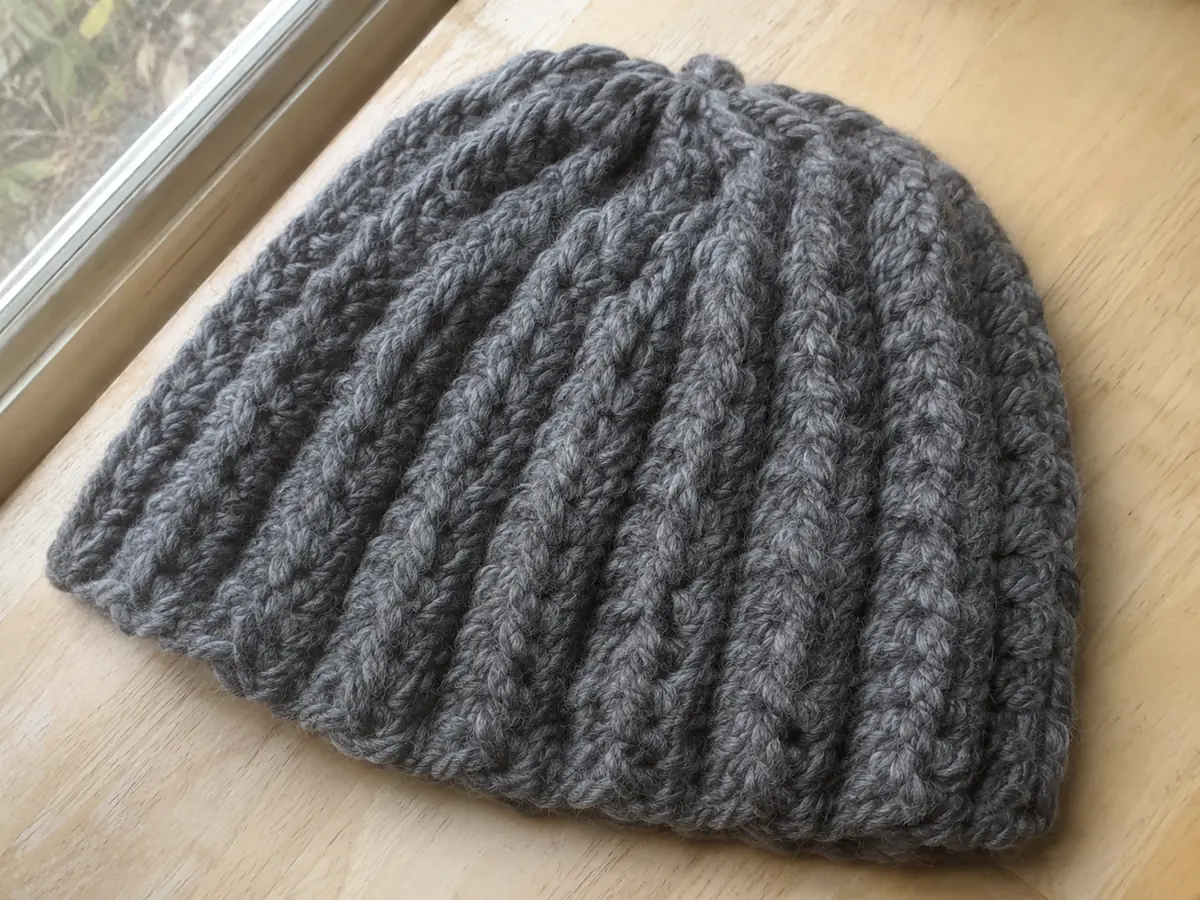
Chunky short-row ribbed hat in 3 versions
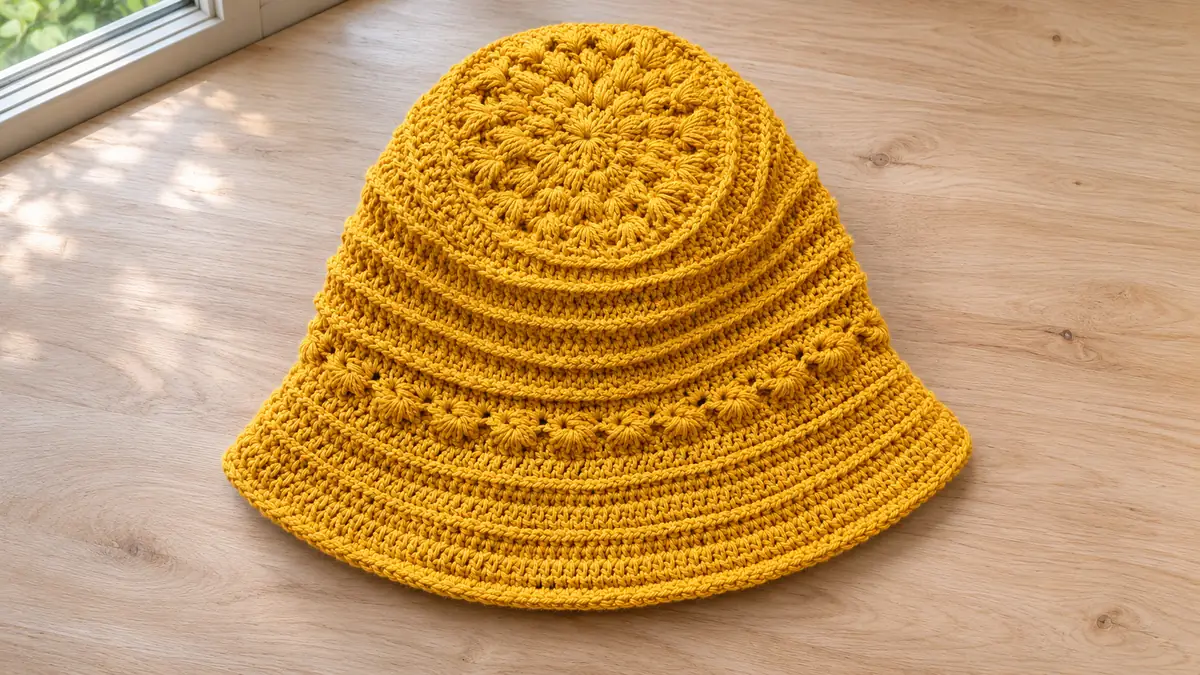
This close-fitting hat is worked sideways in single crochet. Each group of shortened rows shapes a section of the crown, while full-length rows restore the working width between sections. The hat can be worn with or without a turn-up. The source supplies 2 super-bulky foundations and a lighter

By Emma & EllaUpdated
Choose the yarn weight and foundation length
This close-fitting hat is worked sideways in single crochet. Each group of shortened rows shapes a section of the crown, while full-length rows restore the working width between sections. The hat can be worn with or without a turn-up. The source supplies 2 super-bulky foundations and a lighter super-bulky version, plus optional extra foundation lengths for more height.
Materials
For the 2 super-bulky versions, use an 8 mm hook and approximately 96–119 m or more of yarn. For the lighter super-bulky version, use a 6.5 mm hook and at least approximately 137 m. The source states that 1 ball is not enough for the lighter version. Have scissors and a yarn needle ready for the side seam and crown closure.
A longer foundation makes a taller hat and uses more yarn. The version with 31 chains can need more than a ball containing approximately 97 m. Keep this warning separate from the general yardage range: the source does not guarantee that every yarn ball within that range completes every variation.
| Version | Foundation ch | Full row | Shortest row |
|---|---|---|---|
| Close-fitting super bulky | 27 | 26 sc | 20 sc |
| Taller or hand-dyed super bulky yarn | 31 | 30 sc | 24 sc |
| Lighter super bulky | 37 | 36 sc | 28 sc |
The source gives no fixed tension, finished circumference or age-size chart for these 3 versions. The foundation choices concern the height and short-row construction. Do not label them as specific baby, child or adult measurements that are absent from the instructions.
US glossary
Ch means chain, sc means single crochet and sl st means slip stitch. US sc is US single crochet. From Row 2 onwards, use the back loops: insert through the top loop farther from you, leaving the nearer loop unworked. The slip stitch at the beginning of each short return row does not count in that row’s sc total.
For the basic movements, see the crochet learning guide. The difference between turning with 1 ch and turning without a chain is part of the shaping, so follow the ending of each row rather than adding the same turning chain everywhere.
Work the foundation and first shortened rows
Row 1
- Work 27, 31 or 37 ch for the chosen version.
- With the right side facing, begin in the 2nd chain from the hook.
- Work 1 sc in every chain.
- There are 26, 30 or 36 sc respectively.
- Turn and work 1 ch.
The chain omitted at the beginning supplies the starting height, so the working count is 1 less than the foundation count. Check that full count before shortening the next row. The last few stitches are deliberately left unworked later, rather than permanently removed from the foundation.
Row 2
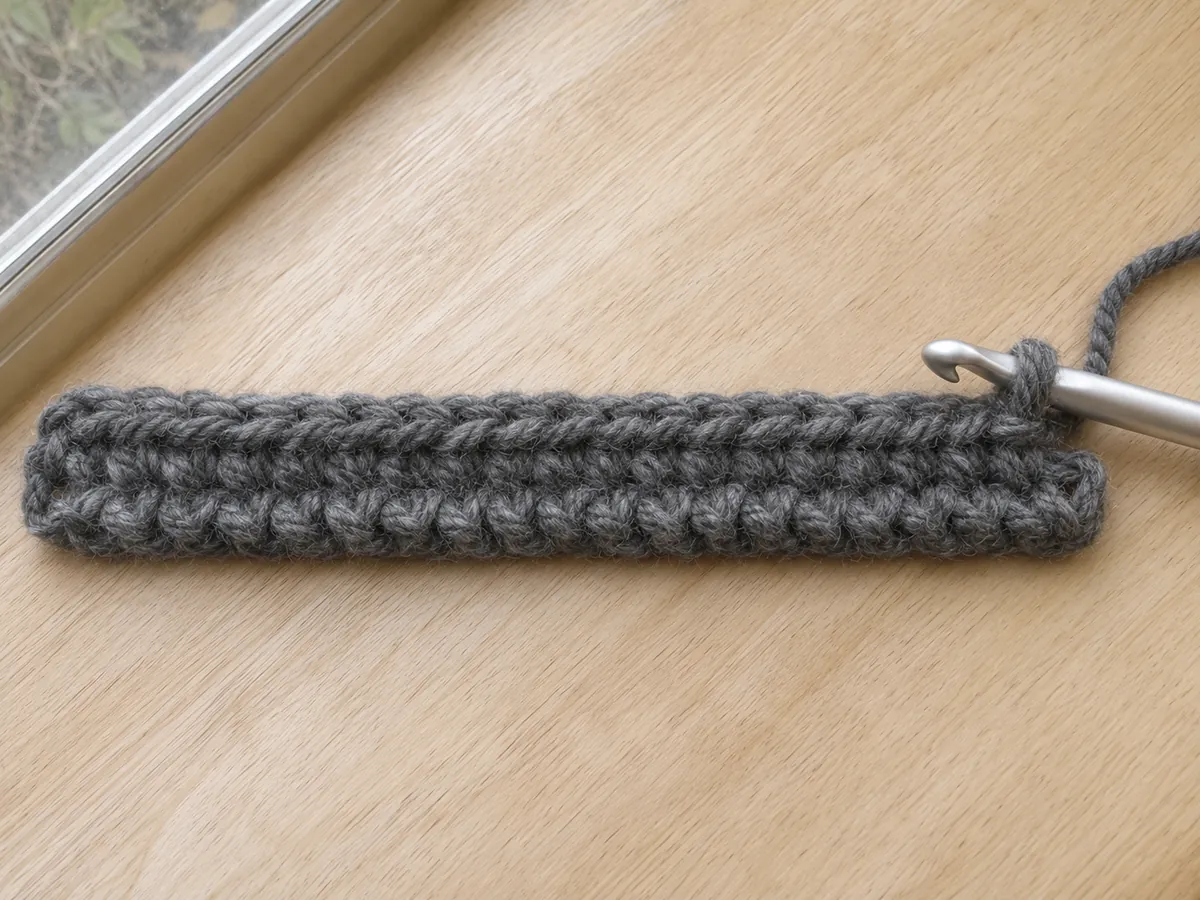
- Beginning in the first stitch, work 1 sc through the back loop of each stitch.
- Leave the final stitch unworked.
- Turn without making a chain.
- There are 25, 29 or 35 sc.
Row 3
- Work 1 sl st through the back loop of the first stitch. Do not count it.
- Work 1 sc through the back loop of every remaining stitch.
- Turn and work 1 ch.
- There are 24, 28 or 34 sc.
Rows 2 and 3 shorten the working length by 2 sc across the pair. Row 2 leaves a stitch at the upper edge; Row 3 uses a non-counted slip stitch before the returning sc. Do not count that sl st as a sc or replace it with a sc, because the reduction is part of the intended crown shape.
Keep the full-length lower edge distinct from the shortened crown edge. If you turn the work around while checking it, identify those edges again before continuing. The crown side collects the waiting stitches and slip stitches that will be picked up by a later full row.
Complete 4 crown sections for your chosen version
Super bulky: 27-chain or 31-chain foundation
- Row 4: Repeat Row 2, leaving the final stitch and turning without a chain. There are 23 or 27 sc.
- Row 5: Repeat Row 3 with the non-counted beginning sl st. There are 22 or 26 sc.
- Row 6: Repeat Row 2. There are 21 or 25 sc.
- Row 7: Repeat Row 3. There are 20 or 24 sc.
- Row 8: Return to full length. Work sc through back loops, picking up the free stitches and slip stitches along the shortened edge. There are 26 or 30 sc. Turn and work 1 ch.
- Row 9: Work 1 sc through the back loop of every stitch. There are 26 or 30 sc. Turn and work 1 ch.
- Row 10: Work 1 sc through the back loop of every stitch. There are 26 or 30 sc. Turn and work 1 ch.
- Row 11: Work 1 sc through the back loop of every stitch. There are 26 or 30 sc. Turn and work 1 ch.
Repeat Rows 2–11 another 3 times, giving 4 crown sections in total. In the final repeat of the 27-chain version, Rows 10 and 11 may be omitted if yarn is running short. This is the source’s specific yarn-saving option; it is not an instruction to omit arbitrary shaping rows from earlier sections.
For a taller super-bulky hat, choose the 31-chain version from the beginning. As noted above, a ball containing approximately 97 m may not be enough. Changing the foundation halfway through would not create the same rectangle, so make that choice before the initial chain.
Lighter super bulky: 37-chain foundation
- Row 4: Repeat Row 2. 33 sc remain.
- Row 5: Repeat Row 3. 32 sc remain.
- Row 6: Repeat Row 2. 31 sc remain.
- Row 7: Repeat Row 3. 30 sc remain.
- Row 8: Repeat Row 2. 29 sc remain.
- Row 9: Repeat Row 3. 28 sc remain.
- Row 10: Work sc through back loops, picking up the waiting stitches and slip stitches at the shortened edge. Restore the full count of 36 sc. Turn and work 1 ch.
- Row 11: Work 36 sc through back loops. Turn and work 1 ch.
- Row 12: Work 36 sc through back loops. Turn and work 1 ch.
- Row 13: Work 36 sc through back loops. Turn and work 1 ch.
Repeat Rows 2–13 another 3 times, giving 4 crown sections. For more height, the source also suggests 39 or 41 foundation chains. The stitch counts shift accordingly; these are longer foundation options, not separately graded circumference sizes. A 39-chain start gives a full row of 38 sc, and a 41-chain start a full row of 40 sc, following the same foundation relationship.
The shorter-row progression still needs the same sequence of operations when choosing a longer foundation. Retain the waiting stitches and the non-counted sl st so the full row can restore the width. Do not replace the pickup row with a row that stops at the shortest edge.
Check each restored full row
At the pickup row, locate the free top loops and slip stitches along the stepped crown edge. Work through them in order to regain the stated full count. The aim is not to add a fresh increase into an unrelated position; it is to include the positions left by the shortened rows. Count the completed full row before beginning the next section.
A different 4-size short-row construction appears in the short-row ribbed hat. Its stitch totals are different, so use the counts for the yarn version selected here rather than combining the 2 sets of numbers.
Join the sides and choose the crown finish
Side seam
Cut the working yarn with enough length for both the side seam and the crown. The source does not specify a numerical tail length. Join the first and last rows. Align the full lower edges and the shaped upper edges so that the tube is not twisted. Secure the seam without pulling it tighter than the surrounding ribbed fabric.
The 4 short-row sections have already reduced the upper edge. Do not cut away the stepped shaping or add another unlisted section to make the piece look rectangular. The crown is finished using 1 of the supplied closures below.
Gathered closure
- Pass the yarn through the upper stitches.
- Draw the opening together.
- Secure the yarn.
- Weave in the end.
Flat closure
- Lay the 2 sides of the upper edge together.
- Sew them closed.
- Secure the yarn.
- Weave in the end.
The source shows both finishing options in its crown-finishing video. Choose either the gathered or flat closure rather than treating the flat seam as a required extra step after gathering. The supplied text does not prescribe another crochet decrease round.
For a full-row rectangle with a folded edge, compare the fisherman hat. This chunky model retains its own short-row sections and can be worn with or without a turn-up. Arrange the lower edge in the chosen position after securing the crown.
Before finishing, check the seam, restored full rows and chosen crown closure as separate areas. Record which foundation option you used and whether the final 27-chain repeat omitted its last 2 rows. These details describe the chosen source variation without assigning an unsupported head measurement or tension to it.
Keep the repeated sections organized
After completing a restored full row, note which section you are in before starting the next shortened sequence. The first section contains the initial full foundation row, while the following sections repeat the designated row range. Repeating the entire foundation again would create a different piece. Marking each completed section on paper helps distinguish the instruction to repeat another 3 times from an instruction to work only 3 sections altogether.
When counting a short return row, count only its sc. The leading slip stitch remains excluded even though it is visible at the crown step. At the next pickup row, that visible position becomes part of the area worked to restore the full length. This change of role is why both the working instruction and the numerical total matter.
If using scraps, keep the same shaping sequence through each yarn change. The source permits leftover yarn but does not provide an additional color chart or a different short-row formula for striped versions. A color change should not become an extra turning chain or another stitch at the upper edge.
Emma & Ella
More crochet projects from The Cooking Twins Yarn.
More from Emma & Ella