Crochet bookworm bookmark: simple US double crochet pattern
This crochet bookworm bookmark combines a long, narrow chain tail with a short curled section. The tail lies between the pages, while the little spiral remains visible above the book. Pairs of tall stitches worked into a short section of the chain make the worm curl without stuffing or a separate

By Emma & EllaUpdated
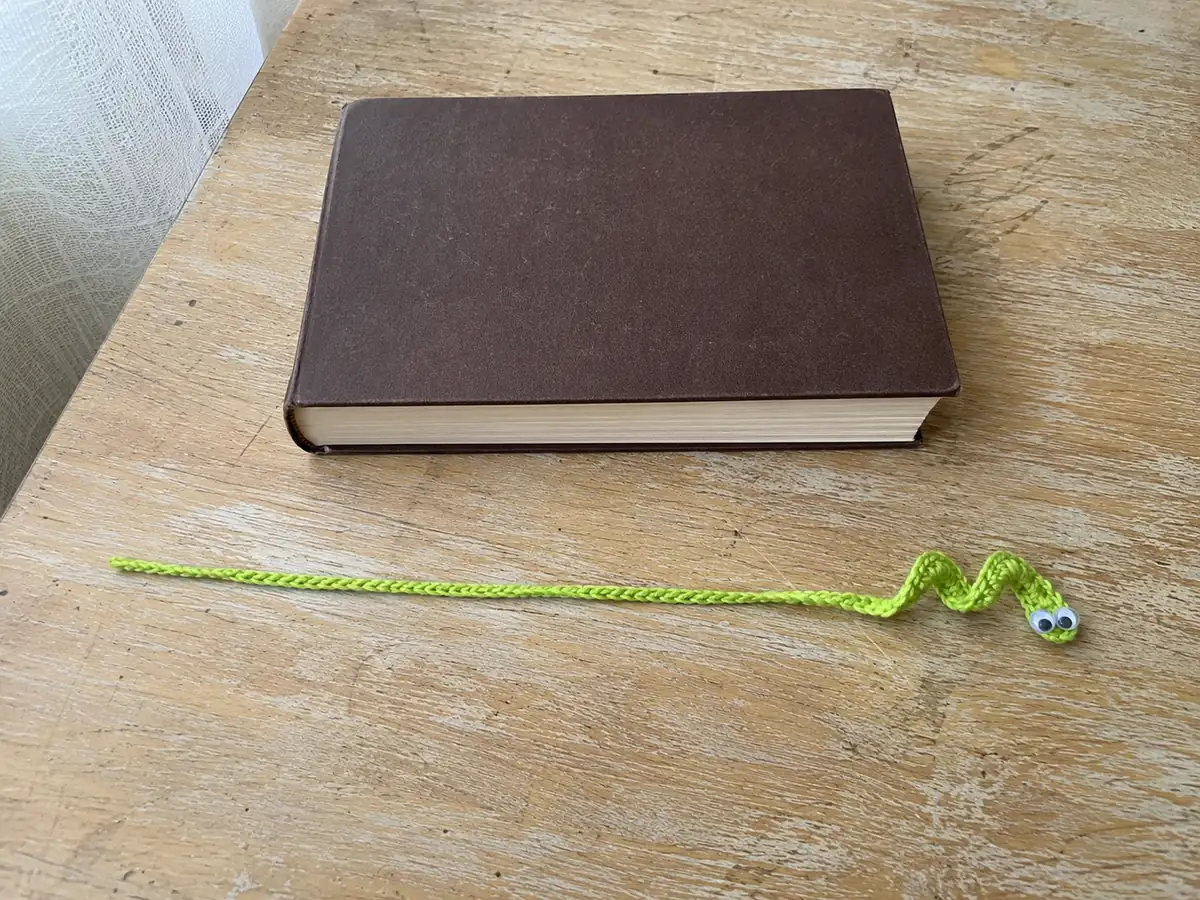
This crochet bookworm bookmark combines a long, narrow chain tail with a short curled section. The tail lies between the pages, while the little spiral remains visible above the book. Pairs of tall stitches worked into a short section of the chain make the worm curl without stuffing or a separate sewn body.
The counted construction is brief:70 foundation chains, 26 US double crochets across 13 chain positions and 1 joining slip stitch. The rest of this guide explains how to keep those parts distinct, finish the tail neatly and position the eyes. It does not add unlisted rounds or turn the small bookmark into a larger amigurumi pattern.
Prepare a fine yarn leftover and read the US terms
Materials for 1 bookmark
| Material | Source specification |
|---|---|
| Yarn | A fine leftover, approximately 1.2 m |
| Hook | A small suitable hook, US size B or similar in the source |
| Tools | Scissors and a blunt yarn needle |
| Eye option 1 | 2 tiny craft eyes and suitable craft glue |
| Eye option 2 | 2 small embroidered eyes in contrasting yarn |
The source provides no fixed finished length or tension sample. The hook should suit the fine yarn rather than being chosen only from the US size letter. A thicker leftover changes the tail's thickness and the size of the spiral, so do not promise the same fit between pages after a major material substitution.
Keep useful starting and finishing tails for securing the ends. The approximate yarn allowance is a source reference, not a reason to cut the ends too short to weave in. If the leftover is uncertain, check that enough remains for the spiral before beginning rather than adding a join at an awkward visible point.
US crochet glossary
Ch means chain, sl st means slip stitch and dc means US double crochet. US dc is the stitch called double crochet in US terminology and Stäbchen in German. It begins with 1 yarn over, then finishes by pulling through 2 loops and through the remaining 2 loops.
A chain is made by catching the working yarn and pulling it through the loop already on the hook. The active loop on the hook is not counted as a completed chain. A slip stitch is made by inserting into the indicated chain, catching the yarn and drawing it through both the chain and the active loop.
If chains are new to you, the crochet learning section offers related basics. Practice recognizing the chain links before beginning the counted foundation so that the long tail can be checked accurately.
Separate the tail from the curled section
Most of the 70-chain foundation remains unworked and becomes the tail. Only a short section near the hook receives double crochet stitches. Do not work pairs of double crochets all the way along the chain:that would create a long spiral and remove the intended narrow bookmark tail.
The bookmark is not stuffed. Its curve comes from adding more stitches than the short foundation can lie flat beneath. Keeping that construction in mind makes the difference between a misplaced stitch and a natural curl easier to recognize.
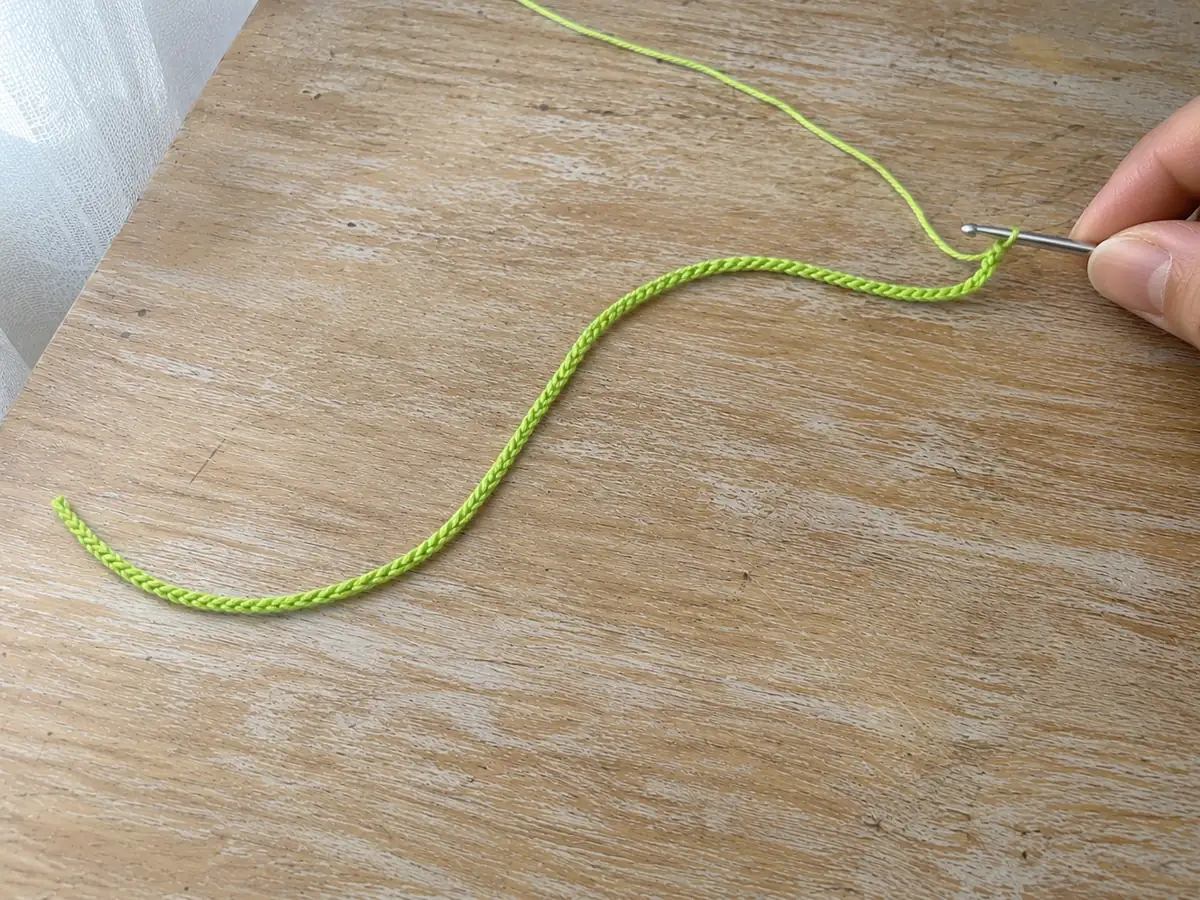
Make the 70-chain foundation and count its working positions
Work the complete foundation
- Make a starting loop with enough tail for finishing.
- Crochet 70 ch.
- Turn the chain ready to work back along it.
- Count the chain links without including the active loop on the hook.
Keep the chain loops reasonably even. Very tight chains make the return stitches difficult to insert, while very loose chains can leave a less regular tail. Aim for a chain that moves freely on the hook rather than pulling every link as tight as possible.
Before starting the spiral, count the full foundation once more. A mistake found here is easier to correct than after 26 double crochets have been added. The number 70 belongs to the whole starting chain, not to the untouched tail alone.
Identify the 3rd chain from the hook
The first double crochet pair goes into the 3rd completed chain from the hook. Count away from the active loop, identifying each link rather than counting the loop on the hook as number 1. The initial skipped chains provide the starting height beside the taller stitches.
Use the same insertion approach along the next positions so that the foundation is not twisted unpredictably. The source does not require a special chain-loop variant. Work consistently into the recognizable chain positions rather than changing between several strands to force a curl.
Keep the long tail free while returning
Let the unworked chain hang loosely or lay it on the surface as you work the short return. Avoid catching that tail in the double crochet stitches accidentally. A loop of the tail pulled into a stitch can make the bookmark kink even though the number of double crochets is correct.
Do not trim the long chain to a desired book height. It is part of the counted construction. If you later choose a different length for another bookmark, record that as your own foundation change rather than presenting it as the unchanged source version.
Crochet the short 26-double crochet spiral
The complete return sequence
- Work 2 dc into the 3rd ch from the hook.
- Work 2 dc into each of the next 12 chains.
- Work 1 sl st into the immediately following chain.
- Cut the working yarn and weave the finishing end into the double crochet section.
The spiral uses 13 insertion positions:the first position plus 12 following positions. Each holds 2 double crochets, so 13 ×2 gives 26 actual double crochet stitches. The final slip stitch is in the next chain, not into the last double crochet pair and not into the far end of the tail.
Count the pairs if it is easier than counting every double crochet. There should be 13 pairs. A pair contains 2 finished double crochets worked into 1 chain, not 2 unfinished double crochets closed together. A cluster would have a different stitch count and would not create the same increased edge.
Why the section curls
The row contains twice as many tall stitches as foundation positions. That extra width makes the short return coil naturally. Arrange the double crochet section lightly with your fingers rather than pulling the chain hard to force a particular shape.
If the curl is irregular, first check for a chain containing only 1 double crochet or an accidentally skipped position. The source does not add an extra spiral round to repair it. Correct the local return sequence before relying on shaping to disguise an omitted stitch.
A 4-color spiral square shows a different flat spiral construction. Its multiple-color structure should not be transferred into this bookmark's simple paired-double crochet return.
Secure the short ends discreetly
Weave the working end within the double crochet fabric without tightening the whole curl into a hard knot. Keep the narrow chain tail outside that finishing path. Inspect the first and last pairs before cutting any excess yarn so that the return remains secure.
The source asks for the end to be hidden in the double crochets, where there is more fabric than in the long chain tail. A very short leftover end can be harder to secure there, which is why useful finishing length matters even in a tiny project.
Flatten the tail, add eyes and finish the bookmark
Shape the chain before using it in a book
Lightly dampen the long chain and pin it straight on a suitable surface. Let it dry fully before placing it between pages. Use a treatment suitable for the actual fiber; the source asks for gentle damp shaping rather than hot pressing.
Keep the spiral separate while straightening the tail. Pulling strongly at the coiled section can distort the double crochet pairs. The goal is a narrow straight tail with a curled top, not a flattened spiral squeezed between the pages.
Test the bookmark in a suitable book only once dry and after finishing the eyes. The source gives no universal page-thickness or book-size fit. A noticeably thicker yarn changes how the tail sits, so judge the actual finished piece rather than assuming every substitution behaves identically.
Choose glued or embroidered eyes
Attach 2 tiny craft eyes to the spiral using appropriate craft glue and let it dry completely. Keep glue away from the chain tail and the surfaces that will touch the pages. Position the eyes together before fixing them permanently so that the expression faces the intended direction.
Alternatively, embroider 2 small eyes using contrasting yarn. The source notes that embroidery can hold better on smooth synthetic fibers. Secure the embroidery without drawing the spiral into a deep hollow. Choosing embroidery changes the finishing method, not the 70-chain foundation or 26-double crochet construction.
Consider the intended recipient and access to small detachable parts. This bookmark is a decorative reading accessory rather than automatically suitable for a very young child's unsupervised use. Check glued parts before reuse if the bookmark has been handled or stored for a long time.
Keep a record for a matching gift
Record the yarn, hook and eye method after finishing. A later bookmark can use the same stitch sequence but appear quite different with another thickness or tension. Compare the completed dried pieces rather than stretching the tails to make them match.
The granny-square earrings offer another small leftover project. Keep their separate counts and materials distinct. For this bookmark, the essential checks remain 70 chains, 13 paired insertion points, 26 double crochets and 1 slip stitch into the following chain.
Work each US double crochet as a complete stitch
For a double crochet, yarn over before inserting the hook into the chain. Catch the working yarn and draw up a loop, leaving3 loops on the hook. Yarn over and pull through2 loops, then yarn over and pull through the remaining2. Repeat that complete action into the same chain to make the pair. Only then move to the next foundation position.
The height of this stitch matters. Using US single crochet would make a shorter denser return,while using a treble would make a taller edge. Both are changes to the stated construction. Keep the US terminology visible if you also use US patterns elsewhere.
When checking the final row, distinguish the2 skipped starting chains from the26 actual double crochets. They provide the beginning height and are not added to that26-stitch calculation. The source explicitly counts13 positions receiving2 double crochets each,followed by the slip stitch in the next chain. This gives a clear checkpoint before shaping and adding the eyes.
Emma & Ella
More crochet projects from The Cooking Twins Yarn.
More from Emma & Ella