Crochet Christmas spiral with mohair and DK yarn
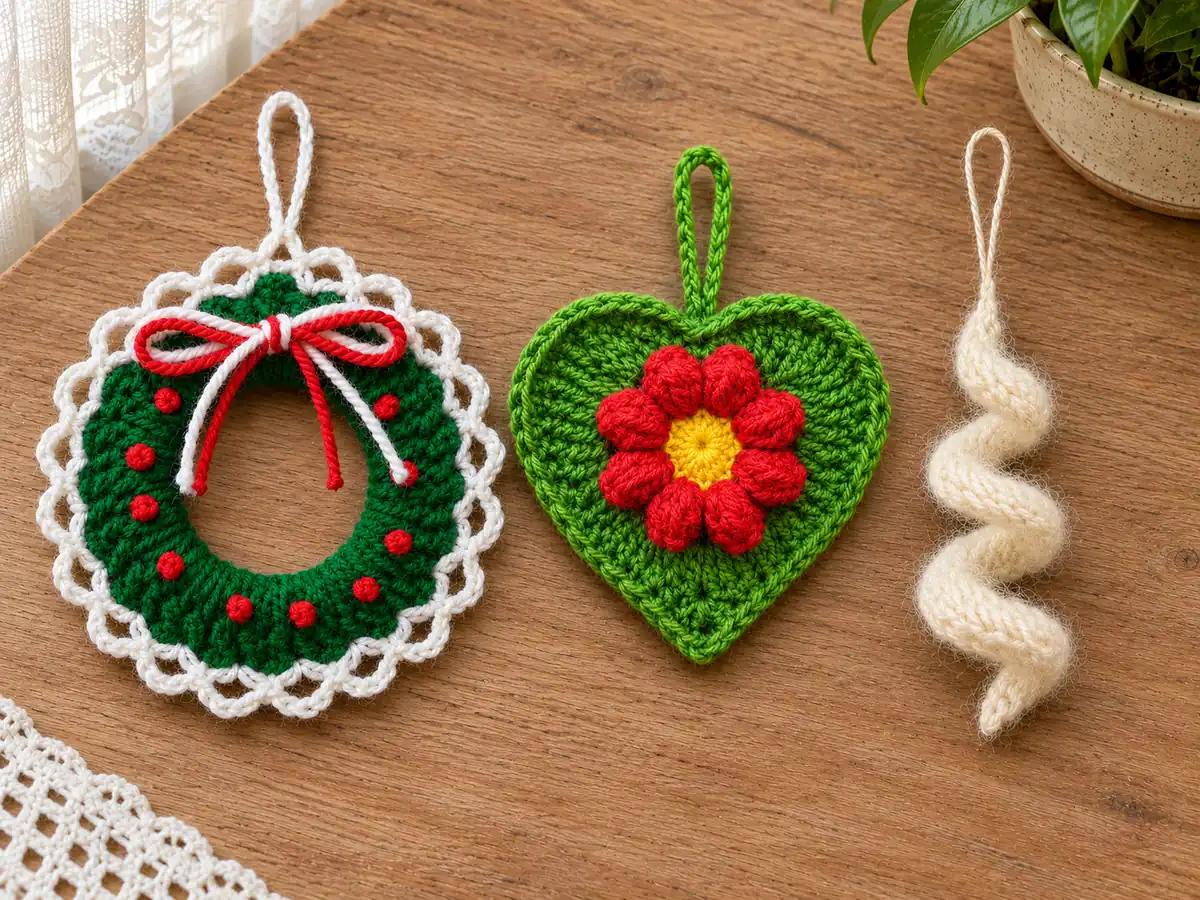
This little spiral uses 1 foundation chain and 1 row worked along it. Several stitches in the same foundation positions make the strip curl naturally. It has no stacked circles, solid cone or hidden framework. The example is approximately 8 cm long and 3 cm in diameter.

By Emma & EllaUpdated
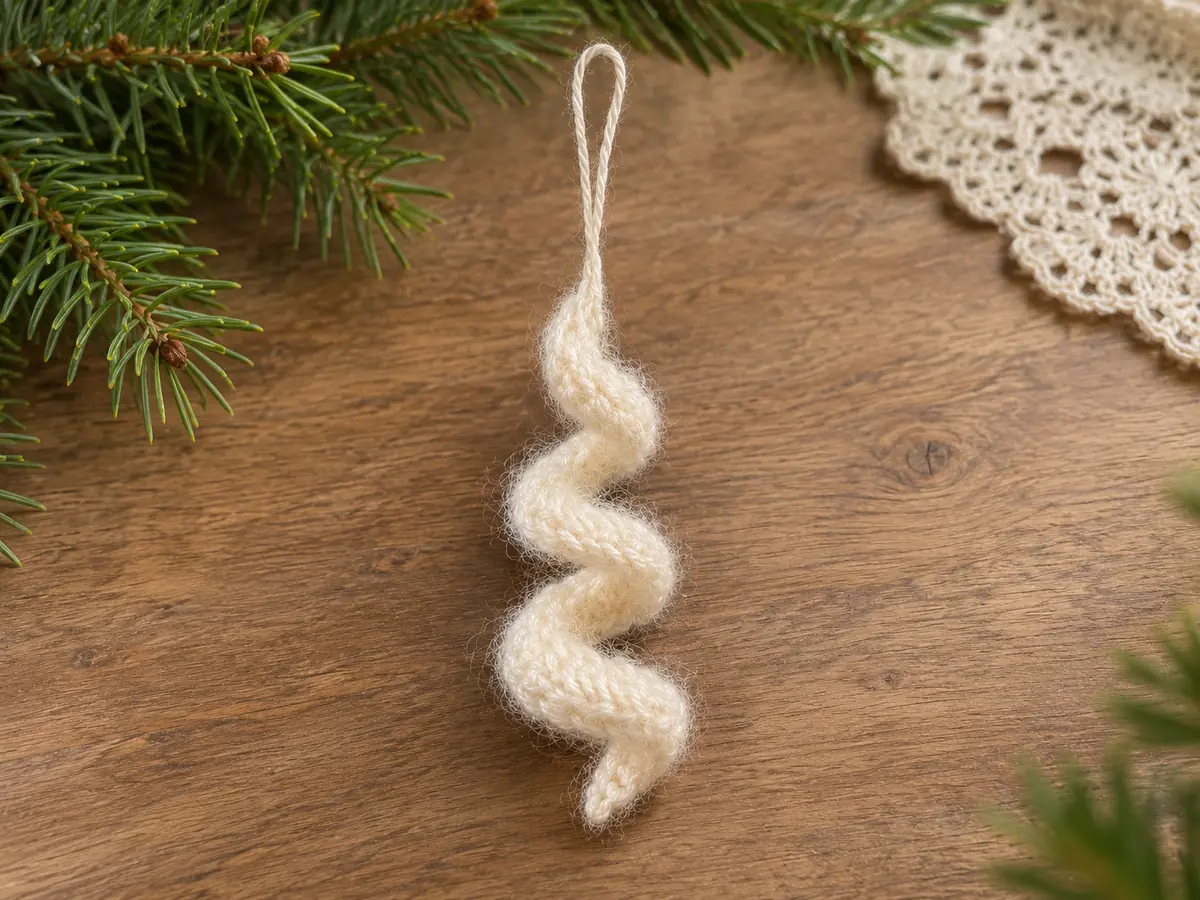
This little spiral uses 1 foundation chain and 1 row worked along it. Several stitches in the same foundation positions make the strip curl naturally. It has no stacked circles, solid cone or hidden framework. The example is approximately 8 cm long and 3 cm in diameter.
Prepare the 2 yarn strands and understand the spiral shape
Materials and reference consumption
Hold 1 strand of DK yarn, approximately 250 m per 100 g, together with 1 strand of fine lace-weight mohair blend, approximately 800 m per 100 g.
Use a 4 mm crochet hook. No compulsory tension is required. The source gives approximately 4 m or 4.4 yards for 1 small spiral.
It does not divide that requirement into separate exact consumption figures for each yarn. Treat it as the guide for the described small version rather than inventing another per-strand table.
The yarn lengths describe the different materials. They are not instructions to hold several mohair strands to match the DK thickness. There are exactly 2 working strands: 1 DK and 1 mohair.
US stitch glossary
Ch means chain. Sc means US single crochet. Hdc means US half double crochet. Dc means US double crochet.
A sc increase is 2 sc in the same position; an hdc increase is 2 hdc there. The middle group's 3 dc are completed separately in the same foundation chain, not closed together as a cluster.
Work back along 1 side, not in rounds
The chain is worked back along 1 side. There is no magic ring or joining slip stitch that connects beginning and end into a ball.
The strip's ends remain the attachment areas for the later hanging loop. Its soft curl comes from more new stitch length than the short foundation can hold flat.
The 6-tier Christmas tree uses independent stacked pieces instead.
Control both strands together
Lay the yarns beside one another so they feed freely. The fine halo strand can wrap around the thicker one if it is held much more tightly.
Guide both with the same hand and catch both in every stitch. A partly split stitch containing only 1 working yarn has another surface and strength.
A single thicker substitute may curl or look different; it does not reproduce the same mohair halo simply because its nominal thickness seems similar.
Make 13 chains and the first low end groups
Foundation chain
With both strands held together, work 13 ch. The working loop on the hook is not a fourteenth chain.
Identify the 12 positions available after skipping the first chain below the hook. Begin in the 2nd chain from the hook.
Keep the foundation accessible rather than pulling the soft yarn so tightly that its chain structure disappears into the halo.
First worked position: 2 sc
Work 2 sc in that second chain. Both use the same foundation position.
For each sc, insert into the chosen chain, collect both yarns and draw through the 2 loops on the hook. Complete the first stitch before returning to the same place for the second.
These lower stitches make the flatter end of the spiral. They are not the first 2 stitches of a repeated all-double crochet group.
Second worked position: 2 hdc and 1 dc
In the next chain, work 2 hdc and 1 dc, all sharing that foundation position.
For hdc, yarn over with both strands, insert and collect the yarns, then draw through all 3 loops. Repeat the complete hdc before making the dc.
This transition raises the edge gradually from the low sc end toward the tall middle section.
Keep the grouped stitches together
Do not accidentally move to the next chain between the 2 hdc and dc. Their shared insertion point is what gives the short foundation extra fabric length.
If the fluffy yarn hides the chain, temporarily mark the currently used position. Remove any helper marker once the groups are counted.
Let the completed strip lie loosely behind the hook. It does not need to be forced straight while the increasing groups make it begin to curl.
Work the 8 middle groups and mirrored final end
Middle foundation positions 3–10
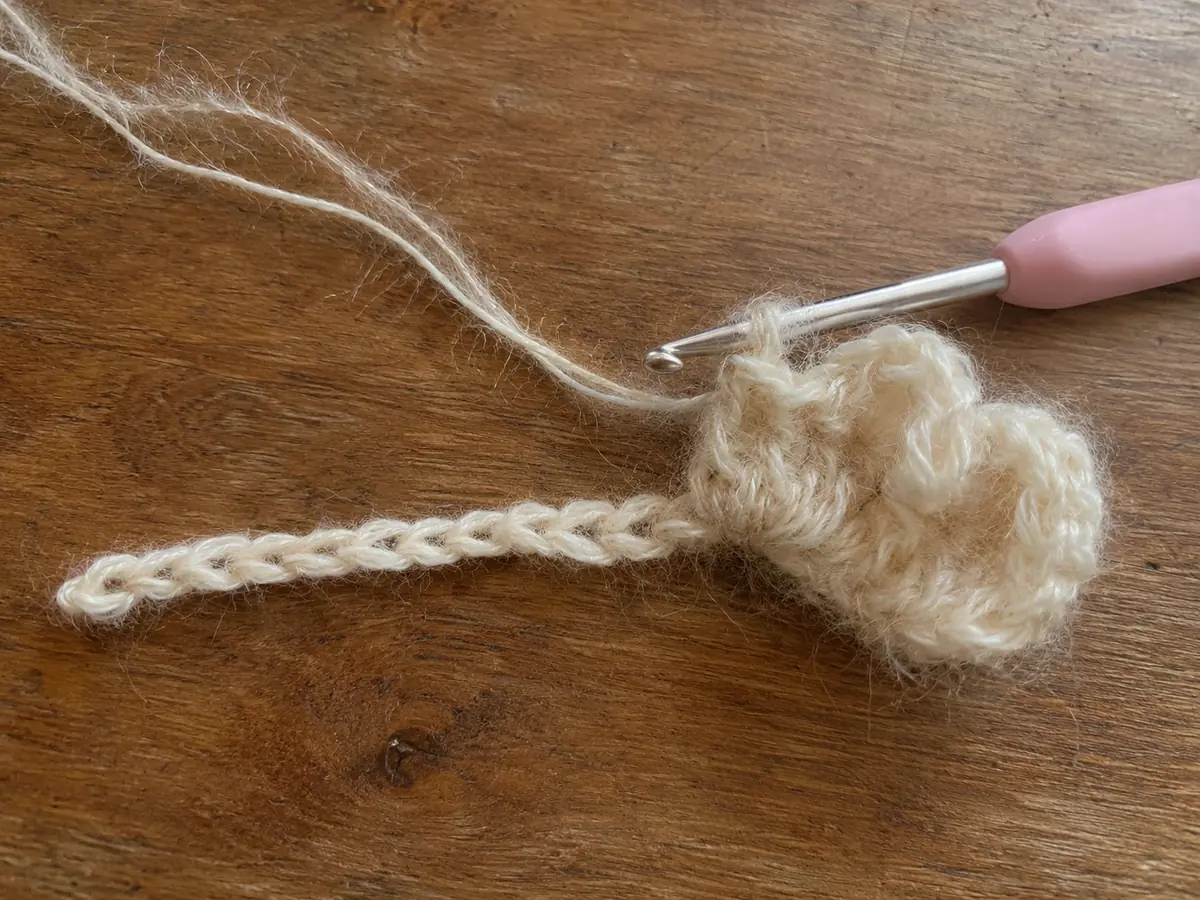
- Worked position 3: 3 dc in the same chain.
- Worked position 4: 3 dc in the same chain.
- Worked position 5: 3 dc in the same chain.
- Worked position 6: 3 dc in the same chain.
- Worked position 7: 3 dc in the same chain.
- Worked position 8: 3 dc in the same chain.
- Worked position 9: 3 dc in the same chain.
- Worked position 10: 3 dc in the same chain.
For dc, yarn over, insert and collect both strands, then draw through 2 loops twice. Three completed dc make each group.
Each group uses the next chain. The 8 groups contain 24 dc in the middle, not 8 dc spread individually along those positions.
Worked position 11: reverse the transition
In the next chain, work 1 dc and 2 hdc. The order mirrors the beginning: highest stitch first, then the lower hdc.
All 3 again share 1 chain. Moving the hdc into separate chains would consume the foundation too soon and alter the end slope.
Worked position 12: final 2 sc
Work 2 sc in the final chain. The complete shaped row is now finished. Cut and secure the yarn.
No second sc row, slip-stitch outline, added star or ball is required. This single row forms the whole spiral body.
Check 12 old positions against 34 new stitches
The worked foundation positions contain 2 sc; 2 hdc and 1 dc; 8 groups of 3 dc; 1 dc and 2 hdc; then 2 sc.
Those are 2 low-end positions, 2 transition positions and 8 middle positions, using exactly 12 chains after the skipped beginning.
The resulting row contains 4 sc, 4 hdc and 26 dc, totalling 34 stitches. That is a check derived from the written sequence, not another round to crochet.
Thirty-four new stitches do not imply a 34-chain foundation. Their concentration in fewer original positions is the reason the edge rolls.
Allow the curl to settle
Let the strip hang freely and arrange its waves gently with the fingers. Yarn and tension affect how strongly it curls.
Do not pull only the mohair strand to force another turn. Both yarns pass through the same stitches; tightening 1 alone distorts them.
The source allows an individual length but supplies only the 13-chain version. A longer personal make requires a consciously changed foundation and middle-group count, not another claimed original size.
The shell-strip tree uses a separate longer-strip construction.
Twist the yarn-end pairs into a hanging loop
Use the existing ends
Beginning and end each contain the 2 yarns held together during crocheting. The source twists those pairs of ends together for the suspension.
Twist and knot them to form a loop of the desired length, then trim the remaining ends. No fixed hanging-chain count is given because this loop is made from existing yarn rather than another crochet chain.
Check the suspension before trimming
Hang the ornament gently before making the final cut. Both yarn anchors should support its shape without dragging a fuzzy edge outward.
The knots must catch the actual yarn strands, not only loose halo fibers. Keep enough remaining length for adjustment until the loop hangs as intended.
The source does not prescribe brushing or combing the mohair. Gentle finger arrangement is sufficient to inspect the curl without introducing another treatment.
Measure body and loop separately
The approximately 8 cm length and 3 cm diameter describe the spiral itself. There is no separate compulsory loop length hidden in those dimensions.
Record the body and chosen suspension separately for matching ornaments. A longer loop does not mean the crocheted body is a larger pattern size.
Inspect the mirrored ends and middle groups
Each end has 2 sc, with the transition groups facing in opposite orders toward the tall middle. Check that all 8 middle groups are present.
A chain with only 2 dc instead of 3 may curl less at that point. Correct its actual stitch count rather than hiding the difference with a tighter hanging knot.
Look from both sides for a loose initial or final loop. The foundation should not be knotted around a neighboring wave.
For a final count check, separate stitch type from foundation position. The middle 8 positions account for 24 dc, but the transition at each side also contains 1 dc. That makes 26 dc overall. The remaining transition stitches are 4 hdc, and the low ends contribute 4 sc. This explains the total without changing the 12 original worked positions.
The yarn held together is treated as 1 working unit during these stitches. A yarn over carries both strands, and a drawn-up loop contains both strands. The usual count of loops on the hook still describes stitch loops, not a new total obtained by counting the individual DK and mohair filaments separately.
At the first transition, finish both hdc before the dc. At the last transition, finish the dc before its 2 hdc. These opposing orders create a gradual rise and fall along the row rather than 2 identically directed ends. That relationship is worth checking before the halo makes the individual stitch tops less obvious.
Keep the suspension ends clear of the curled strip while arranging it. The ends should meet as the chosen loop without wrapping through a neighboring wave and fastening that wave into an unintended knot. If the ornament hangs unevenly, release a caught curl before tightening the final knot further.
A second spiral can be compared at the foundation and middle groups before its hanging length is selected. Match the crocheted structure first, then choose the suspension to suit the display. This keeps an optional finishing length separate from the only fully specified 13-chain body in the source.
Repeat notes and storage
Keep the yarn remnants and hook details together. Another blend may have a different halo, elasticity and curl without becoming another guaranteed source size.
Store the spiral loosely rather than compressing the mohair beneath a tight band. There is no stuffing, wire or glued internal structure to support it.
The flat lace angel is another decoration for the set. The spiral is complete after knotting and trimming; no extra crochet round is needed.
Keep both strands together throughout.
Emma & Ella
More crochet projects from The Cooking Twins Yarn.
More from Emma & Ella