Crochet Christmas gifts: free patterns and thoughtful ideas
Thoughtful crochet Christmas gifts begin with the person who will receive them and the way the finished object will be used. A decorative stocking, a small bell and a mosaic coaster ask for different materials, finishing and packaging. This guide compares free projects already available, with a

By Emma & EllaUpdated
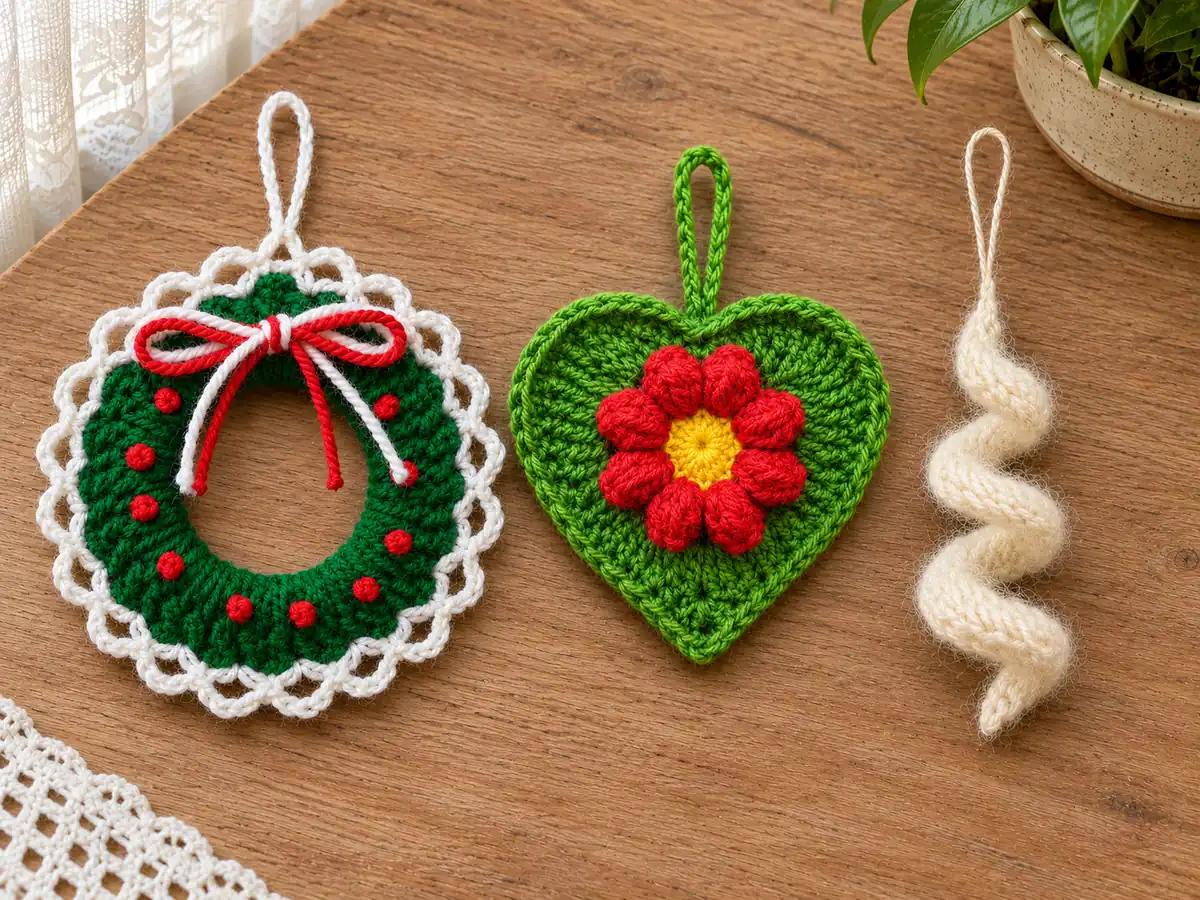
Choose a crochet Christmas gift for the person and its intended use. This guide compares 6 source projects: a mosaic tree coaster, a small tree keychain, a 27-square stocking, a wreath, a popcorn-flower heart and a mohair spiral. Keep each project’s actual materials and measurements with that project, and follow its linked tutorial for the working sequence. The rest of the guide covers timing, finishing, packaging and care.
Choose the recipient before choosing the pattern
A successful handmade Christmas gift suits the person who will receive it. Think about their home, the colors they use and whether they enjoy seasonal decoration. A generous decorative stocking has a different purpose from a small heart attached to a parcel. The best choice is the piece that feels natural in the recipient’s life, rather than the one that happens to use the most elaborate stitch.
Consider what the finished gift asks of the recipient. A flat ornament needs little storage, while a large stocking needs a place to hang. A coaster should arrive with honest care guidance for its yarn mixture. If you do not know the person’s preferences well, a modest removable decoration gives them more freedom than a large item chosen to match your own room.
Choose one main project and finish it neatly. An assortment of unfinished additions rarely improves a thoughtful present. If you want to make a coordinated set, establish the size and finishing of a sample first, then decide what genuinely belongs beside it. A small card explaining the intended use can make a practical difference, especially when the shape is decorative rather than functional.
Budget yarn and finishing materials for the whole gift
For gift planning, count the complete package rather than the crocheted center alone. The stocking uses many separate squares and a joining layout. The coaster includes fringes. The angel needs attached wings and a carefully arranged skirt. Each choice carries finishing work and material needs beyond the most photogenic front view.
Write a shopping list for the selected model, not a generic Christmas craft list. Compare the exact yarn length and fiber with your intended substitute. A seasonal color name does not describe thickness or care. Retain enough matching yarn for a repair or a final seam, particularly when a gift must be completed before a fixed date. Avoid using the last available strand for an optional bow before the structural work is secure.
Set aside the packaging early. A shallow box protects raised stitches better than a tightly tied paper envelope. If the gift is a stocking intended to be filled, decide what it will contain before overloading its hanging loop. A decorative yarn structure should not be assumed to support an arbitrary weight. Presenting it empty or with light contents preserves its shape and lets the recipient choose how to use it.
Mosaic Christmas tree coaster
Construction, materials and dimensions
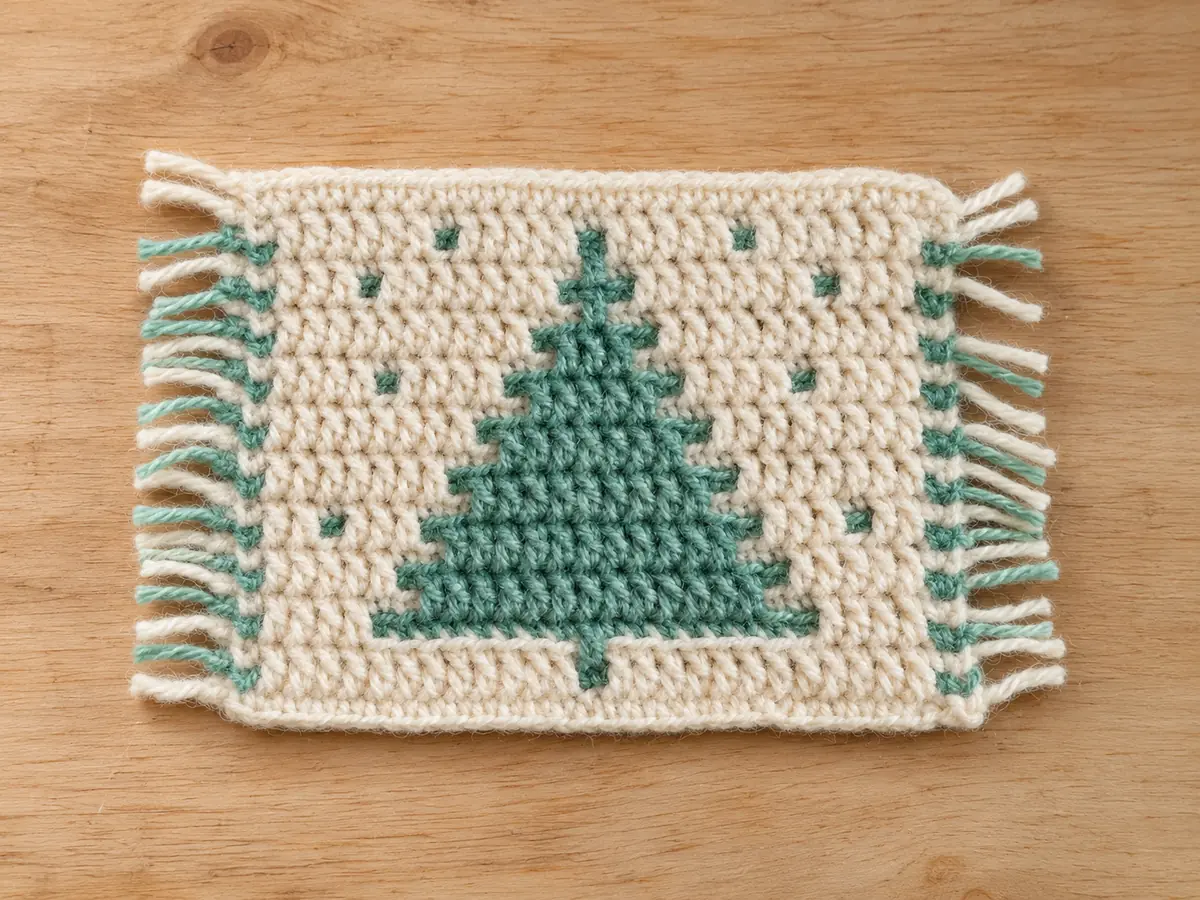
This rectangular coaster has a tree motif created in 2 colors. The complete tutorial includes all 22 rows and a diagram covering the 27 stitches in each row. The example is approximately 16 cm wide and 13 cm high, excluding its short fringe. The material list provides a 4.5 mm hook and yarn with a stated composition of cotton, acrylic and wool. Do not assume a cotton-only substitute will have identical care or performance properties.
Working and finishing this model
For a gift, this coaster offers a specific decorative use rather than a one-size accessory. The Christmas tree appears through the 2-color mosaic arrangement, so a clear contrast between the light background and tree shade is helpful. Read the diagram together with the written 22-row sequence. The pattern keeps 27 positions in each row; the longer mosaic stitches do not introduce an extra row or an additional position beside themselves.
The stated yarn contains 60% cotton, 28% acrylic and 12% wool, with 120 m per 50 g. The supplies include one ball of each color and a 4.5 mm hook. Those balls are the material provision, not a measured 100 g consumption in the small rectangle. Each row is started again from the same side instead of turning, leaving the ends used for the short fringe. Prepare for that process before beginning rather than trimming every end immediately.
Present the finished piece with honest use and care information. No specially tested thermal protection is established by the model, so do not describe it as a pan holder or heatproof mat. Check the rectangular outline and arrange the fringe neatly without claiming it belongs inside the reference 16 × 13 cm body measurement. A flat card or shallow package displays the motif clearly. Keeping the material note with the gift helps the recipient clean it appropriately after use.
Follow the complete mosaic christmas tree coaster pattern.
Granny-square Christmas stocking
Construction, materials and dimensions
This decorative stocking uses 27 small granny squares and a carefully arranged assembly layout. Folded motifs help create the foot and toe, while a textured cuff incorporates a hanging loop. Example squares are approximately 7.6 cm across; the complete stocking is about 15.2 cm wide and 50.8 cm tall. It is a decorative stocking for filling, not a wearable sock. The material list uses Worsted yarn and a 5 mm hook.
Working and finishing this model
This stocking is a more substantial present than a miniature ornament. Its size comes from the 27 granny squares and their planned arrangement, including folded motifs that shape the foot and toe. Follow the assembly layout rather than joining the squares into a simple tube and hoping it will produce the same silhouette. Make and measure a first square before investing in the complete set.
The reference squares are approximately 7.6 cm across, using Worsted category 4 yarn with a 5 mm hook. The suggested yarn packaging offers approximately 201 m per 100 g in each of 3 colors. These are supplied ball sizes, not individually measured use for every color. Keep the squares identified and compare their dimensions as you work; a notably different tension can make the joining edges less even.
The textured cuff and integrated hanging loop belong to the completed construction. Before filling the stocking, check what the support and loop can reasonably carry. It is a decorative container, not a wearable sock or an unrestricted load-bearing bag. Presenting it empty or with a few light treats preserves the outline and lets the recipient choose its future use. When wrapping, avoid sharply folding the cuff or forcing the foot into a narrow box. Include a short note about the yarn and the intended decorative purpose.
Follow the complete granny-square christmas stocking pattern.
Christmas heart with a popcorn flower
Construction, materials and dimensions
The popcorn-flower heart can accompany a message while remaining a complete decoration in its own right. Its yellow center, red popcorn round and 2 green shaping rounds grow as one connected motif, without a separate flower being sewn on afterwards. The listed supplies include those 3 colors and a 4 mm hook. No dependable final size, compulsory yarn weight or measured consumption is given. Finish your chosen yarn combination first, then decide the packaging and how many matching hearts the remaining material can reasonably supply.
Working and finishing this model
The heart is a suitable small attention when you want a bright motif that can accompany a card or parcel. Its flower grows from the same work as the outer shape, with the yellow center followed by red raised stitches and green shaping. The sequence matters: it is not a separate flower attached to a generic heart. Choose the 3 colors together so the center remains visible within the finished outline.
A 4 mm hook is given, but no fixed yarn weight, gauge, finished width or meter consumption is supplied. That makes a complete first sample important before choosing packaging or promising several identical gifts. Compare the thickness of the scraps rather than selecting solely by their colors. A very bulky red section can affect the balance of a much finer green edge. Keep enough of each shade for proper finishing instead of cutting ends too short to hide securely.
If you use the optional felt backing, cut it after checking the actual crocheted shape and test it behind the top indentation and lower point. It should support the heart without protruding into the outline. A removable attachment to wrapping allows the recipient to keep the decoration after opening the present. Keep glue and sticky tape away from the yarn surface. A small written message can provide the personal detail without adding heavy beads that the model does not require.
Follow the complete christmas heart with a popcorn flower pattern.
Small crochet Christmas wreath
Construction, materials and dimensions
As a present, this wreath provides a visible circular decoration without requiring the recipient to find a separate supporting hoop. The crocheted ring begins with a chain and foundation round, then gains its fuller layer and white looped edging. Red embroidery and a bow complete the example. Worsted yarn with a 4 mm hook gives a stated diameter of 5 inches, or approximately 12.7 cm. Check that reference scale against the intended display or wrapping before choosing it as a small gift.
Working and finishing this model
The wreath can serve as a small main present for someone who enjoys decorating their home. Its ring is crocheted rather than built around a commercial hoop, making the construction distinct from many other wreath projects. Check that the intended recipient has a suitable place for the finished reference scale; it is more noticeable than a tiny parcel charm.
The example combines green Worsted yarn, white loop edging and red embroidered accents with a 4 mm hook. Plan all 3 colors before starting the ring and keep the edging yarn reserved. No exact gram or meter consumption is stated, so do not calculate a gift series from the appearance of the remaining green ball alone. Finish a complete sample and use your own measured consumption if several wreaths are required.
Before fixing the bow, lay it on the wreath and check how much of the white border remains visible. An oversized embellishment can hide the feature that gives this model its character. Conceal the embroidered ends carefully at the back, then test the final hanging point. For presentation, use a package that supports the circular form rather than squeezing it into a narrow envelope. A care note should reflect the yarn and any accessories actually used, not a general instruction copied from an unrelated cotton ornament.
Follow the complete small crochet christmas wreath pattern.
Small Christmas tree keychain with embroidered lights
This little tree grows from a narrow point into a stuffed body. A spiraling garland and separate lights decorate its surface. The lowest ring of the keychain is worked over with yarn to become the star at the top. The metal chain and key ring are therefore part of the intended construction, rather than props in a photograph.
The tutorial supplies approximately 5 g of emerald-green yarn, yellow remnants for the lights and star, and another remnant for the garland. You also need stuffing, a 3 mm hook and a yarn needle. No fixed finished height is given. Measure a fully stuffed sample before choosing a small gift box instead of guessing a size from its picture.
Check the connection between the yarn body and the metal chain. Secure woven ends should hold under a gentle inspection; a long loose loop is unsuitable on a key ring. A bag attachment needs the same sound connection. In US terminology, preserve the actual short single crochet stitches corresponding to German fM; do not replace them with taller double crochet stitches when reading a terminology comparison.
Open the Christmas tree keychain pattern.
Mohair and DK Christmas spirals for a small gift series
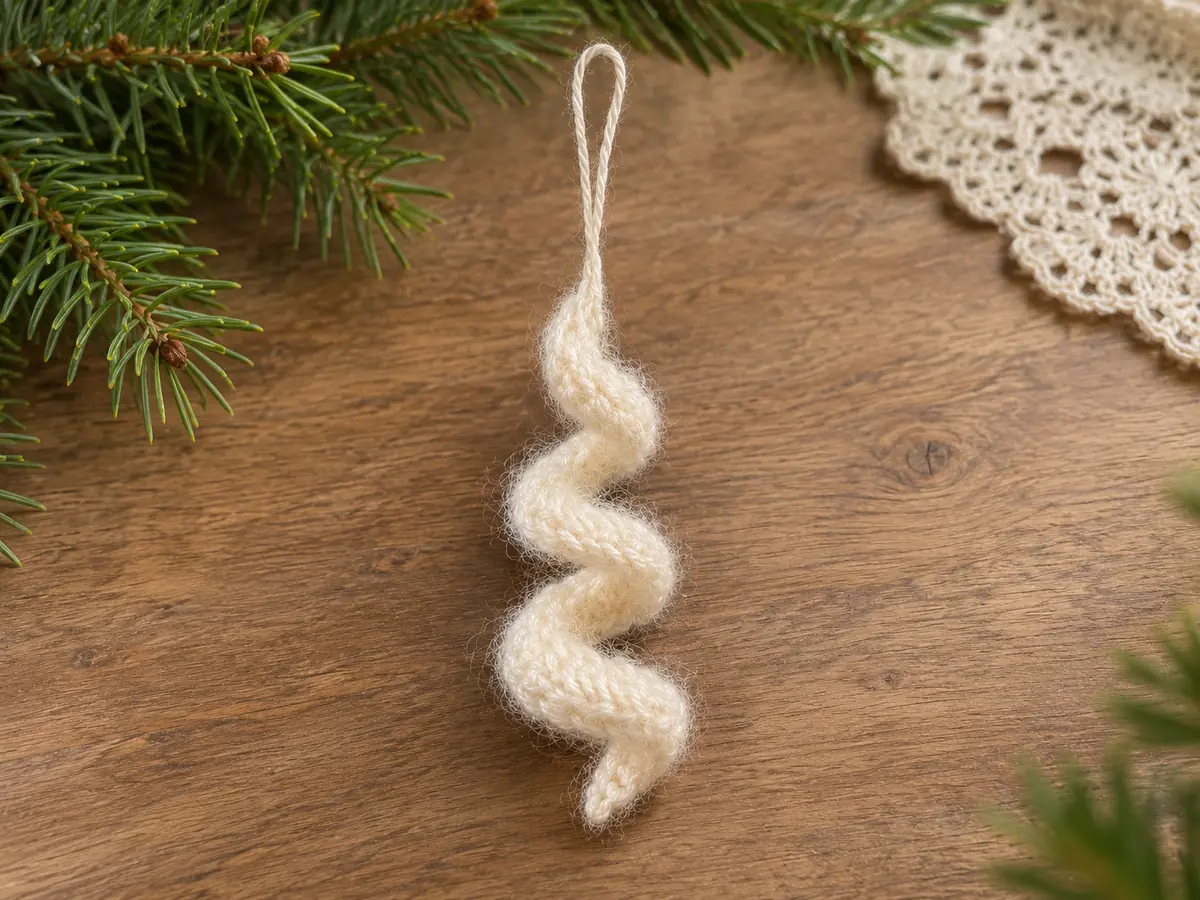
The spiral uses a foundation chain and a row worked along it. Several stitches in the same foundation positions make it curl. The reference is approximately 8 cm long and 3 cm in diameter. It is a narrow ornament that can sit beside a card or decorate a package without needing a large front surface.
Hold a DK strand and a fine mohair-blend strand together. Their stated lengths are approximately 250 m and 800 m per 100 g respectively. Use a 4 mm hook. These are different yarn specifications, not an instruction to multiply the mohair strands. The combined surface differs from a single cotton yarn. Finish a complete sample before assuming a substitute has the same size or consumption.
Let the finished spiral lie or hang freely. Tight packaging compresses the coils and hides their shape. For a series, attach each to a small card with its own separate loop so the pieces can be removed without tangling. Check that both yarns are securely finished and no loose working loops remain on the surface.
Open the mohair and DK Christmas spiral pattern.
Make the gift feel personal without altering its construction
Color is often the safest way to personalise a pattern. Repeat a shade from the recipient’s home or choose a traditional combination that you know they enjoy. Keep the stitch sequence and shaping intact. A change made solely to fit an initial, bead or label can affect the outline, so test decorative additions separately before sewing them permanently onto the main work.
Think about the back as well as the front. A heart on a parcel may later become a hanging decoration, and the recipient will see both sides. Conceal ends carefully and make optional backing neat. On a stocking, the joining lines are a deliberate part of the construction; follow the provided layout rather than hiding uncertainty with extra trim.
Use a short written note to carry information that does not belong in the stitches. It can explain that the ornament was made for a particular tree, or that the stocking is intended for light festive treats. This keeps the crochet visually clear while making the present specific. Include the appropriate care advice, particularly when the project combines yarn with felt, embroidery or another component.
Work backward from the date you need the present
A gift schedule should include assembly, drying and packaging. Finish a sample before deciding that a small motif is quick enough for every person on your list. Multiple colors create ends to weave in; separate parts require alignment; a large granny-square stocking needs both repeated squares and a correct assembly layout. Those tasks remain even after the stitch pattern becomes familiar.
Assign concentrated work to the steps most likely to cause confusion. Read the mosaic coaster diagram when you have enough time to follow a whole planned section. Keep stocking squares together in their intended order. Repeating simple sections can fit into shorter sessions, but do not postpone every seam until the final evening.
If the available time becomes shorter, reduce the quantity of gifts rather than silently abandoning the finishing standard. One properly completed ornament presented neatly can be more useful than a larger project with insecure joins. Choose a known pattern for a close deadline and reserve an unfamiliar technique for a later present when you can test it without pressure.
Pack crochet so its texture survives the journey
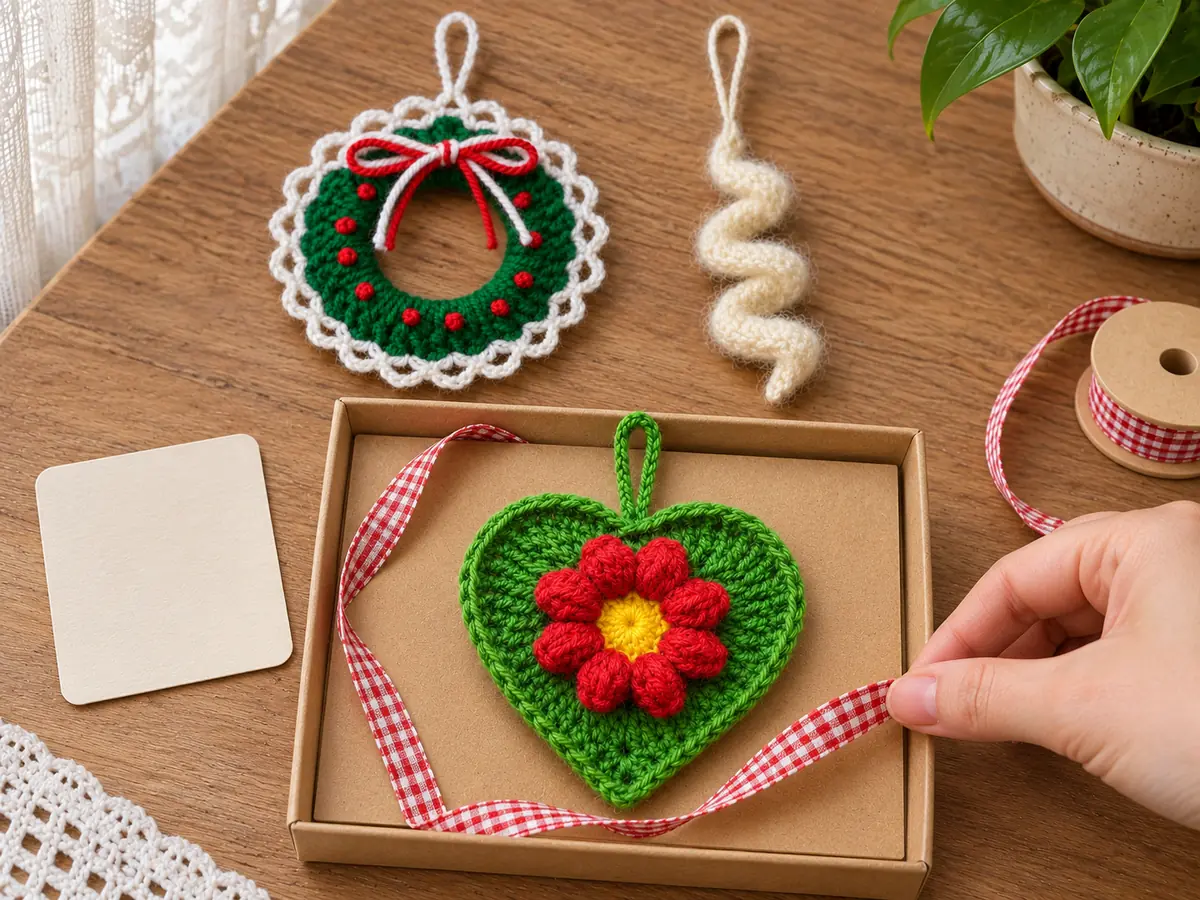
Let any damp-shaped piece dry completely before wrapping. Moisture enclosed in packaging is unhelpful to both the yarn and the presentation. Support raised popcorn stitches without flattening them, and place delicate wings where they cannot catch on tape. A small amount of space around the work protects the outline better than a tightly compressed package.
Keep adhesives on the outer wrapping rather than against the yarn. If a label is needed, attach it to a removable cord or place a card beside the item. Avoid fastening a card through an openwork area where its weight will pull the fabric sideways. The gift should arrive ready to use after straightforward unpacking.
For a posted parcel, consider movement inside the box. Secure the presentation enough that the contents cannot tumble into a corner, while leaving room for dimensional details. Include a clear description of the object’s intended purpose. A decorative stocking is not a wearable sock, a crocheted ornament is not automatically a tested toy, and a coaster’s cleaning method depends on its actual materials.
Questions about handmade Christmas gifts
What can I make when I do not know the recipient’s size? Choose a decorative object rather than a wearable garment. The projects here do not require body measurements. However, their finished dimensions still matter: a large stocking needs more display and storage space than a narrow spiral.
Is a coaster always a practical gift? It can be, provided the recipient understands its materials and care. The featured mosaic project uses a mixed-fiber yarn, so do not describe it as cotton-only or invent heat-resistance claims. Follow its instructions and give material information honestly.
Can I attach an ornament directly to a present? Yes, if the attachment can be removed without damaging the crochet. Keep sticky tape and tight knots away from the fabric. Let the recipient separate the decoration from the packaging easily. That small finishing decision makes the handmade piece reusable after the wrapping has been discarded.
Resolve a last-minute problem without disguising it
If a present does not look ready, identify the unfinished stage before adding decorative trim. A stocking with inconsistent square sizes needs its joins and layout checked; a heart with visible loose ends needs those ends secured. A ribbon cannot repair the underlying issue. Inspect the gift in the position in which the recipient will use it, not only arranged for a photograph.
When yarn is running short, preserve the length needed for structural seams and secure finishing. Do not spend the final matching strand on an optional bow before the main assembly is complete. If the intended set cannot be finished reliably, reduce the number of pieces and present the completed one neatly. A small, useful attention does not need an unplanned companion simply to make the package appear larger.
Recheck the written description on the care card as well. The coaster should not acquire an unsupported heatproof claim, and the decorative stocking should not be described as a wearable sock. If your materials differ from the reference, state the fibers you actually used. Honest information and sound finishing allow the recipient to enjoy the object confidently. They are more valuable than concealing an incomplete seam under a last-minute embellishment or promising a function the model does not establish.
Match the gift to its recipient and use
Consider whether the recipient likes useful tabletop pieces, tree ornaments or shelf decorations, and whether there is space to display the gift. A small well-chosen piece can suit their colors and habits better than a large complicated one without an intended place. A coaster has different surface and care requirements from an ornament; the stocking is decorative, not a wearable sock. Metal key rings, loose felt parts and long loops need their own consideration rather than a blanket toy claim.
Plan for when the gift will actually be used, not only the handover day. A tree keychain may be enjoyed during Advent and a stocking needs to be ready before it is filled. For colleagues, choose 1 manageable model and vary the color if helpful; an individually packaged ornament and short note can remain personal. Decorative models should be identified as decorations when given to children or families.
Divide the schedule into 3 stages: a complete sample, further pieces and finishing. The last stage includes weaving in ends, shaping, drying and packaging; the stocking also requires its layout and seams. If time becomes short, reduce the number of gifts instead of omitting rounds from the pattern. Check the availability of metal fittings and packaging before committing to a series.
Budget complete samples and plan personal variations
Make a material list for each gift and measure actual consumption from a finished sample when repeating it. Purchased ball sizes are not consumption measurements: the coaster’s 2 prepared balls do not mean it contains all their yarn. Sort remnants by thickness and reserve enough for securing ends, loops and small details. Weight alone says little about usable length without the yarn’s length specification.
Prepare rings, filling, felt and ribbon separately, and choose a needle suited to the intended yarn or seam. Label project bags with recipient and color. When using very small remnants, do not divide them into estimated gram portions before you know the real consumption. Reserve a critical shade first; a short yellow length may cover light dots but not several fully worked stars.
Personalize colors, a card and the intended use while keeping construction changes deliberate. A different color is not the same intervention as a different yarn thickness, added round, shorter chain or new insert. The mosaic chart needs its rows and stitches to match the image. Keep enough contrast for the tree to remain readable. A restrained palette can suit a natural interior, while a playful recipient may prefer a colorful heart or unusual spiral.
For several people, a common model with different bow colors or contrasting coaster shades can keep the workflow familiar. Record the choices and photograph the gifts before packaging. Note the actual yarn and care rather than claiming universal durability. Give the final pieces the same careful finishing as the first; reduce the series if necessary to leave time for every seam and end.
Check form, fitting and packaging before giving
Inspect every side in daylight. Hide loose ends, inspect the reverse of hanging pieces and keep flat surfaces level. A loop should hold its own ornament through a structural attachment, not a loose tail. Do not promise an unverified filling weight for a stocking. Add contents carefully and watch its seams and suspension. Placing a cup on a flat coaster checks its arrangement without establishing a general heatproof rating.
For the heart’s optional felt backing, check that the felt follows the shape without protruding beyond the crochet and identify it on the care card. Protect the raised flower rather than squeezing it into a thin envelope. Tie the wreath to a parcel with a separate removable ribbon, without gluing directly to the yarn. Compare completed openings and suspensions before producing matching wreaths.
Package flat pieces on a firm card and give raised pieces space. Fold or roll the stocking loosely without sharply creasing its cuff. Pack only fully dry work. Identify the actual fibers and added felt, glue or metal; do not invent a washing temperature or machine-washing promise. A removable care card and simple reusable box or bag can protect the form without glue on the stitches.
Lay each gift with its card and package on a clear table. Check the intended parts and set quantity, including the keychain’s ring and chain. Remove pins, needles and temporary markers. Compare recipients and colors with your list, photograph the assignment if useful and retain a small yarn remnant for repairs where practical. A crocheting recipient can use the linked complete pattern later; the finished present needs a clear use and care note rather than a technical instruction booklet.
For another selection, visit the tree ornament guide or the Christmas amigurumi guide.
Browse the Christmas crochet decoration guide for related projects.
Emma & Ella
More crochet projects from The Cooking Twins Yarn.
More from Emma & Ella