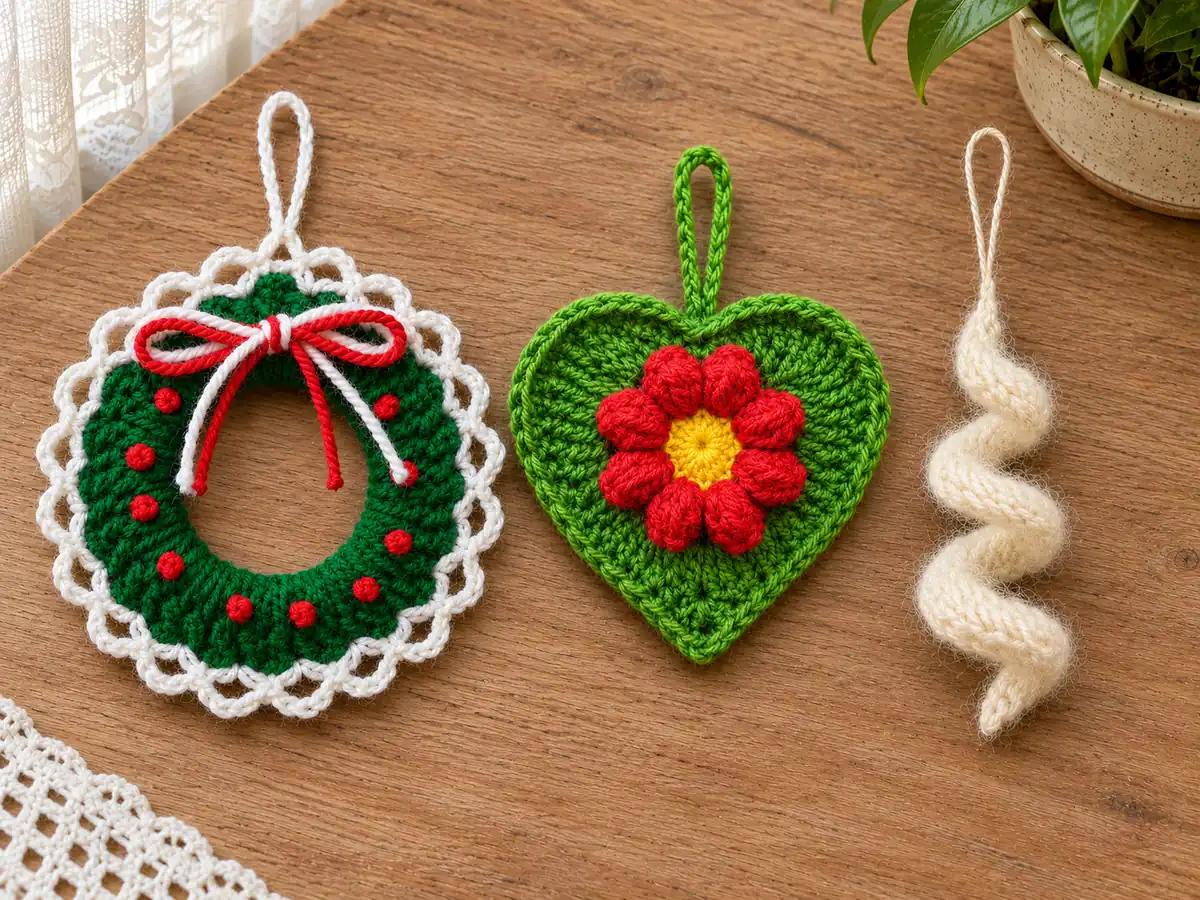
Small crochet Christmas wreath with a white looped border
This little wreath gets its entire ring from yarn. A chain and sc foundation supports a dense double crochet covering, then small chain arches form the white outer edge. Red French knots and a bow add decoration. No plastic or wooden core is required.

By Emma & EllaUpdated
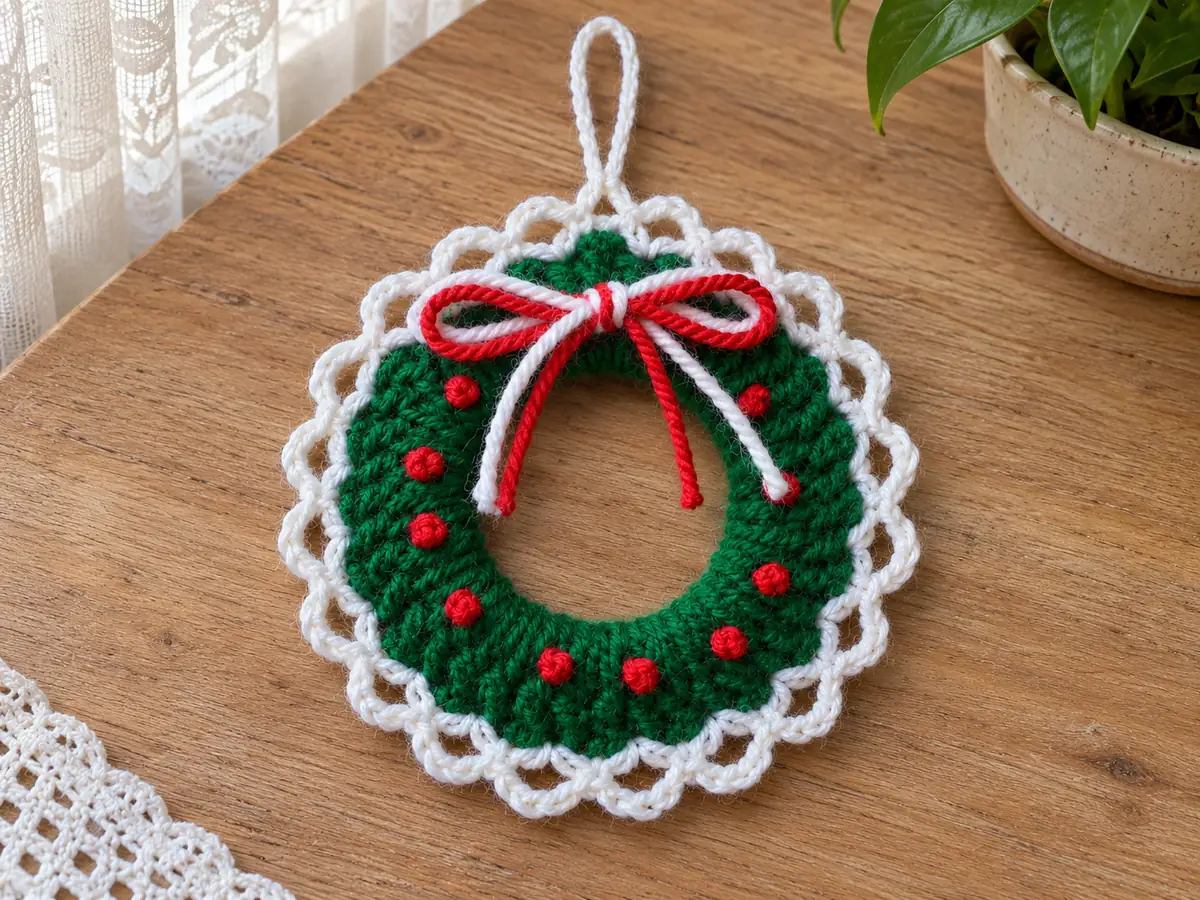
This little wreath gets its entire ring from yarn. A chain and sc foundation supports a dense double crochet covering, then small chain arches form the white outer edge. Red French knots and a bow add decoration. No plastic or wooden core is required.
Prepare the yarn, reference size and 3 design elements
Materials and reference diameter
Use worsted yarn in green, white and red, a 4 mm hook and a yarn needle. A fairly firm yarn is expressly recommended.
The source gives a diameter of 5 inches, approximately 12.7 cm, for the pictured yarn and hook. It supplies no graded smaller or larger size, fixed tension or completed hanging-loop height.
Measure your actual result rather than treating that reference as guaranteed for every substitute yarn. No gram or meter requirements are given.
Color roles and open center
Green forms the shown ring, white its chain-arch edge and red the embroidery. Other combinations are allowed; a yellowish ring with the same white edge is another illustrated possibility.
Plan the top for a bow and optional suspension. Red knots are distributed around the ring without a compulsory count or spacing.
The central hole stays open. No stuffing turns this ornament into a closed ball, and no glued backing is needed as a structural component.
US stitch glossary
Ch means chain and sl st means slip stitch. Sc means US single crochet. Dc means US double crochet.
For dc, yarn over, insert and collect a loop, then draw through 2 loops twice. Sc begins without the initial yarn over.
The sc foundation and taller dc covering have different jobs and are not combined into a single simplified round.
An even double crochet count for the edging
The source asks for approximately 40 dc or another suitable even number. It does not fix every wreath at exactly 40.
The outer arches later skip alternate dc positions. An even total lets that worked-and-skipped rhythm fit around the ring.
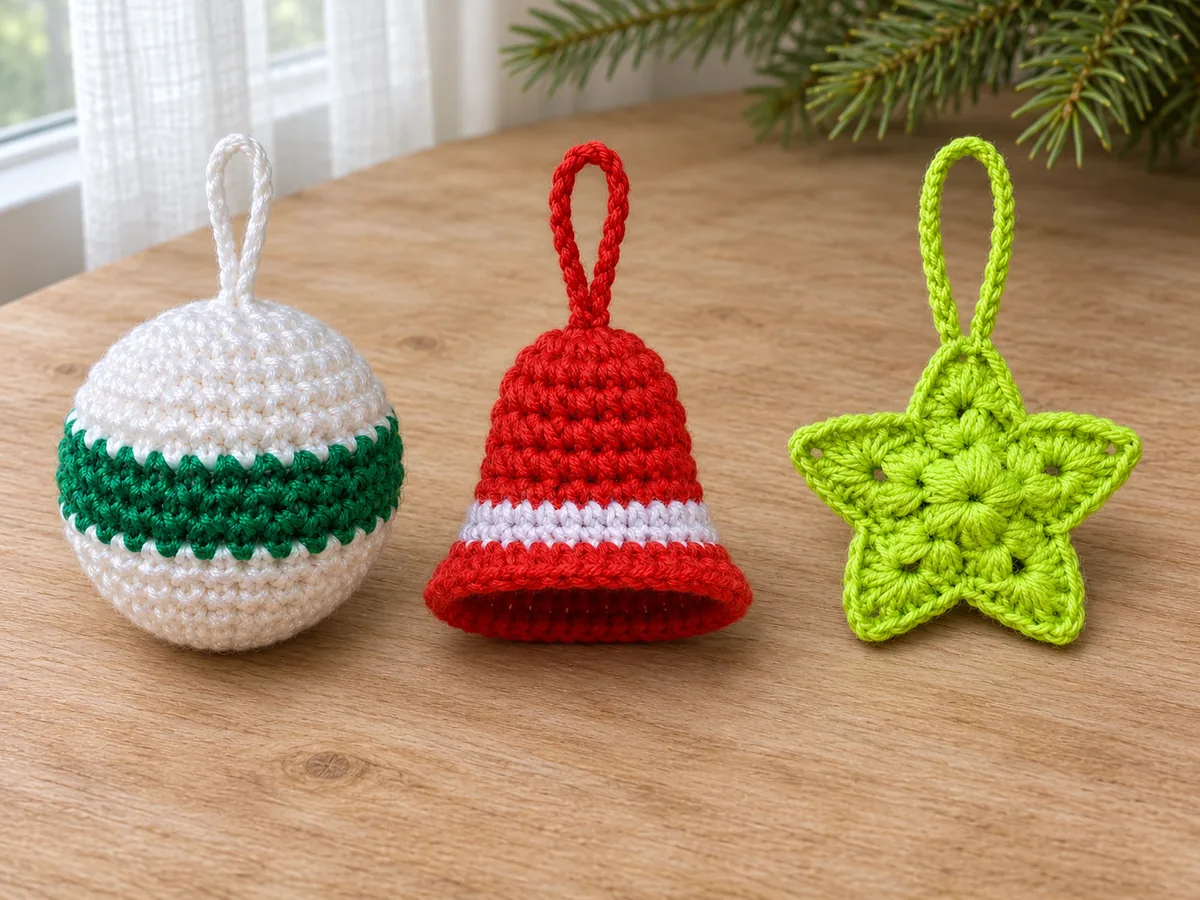
The small Christmas bell provides another ornament for a matching set.
Crochet the foundation ring and dense double crochet covering
Round 1: 20-chain ring
Work 20 ch in the ring color and join, checking the chain is untwisted. This foundation forms the inner circumference.
Do not tighten a magic ring closed: the wreath's central hole must remain. The joining slip stitch connects the chain ends without creating a long extra bridge.
Round 2: sc foundation
Work 2 ch and 1 sc in the same joining chain. Continue 1 sc in the next chain and 2 sc in the following chain around, then join to the top of the starting chain.
No separate final stitch total is supplied for this sc round. The precise counting role of the initial 2 ch beside the first sc is not explicitly defined as another sc.
Retain those stated operations rather than inventing a guaranteed total that the source does not print.
Round 3: approximately 40 dc around the ring
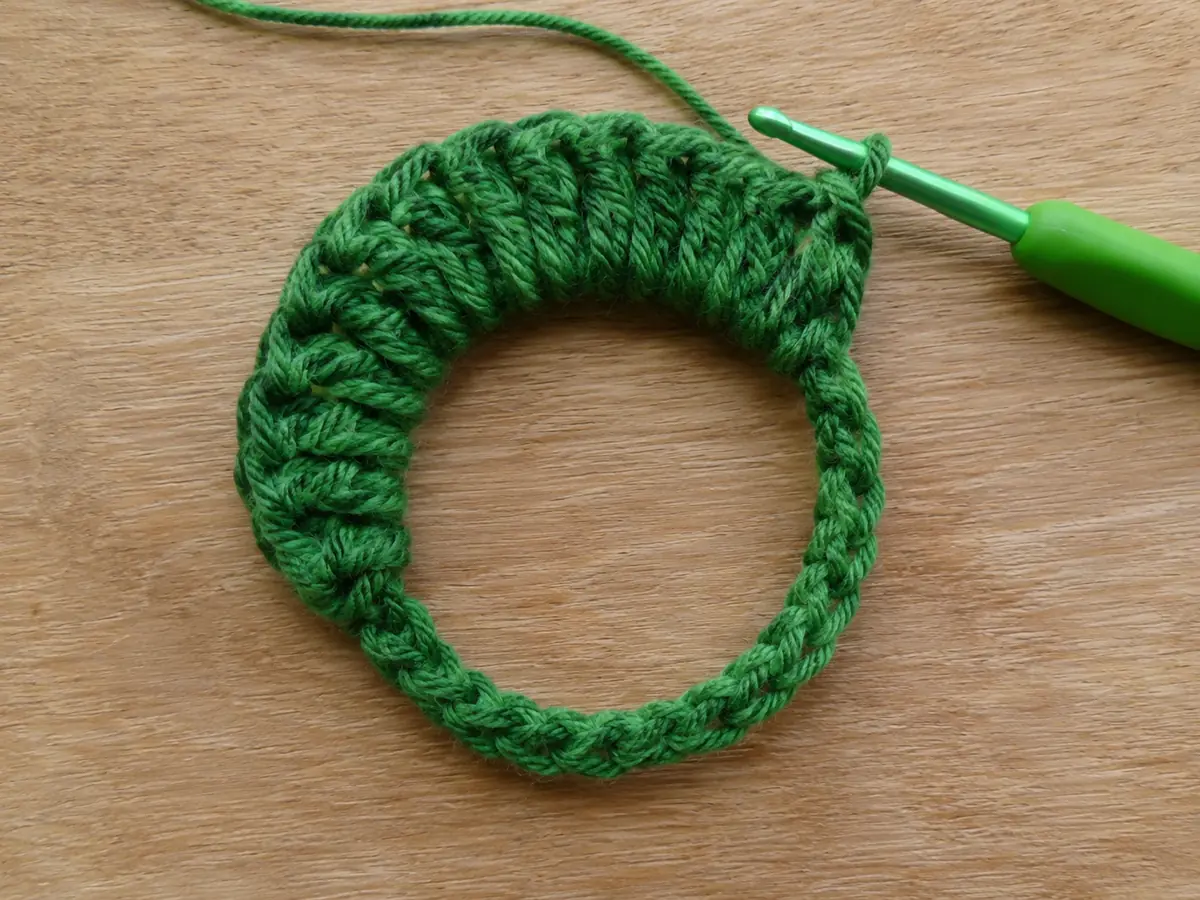
Work 2 ch, then approximately 40 dc over the prepared ring, or a suitable even quantity. Insert around the existing ring structure rather than exclusively placing 1 dc in every sc top.
Slide the covering stitches carefully beside one another as needed so they cover the foundation evenly. The actual ring thickness and your tension determine whether another even count is more suitable.
Do not keep adding stitches regardless of the surface. The covering should be dense and regular without bare areas or strong frilling, while preserving the central opening.
Sl st into the starting 2 ch and finish the ring yarn. That joining stitch is not another full dc position for the edging.
Check the covering before changing color
Count the actual dc and record the selected even total. The next round enters those upper stitch tops rather than again going around the whole foundation.
Lay the ring flat. If it waves strongly, inspect the covering quantity and tension first. The adjustable even count is intended to let the existing ring be covered smoothly.
An extra second dc round is not a stated correction; it would widen the ornament and alter the intended border foundation.
Keep loose ends along the ring rather than across its hole. A long strand spanning the center is usually an end routed across open space instead of hidden within the yarn structure.
Work the white chain arches and optional hanging loop
Border beginning
Join the border color in any dc. Work 3 ch and 1 sc in the same dc, then skip 1 dc.
The source begins this first anchor differently from its following complete groups. Preserve that beginning rather than silently inserting another initial sc.
Repeated arch groups
In the next stitch, work 1 sc, 3 ch and 1 sc. Skip 1 old dc and repeat this complete group around.
Join with sl st to the first sc. Each following full group has 2 sc anchors surrounding its 3-chain arch.
This is a looped chain border, not a conventional picot closed by an extra slip stitch back into the first chain. Do not add that unmentioned operation.
Even-count check
Each border group occupies 1 old dc and leaves the next unused. With 40 dc, the rhythm uses 20 anchoring positions.
Another even covering count produces a corresponding different number of arches. The source does not prescribe a new universal arch total independent of the actual ring.
If a final unpaired position remains, recheck the covering count and skipped stitches before adding an extra arbitrary arch at the join.
Optional 10–12-chain loop
After joining the border, work 10–12 ch and attach with sl st to the first sc. This suspension is optional.
The limits are chain counts, not centimeters. Choose within the stated range and inspect its upward position before cutting.
It should rise from the wreath's top rather than pulling together an opening elsewhere along the border.
Secure the border without flattening its arches
Weave the end through the solid white anchors and existing structure. Do not tighten a long hidden strand across several arches, which can flatten the airy edge on one side.
The red embroidery belongs on the double crochet surface afterwards, not in every white chain opening. Lay the ring flat again and distinguish the inner hole, dense covering and outer arches.
The popcorn-flower Christmas heart has a different decorative structure.
Embroider red French knots and add the bow
Carry embroidery between the ring layers
Work red French knots around the wreath. The source recommends carrying yarn between the ring's layers rather than passing fully to the reverse for every stitch.
Start at the top and retain longer beginning and ending yarn if using it for the bow. Neither the knot count nor exact intervals are fixed.
French-knot method without an invented wrap count
Bring the yarn to the front at the selected position. Wrap it around the needle and insert the needle near the exit point into the crochet surface.
Control the wrap while drawing the yarn through. The source does not state a compulsory number of wraps, so no additional fixed knot size is claimed.
Place knots where the dense ring provides support. The empty center and loose white arches are not the same structural surface as the green double crochet covering.
Keep the carried embroidery yarn relaxed
Look at each next location from the front before carrying the yarn beneath the surface. Short relaxed routes prevent a series of knots acting as a drawstring around the ring.
If a knot appears pulled inward, check tension between it and the previous embroidery point. Loosen a short carry rather than stretching the white border to compensate.
Red-and-white bow at the top
Add the pictured red-and-white bow. The long red embroidery ends can form its basis, with matching white yarn providing the additional color.
No fixed chain count for crocheted bow ties is supplied. The bow may be arranged from yarn strands and secured at the upper ring.
Its center decorates the suspension area; it does not replace a sound hanging-loop connection underneath.
Before finishing the red yarn, follow its route from knot to knot on the front and inspect the reverse after each short section. The source's between-layer method lets the color travel within the dense ring covering. It should not emerge as a straight visible line across the central opening or alongside every white arch.
Keep the ring's construction stages separate during this inspection. The 20-chain foundation establishes the hole, the sc round strengthens that foundation, the dc covering fills its surface and the white groups finish the outer contour. A decorative knot or bow cannot replace a missing connection in any of those earlier stages.
The approximate 40-dc quantity applies to the covering, not the initial chain. Working 40 foundation chains instead of 20 would change the inner circumference before the adjustable covering is even added. Conversely, placing only 20 dc because there were 20 foundation chains would ignore the instruction to cover the prepared ring densely.
The optional hanging chain also has a distinct count and purpose. Its 10–12 chains rise from the completed white border; they are not distributed as extra chains inside every arch. Check the chosen top while the ring lies flat so the loop and bow meet at the intended upper area.
For a coordinated pair, record the first wreath's actual even covering count before starting the second. Matching the material and that count gives a more useful comparison than copying an unspecified number of red knots. Both wreaths can retain the same foundation and border method while their decorative dots are arranged to suit the finished surface.
Final ring and attachment checks
Weave away remaining ends and inspect the original chain-ring join, double crochet closure and suspension anchor.
Lift gently by the loop and rotate to inspect the reverse. No red carrying yarn should cross the open center.
The wreath's form comes from firm yarn, dense covering and even edge tension. No additional rigid insert or glued back is specified.
Compare the outside circle and central opening. The 5-inch reference is not a reason to stretch an uneven stitch arrangement into a claimed size.
For another wreath, record the even dc total, actual yarn and loop length. Knot placement may vary because the source never fixes it.
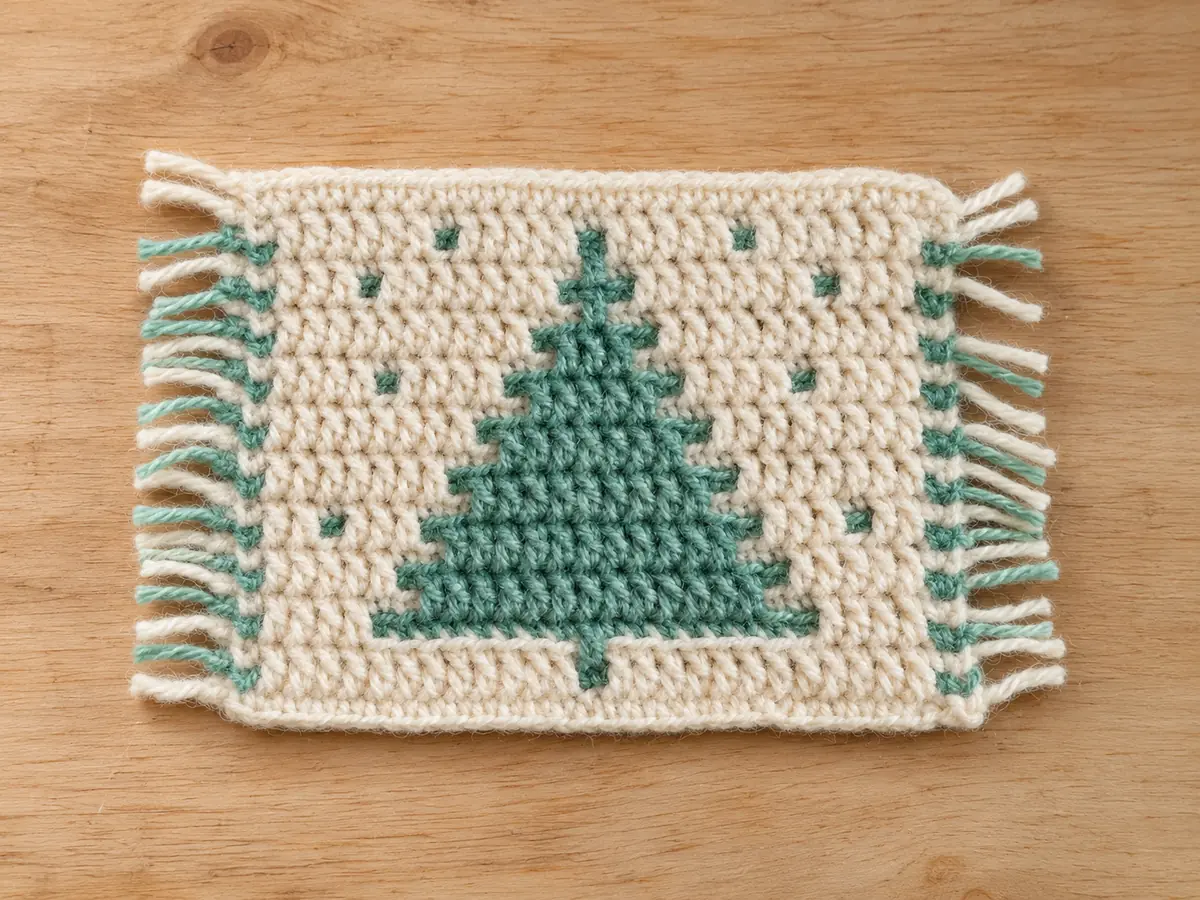
The decorative tree from a shell strip offers another coordinated Christmas shape.
Emma & Ella
More crochet projects from The Cooking Twins Yarn.
More from Emma & Ella