Crochet flower blanket with 10 petals and 3 shape options
This round flower blanket grows from the center in 10 connected petals. Raised post stitches form spokes between the petals. The entire blanket is made in 1 piece rather than assembled from separate motifs.

By Emma & EllaUpdated
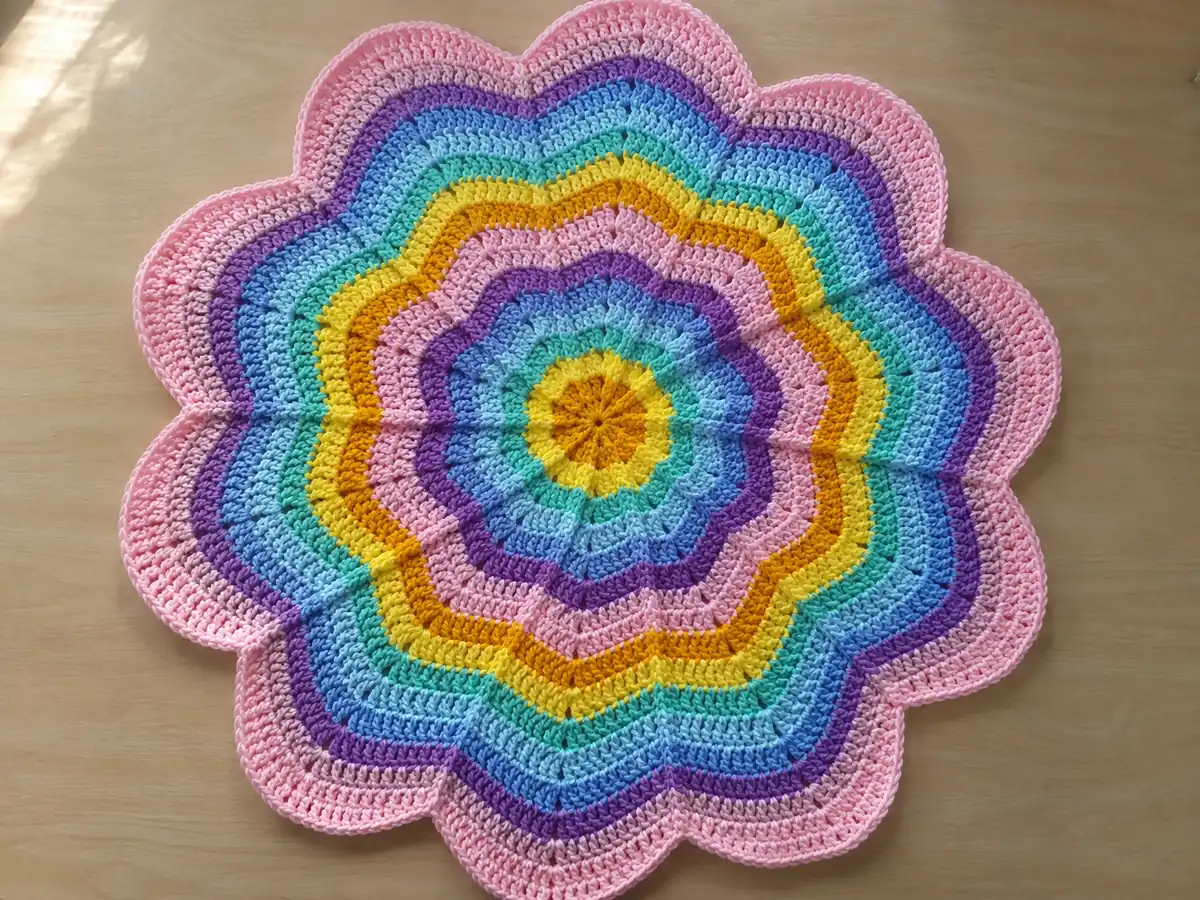
This round flower blanket grows from the center in 10 connected petals. Raised post stitches form spokes between the petals. The entire blanket is made in 1 piece rather than assembled from separate motifs.
Choose standard petals, more rounded petals or pointed star-like petals. All 3 options use the same 10-segment foundation. The reference has 40 pattern rounds in 8-ply acrylic with a 4 mm hook, measuring approximately 125 cm from tip to tip. Its later rounds use the more rounded option.
Prepare the US stitches and common rounds 1–5
Materials and working direction
Use yarn with clearly visible stitches, a suitable hook, yarn needle, scissors and 10 markers. Fiber and thickness can vary. No fixed overall gram quantity is supplied; allow enough yarn for the much longer outer rounds.
The example colors are gold, yellow, turquoise, sky blue, cornflower blue, purple, light mauve and pale pink. Keep the right side facing throughout: join rounds but do not turn. Mark each petal center.
| Term | US meaning |
|---|---|
| sc / hdc / dc | Single crochet / half double crochet / double crochet |
| Fphdc | Front-post half double crochet |
| Fpdc | Front-post double crochet |
| ch / sl st / BLO | Chain / slip stitch / back loop only |
For Fphdc, yarn over and insert front-to-back-to-front around the post, draw up yarn, then draw through all 3 loops. For Fpdc, begin similarly but draw through 2 loops twice. Keep the posts relaxed enough not to gather the blanket.
Starting chains count as the stated first stitch from round 2 onwards; the joining sl st does not count. Each round has 10 petals, meaning the separately described first petal plus 9 more. A supplementary reference to 7 petals conflicts with the full pattern and is not used.
Common foundation
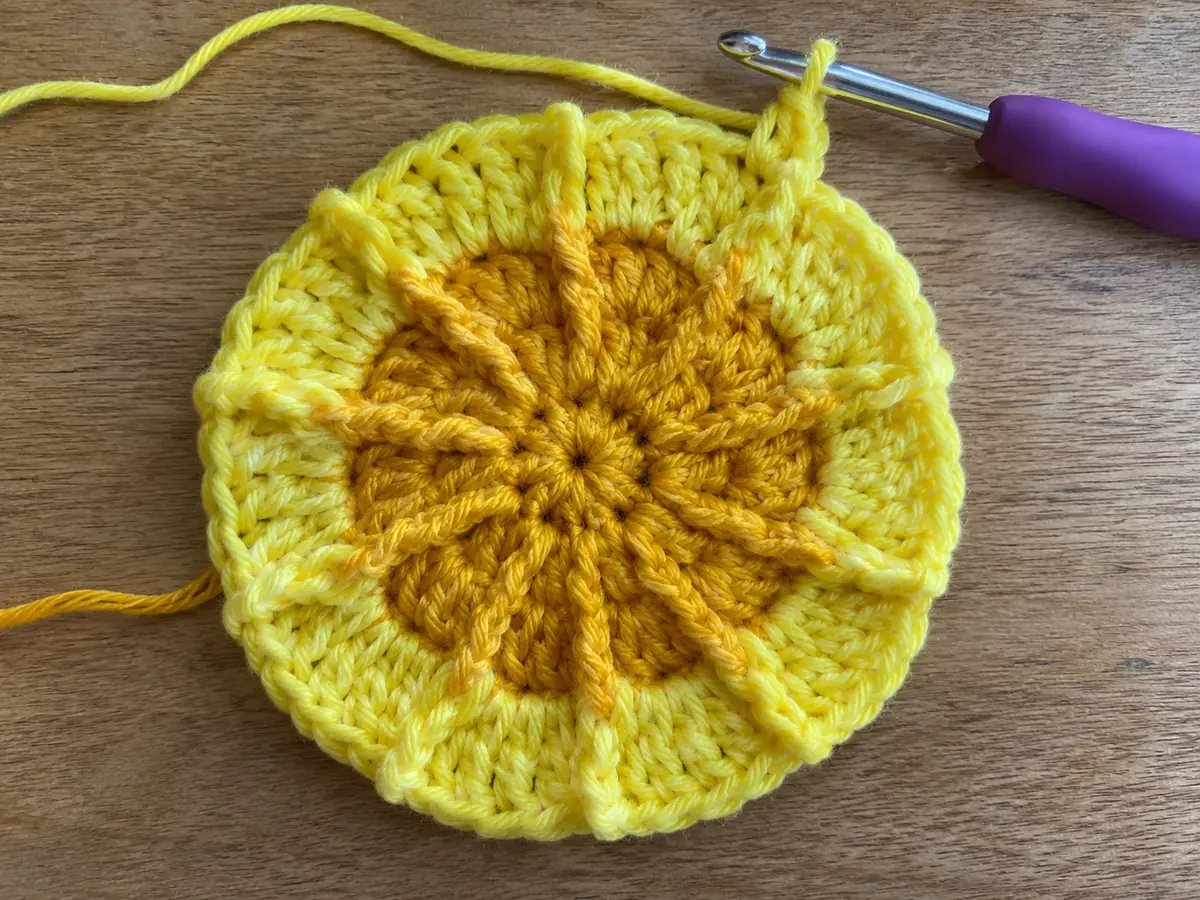
- Round 1: Make a yarn ring, or join 4 ch with sl st. Make 2 ch and 10 dc into the ring. Close and join to the first dc. Only here the 2 ch do not count. Total: 10.
- Round 2: Make 3 ch as first dc, 2 dc in the same first stitch; 3 dc in each remaining stitch. Join into the 3rd starting chain. Total: 30.
- Round 3: 3 ch as first dc, 1 dc in each next 2 stitches; additionally Fpdc around the post of the 3rd stitch just used. For each other group, 1 dc in each of its 3 stitches plus Fpdc around its 3rd post. Total: 30 dc + 10 Fpdc = 40.
- Round 4: Per segment, dc in first dc, 3 dc in middle dc, dc in third dc, Fpdc around previous post stitch. First dc is replaced by 3 ch. Work 10 segments. Total: 50 dc + 10 Fpdc = 60.
Common petal boundary and round 5
From here, move with an sl st into the next dc and make 2 ch as first hdc. This leaves the old petal’s first edge stitch unworked. Each petal has an hdc at either side, an unworked old stitch before the spoke and Fphdc around that spoke.
At subsequent petals, skip their first old edge stitch before working the first hdc. Those 2 skipped edge stitches per segment offset the central 3-stitch group on rounds without a net increase. Join each round into the 2nd starting chain.
- Round 5: After the first hdc, 3 dc in the middle petal stitch, 1 hdc in the next dc, skip the next edge stitch and Fphdc around the spoke. Repeat across 10 petals with the stated boundary. Per petal: 3 dc + 2 hdc + 1 Fphdc = 6; total: 60.
Follow the complete standard, rounded or pointed repeats
Option A: standard petals
- Round 6: Usual hdc boundary; 5 dc in the central stitch; finish with hdc, skipped edge stitch and Fphdc. Per petal: 8; total: 80.
- Round 7: Between boundary hdc stitches, work 3 dc in next stitch, 1 dc in center, 3 dc in next stitch. Per petal: 10; total: 100.
For later rounds, n is the number of individually worked double crochets on each side of the central increase area. Retain the same skipped-edge, hdc and post-spoke boundaries.
- NI, no net increase: After first hdc, 1 dc in each next n stitches, 3 dc in center, 1 dc in each next n stitches; finish the boundary.
- I1, first increase round: After first hdc, n individual dc, 5 dc in center, n individual dc; finish the boundary.
- I2, second increase round: After first hdc, n individual dc, 3 dc in next stitch, 1 dc in center, 3 dc in next stitch, n individual dc; finish the boundary.
| Standard round | Type | n |
|---|---|---|
| 8 | NI | 2 |
| 9 | I1 | 2 |
| 10 | I2 | 2 |
| 11 | NI | 4 |
| 12 | I1 | 4 |
| 13 | I2 | 4 |
| 14 | NI | 6 |
| 15 | I1 | 6 |
| 16 | I2 | 6 |
For each subsequent 3-round block, add 2 to n. More generally, for k starting at 0, rounds 8 + 3k, 9 + 3k and 10 + 3k use n = 2 + 2k. NI keeps the total unchanged; each increase round adds 20.
Option B: more rounded petals
Work rounds 1–7 exactly as option A, including the central 5-dc group in round 6 and 3-dc/1-dc/3-dc arrangement in round 7. Spread the increases differently only from round 8.
- Round 8, NI: Between hdc boundaries, 2 individual dc, 3 dc in center, 2 individual dc. Total: 100.
- Round 9, I1: Between boundaries, 1 dc, 3 dc in next stitch, 1 center dc, 3 dc in next stitch, 1 dc. Total: 120.
- Round 10, I2: Between boundaries, 3 dc in next stitch, 5 individual dc, 3 dc in next stitch. Total: 140.
From round 11, NI is the standard NI. Rounded I1 uses n individual dc, 3 dc in next stitch, 1 center dc, 3 dc in next stitch, n individual dc. Rounded I2 uses n individual dc, 3 dc in next stitch, 5 individual dc, 3 dc in next stitch, n individual dc.
| Rounded round | Type | n |
|---|---|---|
| 11 | NI | 4 |
| 12 | I1 | 3 |
| 13 | I2 | 2 |
| 14 | NI | 6 |
| 15 | I1 | 5 |
| 16 | I2 | 4 |
For k starting at 0, rounds 11 + 3k, 12 + 3k and 13 + 3k use n = 4 + 2k, 3 + 2k and 2 + 2k respectively. The totals match option A, allowing a switch at the corresponding round.
Option C: pointed star petals
Work rounds 1–6 as option A. In round 7, between the hdc boundaries work 1 dc, 5 dc in the center and 1 dc, giving 100 total stitches.
NI and I1 use the same central arrangements as option A. Pointed I2 instead uses n individual dc, 5 dc in center and n individual dc. Keep the usual boundaries.
| Pointed round | Type | n |
|---|---|---|
| 8 | NI | 2 |
| 9 | I1 | 2 |
| 10 | I2 | 3 |
| 11 | NI | 4 |
| 12 | I1 | 4 |
| 13 | I2 | 5 |
| 14 | NI | 6 |
| 15 | I1 | 6 |
| 16 | I2 | 7 |
Generally, rounds 8 + 3k, 9 + 3k and 10 + 3k use n = 2 + 2k, 2 + 2k and 3 + 2k. Continued use makes a more strongly star-shaped outline.
Check every round total and follow the example colors
Complete reference totals through round 43
| Round | Total stitches |
|---|---|
| 1 | 10 |
| 2 | 30 |
| 3 | 40 |
| 4 | 60 |
| 5 | 60 |
| 6 | 80 |
| 7 | 100 |
| 8 | 100 |
| 9 | 120 |
| 10 | 140 |
| 11 | 140 |
| 12 | 160 |
| 13 | 180 |
| 14 | 180 |
| 15 | 200 |
| 16 | 220 |
| 17 | 220 |
| 18 | 240 |
| 19 | 260 |
| 20 | 260 |
| 21 | 280 |
| 22 | 300 |
| 23 | 300 |
| 24 | 320 |
| 25 | 340 |
| 26 | 340 |
| 27 | 360 |
| 28 | 380 |
| 29 | 380 |
| 30 | 400 |
| 31 | 420 |
| 32 | 420 |
| 33 | 440 |
| 34 | 460 |
| 35 | 460 |
| 36 | 480 |
| 37 | 500 |
| 38 | 500 |
| 39 | 520 |
| 40 | 540 |
| 41 | 540 |
| 42 | 560 |
| 43 | 580 |
The supplied table jumps incorrectly from round 36. After round 35 at 460, another increase of 20 gives 480, not 500. The corrected totals above preserve the written stitch arrangements. The 40-round example therefore has 540 stitches at round 40.
Also count individual petals. Each has its assigned spoke, so divide the total by 10. At 140 total, every segment has 14 stitches including that spoke. Check both skipped edge stitches before changing the central increases.
40-round example color plan
| Example round | Color | Petal form |
|---|---|---|
| 1 | Gold | Standard |
| 2 | Gold | Standard |
| 3 | Yellow | Standard |
| 4 | Yellow | Standard |
| 5 | Turquoise | Standard |
| 6 | Turquoise | Standard |
| 7 | Sky blue | Standard |
| 8 | Sky blue | Standard |
| 9 | Cornflower blue | Standard |
| 10 | Cornflower blue | Standard |
| 11 | Purple | Standard |
| 12 | Purple | Standard |
| 13 | Light mauve | Standard |
| 14 | Light mauve | Standard |
| 15 | Pale pink | Standard |
| 16 | Pale pink | Standard |
| 17 | Gold | Standard |
| 18 | Gold | Standard |
| 19 | Gold | Standard |
| 20 | Yellow | Standard |
| 21 | Yellow | Standard |
| 22 | Yellow | Standard |
| 23 | Turquoise | Standard |
| 24 | Turquoise | Standard |
| 25 | Turquoise | Standard |
| 26 | Sky blue | Standard |
| 27 | Sky blue | Standard |
| 28 | Sky blue | More rounded |
| 29 | Cornflower blue | More rounded |
| 30 | Cornflower blue | More rounded |
| 31 | Cornflower blue | More rounded |
| 32 | Purple | More rounded |
| 33 | Purple | More rounded |
| 34 | Purple | More rounded |
| 35 | Light mauve | More rounded |
| 36 | Light mauve | More rounded |
| 37 | Light mauve | More rounded |
| 38 | Pale pink | More rounded |
| 39 | Pale pink | More rounded |
| 40 | Pale pink | More rounded |
Use standard petals through round 27, then the more rounded form from round 28 onward. A pale-pink final edge is optional. For a similarly rounded appearance, move to option B by the final half to final third of the blanket.
You may start color changes at different petals to avoid stacking all joins into a visible line. Retain the correct start at the first worked hdc position, not in the edge stitch meant to be skipped.
Choose optional starts, texture and a suitable finish
Alternative stacked starting stitches
Except in round 1, the 2 starting chains can be replaced by a stacked hdc substitute: without an initial chain, work 1 sc in the first stitch, then another sc in the front loop of that sc without an added chain.
The stated dc substitute is 1 ch, sc in the first stitch, 1 ch, then sc into the front loop of the sc just worked. Join into the upper second sc. Use the selected starting method consistently.
Optional extra ribbing
Normal hdc and dc can be worked in BLO or into the third loop behind the top 2 loops. Keep the right side facing, tilting the fabric slightly to locate that third loop. The raised spokes still wrap their posts.
- Work all ordinary stitches in BLO.
- Alternate 1 BLO round with 1 third-loop round.
- Repeat normal, BLO and third-loop rounds in a 3-round sequence.
- For color emphasis, use the third loop only on the first round of a new color, then work normally.
- Another option begins with 4 normal rounds, then color blocks of 3 rounds from round 5: third loop, BLO, BLO. The source wording for the third round is inconsistent; this version explicitly chooses BLO.
The reference example uses normal stitches without additional ribbing. Optional textures change the surface, not the required petal count or central shaping sequence.
Edging, shape and care
A restrained finish is an sl st round in BLO. Reverse sc, a twisted spin-stitch edge or small shells are other suggested alternatives, not instructions to stack all finishes together. Test a chosen edge across a petal before committing around the whole blanket.
If tips curl strongly after an I2 round, assess a slightly larger hook or looser tension. If fabric accumulates in the valleys, assess a smaller hook or firmer tension. Correct a wrong repeat rather than relying on blocking to replace missing skipped stitches.
Weave ends on the reverse with changes of direction. Wash according to the yarn label and shape gently while damp if suitable. The round rainbow ripple blanket offers another circular outline, while the mixed-stitch blanket uses straight bands.
For separate motifs, see the square blanket; for a raised field texture, see the waffle baby blanket. Keep each design’s own counting rules distinct.
Emma & Ella
More crochet projects from The Cooking Twins Yarn.
More from Emma & Ella