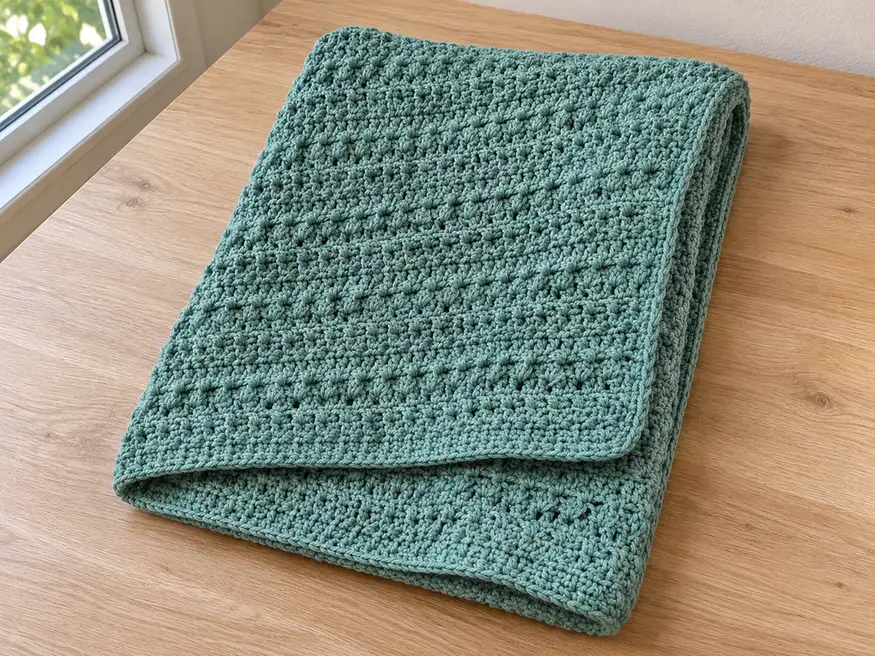
Dense crochet baby blanket with alternating stitches
This small baby blanket gets its texture from alternating short single crochet and taller double crochets. In the following row, the stitches sit in the opposite arrangement. The result is a compact fabric without deliberately added chain-window rows, although any crochet fabric still contains

By Emma & EllaUpdated
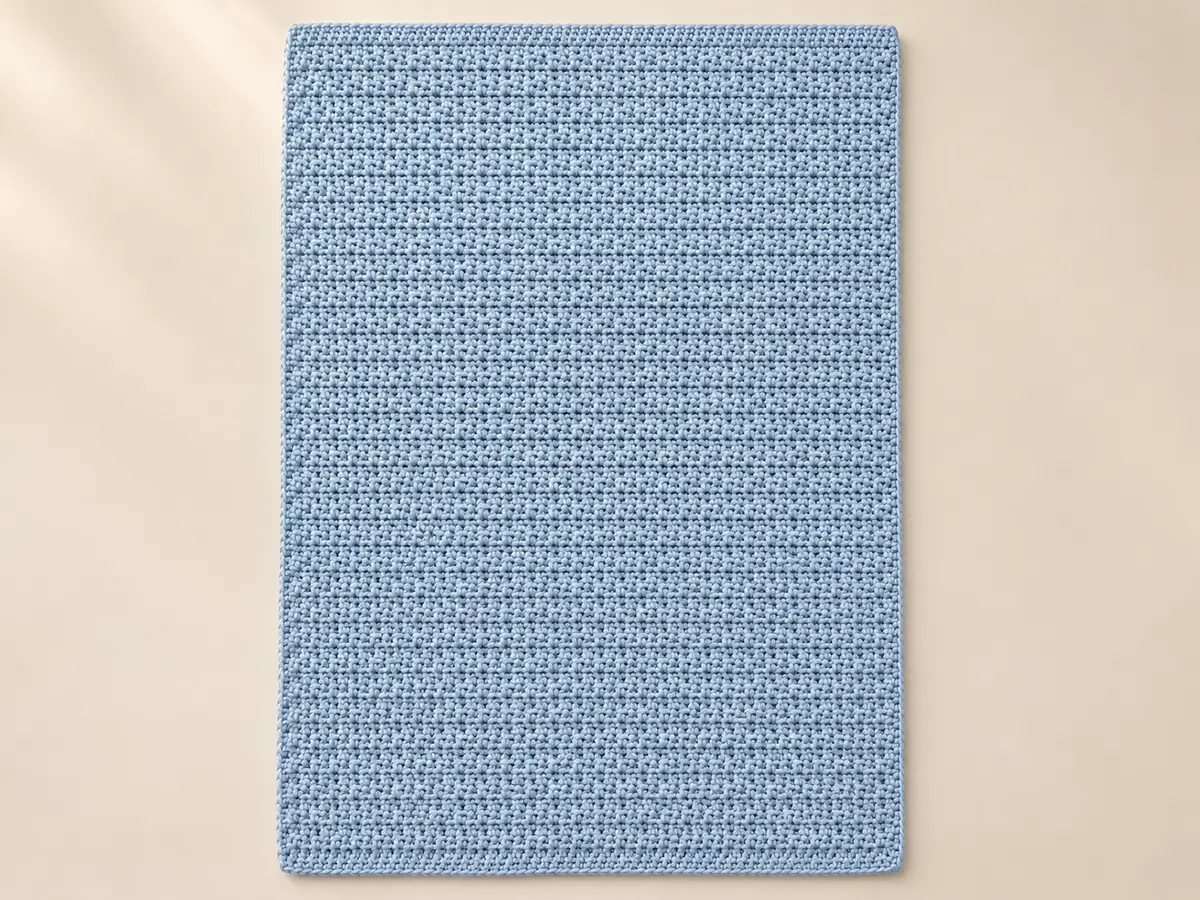
This small baby blanket gets its texture from alternating short single crochet and taller double crochets. In the following row, the stitches sit in the opposite arrangement. The result is a compact fabric without deliberately added chain-window rows, although any crochet fabric still contains small spaces between its stitches.
The reference blanket measures approximately 40 × 60 cm and starts with 50 foundation stitches. Plain rows frame the beginning and end, while the long sides depend on neat turning. There are no separate appliqués or surrounding lace border.
Prepare the yarn, sample and US stitch terms
Materials and quantity limitation
| Item | Reference |
|---|---|
| Yarn | 8-ply / DK; light worsted is also given as an approximate US description |
| Hook | 5.5 mm |
| Other tools | Scissors, yarn needle and preferably 2 edge markers |
| Finished size | Approximately 40 × 60 cm |
| Foundation count | 50 stitches |
Yarn categories are not exact substitutes for one another. Compare the chosen yarn’s length and fabric rather than relying only on an English weight label. Select a soft yarn with clear care instructions for regular use.
No reliable total yarn weight or meter quantity is supplied. Estimate from an adequately sized sample, weighing it and comparing its area with the intended blanket area. Add a reserve for the finishing rows and your own tension.
Buy any additional ball from the same dye lot where possible. A slightly different shade is particularly visible in an otherwise plain-colored project. Measure the sample after the planned wash and complete drying.
US crochet glossary
| Term | US meaning |
|---|---|
| ch | Chain |
| sc | US single crochet |
| hdc | US half double crochet |
| dc | US double crochet |
| Foundation sc | A foundation chain and single-crochet row made together |
The short stitch is US sc and the taller pattern stitch is US dc. The plain transverse rows use hdc. Reading the terms as UK abbreviations would change the stitch heights and therefore the texture.
A sc has no initial yarn over. A dc begins with a yarn over and finishes with 2 successive pull-throughs of 2 loops. An hdc also starts with a yarn over but finishes by drawing through all 3 loops together.
Make the 50-stitch foundation and plain starting edge
Foundation single crochet step by step
- Make 2 ch.
- Insert into the 2nd chain from the hook and draw up a loop.
- Draw the yarn through 1 loop to create the new lower foundation loop.
- Yarn over and draw through both remaining loops to complete the first foundation sc.
- For the next stitch, insert into the newly formed lower foundation loop, preferably under both strands.
- Draw up a loop, draw through 1 loop for the next foundation, then draw through both loops for the sc.
- Continue until there are 50 completed foundation sc.
Count the upper V-shaped stitch tops. The initial helper chains are not extra foundation stitches. Mark the lower foundation loop if the next insertion point is difficult to recognize.
The lower edge should remain flexible rather than pulling tightly together. Avoid tightening every new lower loop into a tiny knot. If the technique is unfamiliar, make a separate 10-stitch sample before starting the full width.
Beginning rows
- Row 1: The 50 foundation sc just completed. Make 2 ch and turn.
- Row 2: Work 1 hdc into each of the 50 stitches. Make 1 ch and turn.
For row 2, start in the first real stitch at the foot of the turning chain and include the final foundation stitch. The turning chains are not a 51st stitch. Move markers into the first and last true stitches of the new row.
The hdc row makes a quiet transverse line before the textured section. It is not the beginning of an all-round border. The long edges remain the ends of the turned pattern rows, so consistent first and last stitches matter.
Repeat the alternating pattern and work the final rows
Pattern row
- Row 3: Work [1 sc, 1 dc] 25 times across the 50 stitches.
- Confirm that the first stitch is sc and the final stitch is dc.
- Make 1 ch and turn.
- Each subsequent pattern row: Repeat row 3, maintaining 50 stitches.
Every new row starts with a sc. Because the previous row ended with a dc and the work has turned, the new sc sits over a dc. The next dc sits over a sc, keeping the stitch heights offset.
Insert through the usual 2 top loops for both stitches. Back-loop-only work or post-stitch insertion is not part of this pattern. Check the 50 stitches and the final dc after each row.
The shorter stitch slightly draws down the taller stitch beneath it, creating the compact texture. Do not stretch the top edge forcefully after every row. Let several rows settle, then inspect the relaxed fabric for even growth.
Complete the ending edge
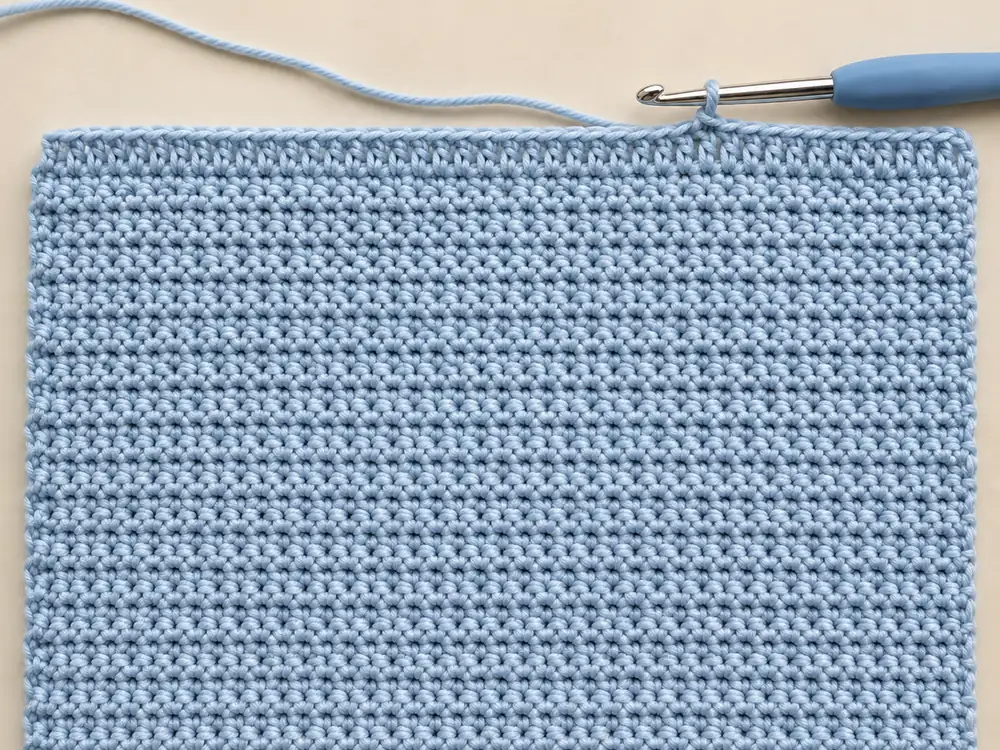
- After the final pattern row: Make 2 ch rather than the usual 1 ch, and turn.
- Finishing row 1: Work 1 hdc into each of the 50 stitches. Make 1 ch and turn.
- Finishing row 2: Work 1 sc into each of the 50 stitches.
- Cut the yarn with a sufficient tail and draw it through the final loop.
Weave the end through the stitches without gathering the edge. The hdc-and-sc ending complements the plain beginning. No additional shell border belongs to this version.
Lay the blanket on a level surface and check its rectangle. If a side is noticeably longer, first inspect the turning and the counts. Strong blocking cannot reliably repair a repeatedly missed or added edge stitch.
Changing width and length
The approximate width of 40 cm over 50 stitches implies about 12.5 stitches per 10 cm by calculation. This is a derived reference, not a separately measured gauge supplied for the pattern.
For a different width, retain an even stitch count so that each row ends with a dc. Round a calculated count to a suitable even number and check it in a sample. Length is adjusted through complete pattern rows.
Allow room for the final 2 finishing rows in the target length. Stopping the textured section at exactly 60 cm makes the completed blanket longer after those rows are added.
Keep the edges straight and care for the finished fabric
Check the first and last stitches
If a row starts accidentally with a dc, identical stitch types may stack rather than alternate. The fabric can look more striped and drape differently. Check the first few stitches aloud or against a note: sc, dc, sc, dc.
A sloping edge often comes from missing the first true stitch or adding a stitch into the turning chain. Count the whole row to 50 rather than checking only a familiar group in the center.
Markers help preserve the real edges, especially after a break. Move them to the new first and last stitches every row. A marker left in an earlier row can be mistaken for the current edge and cause another omission.
Yarn joins and fabric checks
Leave enough tail when changing balls to weave through several stitches. Inspect the reverse for loose loops. Avoid using a tight knot as a substitute for securing the ends within the fabric.
Compare the relaxed width after several rows rather than pulling it to the target measurement each time. A foundation that is too tight can narrow the beginning even when every later row has 50 stitches. Review the foundation technique rather than adding random increases to compensate.
Keep a written record of the last completed pattern row and the measured length. This makes it easier to plan the final transverse rows without repeatedly guessing where the pattern section should stop.
Different blanket structures
The corner-to-corner baby blanket uses open diagonal blocks rather than this dense alternating fabric. The waffle baby blanket has a more pronounced raised structure.
For a later project with several colors and stitches, try the mixed-stitch blanket. Each design has its own repeat conditions and edge construction; do not transfer those counts into this 50-stitch version.
The even-count rule can be checked without adding a new size pattern. Each pair uses 2 stitches, so the basic 50-stitch row contains 25 complete pairs. Any chosen even width can likewise be divided into complete pairs. An odd width would leave an unmatched stitch and change the stated end-of-row arrangement.
That count check works together with the stitch-height check. Ending in dc is useful evidence that the alternating sequence has reached its intended position, but it does not replace counting the row. Accidentally omitting a full pair would still leave the same final stitch type while reducing the width.
When learning foundation sc, keep its lower loops and upper stitch tops visually separate. The lower loop forms the flexible base; the upper V is where the following row is worked. Pulling the lower loop closed before making the next stitch makes the insertion difficult and can tighten the edge unevenly.
Try folding the sample gently after washing to assess whether the fabric feels suitable for the planned blanket. The reference hook gives a starting point, while the actual drape and care properties come from the selected yarn and tension. Recheck the sample dimensions after any hook change.
Before finishing, compare the plain beginning and ending across their full width. They should contain the same 50 stitch positions even though the final row uses sc rather than hdc. Weave the last tail with the edge lying flat so that the finishing action does not pull an otherwise straight row into a gathered corner.
Keep the project notes with the remaining yarn until the blanket is complete. The recorded hook, foundation count and finishing-row plan help distinguish an intentional size adjustment from a forgotten row when returning after a pause.
Cleaning and intended use
Follow the yarn label and dry flat if required. Support the wet fabric so its weight does not stretch the edges. Inspect the woven ends after cleaning and let the blanket dry completely before storing.
For a baby, choose appropriate washable yarn and assess the intended use. The description of a dense pattern is not a safety certification. Avoid long ties, large buttons or loose ornaments, and follow an appropriate safe sleeping arrangement.
Emma & Ella
More crochet projects from The Cooking Twins Yarn.
More from Emma & Ella