Granny ripple crochet blanket in colorful zigzag rows
A granny ripple blanket combines familiar groups of 3 double crochets with a zigzag outline. Peaks contain 2 groups around a chain arch, while a gap is left empty at each valley. The waves are formed while crocheting: there are no separate squares to sew together and no straight stripes that must

By Emma & EllaUpdated
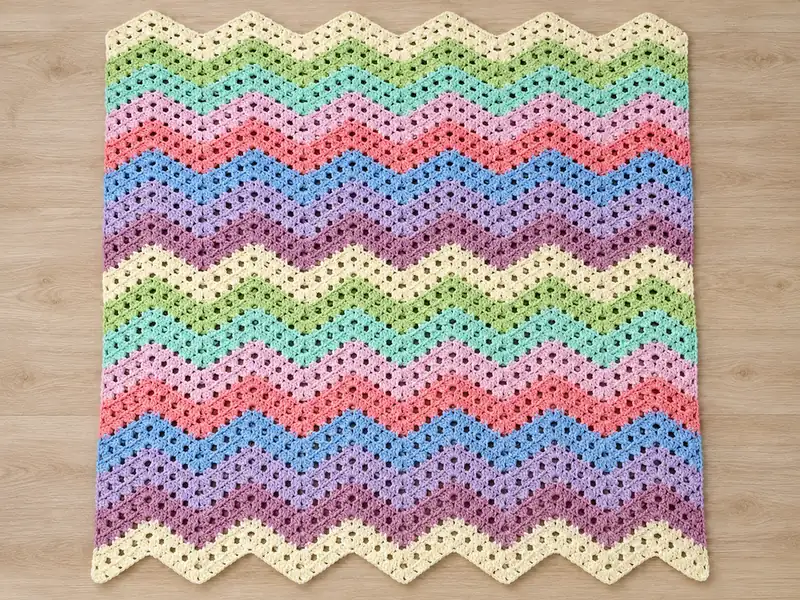
A granny ripple blanket combines familiar groups of 3 double crochets with a zigzag outline. Peaks contain 2 groups around a chain arch, while a gap is left empty at each valley. The waves are formed while crocheting: there are no separate squares to sew together and no straight stripes that must later be forced into waves.
The example changes color every 2 rows across the full width. Its short ends retain their peaks and valleys after a single-crochet finishing row. US terminology is used throughout, including US double crochets for the main groups.
Prepare yarn, measurements and the US glossary
Reference size and materials
| Item | Reference |
|---|---|
| Blanket size | Approximately 89 × 124 cm / 35 × 49 inches |
| Hook | 5 mm |
| Yarn | Washable worsted-weight yarn |
| Supply | 16 balls of 50 g: 800 g total |
| Colors | 2 balls each of 8 colors |
The color sequence can include cream yellow, light green, mint, pale pink, brighter pink, blue, lilac and mauve. Choose a yarn that gives an even, flexible fabric rather than relying on a particular brand or color name.
Prepare scissors, a blunt yarn needle, measuring tape and markers. Record the hook and yarn used, especially when planning to return to the project after a break. Matching dye lots reduce visible changes within a broad stripe.
US crochet terms
| Term | Meaning |
|---|---|
| ch | Chain |
| sc | US single crochet |
| dc | US double crochet |
| Group or cluster here | 3 separately completed dc in the same position, not 3 dc worked together |
The word cluster in this design refers to a group, not an unfinished-stitch bobble. Complete each double crochet separately. The 5 chains at the row end also form the edge arch for the next row.
Do not insert a chain between every ordinary group simply because another granny pattern does so. This construction uses chains specifically at the peaks and outer row edges.
Measure a complete ripple
Make a sample using the intended yarn and hook, then measure after the planned wash and complete drying. Fibers can soften or stretch, so a newly crocheted sample may not represent the finished blanket.
Record both dimensions and sample weight if estimating a different size. Keep a reserve for the finishing rows. Mark peaks or checked repeats to help locate an error, but continue counting rather than treating markers as a substitute.
Work the foundation and the first zigzag row
Foundation formula
| Version | Foundation |
|---|---|
| General rule | A multiple of 18 plus 6 ch |
| Large example | 168 ch = 9 × 18 + 6 |
| Small sample | 24 ch = 1 × 18 + 6 |
| Indicative ripple width | Approximately 10 cm in the described sample |
The large example has 9 ripple repeats. The 10 cm repeat width is an indication rather than a fixed gauge for every worsted yarn. Measure a whole wave, keeping its outer arches relaxed rather than stretching them straight.
For the sample, work the foundation row and enough repeat rows to reach approximately 10 cm in height. If the fabric feels too stiff, choose the hook based on the fabric and measure again before deciding how many repeats the blanket needs.
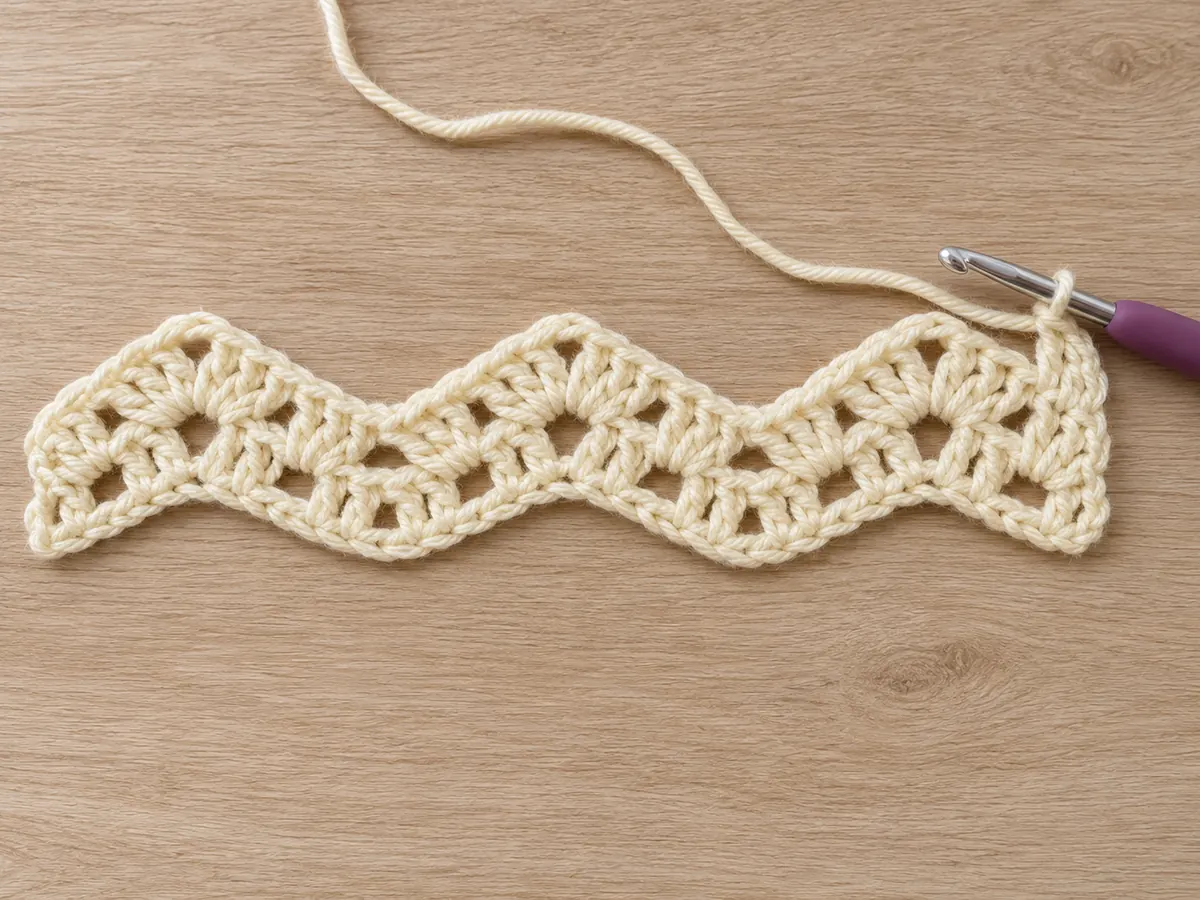
Foundation row, in working order
- Work 3 dc into the 6th chain from the hook.
- Twice: skip 2 chains and work 3 dc into the next chain.
- Skip 5 chains for the valley.
- Twice: work 3 dc into the next chain, then skip 2 chains.
- In the following chain, work 3 dc, 3 ch and 3 dc for the peak.
- Repeat the sequence from step 2 to the end of the foundation.
- Make 5 ch and turn.
Notice the different order before and after the valley. Before it, you skip chains and then place the group. After it, you place the group and then skip chains. Following this order prevents the insertion points from gradually shifting along the foundation.
The 5 skipped chains establish the low part of the wave, while the group–arch–group combination makes a peak. Keep both features distinct. Filling the valley because it appears to be an unused section changes the pattern.
Repeat the granny wave and change color
Pattern row
- Work 3 dc into the first 3-chain space.
- Work 3 dc between the next groups, 2 times.
- Leave the next gap between groups completely unworked for the valley.
- Work 3 dc between the following groups, 2 times.
- In the next peak space, work 3 dc, 3 ch and 3 dc.
- Repeat the wave sequence across the row.
- At the outer edge, work the peak combination into the previous 5-chain edge arch.
- Make 5 ch and turn.
Repeat this pattern row until the desired length. Each normal group is inserted between groups, while the peak combination goes into its chain arch. Keep the valley gap empty on every row.
The rectangular granny blanket grows from the center with different corner rules. Those corner rules do not apply to this row-based wave pattern.
Color changes every 2 rows
Work 2 rows in each color before changing. Check that every wave has its rise, peak, descent and skipped valley before beginning the next stripe. A filled valley can alter the width of all subsequent rows.
Unless the row start specifies otherwise, finish the last pull-through of the old color with the new yarn. Leave long enough ends to weave through several stitch paths later, preferably within the matching color.
Keep a small color card and write the last fully completed row after each session. Recording only the next color can leave you unsure whether the second row of a stripe has been finished.
Check width while the work grows
Lay the blanket flat regularly. The zigzag edge is intentional, but a whole side becoming narrower or a strong cup across the fabric deserves inspection. Check insertion spaces, turning arches and repeat numbers before pulling on the work.
Compare the same points on neighboring waves. If 1 peak is offset, inspect its preceding valley and group placements rather than immediately undoing every color stripe. Marked repeats can limit the section that needs to be checked.
Finish both wave edges and care for the blanket
Final short-edge row in US single crochet
After the final 2 pattern rows, keep the yarn attached. Turn and use sc rather than dc for the finishing row:
- Work 3 sc into the 5-chain edge arch.
- Work 3 sc into the next gap, 2 times.
- Skip the following valley gap.
- Work 3 sc into the next gaps, 2 times.
- Work 6 sc into the peak arch, without chains between them.
- Continue across the wave repeats.
- At the final wave, work the 2 groups before the valley, skip its gap and work the 2 groups after it.
- Work 6 sc into the final 5-chain edge arch.
- Cut and secure the yarn.
Rejoin the original first color at the foundation edge and finish that short wave edge correspondingly in sc. The long sides do not receive an additional surrounding border in this version.
These rows organize the wave groups without straightening them. Do not fill valleys with taller stitches: that would be a different edge construction. Compare both short ends before weaving the final tails.
Weave and dry without forcing the shape
Weave tails in several directions through suitable stitches. A short knot alone is not a secure finish for a frequently washed blanket. Inspect both sides for loose strands and make sure the edge arches remain flexible.
Wash according to the yarn label and dry in shape, flat where appropriate. Support the wet fabric rather than lifting its full weight from a narrow edge. Pins should align it gently, not force a counting error into the desired size.
Strong heat, ironing or steaming is not a universal repair method. Some fibers can change permanently. Keep the care information with a small yarn sample if giving the blanket away.
When planning a different width, use the complete repeat formula rather than adding a few chains to the existing example. The extra 6 chains establish the starting arrangement; they are not another partial ripple. Work a small sample first so that the chosen repeat count can be related to your own relaxed wave width.
Likewise, length is controlled by completed pattern rows, with the color rhythm built in pairs. Decide how the final color should relate to the first stripe before the yarn supply becomes low. Set aside enough of the original first color to finish its foundation edge, since that finishing row is worked later rather than at the beginning.
If you interrupt the foundation row, mark the last fully completed peak or valley. Resuming from a familiar landmark is easier than trying to recognize a half-completed instruction in a long chain. Check whether the next action is a skip followed by a group or a group followed by a skip; the order changes across the valley.
In later rows, count the groups between the valley and peak instead of counting only the individual double crochets. A correctly made group still produces an error when placed in the wrong gap. Looking at the group arrangement helps distinguish a stitch-making problem from an insertion-space problem.
The finishing row needs the same attention. Its 6 sc at a peak are a continuous group, with no chain arch between them. Adding the 3 chains used in the main pattern would recreate a different tip and move the edge away from the specified finish. Keep the sc finishing instructions separate from the dc pattern row in your notes.
Before storing the blanket, check that the center of the fabric is completely dry, not only the exposed edges. Fold without pressing the waves into sharp creases and keep the yarn label available for future cleaning. These simple habits preserve the flexible drape that makes the ripple groups visible.
Other structures and intended use
The waffle baby blanket gives a more textured surface, while the square blanket uses separate motifs. A cuddly rabbit can be a separate accompanying project.
For baby use, choose suitable washable yarn, secure ends carefully and avoid loose ribbons or small embellishments. The blanket’s size, weight and use must suit the situation; an open crochet blanket does not replace a safe sleeping arrangement.
Emma & Ella
More crochet projects from The Cooking Twins Yarn.
More from Emma & Ella