Granny square with alternating solid and eyelet bands
This granny square alternates solid double crochet rounds with open eyelet bands. Unlike an open grouped granny square, the solid sides are made from individual double crochets placed beside each other.

By Emma & EllaUpdated
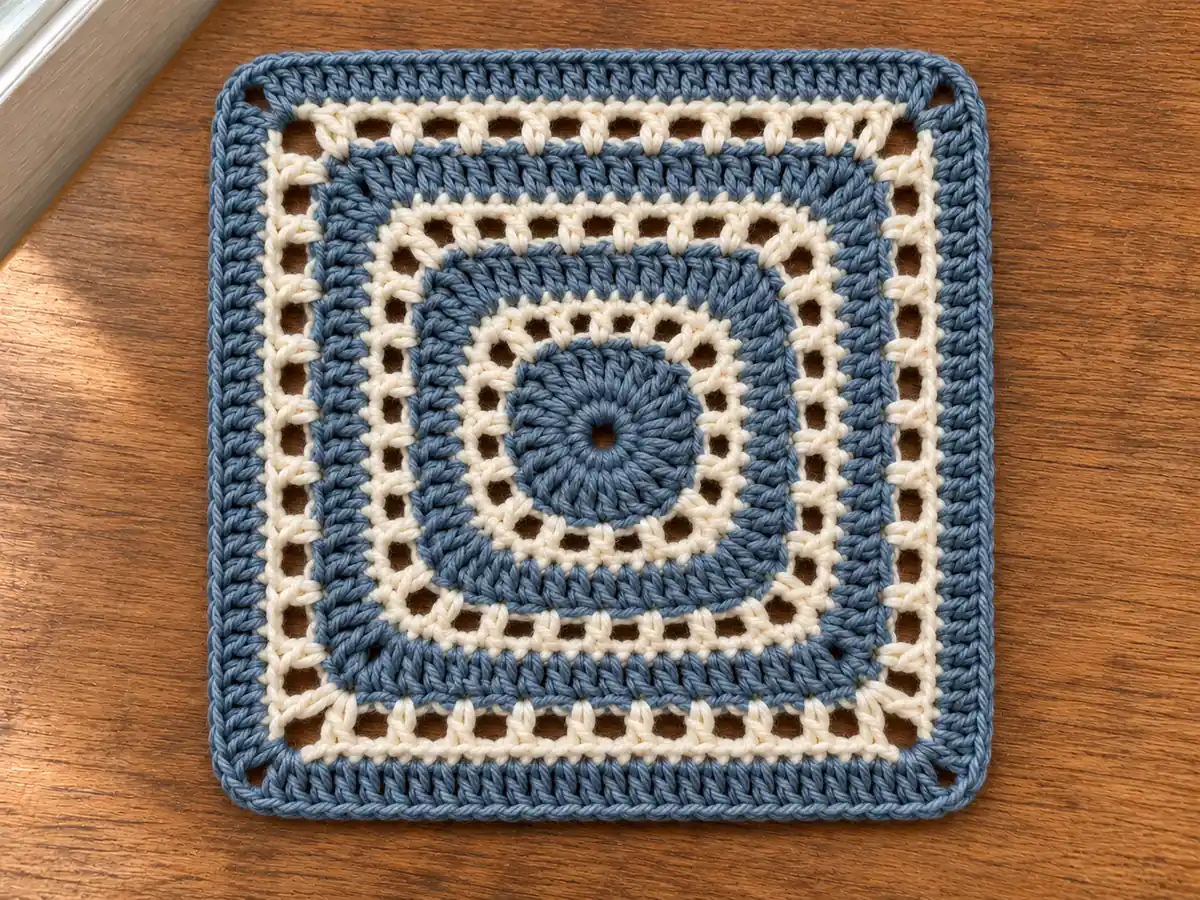
This granny square alternates solid double crochet rounds with open eyelet bands. Unlike an open grouped granny square, the solid sides are made from individual double crochets placed beside each other.
The motif has 7 rounds, beginning in a yarn ring and ending with 25 double crochets per side. No fixed hook size or finished measurement is supplied. Choose suitable yarn and a matching hook, then measure the relaxed first motif before planning a set.
Prepare the US terms and first 2 rounds
Materials and counting conventions
Prepare the chosen yarn, hook, scissors and yarn needle. Corner markers can help distinguish the larger arches from the single-chain eyelets on the sides.
| Term | Meaning |
|---|---|
| dc | US double crochet |
| ch / sl st | Chain / slip stitch |
| Starting 3 ch | Replace the first double crochet |
| Corner arch | 3 ch throughout this motif |
A side eyelet contains 1 ch, while a corner contains 3 ch. Keep those spaces distinct because the following solid round treats them differently.
The classic granny square provides a comparison with open 3-double crochet groups. Do not insert those groups along the solid sides here.
Round 1
- Make a yarn ring.
- Round 1: Make 3 ch and work 11 dc into the ring.
- Join with sl st into the 3rd starting chain.
- Check 12 double crochet positions including the starting chain.
The 12 positions supply the next round’s individual double crochets. The joining slip stitch is not a 13th stitch, and the starting chain is already included.
Round 2
- Round 2: Make 6 ch as the first dc plus the first corner arch.
- Work [dc in next stitch, 1 ch, dc in next stitch, 1 ch, dc in next stitch, 3 ch] 3 times.
- Work dc into the next stitch, 1 ch, dc into the final stitch and 1 ch.
- Join into the 3rd of the initial 6 chains.
Check 12 dc, 8 side arches of 1 ch and 4 corner arches of 3 ch. The first combined chain supplies a double crochet and corner, not an extra uncounted rise before another full corner.
Work the first solid and open bands: rounds 3–5
Corner starts from round 3
From round 3, begin in a corner space. Work 3 ch and 1 dc as the first corner half, then 3 ch and 2 dc. Every other corner receives 2 dc, 3 ch and 2 dc.
This relocates the join from the side-based start of the supplied reference, but does not change the stitch counts. Keep the same corner-start approach through the later rounds.
Round 3: solid double crochets
- Round 3: Work 1 dc into every previous dc.
- Work 1 dc into every 1-chain side space.
- Work 2 dc, 3 ch and 2 dc in each corner space, using the stated beginning corner at the start.
- Join into the 3rd starting chain.
Check 36 dc, or 9 positions per side between corner arches. The side spaces each receive 1 double crochet, while the larger corner arch receives its full group.
Round 4: eyelet band
- Round 4: Keep the same 2-dc, 3-ch, 2-dc corner groups.
- Along each old 9-double crochet side, skip positions 1, 3, 5, 7 and 9.
- Make 1 ch over each skipped position.
- Work 1 dc in each of the 4 remaining even positions.
- Include the chain eyelets immediately after and before the corner groups.
- Begin the first dc with 3 ch and join with sl st.
Check 32 dc and 20 single-chain side spaces, plus the 4 separate corner arches. The corner double crochets are included in the double crochet total, while the corner chains are not side eyelets.
Round 5: fill the eyelets
- Round 5: Work 1 dc into every dc and every 1-chain side space.
- Work 2 dc, 3 ch and 2 dc in each corner.
- Join into the 3rd starting chain.
Check 68 dc, or 17 per side, with 4 corner arches. The solid granny square offers a comparison with a consistently closed surface.
Finish the outer eyelet band and round 7
Round 6
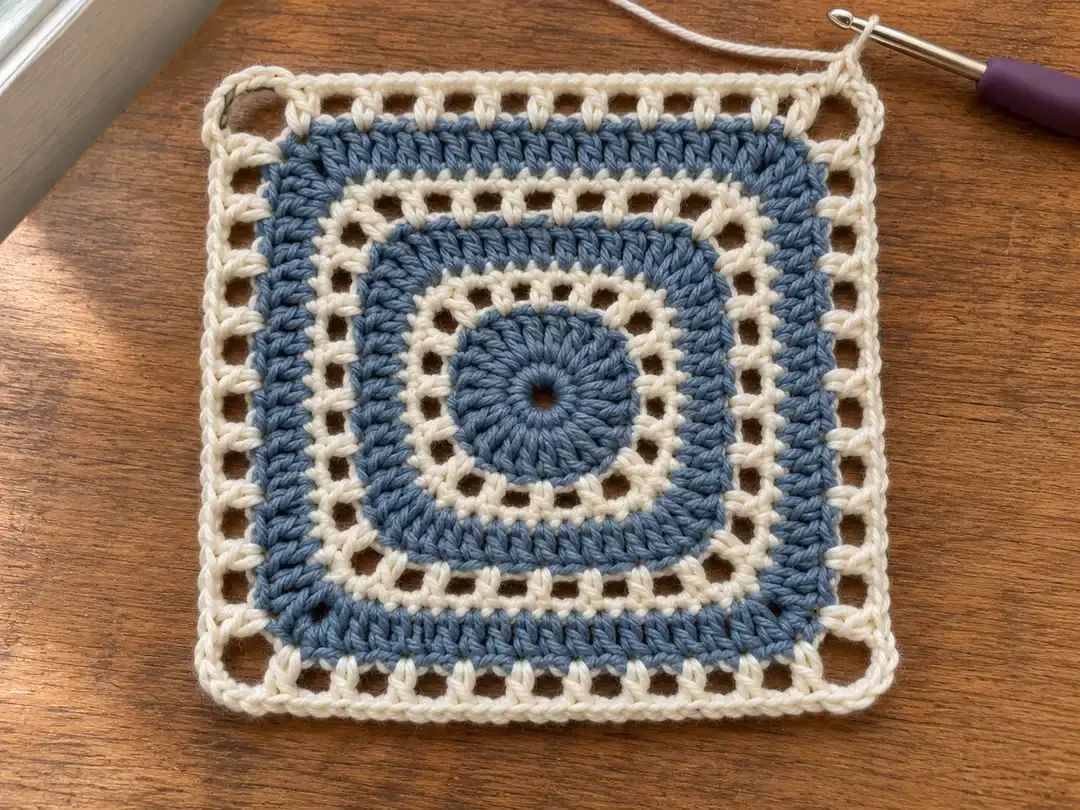
- Round 6: Repeat round 4’s principle over the 17 old side double crochets.
- Skip every odd-numbered side stitch with 1 ch.
- Work dc in every even-numbered side stitch.
- Keep all 4 corner groups unchanged.
- Join with sl st.
Check 48 dc and 36 single-chain side spaces, plus 4 corner arches. Each old side has 9 odd positions and 8 even positions, so count those separately if the eyelets appear uneven.
Round 7
- Round 7: Work 1 dc into every dc and every 1-chain side space.
- Work 2 dc, 3 ch and 2 dc into every corner arch.
- Join with sl st, cut the yarn and secure the ends.
Check 100 dc and 4 corner arches. That gives 25 dc from corner arch to corner arch on every side.
Complete checkpoint table
| Round | Double crochet positions | Side eyelets | Corner arches |
|---|---|---|---|
| 1 | 12 | None | Not yet established |
| 2 | 12 | 8 | 4 |
| 3 | 36 | None | 4 |
| 4 | 32 | 20 | 4 |
| 5 | 68 | None | 4 |
| 6 | 48 | 36 | 4 |
| 7 | 100 | None | 4 |
Check the alternating spaces and finish matching squares
Read the side arithmetic
In round 4, each side uses 4 ordinary double crochets over the even old positions and 5 chain eyelets over the odd ones. The corner halves add 4 double crochets to its new side, making 8 real double crochets and 5 spaces.
Round 5 fills those 13 positions and adds another 4 from its new corner halves, giving 17 double crochets per side. The same relationship repeats at the larger outer band.
In round 6, the 8 even old positions become double crochets and the 9 odd positions become chain eyelets. With 4 corner-half double crochets, that makes 12 real double crochets and 9 spaces per side.
Round 7 fills those 21 positions and adds 4 through the corners, giving 25. These calculations explain the supplied counts rather than adding any new rounds.
Prevent extra stitches beside eyelets
When making a solid round, work into both the double crochet tops and the single-chain spaces as instructed. A space receives 1 dc, not another full corner group.
When making an open round, the chain replaces the skipped old side stitch. Do not work a double crochet into that skipped stitch as well, or the width grows beyond the intended pattern.
Keep the first and last side eyelets visible beside the corners. Omitting them can make the open band look nearly correct while shortening the side allocation.
The same word “space” can refer to different parts of this motif, so identify its chain length before working. A 1-chain side space is filled with a single double crochet in the following solid round. A 3-chain corner space receives 2 double crochets, 3 chains and 2 double crochets.
The starting chains also have a specific role. The initial 3 chains of an ordinary round replace its first double crochet. They are not a separate height aid followed by another double crochet in that same first position. Keep the counted replacement in the side total.
Round 2 is different because its initial 6 chains combine the first double crochet height with the first corner arch. Joining into the 3rd chain preserves that division: the upper 3 chains are the corner space rather than part of a tall 6-chain stitch.
In the open rounds, count the old side stitches before beginning the skip pattern. Round 4 begins from 9 positions, while round 6 begins from 17. The number changes, but both have an odd first and last position that becomes an eyelet beside a corner.
Those end eyelets matter because they separate the old side’s skipped positions from the new corner group. A corner can contain the correct 4 double crochets yet still sit too tightly if an adjacent side chain is missing.
When examining the whole round, distinguish the real-double crochet total from the combined stitch-and-space allocation. Round 4 has fewer real double crochets than round 3 but does not simply shrink: its single-chain spaces preserve the intervening positions while the corners provide growth.
The next solid round restores those eyelet positions to real double crochets. This is why the solid-round count rises more than it would if only the previous double crochet tops were worked. Ignoring the chain spaces leaves an uneven and narrower filling round.
For a matching set, check the motif after each solid band. Its clearer continuous side makes a useful place to confirm the count before another open band is added. A wrong outer total can then be traced to a specific preceding band.
Keep the 4 corner markers in the chain arches rather than in an adjacent double crochet. A marker shifted sideways can make a correct corner appear to be in the wrong place and lead to unnecessary changes.
If the motif curls while being held, set it down before deciding whether its structure is wrong. Hand pressure can fold an open corner or compress a chain arch temporarily. Assess the relaxed fabric and count before changing the hook.
When using different colors for the bands, keep their yarn thickness compatible. The contrast makes the open and closed rows visible, but a heavier outer yarn can alter the finished scale. Measure the first completed sample before making a large collection.
Store the stitch-count table with the project notes. The series 36, 32, 68, 48 and 100 refers to different combinations of solid and open rounds, so it is not a simple increase-only progression to memorise without the associated spaces.
Before joining motifs, compare their corner arches in pairs and count the 25 outer double crochets along each side. An edge can appear similar in length while hiding an omitted stitch, especially after stretching. Correct the crochet structure before using a seam to bring the pieces together, then align them without force.
Measure and care
Weave ends on the reverse without gathering the eyelet band. Shape gently according to the yarn’s care instructions and let the motif dry before comparing edge lengths.
For another open motif, see the 3-color open granny square. Its corner and side group sizes differ, so measure the actual samples before joining them.
Record the yarn and hook with the relaxed finished size. No fixed outer measurement is supplied here, and a larger project needs planning from the actual 25-double crochet sides of your own motif.
Emma & Ella
More crochet projects from The Cooking Twins Yarn.
More from Emma & Ella