Solid crochet granny square with continuous double crochet sides
This solid granny square has ordinary double crochet stitches placed directly beside each other along the sides. Only the corners contain chain arches. The result is an even motif for bags, cushions and blankets, with a more continuous surface than open granny groups.

By Emma & EllaUpdated
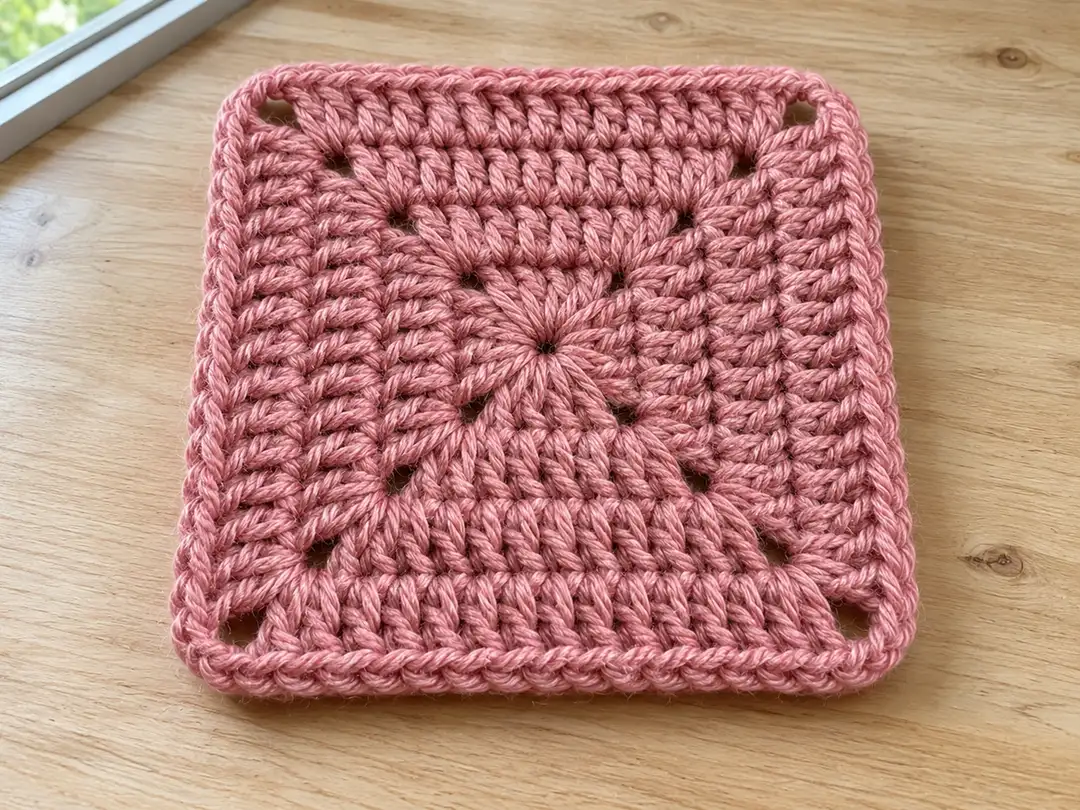
This solid granny square has ordinary double crochet stitches placed directly beside each other along the sides. Only the corners contain chain arches. The result is an even motif for bags, cushions and blankets, with a more continuous surface than open granny groups.
The reference square uses approximately 9 g of DK yarn with a 4 mm hook and measures around 13 × 13 cm. Those figures depend on yarn and tension. Work a complete sample before planning how many matching motifs a larger project needs.
Prepare the yarn and first 4-corner round
Materials and US terms
- Approximately 9 g DK yarn for the reference motif.
- A 4 mm crochet hook.
- Scissors and yarn needle.
- Optional 4 corner markers.
| Term | Meaning |
|---|---|
| ch | Chain |
| sl st | Slip stitch |
| dc | US double crochet |
Each beginning 2-chain rise replaces a double crochet. When joining, insert into the first real double crochet beside that chain, as specified by this version. Do not automatically substitute the joining location used by another granny-square pattern.
A US double crochet begins with 1 yarn over. Insert, draw up yarn and pull through 2 loops twice. Keeping that movement consistent produces an even line of side stitches.
Foundation and round 1
- Make 6 ch and join with an sl st into the first chain for a ring. A yarn ring is an alternative.
- Round 1: Make 2 ch and work 1 dc into the ring.
- Work [2 ch, 3 dc into the ring] 3 times.
- Make 2 ch for the 4th corner arch and work 1 final dc into the ring.
- Join with sl st into the first real double crochet.
- Work another sl st into the next corner arch.
The short supplied line omits the 4th arch. The explicit 2 ch before the final double crochet supply the 4 corners needed by later rounds. This correction is stated openly rather than leaving the round with only 3 corner spaces.
Count 4 arches and 3 double crochet positions per side, including the starting chain replacement. The beginning and ending stitches share a side around the join, so do not treat the ending double crochet as a separate extra side.
Work rounds 2–5 with complete corners
Repeated corner method
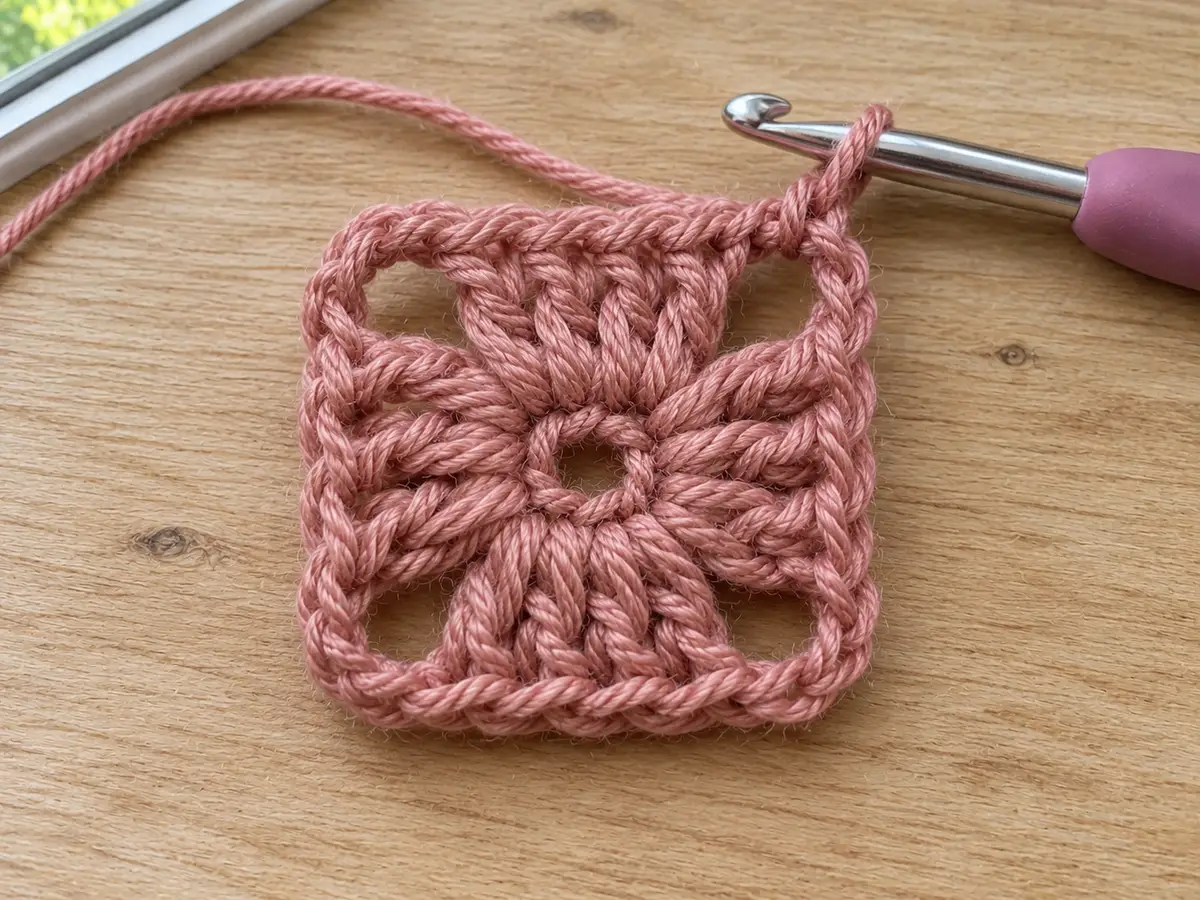
In the first corner space, work 2 ch, 1 dc, 2 ch and 2 dc. The beginning chain replaces the first double crochet, giving the same corner arrangement as the other spaces.
At each remaining corner, work 2 dc, 2 ch and 2 dc. Along the sides, work 1 dc into every previous side stitch rather than making groups separated by chain gaps.
Individual rounds
- Round 2: Work the first corner arrangement, then 1 dc in each of the 3 old side positions between corners. Work the ordinary corner group in each following corner. Join into the first real dc and sl st into the corner arch.
- Round 3: Repeat the corner method and work 1 dc in each of the 7 old side positions. Join into the first real dc and sl st into the corner arch.
- Round 4: Repeat the corner method and work 1 dc in each of the 11 old side positions. Join into the first real dc and sl st into the corner arch.
- Round 5: Repeat the corner method and work 1 dc in each of the 15 old side positions. Join into the first real dc.
The corner arches remain the only deliberate chain spaces. Do not add a chain between every pair of side double crochets. That would create a different, more open fabric.
Use the corners as clear turning points around the perimeter. A marked arch should receive its complete corner group, while an ordinary double crochet top receives only its single side double crochet.
If the corner arches feel too tight, the supplied option is to use 3 ch instead of 2 consistently at every corner. Apply that choice uniformly rather than changing only a single corner to conceal an error.
The classic granny square also creates gaps along the sides through its 3-double crochet groups. This solid motif keeps those sides continuous.
Count the sides and maintain matching motifs
Old side stitches and new full side counts
| Round | Old side positions worked between corner groups | New positions from corner arch to corner arch |
|---|---|---|
| 1 | Foundation arrangement | 3 |
| 2 | 3 | 7 |
| 3 | 7 | 11 |
| 4 | 11 | 15 |
| 5 | 15 | 19 |
Every new side gains 2 double crochets from the corner half at either end, adding 4 positions. The old side count and new complete side count are different figures, so identify which is being checked.
For example, round 3 works across 7 old side stitches. Its new corner halves contribute 2 at the beginning and 2 at the end, producing 11 positions between its new corner arches.
The chain arch itself is not another double crochet. Counting its 2 chains as side stitches would mix the corner space with the solid double crochet line and make the following round difficult to compare.
Check the first real stitch and the join
The beginning 2 ch count as a double crochet position even though the round joins into the first real double crochet. Keep both facts in mind. The join location does not mean the chain replacement should be omitted from the side count.
Mark the first real double crochet if it hides beside the chain rise. A tight slip stitch can make its top harder to recognize, so keep the join neat without pulling it into a knot.
The extra slip stitch into the corner arch positions the hook for the next round. It is not an added side double crochet and should not be counted as another pattern position.
Compare samples before joining
Lay completed motifs flat in the same orientation and compare their relaxed edge lengths. Check all 4 sides rather than measuring only a diagonal corner-to-corner stretch.
If a square is smaller, count its side stitches and corners first. If the counts match, inspect yarn thickness and tension. Pulling a small square forcibly to a larger size may distort the fabric without creating a stable match.
Keep a note of the yarn, hook and chosen 2- or 3-chain corner option. Consistent choices help a set fit together more readily than changing corner space sizes midway through the collection.
Finish the square and plan its later use
Secure the final round
- After joining round 5, make 1 ch.
- Cut the yarn and draw the end through.
- Weave the beginning and ending tails on the reverse.
- Lay the square flat and align the corner arches.
Weave without gathering the outer round or center. A tail pulled tightly across a corner can make a correctly counted square appear uneven. Check its shape after securing each end.
Use several suitable stitch paths rather than relying only on a short knot. Keep the reverse free of long loose loops that could catch during later joining.
Prepare corresponding corners
Before joining several squares, mark corner spaces in pairs. Match side positions as well as corners so that the seam does not shift a row of double crochets sideways.
This pattern supplies the square itself, not a fixed blanket layout, bag assembly or universal joining method. Measure the actual motifs when choosing the number required for a later project.
A Sunburst square adds a raised circular center. Compare its finished edge length before assuming it can be joined directly to this 5-round solid square.
Read the fabric before changing it
If the center cups, inspect the starting ring and the first round’s 4 arches. Do not immediately add chains to every later side, since those spaces are absent from the intended solid construction.
If a side seems shorter, check for a missed double crochet beside the beginning chain or corner group. The side count sequence provides a more reliable diagnosis than adding a random stitch where the edge appears narrow.
If only a corner is tight, compare the corner chains with the rest of the motif. The stated 3-chain option is available, but it should be a consistent corner choice rather than a substitute for missing side stitches.
When working around the square, distinguish an ordinary stitch from a corner space before inserting the hook. The corner group shares a single open arch, while the side double crochets use individual tops. Treating the open arch like only 1 side stitch would remove the growth needed at that corner.
The first corner is complete once its starting chain, additional double crochet, arch and final 2 double crochets are made. At the end of the round, join to the stated real double crochet without adding a second full corner there. Doubling that group would distort the beginning corner while leaving the other 3 apparently normal.
For a repeated set, pause after each round to check the progression rather than waiting until all 5 rounds are finished. The 3, 7, 11, 15 and 19 positions show exactly where a side first becomes incorrect. This narrows the section to undo if needed.
Use markers as references, not as an alternative to counting. A marker accidentally moved into a neighboring side stitch can make a corner group look misplaced. Keep it in the chain arch and compare that space with the other corners before continuing.
With remnants, make comparison squares before committing the color arrangement. A softer yarn can relax more than a firmer yarn of the same labelled weight. The reference 9 g is useful for the stated DK sample but is not a universal allowance for every substitute.
Inspect the square from both sides after weaving. The reverse may reveal a gathered tail or a loose join that is less noticeable from the front. Correct those details before assembling a larger piece, when the individual motif is still easy to handle.
Care and learning
Follow the chosen yarn’s care instructions and shape gently when appropriate. Do not force the motif to the reference 13 cm measurement when a different yarn naturally produces another size.
Let it dry fully before measuring for a seam. Store finished motifs flat or loosely stacked so their corners remain easy to align.
For further chain and double crochet practice, browse the crochet learning collection. Keep a completed reference motif with the project notes while making a matching set.
Emma & Ella
More crochet projects from The Cooking Twins Yarn.
More from Emma & Ella