Knitted Christmas angel with short-row wings: full pattern
This Christmas angel is knitted, with a dress worked in the round, a lightly stuffed head and garter-stitch wings shaped by short rows. The reference figures are approximately 9 cm or 3.5 inches high. The German and English source versions describe the same model and are combined here as a single

By Emma & EllaUpdated
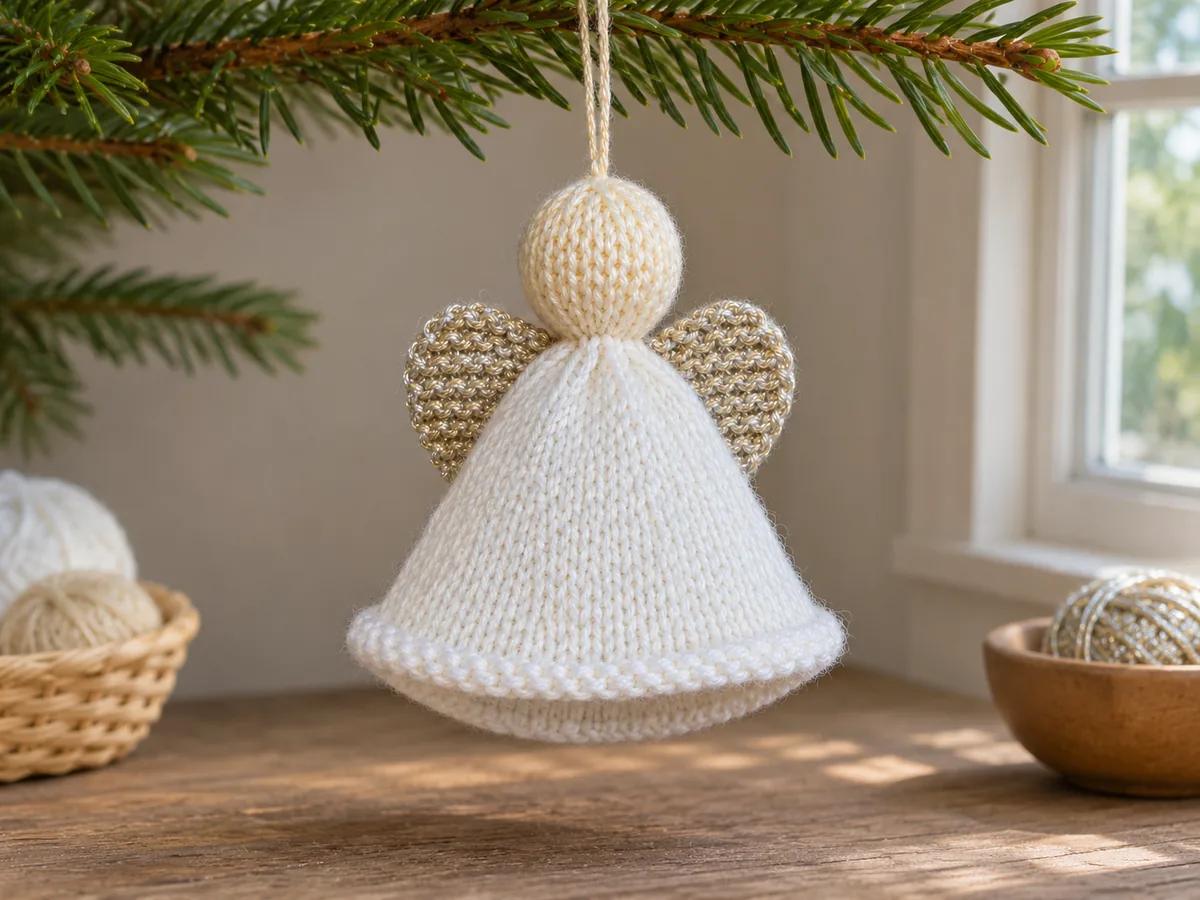
This Christmas angel is knitted, with a dress worked in the round, a lightly stuffed head and garter-stitch wings shaped by short rows. The reference figures are approximately 9 cm or 3.5 inches high. The German and English source versions describe the same model and are combined here as a single complete construction.
The dress remains open underneath. Regular decreases shape it from a broad lower edge toward the neck, then the head continues above a color change. A separately knitted wing strip is sewn at the back. Its reference shape is retained below because the source does not give a fixed quantity of short-row cycles.
Yarn, double-pointed needles and knitting terms
Materials
The example body yarn has 120 m per 50 g and contains 55% cotton and 45% acrylic. Use white and natural or beige. The 50 g figure describes the yarn packaging, not a confirmed quantity consumed by a single angel. No per-figure gram amount is supplied.
Use gold or silver shiny yarn for the wings. The example contains 65% viscose and 35% polyester. You may optionally hold a white, possibly fluffy strand with it. The source permits a range of yarns and gives neither a fixed knitting-needle diameter nor a compulsory gauge.
You also need stuffing for the head and thread for sewing and hanging. No filling weight is specified. The dress is not described as a fully closed stuffed body.
Needle distribution
Distribute the body stitches across 4 double-pointed needles, initially 12 per needle. Use another working needle to knit them. The source’s English version clarifies this distribution where the German needle description is ambiguous. The 4 holding needles do not represent separate body pieces.
Knitting glossary
K means knit, and k2tog means knit 2 stitches together, decreasing by 1. Knitting every round produces stockinette stitch. The wings are knitted back and forth in knit stitches, producing garter ridges. A ridge consists of an outward row and its return row.
Wrap and turn, abbreviated w&t, turns a short row before all 9 wing stitches have been worked. It wraps an existing stitch rather than adding a new stitch or decreasing the cast-on quantity. The full movement is explained with the wings below.
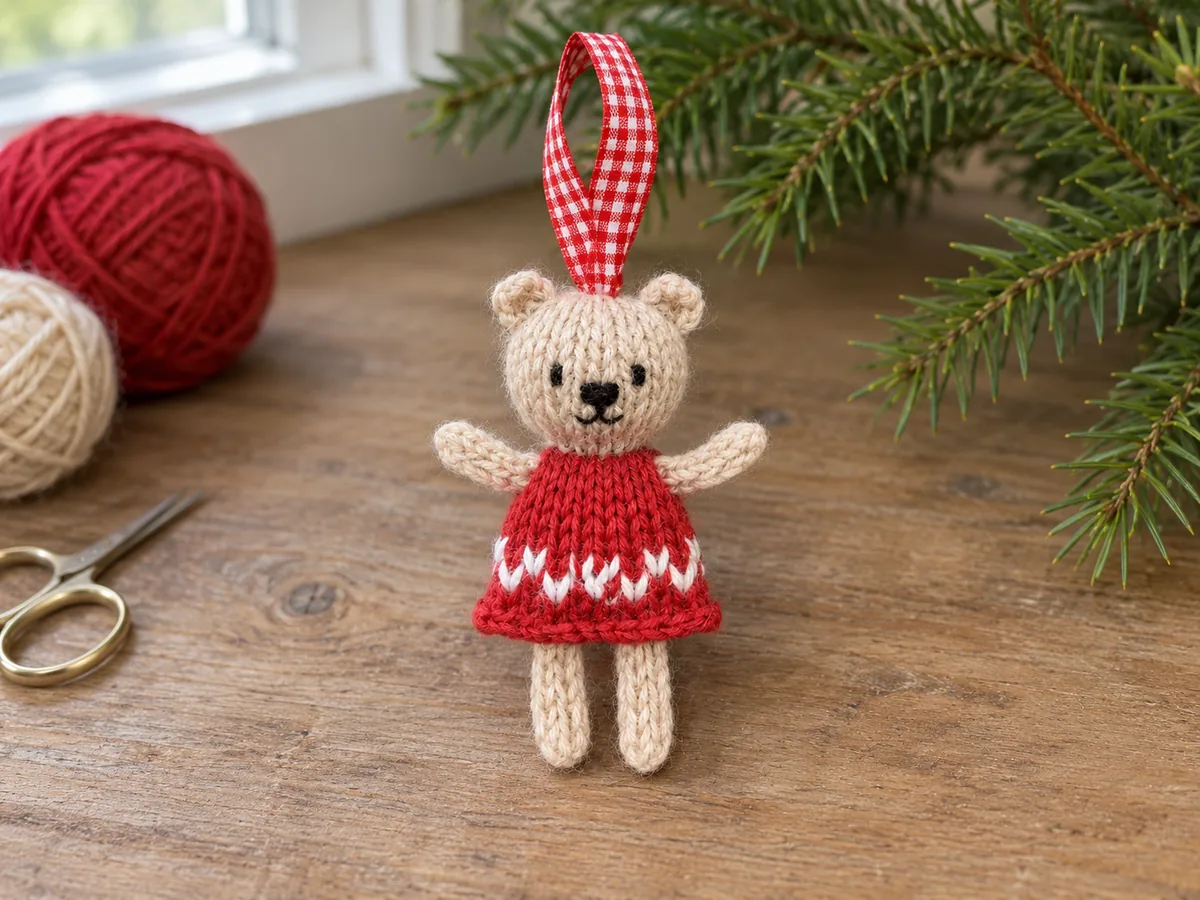
For another knitted decoration, see the mini knitted bear ornaments.
Knit the dress from 48 stitches to 20
Cast on and join
Cast on 48 stitches and distribute 12 on each of the 4 needles. Join in the round without twisting the cast-on edge. The round begins between the fourth and first holding needles; mark that point if helpful.
Repeat 2 plain knit rounds and a decrease round until each needle holds 5 stitches. Every decrease round works k2tog at the start of each needle, removing 4 stitches in total. The sequence requires 7 decrease rounds, giving 48 − 28 = 20 stitches.
All dress rounds
- Dress round 1: Knit all stitches: 48 stitches in total.
- Dress round 2: Knit all stitches: 48 stitches in total.
- Dress round 3: On each of the 4 needles, knit its first 2 stitches together, then knit the rest: 44 stitches in total.
- Dress round 4: Knit all stitches: 44 stitches in total.
- Dress round 5: Knit all stitches: 44 stitches in total.
- Dress round 6: On each of the 4 needles, knit its first 2 stitches together, then knit the rest: 40 stitches in total.
- Dress round 7: Knit all stitches: 40 stitches in total.
- Dress round 8: Knit all stitches: 40 stitches in total.
- Dress round 9: On each of the 4 needles, knit its first 2 stitches together, then knit the rest: 36 stitches in total.
- Dress round 10: Knit all stitches: 36 stitches in total.
- Dress round 11: Knit all stitches: 36 stitches in total.
- Dress round 12: On each of the 4 needles, knit its first 2 stitches together, then knit the rest: 32 stitches in total.
- Dress round 13: Knit all stitches: 32 stitches in total.
- Dress round 14: Knit all stitches: 32 stitches in total.
- Dress round 15: On each of the 4 needles, knit its first 2 stitches together, then knit the rest: 28 stitches in total.
- Dress round 16: Knit all stitches: 28 stitches in total.
- Dress round 17: Knit all stitches: 28 stitches in total.
- Dress round 18: On each of the 4 needles, knit its first 2 stitches together, then knit the rest: 24 stitches in total.
- Dress round 19: Knit all stitches: 24 stitches in total.
- Dress round 20: Knit all stitches: 24 stitches in total.
- Dress round 21: On each of the 4 needles, knit its first 2 stitches together, then knit the rest: 20 stitches in total.
- Dress round 22: Knit 20 stitches.
- Dress round 23: Knit 20 stitches.
- Dress round 24: Knit 20 stitches.
- Dress round 25: Knit 20 stitches.
The per-needle sequence is 12, 11, 10, 9, 8, 7, 6 and 5. Keep both plain rounds before each decrease. Decreasing every round would shorten the cone and change its slope.
After the seventh decrease, the 4 further rounds at 20 stitches complete the dress before changing to the head color. There is no separate collar or neckband to add. The color boundary is used later for tying the neck.
Knit the head and shape the short-row wings
Head rounds
- Head round 1: In the second color, knit 20 stitches.
- Head round 2: In the second color, knit 20 stitches.
- Head round 3: In the second color, knit 20 stitches.
- Head round 4: In the second color, knit 20 stitches.
- Head round 5: In the second color, knit 20 stitches.
- Head round 6: In the second color, knit 20 stitches.
- Head round 7: In the second color, knit 20 stitches.
- Head round 8: At the start of each holding needle, work k2tog, then knit the rest: 16 stitches, 4 per needle.
- Head round 9: Knit 16 stitches.
- Head round 10: Knit 16 stitches.
- Head round 11: Work k2tog at each needle’s start, then knit the rest: 12 stitches, 3 per needle.
Tie a thread around the neck at the color change. Stuff the head, then cut the working yarn and draw it through all 12 remaining stitches to close the top. This is a gathered closure, not an additional normal bound-off round.
Wrap-and-turn movement
Cast on 9 stitches in the chosen wing yarn. For w&t, bring the yarn in front, slip the next stitch purlwise, take the yarn behind, slip that stitch back to the left needle, bring the yarn forward again and turn. The yarn wraps the turning stitch.
The return row leads back toward the outer starting edge. All rows are knitted. Their varying lengths build the curved wing strip without reducing the 9 cast-on stitches.
6-ridge wing sequence
- Wing ridge 1, outward row: Knit 8, wrap the next stitch and turn.
- Wing ridge 1, return row: Knit 8 back.
- Wing ridge 2, outward row: Knit 6, wrap the next stitch and turn.
- Wing ridge 2, return row: Knit 6 back.
- Wing ridge 3, outward row: Knit 4, wrap the next stitch and turn.
- Wing ridge 3, return row: Knit 4 back.
- Wing ridge 4, outward row: Knit 2, wrap the next stitch and turn.
- Wing ridge 4, return row: Knit 2 back.
- Wing ridge 5, outward row: Knit 4, wrap the next stitch and turn.
- Wing ridge 5, return row: Knit 4 back.
- Wing ridge 6, outward row: Knit 6, wrap the next stitch and turn.
- Wing ridge 6, return row: Knit 6 back.
Repeat these 6 ridges until the wing shape matches the source reference. No fixed number of full repeats is supplied. Compare the upper lobes and central dip rather than inventing a cycle quantity. The row lengths descend 8, 6, 4, 2 and rise through 4 and 6 before returning to 8 in the next cycle.
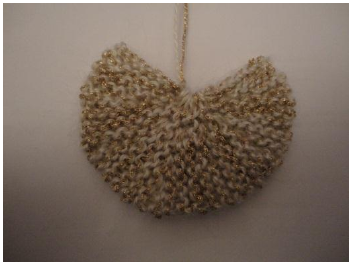
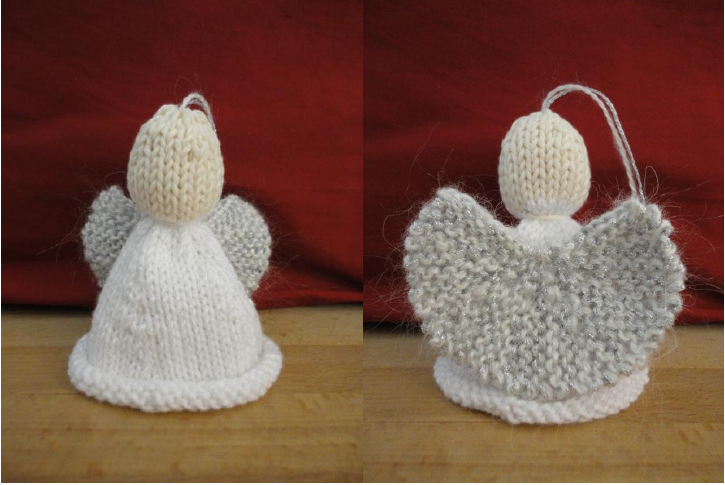
The preserved references show the curved strip and its final placement. Another construction appears in the crocheted pleated-skirt angel.
Attach the wings and finish the angel
Wing placement
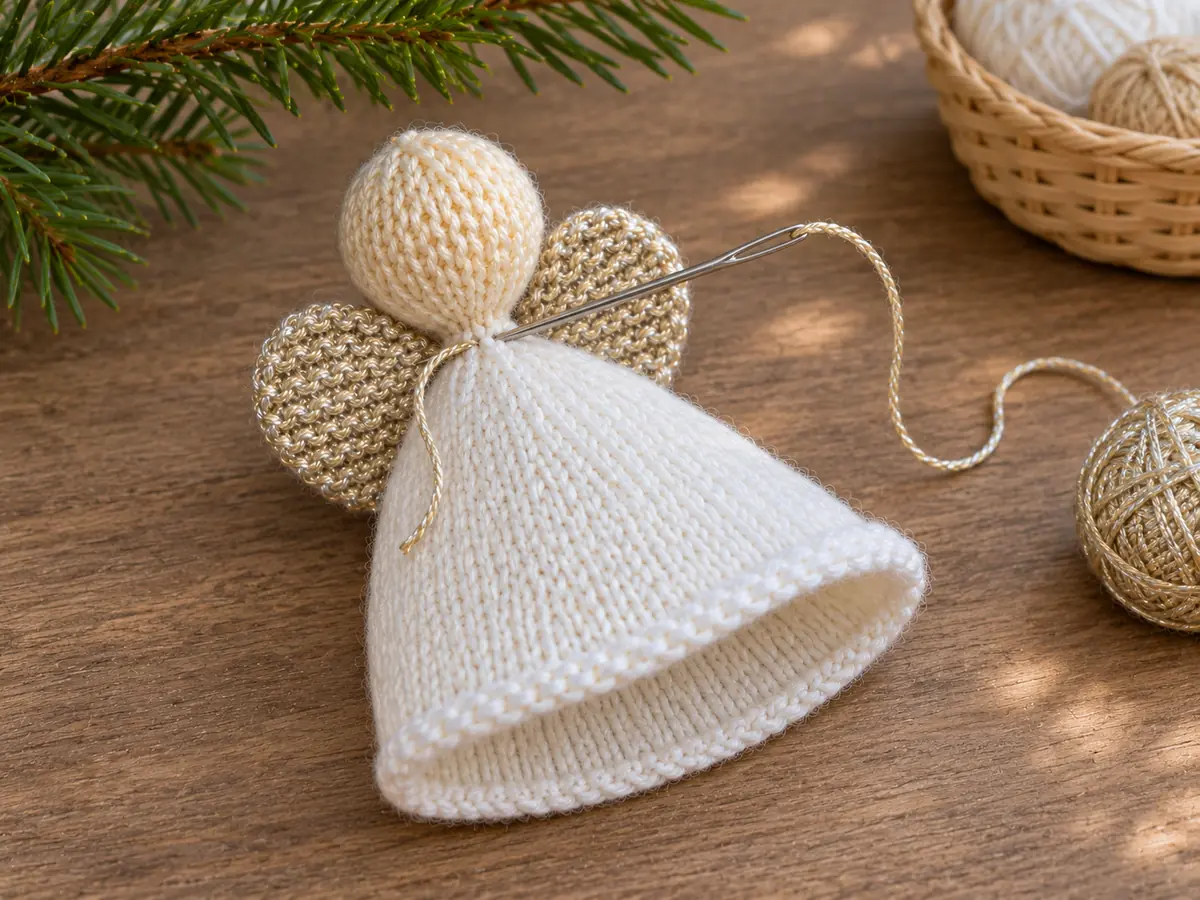
Weave in the ends and sew the wings to the body. Center the strip at the back with its upper curves beside the neck. The reference back view helps identify the orientation; the central dip sits behind the upper head-and-neck area.
No exact attachment round or stitch distance is supplied. Position it according to the shape shown rather than presenting a chosen round number as a source requirement. An upside-down strip would have the same ridges but a different silhouette.
Optional face, halo and hanging thread
You may embroider a face if desired, or leave it plain. No eye spacing or embroidery count is given. A halo may be braided or crocheted from gold or silver yarn, but no length or chain quantity is prescribed. Add a hanging thread and secure it through the knitted structure.
The optional details do not change the body rounds. The head’s closing thread must pass through every remaining stitch, and the neck tie should keep the filling in the head. Leave the lower dress edge open rather than adding an unlisted bottom seam.
Keep separate notes for the dress and head counts. The dress reaches 20 stitches only after its seventh decrease round, then has 4 further plain rounds. The first 7 head rounds retain that 20-stitch circumference. Decreasing at the color change instead would narrow the head prematurely.
For the wings, count a ridge as the full outward-and-return movement. The 6-ridge sequence contains 12 short rows, not 12 full-width rows over every cast-on stitch. The wrap positions determine each row’s length. Check those turning positions against the reference shape before sewing the strip permanently to the back.
Inspect the neck tie and top closure before trimming their tails. Keep the head filling contained without drawing the open dress into the same gathered closure.
Record the actual execution
The 9 cm reference height belongs to the pictured angels in the described yarn. With no fixed needle size or gauge, it is not a universal size guarantee. Record your yarn, chosen needles and actual wing-cycle quantity for a matching repeat.
For another small angel, see the flat lace crochet angel. This knitted model is complete after the wings and hanging attachment are secured.
Emma & Ella
More crochet projects from The Cooking Twins Yarn.
More from Emma & Ella