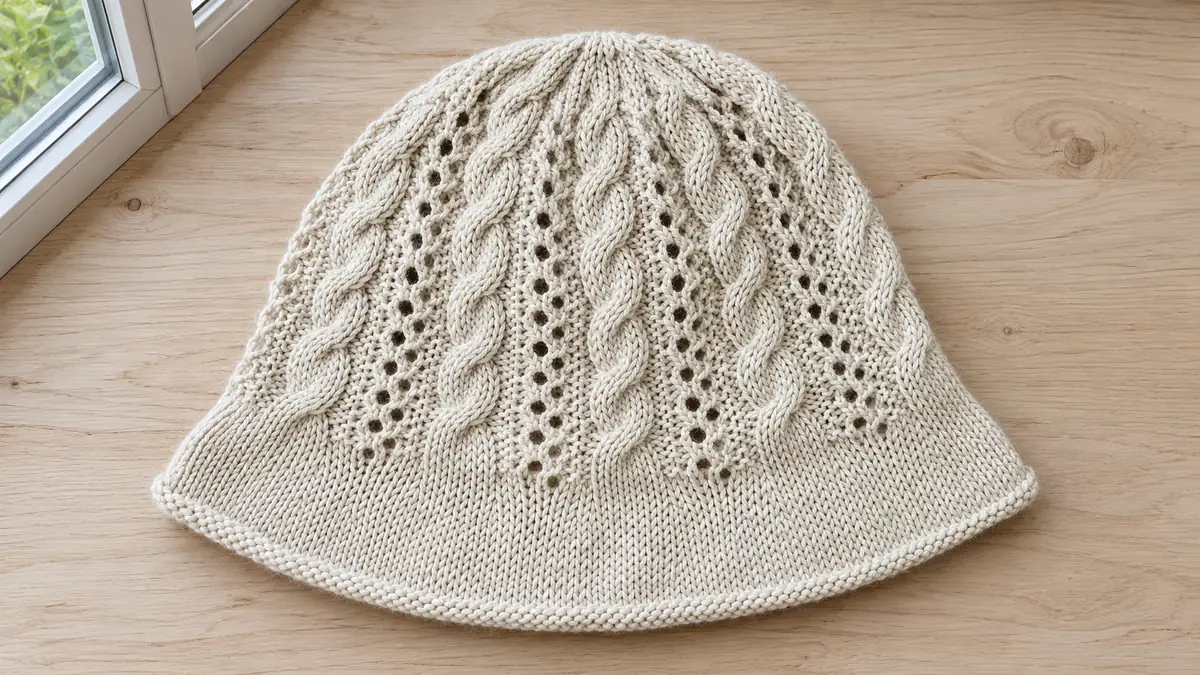
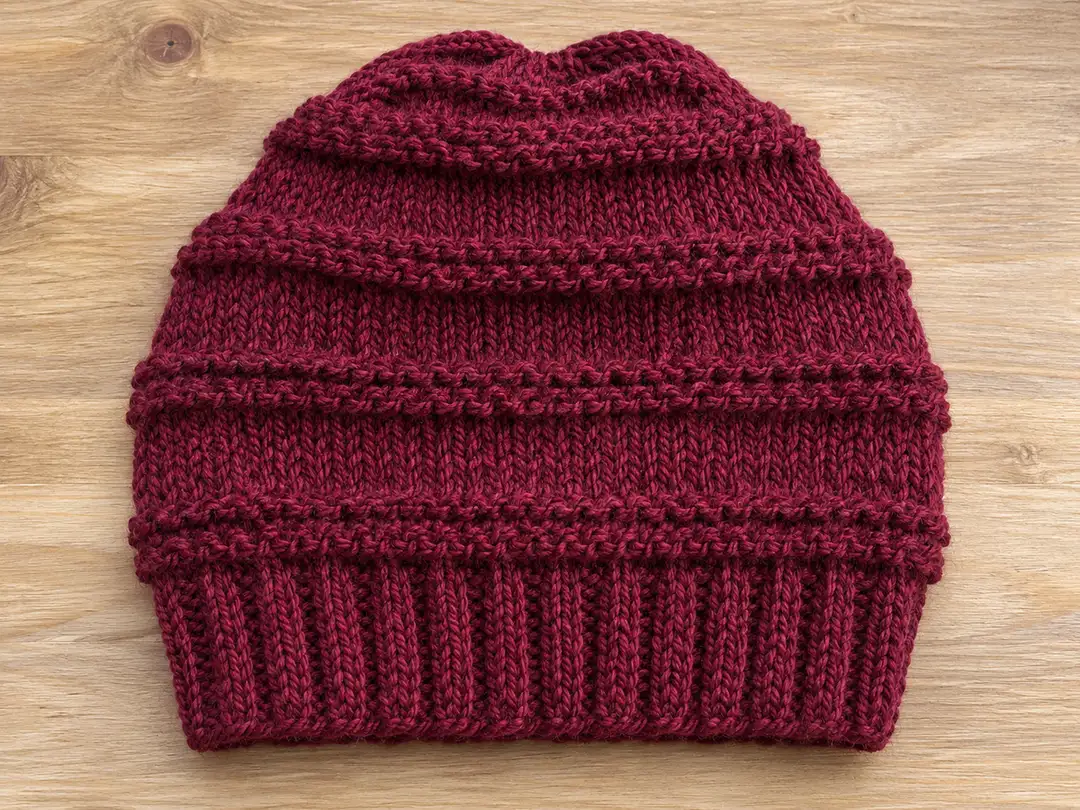
Knitted hat with horizontal texture stripes
This hat is knitted in the round from the lower edge to the crown. Its horizontal bands come from changing between knit rounds, purl rounds and ribbed rounds rather than from a required sequence of yarn colors. The main size is intended for an average adult woman’s head. A smaller child version

By Emma & EllaUpdated
Prepare the yarn and understand the textured bands
This hat is knitted in the round from the lower edge to the crown. Its horizontal bands come from changing between knit rounds, purl rounds and ribbed rounds rather than from a required sequence of yarn colors. The main size is intended for an average adult woman’s head. A smaller child version changes the cast-on, the lower ribbing and selected purl bands, then begins the crown at a different point.
Materials and tension
You need approximately 110 m chunky yarn, a 6 mm circular knitting needle, a stitch marker, a blunt yarn needle and scissors. The instructions do not specify a circular needle cable length or an alternative needle arrangement for the narrowing crown. Select an arrangement suitable for working the stated number of stitches without stretching the work to fit the needle.
| Tension check | Measurement |
|---|---|
| 8 stitches in twisted rib, meaning 4 repeats of k1 through back loop, p1 | Approximately 5.1 cm |
| 4 rounds of the rib pattern | Approximately 2.5 cm high |
| 4 purl rounds laid flat | Approximately 2.5 cm high |
Measure the rib in the specified pattern rather than treating 8 plain knit stitches as an equivalent sample. The purl-band height is also given with the fabric laid flat. These measurements explain the intended fabric; they do not provide a separate finished circumference or depth. Avoid assigning an unsupported centimeter size to the adult or child label.
Knitting abbreviations
K means knit, p means purl and k2tog means knit 2 stitches together as 1. K1 through the back loop means inserting the needle through the rear loop to twist that knit stitch. The twisted knit stitch is used in the initial ribbing. The later k1, p1 bands are ordinary rib unless otherwise specified; do not automatically twist those later knit stitches as well.
This is a knitting pattern. Its knit and purl instructions must not be read as crochet stitches, even though other projects on the site use crochet. More knitted projects can be found in the knitting category. Use the marker to identify the beginning of every round so that the texture changes start consistently.
Cast on and work the adult brim
Join with 68 stitches
Cast on 68 stitches. Alternatively, cast on 69 if you prefer to use an additional joining stitch, then lift that extra stitch over the first stitch when joining. There must be 68 stitches after joining in either case. Place the marker at the beginning of the round. Check the cast-on edge is not twisted before knitting the first complete round.
The optional 69th stitch is used only for the join. It does not remain in the working count and is not an extra stitch to carry into the ribbing or decreases. Recount after joining if you used this method. An unnoticed extra stitch would disrupt the alternating rib and the exact crown arithmetic later.
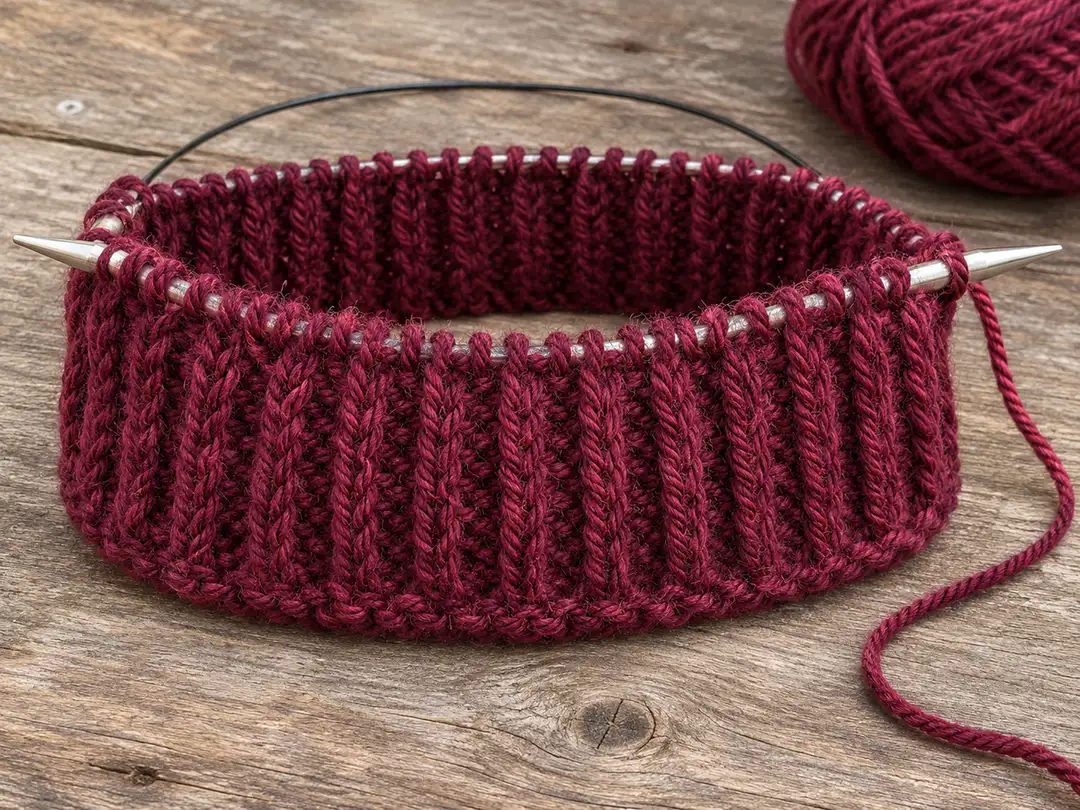
Rounds 1–9
- Round 1: Purl every stitch. Keep 68 stitches.
- Round 2: Repeat k1 through the back loop, p1 around. Keep 68 stitches.
- Round 3: Repeat k1 through the back loop, p1 around. Keep 68 stitches.
- Round 4: Repeat k1 through the back loop, p1 around. Keep 68 stitches.
- Round 5: Repeat k1 through the back loop, p1 around. Keep 68 stitches.
- Round 6: Repeat k1 through the back loop, p1 around. Keep 68 stitches.
- Round 7: Repeat k1 through the back loop, p1 around. Keep 68 stitches.
- Round 8: Repeat k1 through the back loop, p1 around. Keep 68 stitches.
- Round 9: Repeat k1 through the back loop, p1 around. Keep 68 stitches.
For the twisted knit stitch, approach the back loop as specified. The purl stitch beside it remains a normal purl. Repeat the same pair around each of these 8 rib rounds. With 68 stitches, there are 34 pairs. The initial purl round is separate from those 8 rounds and is included as Round 1 in the numbered sequence.
Keep the marker at the round boundary rather than moving it to a visually prominent rib. This makes the transition to the horizontal bands easier to track. If you put the work down, write the last completed round number rather than only noting that the ribbing is finished. That prevents the first texture band being counted as another ribbing round.
A crocheted rectangle construction with a folded lower edge is available in the fisherman hat. That is a different technique; its rows and crochet stitches do not replace the circular knitting sequence here.
Knit the horizontal bands and decrease the adult crown
Rounds 10–20: first texture sequence
- Round 10: Knit every stitch. Keep 68 stitches.
- Round 11: Knit every stitch. Keep 68 stitches.
- Round 12: Purl every stitch. Keep 68 stitches.
- Round 13: Purl every stitch. Keep 68 stitches.
- Round 14: Purl every stitch. Keep 68 stitches.
- Round 15: Purl every stitch. Keep 68 stitches.
- Round 16: Knit every stitch. Keep 68 stitches.
- Round 17: Knit every stitch. Keep 68 stitches.
- Round 18: Repeat k1, p1 around. Keep 68 stitches.
- Round 19: Repeat k1, p1 around. Keep 68 stitches.
- Round 20: Repeat k1, p1 around. Keep 68 stitches.
Rounds 21–31: repeat that complete sequence
- Round 21: Knit every stitch. Keep 68 stitches.
- Round 22: Knit every stitch. Keep 68 stitches.
- Round 23: Purl every stitch. Keep 68 stitches.
- Round 24: Purl every stitch. Keep 68 stitches.
- Round 25: Purl every stitch. Keep 68 stitches.
- Round 26: Purl every stitch. Keep 68 stitches.
- Round 27: Knit every stitch. Keep 68 stitches.
- Round 28: Knit every stitch. Keep 68 stitches.
- Round 29: Repeat k1, p1 around. Keep 68 stitches.
- Round 30: Repeat k1, p1 around. Keep 68 stitches.
- Round 31: Repeat k1, p1 around. Keep 68 stitches.
Rounds 21–31 repeat Rounds 10–20 once in full. The 2 knit rounds, 4 purl rounds, 2 knit rounds and 3 rib rounds are all retained. The purl bands project differently from the plain-knit bands, creating the horizontal texture. Continue to count rounds rather than judging the repeat only by the appearance of the ridges.
Rounds 32–40
- Round 32: Knit every stitch. Keep 68 stitches.
- Round 33: Knit every stitch. Keep 68 stitches.
- Round 34: Purl every stitch. Keep 68 stitches.
- Round 35: Purl every stitch. Keep 68 stitches.
- Round 36: Purl every stitch. Keep 68 stitches.
- Round 37: Knit every stitch. Keep 68 stitches.
- Round 38: Repeat k1, p1 around. Keep 68 stitches.
- Round 39: Repeat k1, p1 around. Keep 68 stitches.
- Round 40: Knit every stitch. Keep 68 stitches.
The final purl band in this section has 3 rounds, Rounds 34–36, rather than the 4 rounds used in the earlier bands. The ordinary rib band has 2 rounds, Rounds 38–39. Retain those shorter sections as written. They are not incomplete copies of the earlier 11-round repeat.
Adult crown, Rounds 41–50
| Round | Instruction | Stitches remaining |
|---|---|---|
| 41 | Repeat k15, k2tog 4 times | 64 |
| 42 | Knit every stitch | 64 |
| 43 | Repeat k6, k2tog 8 times | 56 |
| 44 | Knit every stitch | 56 |
| 45 | Repeat k5, k2tog 8 times | 48 |
| 46 | Knit every stitch | 48 |
| 47 | Repeat k4, k2tog 8 times | 40 |
| 48 | Knit every stitch | 40 |
| 49 | Repeat k3, k2tog 8 times | 32 |
| 50 | Knit every stitch | 32 |
Round 41 uses 4 decreases to bring 68 stitches down to 64. Each later decrease round uses 8 decreases. The plain knit rounds between them retain the count produced by the preceding decrease round. Do not decrease on those intervening rounds. The final count is 32 stitches, not a smaller invented closure count.
After a k2tog, count the resulting stitch as 1. For example, the k6, k2tog repeat consumes 8 old stitches and produces 7 new stitches; 8 repeats take 64 stitches to 56. Checking the relationship between the starting count and the repeated unit is a useful way to locate a missed decrease without changing the printed instruction.
Close the crown and make the smaller version
Gather and secure the adult crown
- Cut the yarn, leaving a long end.
- Thread the end into the yarn needle and pass it through all 32 remaining stitches.
- Remove the knitting needle and pull the opening firmly closed.
- Take the yarn end to the inside.
- Turn the hat inside out and pass the end through the gathered stitches again.
- Pull firmly, secure the end and weave in all ends.
The instructions specify a long tail without giving a numerical length. Leave enough to make the stated second pass and secure the end, but do not describe an invented tail measurement as part of the pattern. Keep the live stitches on the knitting needle until the yarn needle has passed through them so that they are not dropped during the transfer.
A faux-fur pompom may be attached if desired. It is optional and does not change the crown decrease sequence. Close and secure the crown first, then position the pompom on the finished top. The source does not give a pompom diameter or a particular attachment mechanism.
Child version: cast-on and body changes
- Cast on 64 stitches.
- Work the initial purl round.
- Work 6 rounds of k1 through the back loop, p1 rib instead of the adult version’s 8 rib rounds.
- In sections where 4 purl rounds are specified, work 3 purl rounds instead.
- If more height is needed, retain the 4 purl rounds in those sections.
The child adjustments shorten the initial rib and the earlier 4-round purl bands. They do not instruct you to reduce every purl section indiscriminately: the later adult section already contains 3 purl rounds. Because the shorter bands change the overall numbering, follow their position in the texture sequence rather than calling the child’s final body round Round 40 automatically.
Child crown sequence
Begin the child decreases with the instruction used in adult Round 43, then continue to the final round of that table. The following list gives those operations as a separate crown sequence, avoiding a claim that the child body has the same total number of rounds as the adult body.
- Child crown Round 1: Repeat k6, k2tog 8 times. 56 stitches remain.
- Child crown Round 2: Knit all 56 stitches.
- Child crown Round 3: Repeat k5, k2tog 8 times. 48 stitches remain.
- Child crown Round 4: Knit all 48 stitches.
- Child crown Round 5: Repeat k4, k2tog 8 times. 40 stitches remain.
- Child crown Round 6: Knit all 40 stitches.
- Child crown Round 7: Repeat k3, k2tog 8 times. 32 stitches remain.
- Child crown Round 8: Knit all 32 stitches.
Close the remaining 32 stitches by the same threaded gathering and second securing pass described above. The 64-stitch cast-on makes the adult Round 41 unnecessary for the smaller version: it already has the count needed before the k6, k2tog decrease. Do not work that adult reduction first and then try to force the 8-repeat sequence onto a different total.
For another knitted floral project using shaped sections, see the knitted pinwheel flowers. Keep your own hat notes focused on the selected body-height option, especially whether you retained 3 or 4 rounds in the adjustable purl bands, so the chosen version can be followed consistently.
Emma & Ella
More crochet projects from The Cooking Twins Yarn.
More from Emma & Ella