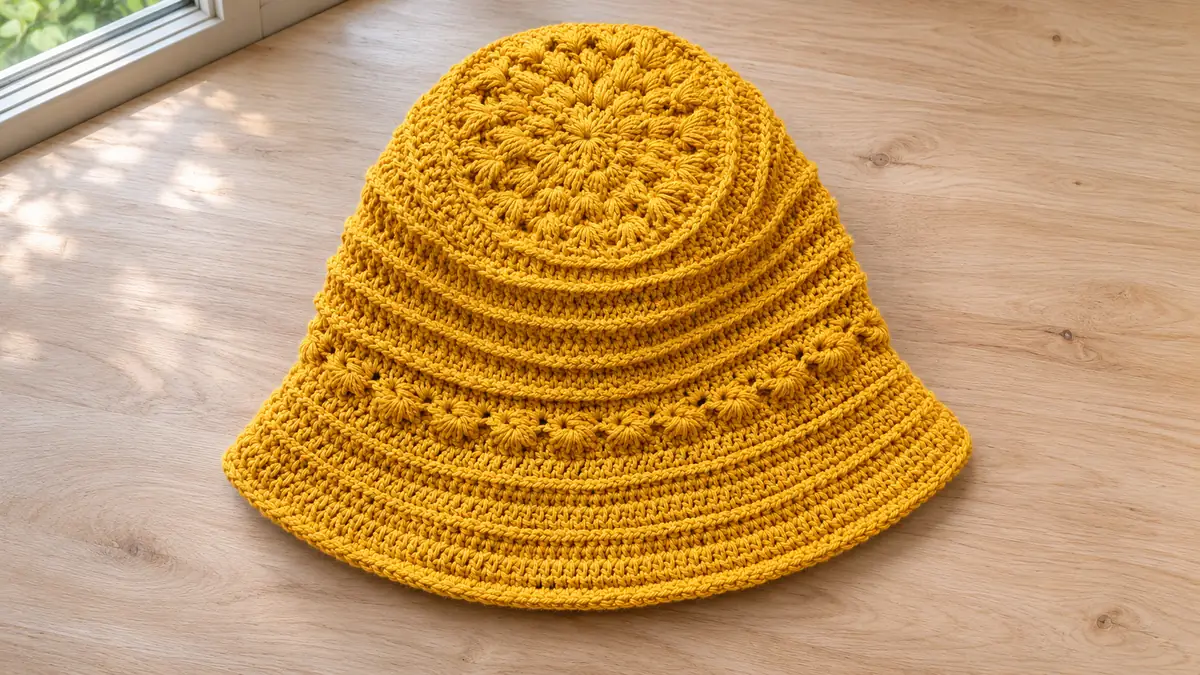
Scrap yarn moss stitch hat with an integrated ribbed brim
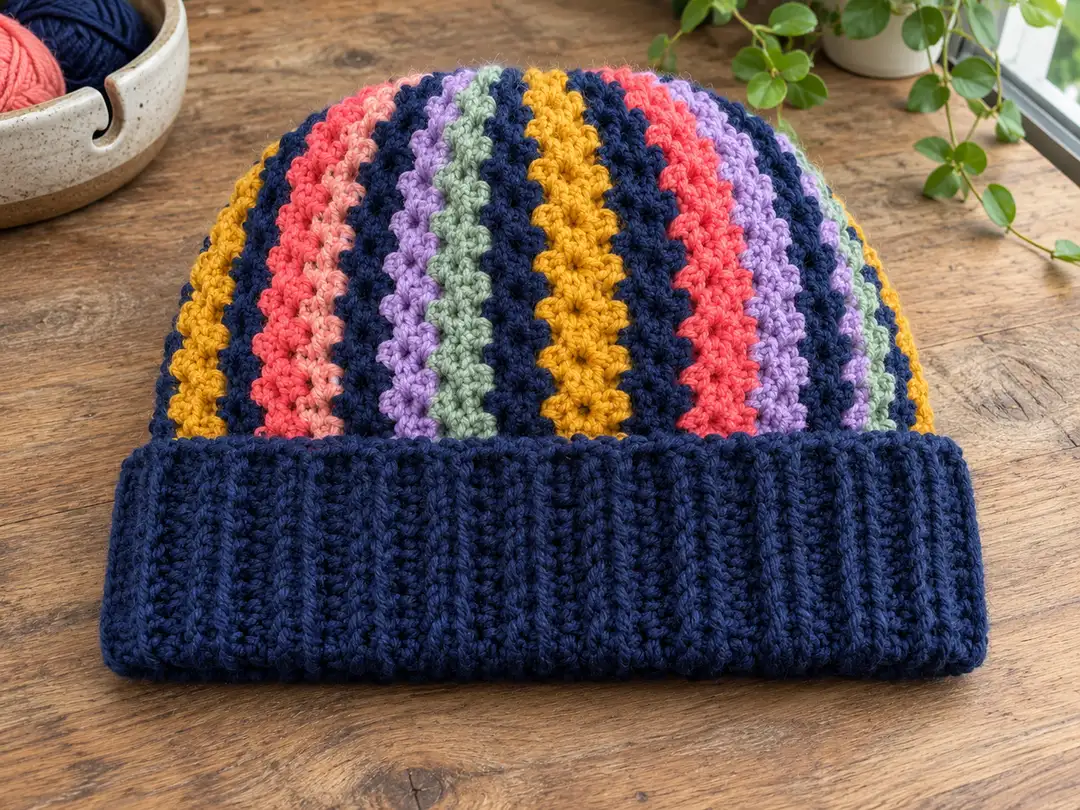
The ribbed brim and moss stitch body of this hat are worked within the same rows. The main color continues through the brim, while the body alternates between main-color sections and stripes made from scraps. Once the flat fabric is wide enough, the first and last edges are joined and the upper row

By Emma & EllaUpdated
Choose the size and organize the scrap colors
The ribbed brim and moss stitch body of this hat are worked within the same rows. The main color continues through the brim, while the body alternates between main-color sections and stripes made from scraps. Once the flat fabric is wide enough, the first and last edges are joined and the upper row ends are reduced into a gathered crown.
Materials and tension
Use DK yarn, a 4 mm crochet hook, a stitch marker, a yarn needle and scissors. A pompom is optional. The moss stitch tension is 12 sc and 12 chain spaces, with 21 rows, over 10 × 10 cm. Count the sc and chain spaces separately when checking this tension; the pattern’s surface is made from both elements.
| Size | Relaxed circumference × height with turn-up | Yarn | Foundation | Total rows |
|---|---|---|---|---|
| Child, 8–12 years | 47 × 18 cm | 50 g main color and 20 g scraps; approximately 2.5 m per stripe | 53 ch | 104 |
| Teenager/adult | 52 × 23 cm | 65 g main color and 21 g scraps; approximately 3 m per stripe | 63 ch | 112 |
These measurements are unstretched. The source gives 26 scrap-yarn stripes for the child size and 28 for the larger size. Keep the main color available throughout, since it is used in the brim even during a scrap-color stripe across the body.
US terminology
Ch means chain, sc means single crochet, sl st means slip stitch and dc means double crochet. US sc is US single crochet and US dc is US double crochet. Moss stitch here combines sc with 1-chain spaces, skipping the stitch below a chain and placing the next sc into the next chain space. The brim uses back-loop sc, with specified edge stitches worked through both loops.
For the basic stitches, see the crochet learning guide. The marker sits at the boundary between the brim and body. Move it into the new boundary position rather than leaving it several rows behind.
The size order below is child first, then teenager/adult in brackets. Both sizes have a 20-stitch brim section, while the moss stitch section grows from 16 to 21 repeats. Do not change the brim count when choosing the larger foundation.
Establish the brim and moss stitch in the first 2 rows
Row 1
- With the main color, work 53 (63) ch.
- Beginning in the 2nd chain from the hook, work 20 sc.
- Mark the 20th sc.
- Work 1 ch, skip 1 chain and work 1 sc, 16 (21) times.
- Work 2 ch and turn.
There are 52 (62) working positions, including the chains within the moss stitch. The 20 plain sc establish the brim boundary. The remaining foundation positions are used in alternating skipped-chain and sc pairs. Count the chain spaces as part of the pattern width rather than counting only the visible sc.
Row 2
- Work 1 sc into the first 1-chain space.
- Repeat 1 ch, skip 1 stitch and 1 sc into the next 1-chain space 15 (20) times.
- Move the marker at the brim boundary.
- Work 19 sc through back loops.
- Work the last sc through both loops.
- Work 1 ch and turn.
The turning method differs at the 2 ends: the moss stitch end has 2 ch, while the brim end has 1 ch. Keep that difference as written. It sets up the return into the chain spaces and the solid brim edge respectively. The final sc through both loops gives the brim’s outer edge a different treatment from its internal back-loop stitches.
Check the marker boundary before starting the colored stripe. The main color must remain in the brim, while the scrap color begins only as you complete the last brim stitch. That transition is easier to follow when the 20-stitch section is clearly identified.
Repeat the 4 stripe rows to the required width
Row 3: main-color brim, scrap-color body
- With the main color, work 1 sc through both loops.
- Work 19 sc through back loops and move the marker.
- Change to the scrap color while completing the final brim stitch.
- Leave the main color hanging behind the work.
- Work 1 ch, skip 1 stitch and 1 sc into the next chain space 16 (21) times.
- Place the final sc into the space before the 2 turning chains.
- Work 2 ch and turn.
Changing color on the final pull-through of the last brim stitch allows the new color to begin in the body without making an extra stitch at the boundary. Do not cut the main color here; it is needed again when the return row reaches the brim.
Row 4: return through the scrap stripe
- With the scrap color, work 1 sc into the first 1-chain space.
- Repeat 1 ch, skip 1 stitch and 1 sc into the next chain space 15 (20) times.
- Change to the main color on the final pull-through.
- Move the marker, work 19 back-loop sc and 1 sc through both loops.
- Cut the scrap yarn, leaving a sufficiently long end.
- Work 1 ch and turn.
The source does not give a numerical length for that scrap tail. Leave it available for the stated weaving-in step rather than assigning a new fixed measurement. The main color resumes for the brim, so the colored stripe does not extend through the folded section.
Row 5: main color throughout
- Work the same stitch arrangement as Row 3, but remain in the main color throughout.
- In the moss stitch section, crochet over the scrap-yarn end.
- Work 2 ch and turn at the body end.
Row 6: main-color return
- Work the same stitch arrangement as Row 2 in the main color.
- Keep the 19 back-loop sc and final both-loop sc at the brim.
- Work 1 ch and turn.
Repeat Rows 3–6. Finish the child version after Row 104 and the larger version after Row 112, each ending with a repeat of Row 4. If adjusting the circumference, likewise finish after a Row 4. The specified stopping position matters for the seam and color arrangement; do not stop on an arbitrary row simply because the piece looks nearly wide enough.
The numbered repeat continues beyond its first occurrence. Row 104 or Row 112 is a Row 4-type return in the repeating sequence, not a direction to restart the entire foundation. Keep a tally of completed rows and scrap stripes. The source’s 26 or 28 stripes provides another check on the intended sequence.
For a different use of leftover yarn with visible tied ends, see the short-fringed scrap yarn hat. This moss stitch version instead carries the main color through the brim and works the scrap tail into the following main-color section.
Join the seam and reduce the row ends into the crown
Side seam
- Place the right sides together.
- Join the foundation edge and the final row with slip stitches.
- Insert through the corresponding foundation chain and the front loop of the final row.
- Work from the brim toward the upper edge.
- Secure the working loop with the marker.
- Turn the tube right side out.
The seam joins the edges that determine the circumference. Keep the brim ends aligned before working upwards. The front-loop treatment on the final row is specified; do not automatically replace it with both loops merely because the seam is made with slip stitches.
Crown Round 1
- Work 1 ch.
- Along the upper edge, combine each pair of neighboring row ends into 1 sc.
- There are 52 (56) sc.
- Join with a sl st into the first sc.
- Work 2 ch and do not turn.
The row counts divide into pairs: 104 row ends produce 52 sc, and 112 produce 56. These are row-end combinations, not 1 sc into every separate row end. Keep this distinction clear to avoid retaining twice the intended crown count.
Crown Round 2 and gathering
- Begin in the same position.
- Work the stitches together in pairs as double crochet decreases.
- There are 26 (28) stitches.
- Join with a sl st into the top beginning chain.
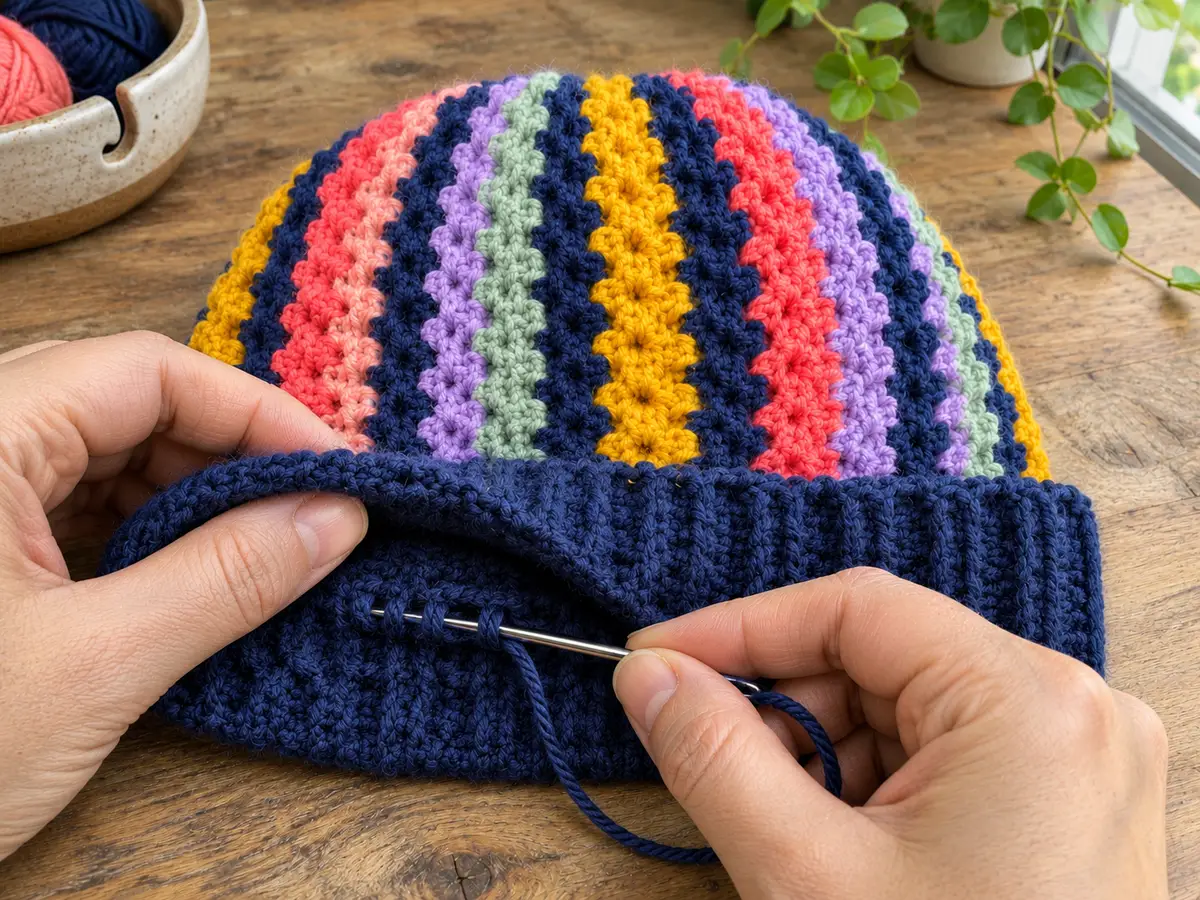
- Cut the yarn, leaving a long end.
- Thread the end loosely through the front loops of the final round.
- Draw the opening together, secure the yarn and weave in all ends.
Each paired double crochet decrease turns 2 base stitches into 1, halving the preceding 52 or 56. After that round, the yarn tail performs the final gathering. The source gives a long tail without a numerical length, so keep enough for the stated threading and securing rather than adding a fixed measurement.
Fold the brim in half and attach a pompom if desired. The pompom is optional, and no mandatory diameter or attachment system is supplied. Check that the side seam and gathered opening are secure before arranging the fold.
A simpler ribbed fold is shown in the fisherman-style hat. Here the brim and striped moss stitch have been worked together within the same rows. The completed hat retains the main-color fold beneath its scrap-color body.
Check the moss stitch and brim boundary
Look at the chain spaces rather than trying to place the sc into the top of every visible sc. The moss stitch repeats are anchored in the spaces specified in the instructions. Missing a space changes the body width, while adding a sc beside a space creates another working position. At the brim boundary, count the solid stitches separately from the alternating body pattern so a displaced marker does not turn part of the brim into moss stitch.
When carrying the main color through a scrap stripe, leave it behind the work as instructed. Do not draw it so tightly across the boundary that the fabric puckers. On the return, take it up at the last pull-through before the brim. This keeps the color change at the same construction boundary in both directions without adding another stitch.
Before joining, lay the piece out and identify the upper edge by its row ends and the lower edge by the ribbed brim. Pairing neighboring row ends at the crown is different from working into the foundation-chain positions used for the side seam. If you pause between those stages, mark the secured working loop and the beginning of the upper edge so the fabric is not reoriented accidentally. Finally, keep the folded brim free while drawing the crown tail tight; the gathering belongs only to the upper opening.
Emma & Ella
More crochet projects from The Cooking Twins Yarn.
More from Emma & Ella