2-color striped crochet beanie in3 sizes
This 2-color beanie is crocheted from the crown toward the lower edge. A taller US double crochet round in the main color alternates with a lower US single-crochet round in the contrast color. The final 3 rounds use only the contrast color, creating a separate edge without a sewn-on brim.

By Emma & EllaUpdated
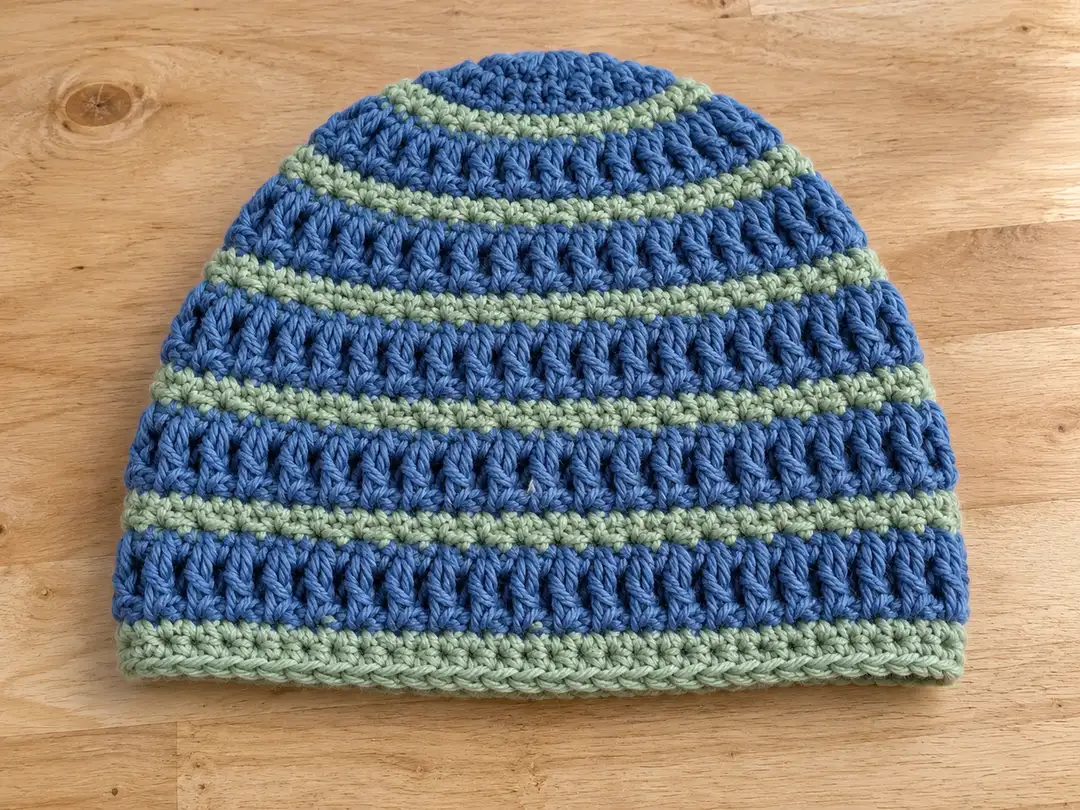
This 2-color beanie is crocheted from the crown toward the lower edge. A taller US double crochet round in the main color alternates with a lower US single-crochet round in the contrast color. The final 3 rounds use only the contrast color, creating a separate edge without a sewn-on brim.
The source gives 3 versions:small baby or toddler, medium and large. Use the measurements and material allowances for the selected version rather than mixing their increase rounds. The sizes are rounded reference values, and actual yarn tension still determines the finished fabric.
Choose the size, yarn and color-change method
Materials and 3-size table
Use worsted yarn, a5.5 mm crochet hook and a yarn needle. Have scissors ready for finishing. The source tension is 12 US double crochets and 8 rows over approximately 10 ×10 cm.
| Size | Finished circumference ×height | Suggested maximum head circumference | Main yarn | Contrast yarn |
|---|---|---|---|---|
| Baby/toddler | 39 ×15 cm | 43 cm | 68 m | 27 m |
| Medium | 53 ×20 cm | 58 cm | 91 m | 46 m |
| Large | 58 ×23 cm | 64 cm | 137 m | 69 m |
The hat is intended to stretch beyond its finished circumference. Check the actual fabric rather than treating the largest head reference as a guaranteed fit for any yarn. A dense carried edge or tight joining stitch can affect the opening independently of the main stitch count.
Make a sample with the intended yarn and hook before choosing a version. Measure relaxed, dry fabric rather than stretching it to the table. The source gives a common tension rather than additional needle sizes for each version.
US crochet glossary
Ch means chain, sl st means slip stitch, sc means US single crochet and dc means US double crochet. US sc is US single crochet, and US dc is US double crochet. MC is main color and CC is contrast.
In double crochet rounds, the 3 beginning chains count as the first dc. In sc rounds, the beginning 1 chain does not count. Keep those 2 conventions separate. Counting both beginnings as ordinary stitches would add unwanted positions in the short rounds.
The crochet learning section offers related basics. Do not replace the alternating stitch heights with ordinary single-height stripes, as the construction uses both texture and color.
Change color when joining
Draw the new color through the joining insertion and through the loop on the hook when closing a round. Leave the unused yarn hanging and carry it loosely inside to its next round. Do not cut both colors after every stripe.
Keep the travelling strand relaxed enough not to draw the join into a short tight column. Check the reverse as well as the visible stripes. A correct color order does not by itself prove that the join has the intended stretch.
Work the first 6 rounds shared by all sizes
Starting ring and increase sequence
- Round 1, MC:join 4 ch into a ring or use a magic ring.Work 3 ch and 11 dc into the ring.Join with CC in the top starting chain.Total 12 dc.
- Round 2, CC:1 ch, 2 sc into every double crochet.Join using MC.Total 24 sc.
- Round 3, MC:3 ch, 1 dc into same stitch, 1 dc into next stitch; continue 2 dc in 1 stitch, 1 dc in next around.Join using CC.Total 36 dc.
- Round 4, CC:1 ch, 1 sc in each stitch.Join using MC.Total 36.
- Round 5, MC:3 ch, 1 dc into same stitch, 1 dc into each of next 2 stitches; continue 2 dc in 1 stitch, then 1 dc in each of next 2 around.Join using CC.Total 48.
- Round 6, CC:1 ch, 1 sc in each stitch.Join using MC.Total 48.
Use only 1 starting-ring alternative. The 3-chain first double crochet in an increase group is paired with the additional double crochet into that same position. Do not add 2 more double crochets there, which would create a3-stitch group instead of 2.
Round 3 uses 12 repeats of 2 old stitches to create 36. Round 5 uses 12 repeats of 3 old stitches to create 48. The unchanged CC rounds retain the current count and do not add more crown width.
Plain round conventions after the increases
A plain sc round begins 1 ch and works 1 sc into every stitch, joining to the first actual sc. A plain double crochet round begins 3 ch as its first dc and works 1 dc into each remaining stitch, joining to the top starting chain.
Keep the starting marker or visual join position consistent. A slip stitch is a closure rather than an extra ordinary stitch in the next round. Count before moving to the size-specific section if the crown edge appears uneven.
Continue the small, medium or large body
Baby or toddler version:48 stitches
- Small round 7:MC, 48 dc.
- Small round 8:CC, 48 sc.
- Small round 9:MC, 48 dc.
- Small round 10:CC, 48 sc.
- Small round 11:MC, 48 dc.
Cut MC after round 11, leaving approximately 15 cm for finishing. Do not add the medium version's next increase. The small body remains at 48 until its final 3 contrast rounds.
Medium version:increase to 60
- Medium round 7, MC:3 ch, 1 dc into first stitch, 1 dc into each of next 3; repeat 2 dc in 1 stitch, 1 dc in each of next 3 around.Total 60.
- Medium round 8:CC, 60 sc.
- Medium round 9:MC, 60 dc.
- Medium round 10:CC, 60 sc.
- Medium round 11:MC, 60 dc.
- Medium round 12:CC, 60 sc.
- Medium round 13:MC, 60 dc.
- Medium round 14:CC, 60 sc.
- Medium round 15:MC, 60 dc.
Cut MC after round 15 with approximately 15 cm remaining. The round 7 repeat uses 4 old positions and makes 5, so 12 repeats take 48 to 60. Later body rounds keep that width rather than increasing on every MC round.
Large version:increase to 72
- Large round 7:as medium round 7, increase to 60.
- Large round 8:CC, 60 sc.
- Large round 9, MC:3 ch, 1 dc into first stitch, 1 dc into each of next 4; repeat 2 dc in 1 stitch, 1 dc in each of next 4 around.Total 72.
- Large round 10:CC, 72 sc.
- Large round 11:MC, 72 dc.
- Large round 12:CC, 72 sc.
- Large round 13:MC, 72 dc.
- Large round 14:CC, 72 sc.
- Large round 15:MC, 72 dc.
- Large round 16:CC, 72 sc.
- Large round 17:MC, 72 dc.
Cut MC after round 17 with approximately 15 cm remaining. Its final increase uses 5 old positions and produces 6 per group, so 12 groups turn 60 into 72. Keep the small, medium and large counts distinct when using the common plain-round method.
Finish with 3 contrast rounds and secure the ends
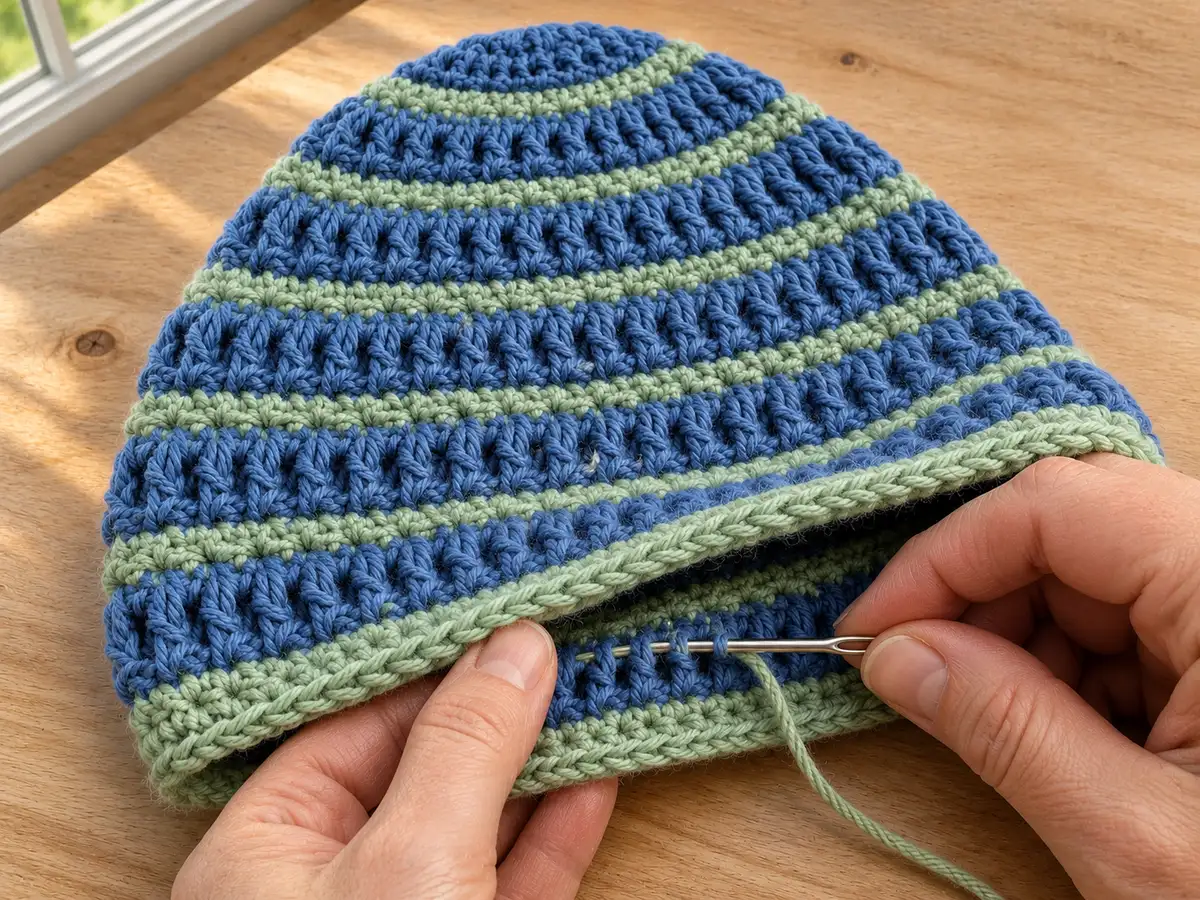
Final edge for every version
Keep working in CC without further color changes. The final sequence is 1 sc round, 1 double crochet round and 1 sc round, each joined with sl st. The stitch count stays at the selected body's48, 60 or 72.
- Small round 12:CC, 48 sc.
- Small round 13:CC, 48 dc.
- Small round 14:CC, 48 sc.
- Medium round 16:CC, 60 sc.
- Medium round 17:CC, 60 dc.
- Medium round 18:CC, 60 sc.
- Large round 18:CC, 72 sc.
- Large round 19:CC, 72 dc.
- Large round 20:CC, 72 sc.
The source permits an additional reverse-sc, or crab-stitch, round for a decorative edge. It is optional rather than 1 of the 3 required contrast rounds. No separate size-changing calculation is supplied for that embellishment.
Check the lower opening before trimming
Inspect the round join and test the edge's stretch gently. Beginning chains and closures can become tighter than the main fabric if pulled sharply. Do not force a tight edge to match an unsupported measurement before checking its stitches.
Weave the retained MC tail and finishing CC ends through suitable inside stitches without gathering the stripes. Cut excess only after the ends are secure. Keep the color-change column free from long loose loops.
Record the selected size and compare other constructions
Record yarn, hook, selected version and any optional edge. A different worsted yarn can change both height and circumference at the same count. Keep the source dimensions separate from your own measured result.
The autumn hat with a ribbed brim is another 2-color option, but its body is built onto a transverse brim rather than this crown-first circle. The rectangle ribbed hat uses a side seam and gathered top. Neither shares this 12-to 48/60/72 increase sequence.
Keep the size branch and starting-chain convention visible
Write the chosen version beside the common first6 rounds before beginning. All3 hats look similar at48 stitches, but they diverge at round7. The small version stays plain, while medium and large both add12 stitches. Only the large version adds another12 at round9. A note of the selected branch prevents a larger crown being worked automatically when you intended the smaller hat.
The beginning3 chains count as1 double crochet in a tall round. If an increase is required at that position, the additional double crochet is worked into the same base stitch. On a plain tall round,the next ordinary double crochet goes into the following position instead. Keeping this difference clear avoids adding1 accidental stitch at every join.
The beginning1 chain of a sc round has a different role: it provides movement into the next round but does not replace its first sc. Work the actual first sc as stated and join to it at the end. Do not join into the uncounted chain and then treat that join as another base stitch.
When changing color, keep the unused strand inside the hat without wrapping it tightly around the edge. The stripe sequence alternates every round until the final contrast section. A short carried strand can draw the2 neighboring rounds together and make the color-change column less elastic than the rest of the fabric.
Before cutting MC, check the completed round number for the selected size: 11,15 or17. The retained15 cm tail is for finishing,not an instruction to add another stripe. The next3 rounds stay in CC in the same sc, dc, sc order for every version.
Keep both relaxed measurements and material details with the project. The rounded source size table is a reference rather than a claim that every worsted yarn and every crocheter produce identical fabric. If your sample differs, review it before assuming that a different final edging can correct the whole hat.
Emma & Ella
More crochet projects from The Cooking Twins Yarn.
More from Emma & Ella