Colorwork baby socks knitting pattern: 2 sizes
These small socks are knitted from cuff to toe. An elastic ribbed cuff is followed by a narrow colorwork band, a German short-row heel, a striped foot and a star toe. Both sizes use a 12-stitch color repeat, but the larger sock includes a second colorwork band. The stitch positions are written out

By Emma & EllaUpdated
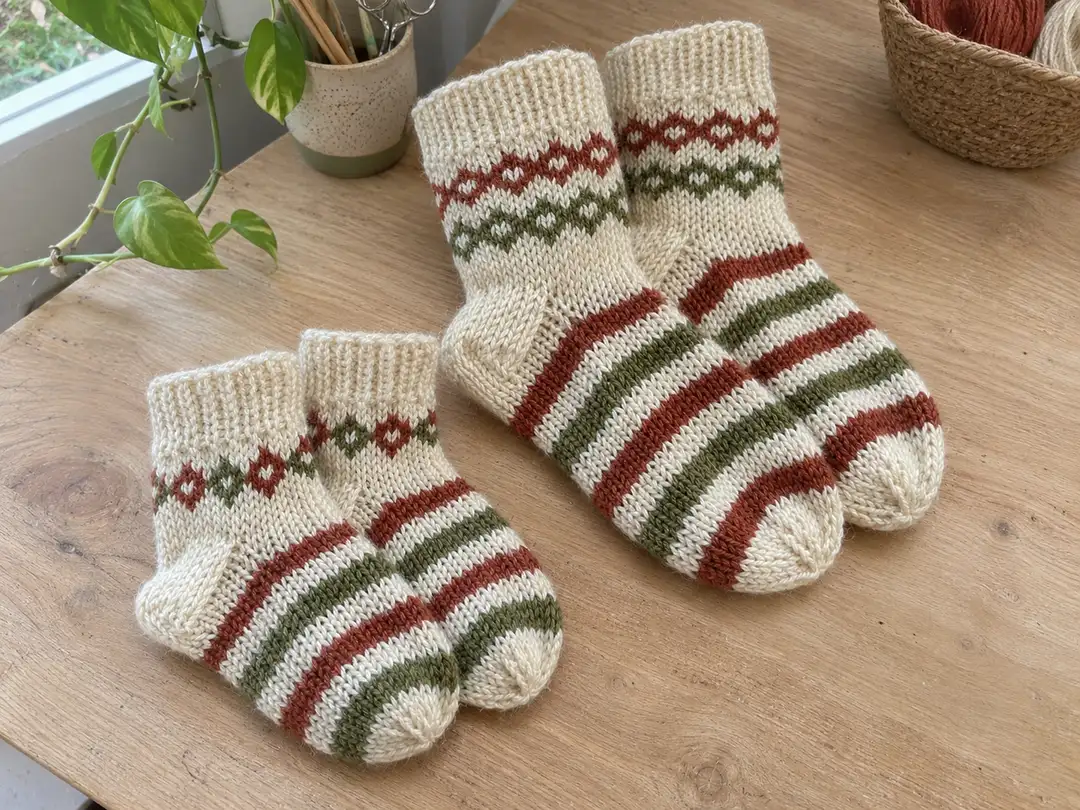
These small socks are knitted from cuff to toe. An elastic ribbed cuff is followed by a narrow colorwork band, a German short-row heel, a striped foot and a star toe. Both sizes use a 12-stitch color repeat, but the larger sock includes a second colorwork band. The stitch positions are written out so that the small geometric motif can be followed without a separate chart.
All paired numbers are given in the order small, large. The small sock has an approximate foot length of 10 cm. The larger version is labelled children's size 25 in the source and has an approximate foot length of 14 cm. Choose by the actual required foot length and your tension rather than relying only on the age or shoe-size label.
Prepare the yarn and knit the ribbed cuffs
Materials, tension and size references
| Feature | Small | Large |
|---|---|---|
| Reference foot length | 10 cm | 14 cm |
| Yarn amount | 12 g main color + 4 g contrast, total 16 g | Approximately 30 g total |
| Cast-on stitches | 44 | 48 |
| Cuff rounds | 8 | 10 |
| Colorwork rounds | 7 | 17 |
| Heel stitches | 20 | 24 |
Use fine sock yarn. Leftovers can work if their thickness, elasticity and care requirements are compatible. The small version uses 1 main and 1 contrast color. The larger version uses 2 motif bands with different contrast colors. Keep the floats relaxed so that the band can stretch over the foot; a tight colorwork section can be restrictive even with the correct stitch count.
Prepare 2 mm, 2.25 mm and 2.5 mm needles as double-pointed needles or a long circular needle for magic loop. You also need a yarn needle, scissors and optionally 2 markers for the heel division. The reference tension is 34 stitches and 42 rounds per 10 cm in stockinette stitch on 2.5 mm needles.
These are knitting instructions. K means knit, p means purl, k2tog means knit 2 together, and kfb means knit into the front and back of the same stitch to increase. Main color is MC; the contrasts are CC1 and CC2. The hooded baby cardigan offers a separate coordinating project, but its measurements do not determine the sock fit.
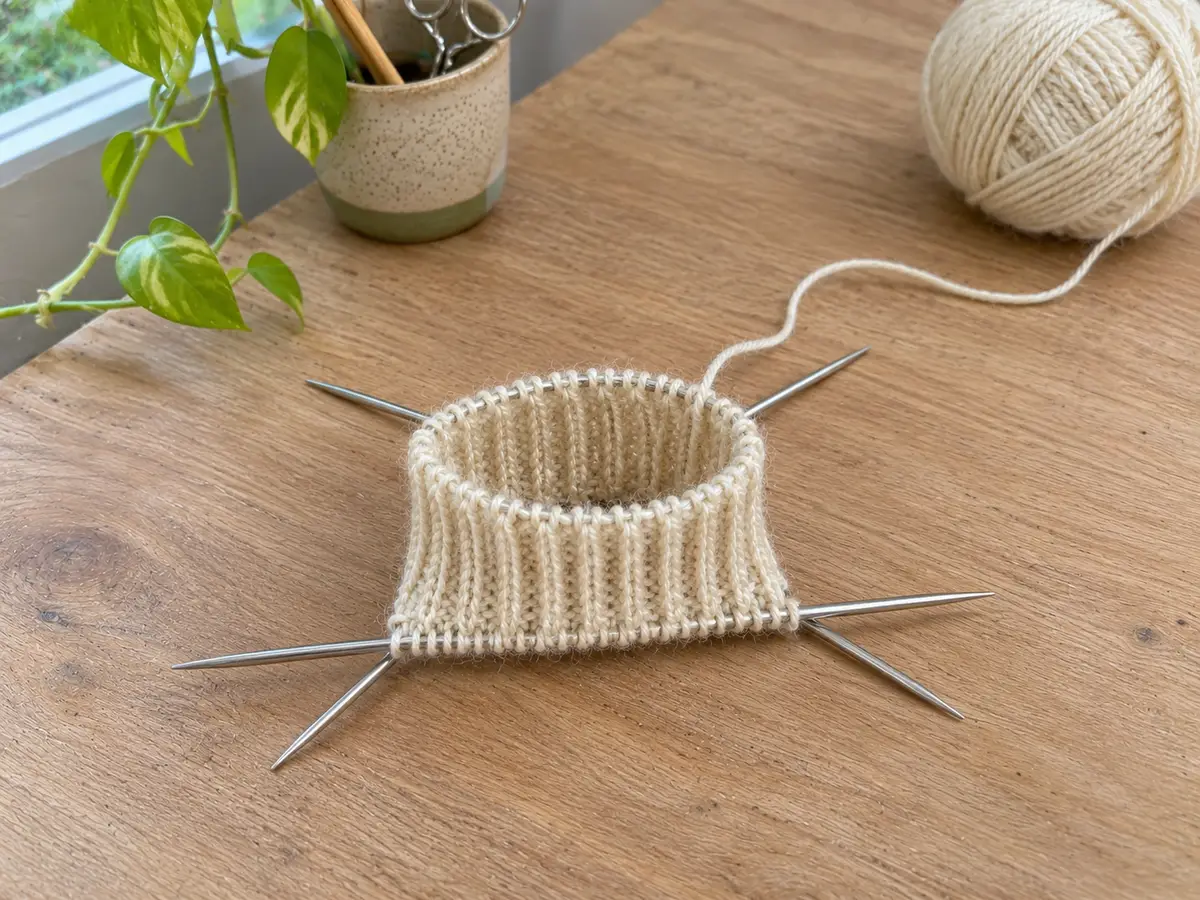
Cuff and preparation round
- Cast on 44 or 48 stitches in MC on 2 mm needles.
- Join without twisting the cast-on edge.
- Work k1, p1 rib for 8 or 10 rounds, according to size.
- Change to 2.5 mm needles.
- Small preparation round: repeat k10, kfb 4 times, increasing 44 stitches to 48.
- Large preparation round: knit all 48 stitches without increasing.
Both sizes now have 48 stitches, or 4 repeats of 12. Number each repeat from 1 to 12 in knitting direction, then begin again at 1 for the next repeat. The motif positions below describe positions inside each repeat, not the overall stitch numbers around the sock.
Knit the complete colorwork bands
First band in CC1
Only the listed positions are knitted in the contrast color. Knit every unlisted position in MC. Repeat the 12-position sequence 4 times around every round. These color changes do not add or remove stitches.
| Motif round | CC1 positions within each 12-stitch repeat |
|---|---|
| 1 | 1, 7, 8, 9 |
| 2 | 2, 6, 7, 8, 9, 10 |
| 3 | 3, 5, 6, 7, 8, 9, 10, 11 |
| 4 | 4, 5, 6, 7, 8, 9, 11, 12 |
| 5 | 3, 5, 6, 7, 8, 9, 10, 11 |
| 6 | 2, 6, 7, 8, 9, 10 |
| 7 | 1, 7, 8, 9 |
The small version finishes its motif after round 7. Cut and secure the contrast yarn, then follow its transition instructions below. The larger version continues with the following 10 rounds. Keep the floats loose across each repeat rather than tightening them at the boundary between repeats.
Second band for the large size only
| Motif round | Instructions or CC2 positions |
|---|---|
| 8 | All stitches MC |
| 9 | All stitches MC |
| 10 | All stitches MC |
| 11 | 1, 7, 11, 12 |
| 12 | 1, 2, 6, 10, 11, 12 |
| 13 | 1, 2, 3, 5, 9, 10, 11, 12 |
| 14 | 1, 2, 3, 4, 8, 9, 11, 12 |
| 15 | 1, 2, 3, 5, 9, 10, 11, 12 |
| 16 | 1, 2, 6, 10, 11, 12 |
| 17 | 1, 7, 11, 12 |
After the relevant band, cut the contrast yarn and weave it in. Change to 2.25 mm needles and continue in MC. For the small size, repeat k4, k2tog around, reducing 48 stitches to 40. For the large size, knit 1 unchanged round over 48 stitches.
Do not apply the small size's decrease to the large sock at this point. The large sock retains 48 stitches through its heel and foot and reaches 40 only at the beginning of the toe. This distinction keeps the heel division and later toe sequence consistent.
Shape the heel with German short rows
Divide the heel and make double stitches
Work the heel over half the total stitches: 20 for small or 24 for large. The other half rests. Divide the heel mentally into 7/6/7 stitches or 8/8/8 stitches. Use markers if that helps identify the center section without confusing the resting instep stitches with the active heel.
To make a double stitch after turning, slip the first stitch purlwise with yarn in front and pull the yarn firmly upwards over the needle until 2 legs are visible. They belong to 1 stitch. When working that double stitch later, take both legs together as a single knit or purl stitch. Counting the legs separately creates a false increase and can leave holes.
Shorten the heel rows
- Heel row 1, right side: knit all heel stitches and turn.
- Heel row 2: make a double stitch, purl to the end and turn.
- Heel row 3: make a double stitch, knit to the last double stitch without working it, then turn.
- Heel row 4: make a double stitch, purl to the last double stitch without working it, then turn.
Repeat rows 3 and 4 until there are 7 or 8 double stitches on the left side and 1 fewer on the right side. That unequal intermediate count is part of the sequence. Do not add an invented balancing row to make both sides equal at this stage.
Extend the rows again
- Next right-side row: make a double stitch, knit to the next double stitch, knit both its legs together as 1 stitch and turn.
- Next wrong-side row: slip the first stitch with yarn in front, purl to the next double stitch, purl it as 1 stitch and turn.
- Next right-side row: slip the first stitch with yarn behind, knit to the next double stitch, work it as 1 stitch and turn.
- Next wrong-side row: slip the first stitch with yarn in front, purl to the next double stitch, work it as 1 stitch and turn.
Repeat the last 2 rows until 1 double stitch remains on each side. On the next right-side row, slip the first stitch with yarn behind, knit to the double stitch and work it knitwise. Do not turn again. Continue around all the sock stitches and work the final remaining double stitch knitwise when reached.
The sock still has 40 or 48 total stitches. The heel shaping has not added permanent stitches. Inspect the double-stitch areas before moving far into the foot so that an unworked leg or accidental extra loop can be recognised while the heel is still easy to inspect.
Stripe the foot and finish the star toe
Foot stripes and length
Work the foot in stockinette stitch in the round. Each stripe section has 4 MC rounds followed by 2 contrast rounds. The source uses 3 sections for small, giving 18 rounds, and 5 sections for large, giving 30 rounds. These are examples at the source tension, not a substitute for checking the required foot length and allowing for the toe.
Keep the color changes at a recurring position so that both socks are comparable. You may exchange the colors between socks for an intentionally different pair, but record the change. Different color proportions can alter the amount of each shade used, so the original gram division may no longer apply.
Star toe: separate decrease and plain rounds
- Large only, initial decrease round: repeat k4, k2tog. Total 40.
- Large only, next plain round 1: knit 40.
- Large only, next plain round 2: knit 40.
- Large only, next plain round 3: knit 40.
- Large only, next plain round 4: knit 40.
- Both sizes, next decrease round: repeat k3, k2tog. Total 32.
- Next plain round 1: knit 32.
- Next plain round 2: knit 32.
- Next plain round 3: knit 32.
- Next decrease round: repeat k2, k2tog. Total 24.
- Next plain round 1: knit 24.
- Next plain round 2: knit 24.
- Next decrease round: repeat k1, k2tog. Total 16.
- Next plain round: knit 16.
- Final decrease round: k2tog throughout. Total 8.
The small size begins at the shared 40-to-32 decrease because it already has 40 stitches. Cut the yarn, pass it through the remaining 8 stitches, close the toe and secure the end inside. Do not work the large-only preliminary section on the small sock.
Make the matching sock and finish
Knit the second sock using the same size, colors and recorded foot rounds. Check the heels for unresolved double stitches and the motif bands for overly tight floats. Relax the socks according to the yarn care instructions rather than forcing them onto a desired measurement when the original tension was incorrect.
For a larger project worked in the opposite direction, see the toe-up lace socks. The knitted baby animals use leftovers in a different way. Keep this sock's 12-stitch motif, double-stitch heel and star toe notes together for another matching pair.
Keep the size sequence visible while working
Mark the selected size in your notes before casting on, especially if you are interrupted between the cuff and heel. Both sizes temporarily share 48 stitches during colorwork, which can make it easy to resume from the wrong branch of the instructions. The small sock then decreases to 40 before the heel, while the large one stays at 48. Check that transition as well as the chosen foot length.
For the colorwork, review a complete 12-stitch repeat before moving to the next. Unlisted positions stay in the main color even when the contrast yarn continues behind them. Spread the stitches gently along the needle while checking the floats instead of tightening the carried yarn between motifs. Record the final foot stripe section and toe starting point so that the second sock follows the same sequence without relying on its apparent length alone.
Emma & Ella
More crochet projects from The Cooking Twins Yarn.
More from Emma & Ella