Crochet baby blanket with a wide patterned border
This baby blanket combines a dense cream center with a wide 3-color border. The center is worked in rows; 25 rounds then build the surrounding pattern. Single crochet, half double crochets, crossed double crochets and chain windows alternate before a blue picot edge.

By Emma & EllaUpdated
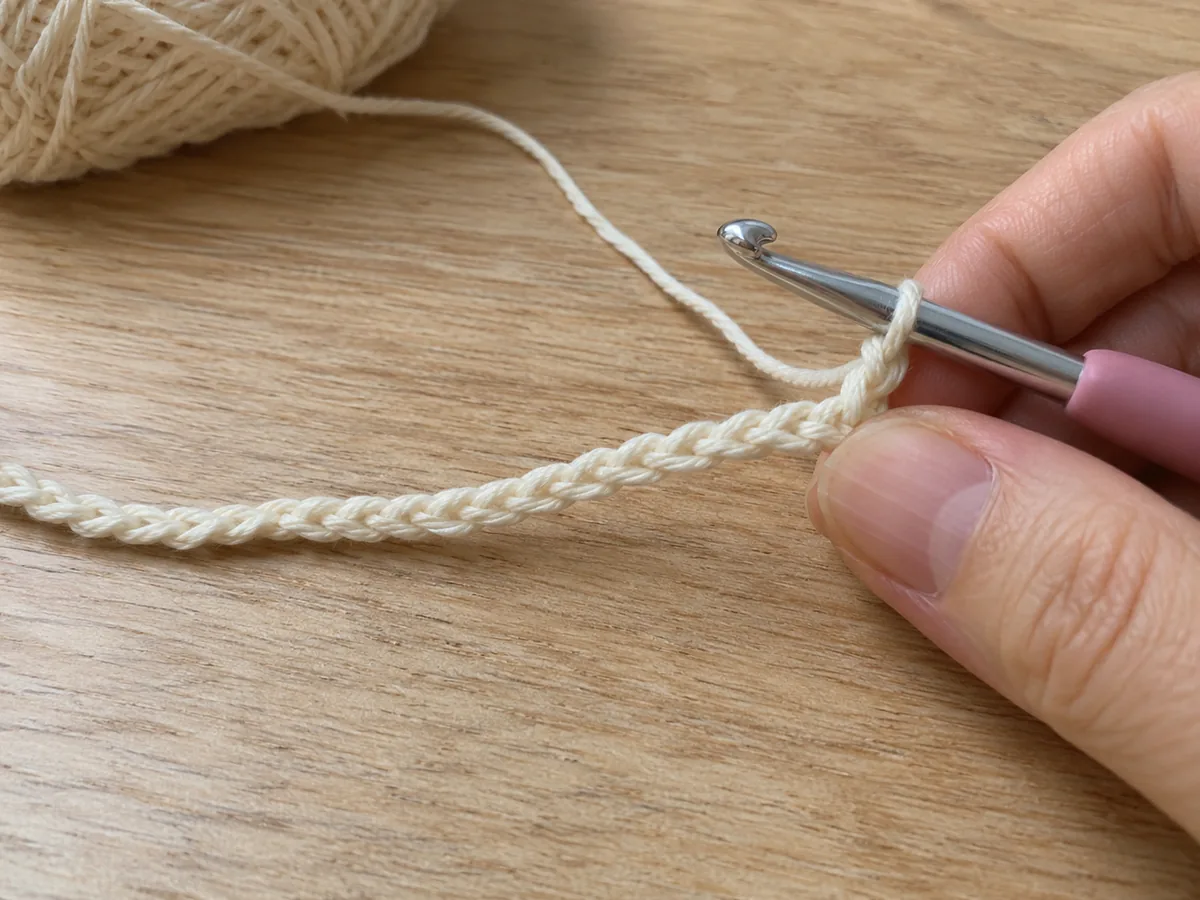
This baby blanket combines a dense cream center with a wide 3-color border. The center is worked in rows; 25 rounds then build the surrounding pattern. Single crochet, half double crochets, crossed double crochets and chain windows alternate before a blue picot edge.
The border is part of the design rather than an optional generic finish. Its later rounds depend on earlier stitch counts, so the complete sequence is provided below. All stitch names use US terminology.
Prepare the yarn, hook sizes and US stitch definitions
Reference materials and size
| Item | Reference |
|---|---|
| Finished dimensions | Approximately 77 × 63 cm |
| Yarn length | Cotton, 175 m per 50 g |
| A: cream | 4 balls |
| B: yellow | 2 balls |
| C: blue | 2 balls |
| Total yarn supplied | 400 g / 1,400 m |
| Hooks | 4 mm for the center; 3.5 mm for the border |
Also prepare scissors, a blunt yarn needle, measuring tape and markers. Keep a separate supply of each border color so that the center does not use yarn needed for the wide edge.
Make a sample in the intended yarn and measure after the planned washing and complete drying. Record the hook, dimensions and sample weight. Different yarn can change both size and consumption; the reference measurements are not a guarantee for every cotton.
US glossary and special stitches
| Term | Meaning |
|---|---|
| sc / hdc / dc | US single crochet / half double crochet / double crochet |
| ch / sl st / BLO | Chain / slip stitch / back loop only |
| 2-dc cluster | 2 unfinished double crochets completed together in the same insertion point |
| Crossed pair | Skip a stitch, dc in the following stitch, then dc back into the skipped stitch |
| Picot | 3 ch, sl st into the center of its associated sc, taking both side loops |
The cluster is not a decrease across neighboring stitches. Work both incomplete double crochets in the same place, then draw through the 3 remaining loops together. Keep that distinction clear throughout the center.
Use markers for corners and checked sections, but still count. If a side changes width, return to the last verified section rather than adding arbitrary stitches near the end.
Work the cream center over 78 separate rows
Foundation and its final stitch
With A and 4 mm, make 89 ch. Work a cluster into the 3rd chain. Skip 2 chains, then repeat [1 sc and 1 cluster in the next chain, skip 2 chains].
After the final cluster in foundation chain 87, skip only chain 88 and work 1 sc into the final chain 89. The general skip-2 instruction stops before that specifically stated last stitch. This preserves 29 clusters and 29 sc, including the final sc.
The center begins with a cluster and ends with a sc. The foundation is 89 = 87 + 2, including the starting rise. Do not automatically change it to 90 because the underlying repeat is associated with a multiple of 3.
Complete row checklist
- Row 1: Work the 89-chain foundation sequence described above; 29 clusters and 29 sc.
- Row 2: 2 ch, cluster in first sc; skip previous cluster; repeat [sc and cluster in next sc, skip previous cluster]; end with sc in the previous starting 2 ch. Turn.
- Row 3: 2 ch, cluster in first sc; skip previous cluster; repeat [sc and cluster in next sc, skip previous cluster]; end with sc in the previous starting 2 ch. Turn.
- Row 4: 2 ch, cluster in first sc; skip previous cluster; repeat [sc and cluster in next sc, skip previous cluster]; end with sc in the previous starting 2 ch. Turn.
- Row 5: 2 ch, cluster in first sc; skip previous cluster; repeat [sc and cluster in next sc, skip previous cluster]; end with sc in the previous starting 2 ch. Turn.
- Row 6: 2 ch, cluster in first sc; skip previous cluster; repeat [sc and cluster in next sc, skip previous cluster]; end with sc in the previous starting 2 ch. Turn.
- Row 7: 2 ch, cluster in first sc; skip previous cluster; repeat [sc and cluster in next sc, skip previous cluster]; end with sc in the previous starting 2 ch. Turn.
- Row 8: 2 ch, cluster in first sc; skip previous cluster; repeat [sc and cluster in next sc, skip previous cluster]; end with sc in the previous starting 2 ch. Turn.
- Row 9: 2 ch, cluster in first sc; skip previous cluster; repeat [sc and cluster in next sc, skip previous cluster]; end with sc in the previous starting 2 ch. Turn.
- Row 10: 2 ch, cluster in first sc; skip previous cluster; repeat [sc and cluster in next sc, skip previous cluster]; end with sc in the previous starting 2 ch. Turn.
- Row 11: 2 ch, cluster in first sc; skip previous cluster; repeat [sc and cluster in next sc, skip previous cluster]; end with sc in the previous starting 2 ch. Turn.
- Row 12: 2 ch, cluster in first sc; skip previous cluster; repeat [sc and cluster in next sc, skip previous cluster]; end with sc in the previous starting 2 ch. Turn.
- Row 13: 2 ch, cluster in first sc; skip previous cluster; repeat [sc and cluster in next sc, skip previous cluster]; end with sc in the previous starting 2 ch. Turn.
- Row 14: 2 ch, cluster in first sc; skip previous cluster; repeat [sc and cluster in next sc, skip previous cluster]; end with sc in the previous starting 2 ch. Turn.
- Row 15: 2 ch, cluster in first sc; skip previous cluster; repeat [sc and cluster in next sc, skip previous cluster]; end with sc in the previous starting 2 ch. Turn.
- Row 16: 2 ch, cluster in first sc; skip previous cluster; repeat [sc and cluster in next sc, skip previous cluster]; end with sc in the previous starting 2 ch. Turn.
- Row 17: 2 ch, cluster in first sc; skip previous cluster; repeat [sc and cluster in next sc, skip previous cluster]; end with sc in the previous starting 2 ch. Turn.
- Row 18: 2 ch, cluster in first sc; skip previous cluster; repeat [sc and cluster in next sc, skip previous cluster]; end with sc in the previous starting 2 ch. Turn.
- Row 19: 2 ch, cluster in first sc; skip previous cluster; repeat [sc and cluster in next sc, skip previous cluster]; end with sc in the previous starting 2 ch. Turn.
- Row 20: 2 ch, cluster in first sc; skip previous cluster; repeat [sc and cluster in next sc, skip previous cluster]; end with sc in the previous starting 2 ch. Turn.
- Row 21: 2 ch, cluster in first sc; skip previous cluster; repeat [sc and cluster in next sc, skip previous cluster]; end with sc in the previous starting 2 ch. Turn.
- Row 22: 2 ch, cluster in first sc; skip previous cluster; repeat [sc and cluster in next sc, skip previous cluster]; end with sc in the previous starting 2 ch. Turn.
- Row 23: 2 ch, cluster in first sc; skip previous cluster; repeat [sc and cluster in next sc, skip previous cluster]; end with sc in the previous starting 2 ch. Turn.
- Row 24: 2 ch, cluster in first sc; skip previous cluster; repeat [sc and cluster in next sc, skip previous cluster]; end with sc in the previous starting 2 ch. Turn.
- Row 25: 2 ch, cluster in first sc; skip previous cluster; repeat [sc and cluster in next sc, skip previous cluster]; end with sc in the previous starting 2 ch. Turn.
- Row 26: 2 ch, cluster in first sc; skip previous cluster; repeat [sc and cluster in next sc, skip previous cluster]; end with sc in the previous starting 2 ch. Turn.
- Row 27: 2 ch, cluster in first sc; skip previous cluster; repeat [sc and cluster in next sc, skip previous cluster]; end with sc in the previous starting 2 ch. Turn.
- Row 28: 2 ch, cluster in first sc; skip previous cluster; repeat [sc and cluster in next sc, skip previous cluster]; end with sc in the previous starting 2 ch. Turn.
- Row 29: 2 ch, cluster in first sc; skip previous cluster; repeat [sc and cluster in next sc, skip previous cluster]; end with sc in the previous starting 2 ch. Turn.
- Row 30: 2 ch, cluster in first sc; skip previous cluster; repeat [sc and cluster in next sc, skip previous cluster]; end with sc in the previous starting 2 ch. Turn.
- Row 31: 2 ch, cluster in first sc; skip previous cluster; repeat [sc and cluster in next sc, skip previous cluster]; end with sc in the previous starting 2 ch. Turn.
- Row 32: 2 ch, cluster in first sc; skip previous cluster; repeat [sc and cluster in next sc, skip previous cluster]; end with sc in the previous starting 2 ch. Turn.
- Row 33: 2 ch, cluster in first sc; skip previous cluster; repeat [sc and cluster in next sc, skip previous cluster]; end with sc in the previous starting 2 ch. Turn.
- Row 34: 2 ch, cluster in first sc; skip previous cluster; repeat [sc and cluster in next sc, skip previous cluster]; end with sc in the previous starting 2 ch. Turn.
- Row 35: 2 ch, cluster in first sc; skip previous cluster; repeat [sc and cluster in next sc, skip previous cluster]; end with sc in the previous starting 2 ch. Turn.
- Row 36: 2 ch, cluster in first sc; skip previous cluster; repeat [sc and cluster in next sc, skip previous cluster]; end with sc in the previous starting 2 ch. Turn.
- Row 37: 2 ch, cluster in first sc; skip previous cluster; repeat [sc and cluster in next sc, skip previous cluster]; end with sc in the previous starting 2 ch. Turn.
- Row 38: 2 ch, cluster in first sc; skip previous cluster; repeat [sc and cluster in next sc, skip previous cluster]; end with sc in the previous starting 2 ch. Turn.
- Row 39: 2 ch, cluster in first sc; skip previous cluster; repeat [sc and cluster in next sc, skip previous cluster]; end with sc in the previous starting 2 ch. Turn.
- Row 40: 2 ch, cluster in first sc; skip previous cluster; repeat [sc and cluster in next sc, skip previous cluster]; end with sc in the previous starting 2 ch. Turn.
- Row 41: 2 ch, cluster in first sc; skip previous cluster; repeat [sc and cluster in next sc, skip previous cluster]; end with sc in the previous starting 2 ch. Turn.
- Row 42: 2 ch, cluster in first sc; skip previous cluster; repeat [sc and cluster in next sc, skip previous cluster]; end with sc in the previous starting 2 ch. Turn.
- Row 43: 2 ch, cluster in first sc; skip previous cluster; repeat [sc and cluster in next sc, skip previous cluster]; end with sc in the previous starting 2 ch. Turn.
- Row 44: 2 ch, cluster in first sc; skip previous cluster; repeat [sc and cluster in next sc, skip previous cluster]; end with sc in the previous starting 2 ch. Turn.
- Row 45: 2 ch, cluster in first sc; skip previous cluster; repeat [sc and cluster in next sc, skip previous cluster]; end with sc in the previous starting 2 ch. Turn.
- Row 46: 2 ch, cluster in first sc; skip previous cluster; repeat [sc and cluster in next sc, skip previous cluster]; end with sc in the previous starting 2 ch. Turn.
- Row 47: 2 ch, cluster in first sc; skip previous cluster; repeat [sc and cluster in next sc, skip previous cluster]; end with sc in the previous starting 2 ch. Turn.
- Row 48: 2 ch, cluster in first sc; skip previous cluster; repeat [sc and cluster in next sc, skip previous cluster]; end with sc in the previous starting 2 ch. Turn.
- Row 49: 2 ch, cluster in first sc; skip previous cluster; repeat [sc and cluster in next sc, skip previous cluster]; end with sc in the previous starting 2 ch. Turn.
- Row 50: 2 ch, cluster in first sc; skip previous cluster; repeat [sc and cluster in next sc, skip previous cluster]; end with sc in the previous starting 2 ch. Turn.
- Row 51: 2 ch, cluster in first sc; skip previous cluster; repeat [sc and cluster in next sc, skip previous cluster]; end with sc in the previous starting 2 ch. Turn.
- Row 52: 2 ch, cluster in first sc; skip previous cluster; repeat [sc and cluster in next sc, skip previous cluster]; end with sc in the previous starting 2 ch. Turn.
- Row 53: 2 ch, cluster in first sc; skip previous cluster; repeat [sc and cluster in next sc, skip previous cluster]; end with sc in the previous starting 2 ch. Turn.
- Row 54: 2 ch, cluster in first sc; skip previous cluster; repeat [sc and cluster in next sc, skip previous cluster]; end with sc in the previous starting 2 ch. Turn.
- Row 55: 2 ch, cluster in first sc; skip previous cluster; repeat [sc and cluster in next sc, skip previous cluster]; end with sc in the previous starting 2 ch. Turn.
- Row 56: 2 ch, cluster in first sc; skip previous cluster; repeat [sc and cluster in next sc, skip previous cluster]; end with sc in the previous starting 2 ch. Turn.
- Row 57: 2 ch, cluster in first sc; skip previous cluster; repeat [sc and cluster in next sc, skip previous cluster]; end with sc in the previous starting 2 ch. Turn.
- Row 58: 2 ch, cluster in first sc; skip previous cluster; repeat [sc and cluster in next sc, skip previous cluster]; end with sc in the previous starting 2 ch. Turn.
- Row 59: 2 ch, cluster in first sc; skip previous cluster; repeat [sc and cluster in next sc, skip previous cluster]; end with sc in the previous starting 2 ch. Turn.
- Row 60: 2 ch, cluster in first sc; skip previous cluster; repeat [sc and cluster in next sc, skip previous cluster]; end with sc in the previous starting 2 ch. Turn.
- Row 61: 2 ch, cluster in first sc; skip previous cluster; repeat [sc and cluster in next sc, skip previous cluster]; end with sc in the previous starting 2 ch. Turn.
- Row 62: 2 ch, cluster in first sc; skip previous cluster; repeat [sc and cluster in next sc, skip previous cluster]; end with sc in the previous starting 2 ch. Turn.
- Row 63: 2 ch, cluster in first sc; skip previous cluster; repeat [sc and cluster in next sc, skip previous cluster]; end with sc in the previous starting 2 ch. Turn.
- Row 64: 2 ch, cluster in first sc; skip previous cluster; repeat [sc and cluster in next sc, skip previous cluster]; end with sc in the previous starting 2 ch. Turn.
- Row 65: 2 ch, cluster in first sc; skip previous cluster; repeat [sc and cluster in next sc, skip previous cluster]; end with sc in the previous starting 2 ch. Turn.
- Row 66: 2 ch, cluster in first sc; skip previous cluster; repeat [sc and cluster in next sc, skip previous cluster]; end with sc in the previous starting 2 ch. Turn.
- Row 67: 2 ch, cluster in first sc; skip previous cluster; repeat [sc and cluster in next sc, skip previous cluster]; end with sc in the previous starting 2 ch. Turn.
- Row 68: 2 ch, cluster in first sc; skip previous cluster; repeat [sc and cluster in next sc, skip previous cluster]; end with sc in the previous starting 2 ch. Turn.
- Row 69: 2 ch, cluster in first sc; skip previous cluster; repeat [sc and cluster in next sc, skip previous cluster]; end with sc in the previous starting 2 ch. Turn.
- Row 70: 2 ch, cluster in first sc; skip previous cluster; repeat [sc and cluster in next sc, skip previous cluster]; end with sc in the previous starting 2 ch. Turn.
- Row 71: 2 ch, cluster in first sc; skip previous cluster; repeat [sc and cluster in next sc, skip previous cluster]; end with sc in the previous starting 2 ch. Turn.
- Row 72: 2 ch, cluster in first sc; skip previous cluster; repeat [sc and cluster in next sc, skip previous cluster]; end with sc in the previous starting 2 ch. Turn.
- Row 73: 2 ch, cluster in first sc; skip previous cluster; repeat [sc and cluster in next sc, skip previous cluster]; end with sc in the previous starting 2 ch. Turn.
- Row 74: 2 ch, cluster in first sc; skip previous cluster; repeat [sc and cluster in next sc, skip previous cluster]; end with sc in the previous starting 2 ch. Turn.
- Row 75: 2 ch, cluster in first sc; skip previous cluster; repeat [sc and cluster in next sc, skip previous cluster]; end with sc in the previous starting 2 ch. Turn.
- Row 76: 2 ch, cluster in first sc; skip previous cluster; repeat [sc and cluster in next sc, skip previous cluster]; end with sc in the previous starting 2 ch. Turn.
- Row 77: 2 ch, cluster in first sc; skip previous cluster; repeat [sc and cluster in next sc, skip previous cluster]; end with sc in the previous starting 2 ch. Turn.
- Row 78: 2 ch, cluster in first sc; skip previous cluster; repeat [sc and cluster in next sc, skip previous cluster]; end with sc in the previous starting 2 ch. Turn.
In every repeat row, place the sc-and-cluster pair into a sc rather than the top of a cluster. The final sc goes into the previous beginning chain. Mark that edge if it becomes difficult to distinguish.
Keep a record of the last completed row, especially after a pause. The border is distributed over the row ends, so missing center rows affects the long-edge allocation later.
Work all 25 border rounds in order
Read the corner and side counts together
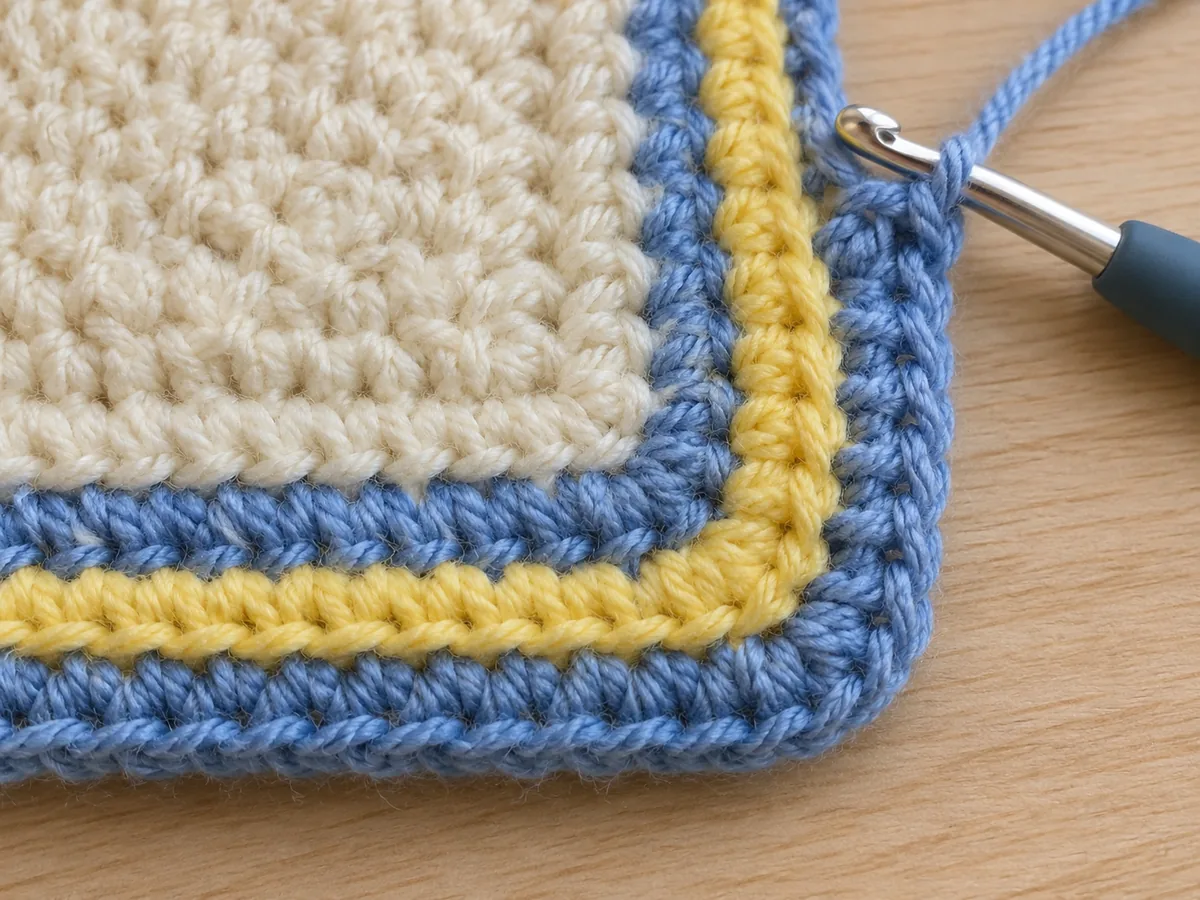
Change to 3.5 mm. Begin color changes in a corner and join each round with an sl st. Where yarn is newly joined, secure the earlier end appropriately. Do not work the starting corner a second time when returning to it.
After the chain corners begin, the corner groups are stated separately from the side sequence. Some reference side figures include stitches carried forward from the previous corner. Use the written side instructions with the new corner group rather than adding every number as an independent total around the blanket.
Distribute the first round evenly over the row ends. Check the required total early, instead of forcing several extra insertions into the final few positions of a side.
| Round | Color | Instruction and short / long side counts |
|---|---|---|
| 1 | A | Begin with 1 ch and 1 sc. Across the top work 1 sc in every sc and 2 sc in every cluster. Work 3 sc in each corner and distribute sc evenly along the remaining edges. Add the remaining 2 sc to the starting corner and join. Between corner groups: 86 sc on short sides, 116 on long sides. |
| 2 | C | 3 sc in every middle corner stitch; 1 sc elsewhere. Side counts: 88 / 118 sc. |
| 3 | B | Repeat the sc corner arrangement in BLO. Side counts: 90 / 120. |
| 4 | C | Again in BLO, 3 sc in each middle corner stitch. Side counts: 92 / 122. |
| 5 | B | Each corner: 2 hdc, 2 ch, 2 hdc. Work 1 hdc per side stitch. Side counts: 94 / 124 hdc. |
| 6 | C | Each corner: 2 dc, 2 ch, 2 dc. Skip the first partly hidden side stitch and the second; dc in the third, then dc back into the second. Continue crossed pairs, leaving the final side stitch before the corner unworked. Side totals: 96 / 126 dc, or 48 / 63 crossed pairs. |
| 7 | B | Each corner: 2 hdc, 2 ch, 2 hdc. Work 1 hdc per side stitch. Side totals: 100 / 130. |
| 8 | A | Each corner: 2 dc, 2 ch, 2 dc. Work 1 dc per side stitch. Side totals: 104 / 134. |
| 9 | C | Each corner: 2 hdc, 2 ch, 2 hdc. Skip the first partly hidden side stitch, then 1 hdc per remaining stitch. Side totals: 107 / 137. |
| 10 | B | Each corner: 1 sc, 2 ch, 1 sc. Skip the first side stitch, then 1 sc per remaining stitch. Side totals: 110 / 140. |
| 11 | B | Each corner: 2 dc, 2 ch, 2 dc. Make 1 ch, skip 1 stitch, then repeat [1 dc in each of next 2 stitches, 1 ch, skip 1 stitch]. Short sides: 74 dc and 38 ch; long sides: 94 dc and 48 ch. |
| 12 | C | Each corner: 1 sc, 2 ch, 1 sc. Work 1 sc into every stitch and 1 sc into each individual chain space. Side totals: 116 / 146 sc. |
| 13 | C | As round 11: corners of 2 dc, 2 ch, 2 dc, with the repeating 2-dc, 1-ch, skip-1 arrangement. Short sides: 78 dc + 40 ch; long sides: 98 dc + 50 ch. |
| 14 | B | Each corner: 2 hdc, 2 ch, 2 hdc. Work 1 hdc into each stitch and individual chain space. Side totals: 122 / 152. |
| 15 | A | Each corner: 2 dc, 2 ch, 2 dc. Skip the first side stitch initially, dc into the second and dc back into the first. Continue crossed pairs. Side totals: 126 / 156 dc, or 63 / 78 pairs. |
| 16 | B | Each corner: 2 hdc, 2 ch, 2 hdc. Skip the first side stitch, then 1 hdc per remaining stitch. Side totals: 129 / 159. |
| 17 | C | Each corner: 2 dc, 2 ch, 2 dc. Skip the first side stitch, then 1 dc per remaining stitch. Side totals: 132 / 162. |
| 18 | B | Each corner is deliberately asymmetric: 2 sc, 2 ch, 1 sc. Work 1 sc elsewhere. Side totals: 136 / 166. |
| 19 | B | Each corner: 2 hdc, 2 ch, 2 hdc. Make 1 ch and skip the next stitch; continue [1 hdc in next stitch, 1 ch, skip 1 stitch]. Short sides: 69 hdc + 70 ch; long sides: 84 hdc + 85 ch. |
| 20 | C | Each corner: 1 sc, 2 ch, 1 sc. Begin each side with 2 sc. Alternate 1 dc into the stitch skipped in round 19 and 1 sc into the next hdc. The dc lies in front of the previous chain arch. Work 1 sc into the final side stitch. Short sides: 70 dc + 73 sc; long sides: 85 dc + 88 sc. |
| 21 | B | Each corner: 1 sc, 2 ch, 1 sc. Skip the first side stitch, then 1 sc per remaining stitch. Side totals: 144 / 174. |
| 22 | A | Each corner: 2 hdc, 2 ch, 2 hdc. Skip the first side stitch, then 1 hdc per remaining stitch. Side totals: 145 / 175. |
| 23 | B | Each corner: 1 sc, 2 ch, 1 sc. Skip the first side stitch, then 1 sc per remaining stitch. Side totals: 148 / 178. |
| 24 | C | Each corner: 1 sc, 3 ch, 1 sc. Begin each side with 3 ch and skip 3 stitches; continue [1 sc in next stitch, 2 ch, skip 2 stitches]. Each short side: 49 sc, 1 arch of 3 ch and 49 arches of 2 ch. Each long side: 59 sc, 1 arch of 3 ch and 59 arches of 2 ch. |
| 25 | C | In each corner arch: 2 sc, picot, 2 sc. Skip next sc; in the first side 3-ch arch work 2 sc, picot, 1 sc. Continue skipping each next sc and working the same group in every 2-ch arch. Short sides: 150 sc + 50 picots; long sides: 180 sc + 60 picots. Join and secure. |
The asymmetric corner in round 18 and the skipped first stitches in several rounds are deliberate. Do not restore those skipped stitches out of habit. Likewise, round 20 places its taller stitches into the skipped stitches below the chain arches, not simply into every chain space.
Finish the ends, check the shape and care for the blanket
Color joins and edge inspection
Unless a round start specifies otherwise, complete the last pull-through of the old color with the new color. Leave enough tail to weave in securely in several directions through appropriate stitches, preferably within the matching color.
A short knot alone is not a dependable finish for a blanket that may be washed regularly. Inspect both sides after weaving, checking for loose loops or visible strands across the chain windows.
Lay the blanket flat after major sections. Strong waving, cupping or a sudden narrow side deserves a count check. Review skipped stitches, corner groups, turning chains and repeat numbers before trying to stretch the fabric into shape.
Changing yarn or size
A different yarn is possible when its fabric and care properties suit the project, but plan the dimensions from a washed sample and retain the repeat conditions. A larger hook alone does not automatically repair an incorrectly counted border.
For a simpler alternative, the dense baby blanket avoids this wide sequence. Do not simplify this border by removing an arbitrary middle round, because the later windows and crossed rows rely on their predecessors.
The waffle baby blanket produces structure through post stitches, while the square-motif blanket uses separate components. Their counts and edges belong to those designs.
Washing and use
Follow the yarn label and dry in shape. Where flat drying is appropriate, support the wet fabric and use pins only for gentle alignment. Strong heat or forceful steaming is not a general repair method, particularly for fibers that can change permanently.
Keep care instructions with a small yarn sample if giving the blanket away. For baby use, select washable suitable yarn, weave ends carefully and omit loose ribbons or embellishments. The blanket does not replace an appropriate safe sleeping arrangement.
A cuddly rabbit can be made as a separate accompanying project. Its materials and assembly are independent of the blanket pattern.
Emma & Ella
More crochet projects from The Cooking Twins Yarn.
More from Emma & Ella