Crochet carnation with a calyx,leaves and wrapped stem
This crochet carnation begins with 8 US double crochets. Three later increase rounds triple the stitch count each time, creating the dense ruffled flower. A separate green calyx, 2 narrow leaves and a wrapped supported stem are assembled afterwards. The flower and green components therefore have

By Emma & EllaUpdated
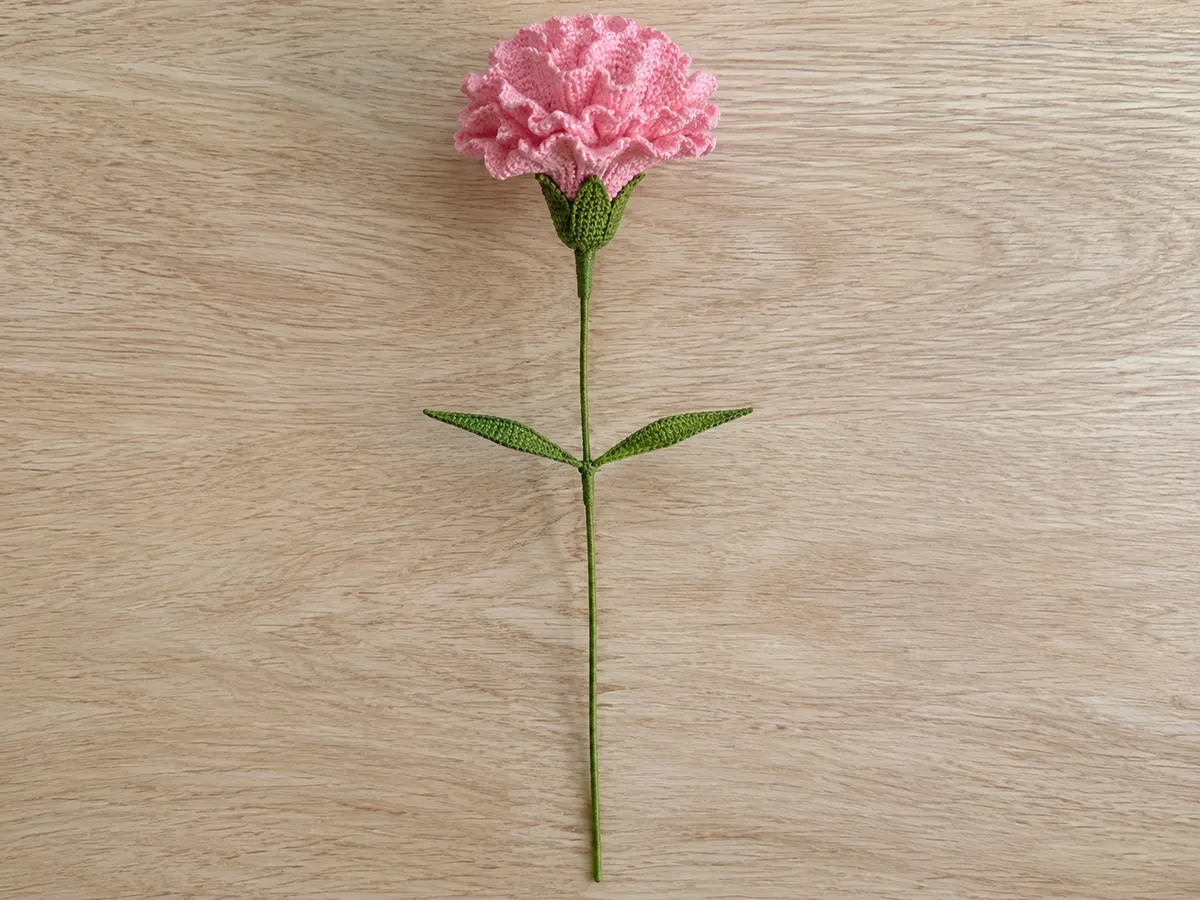
This crochet carnation begins with 8 US double crochets. Three later increase rounds triple the stitch count each time, creating the dense ruffled flower. A separate green calyx, 2 narrow leaves and a wrapped supported stem are assembled afterwards. The flower and green components therefore have independent round counts.
The source gives material quantities for 12 carnations as well as individual wire lengths. Keep those batch quantities separate from a single-flower allowance. The instructions below preserve the full flower, calyx, leaf and assembly sequence using US crochet terminology.
Prepare cotton thread, wire and the stem
Materials and batch quantities
| Item | Source specification |
|---|---|
| Thread | No.5 cotton crochet thread in flower color and green |
| Hook | 1.75–2 mm |
| Tools | Stitch marker and yarn needle |
| Wrapping | Stretch florist tape |
| Fine wire | 0.4 mm diameter |
| Green stem | 2 mm diameter |
| For 12 flowers | 4 balls flower color, 1 green ball, approximately 13.7 m wire |
| Tape reference | 1 roll described as sufficient for up to 24 flowers |
The source does not give ball weights or a fixed finished flower diameter. Do not divide the batch allowance into an exact unsupported gram amount per flower. The hook should suit the stated thread and your tension, while keeping the small green components firm enough for their assembly.
Have scissors suitable for the yarn and an appropriate means of handling the wire. The wire and stem are structural parts of a decorative flower rather than knitted fabric. Keep ends contained and consider the intended display, especially where rigid supports might be accessible.
US stitch glossary
Ch means chain, sl st means slip stitch, sc means US single crochet, hdc means US half double crochet and dc means US double crochet. US sc is US single crochet, hdc is US half double crochet and dc is US double crochet. The 3 starting chains in the flower's double crochet rounds count as the first dc.
Dc 2tog means 2 unfinished double crochets closed together across 2 base positions. It is different from 2 finished double crochets sharing 1 position. The calyx points use the former, while the flower's increase rounds place 3 separately completed double crochets into each existing stitch.
The crochet learning section offers related basic stitches. Check the country terminology before comparing patterns, as a US double crochet is the US double crochet used for this ruffled flower.
Keep the marker on the actual stitch
The source marks the 3rd starting chain in the double crochet rounds and the first actual sc in the final flower round. Those positions identify the joins. Do not count a joining slip stitch as an additional flower stitch or let the marker shift 1 position without noting it.
Record completed rounds, not only the visible ruffle size. The flower remains narrow through its first 4 rounds and then expands sharply. Its changing appearance is planned and does not mean a shaping step has been omitted.
Crochet the flower in 8 rounds
Rounds 1–4: narrow flower base
- Join 5 ch into a ring with a sl st.
- Flower round 1:3 ch as first dc, 7 dc into the ring.Mark the 3rd starting chain and join there.Total 8 dc.
- Flower round 2:3 ch as first dc, 1 dc in each remaining stitch, join.Total 8.
- Flower round 3:3 ch as first dc, 1 dc in each remaining stitch, join.Total 8.
- Flower round 4:repeat the same 8-double crochet round.When closing, lay in an approximately 30.5 cm length of wire.
The starting 3 chains provide 1 of the 8 positions. Do not add another full set of 8 double crochets beside them. The wire is introduced at the closure of round 4 and enclosed during the following round, not threaded through the completed ruffle edge afterwards.
Rounds 5–7: triple the count each round
- Flower round 5:work over the wire.3 ch as first dc, 2 dc in the same base position, then 3 dc in every remaining stitch.Join.Total 24.
- Flower round 6:repeat the same triple-increase method.Total 72.
- Flower round 7:repeat the same triple-increase method.Total 216.
The count progression is 8×3=24, 24×3=72 and 72×3=216. The fabric becomes ruffled because far more stitches are being added than the base circumference can lie flat beneath. Do not try to flatten the flower during these rounds or omit increases to make the edge seem tidier.
Count groups rather than estimating the fullness. Each old stitch receives 3 finished double crochets, including the beginning position represented by the chain and 2 additional double crochets. A cluster closed together would not produce the same 216-stitch edge.
Round 8: small chain arches
Make 1 uncounted chain and mark the first sc. Work sc around the edge with 3 chains between successive sc positions, including the arch at the closing join. Join with a sl st into the marked first sc.
The source gives 216 sc and 648 chains, 864 combined positions. That sum mixes 2 different kinds of element:216 ordinary stitches plus 216 arches of 3 chains. Do not read 864 as 864 single crochets or as an instruction to make another increase round.
Inspect the full edge before finishing. Every preceding double crochet position needs its corresponding sc and every gap its chain arch. A missed arch can be hidden among the ruffles, so follow the sequence rather than judging the final flower only from above.
A crochet iris offers another rippled edge, but its separately wired petals use a different construction. Keep the carnation's8-round flower count independent.
Make the green calyx and 2 narrow leaves
Calyx base and straight rounds
Join 5 ch into a ring and work the green calyx in a spiral. The source wording mentions 1 uncounted chain, a marked first sc and 9 further sc. Count the marked stitch separately so that the first round contains 10 sc.
- Calyx round 1:1 uncounted ch, marked first sc plus 9 further sc in the ring.Total 10.
- Calyx round 2:repeat 1 sc, 2 sc into next stitch 5 times.Total 15.
- Calyx round 3:15 sc.
- Calyx round 4:15 sc.
- Calyx round 5:15 sc.
- Calyx round 6:15 sc.
- Calyx round 7:15 sc.
- Calyx round 8:15 sc.
- Calyx round 9:15 sc.
- Calyx round 10:15 sc.
- Calyx round 11:15 sc.
Move the marker to retain the start of each completed spiral round. The 9 unchanged rounds from 3 through 11 give the calyx its depth. Do not join every round with an additional sl st unless the later instruction calls for it.
Calyx round 12:5 points
- Join with a sl st into the marked stitch.
- For each point, make 3 ch.
- Work dc 2tog across the next 2 stitches.
- Make 3 ch and 1 sl st into the joined double crochet stitch.
- Make 3 ch and 1 sl st into the next stitch.
- Repeat the complete point sequence 5 times.
- Leave approximately 10 cm for sewing.
Each point uses the 2 positions of its double crochet decrease and the following slip-stitch position, so 5 points fit the 15-stitch rim. Keep the slip stitch into the joined double crochet distinct from the later slip stitch into the next base stitch.
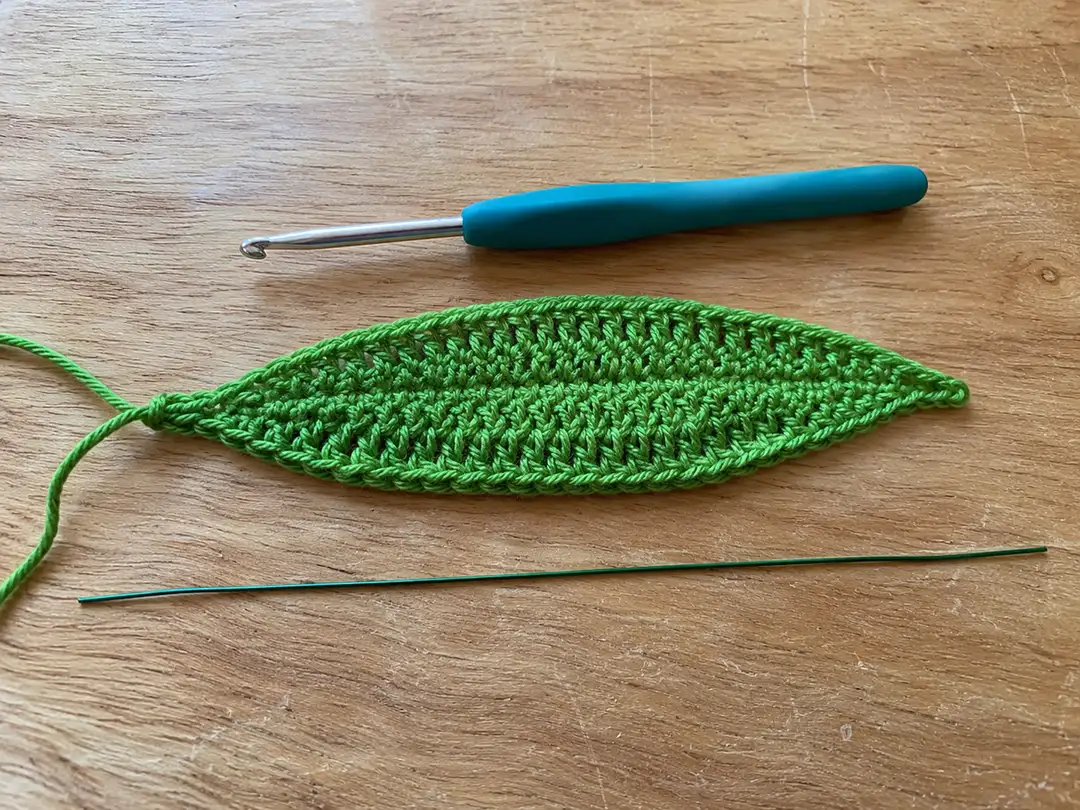
Leaves: make 2 with wire
- Make 15 ch and place approximately 12.7 cm of wire at the final chain.
- Continue enclosing the wire.Make 2 ch as the first hdc.
- Work 1 hdc into the 4th chain from the hook and 1 hdc into each of the next 3 chains.
- Work 10 sc toward the first foundation chain.
- Work 1 additional sc into that first chain, 2 ch and 1 sl st into the sc just made.
- On the other side, work 1 sc into the same first chain, 1 sc into each of the next 9 chains and 1 hdc into each of the next 5 chains.
Keep the source's starting-chain reference and side-return sequence intact. The wire supports the narrow leaf and is worked inside the stitch path. No separate graded leaf widths or extra edging round are supplied.
Wrap the stem and assemble the carnation
Secure the flower and begin the tape
- Insert the green stem into the flower and tie it securely with the wire enclosed earlier.
- Begin wrapping approximately 1.3 cm at the flower base and continue toward the stem.
- Stretch the florist tape lightly as it is wrapped so that it adheres to itself.
The source notes that a little water may help if required. Follow the actual tape's handling needs rather than assuming every product behaves identically. Keep the flower supported while wrapping so that the ruffled edge is not used as a handle.
Position the calyx and opposite leaves
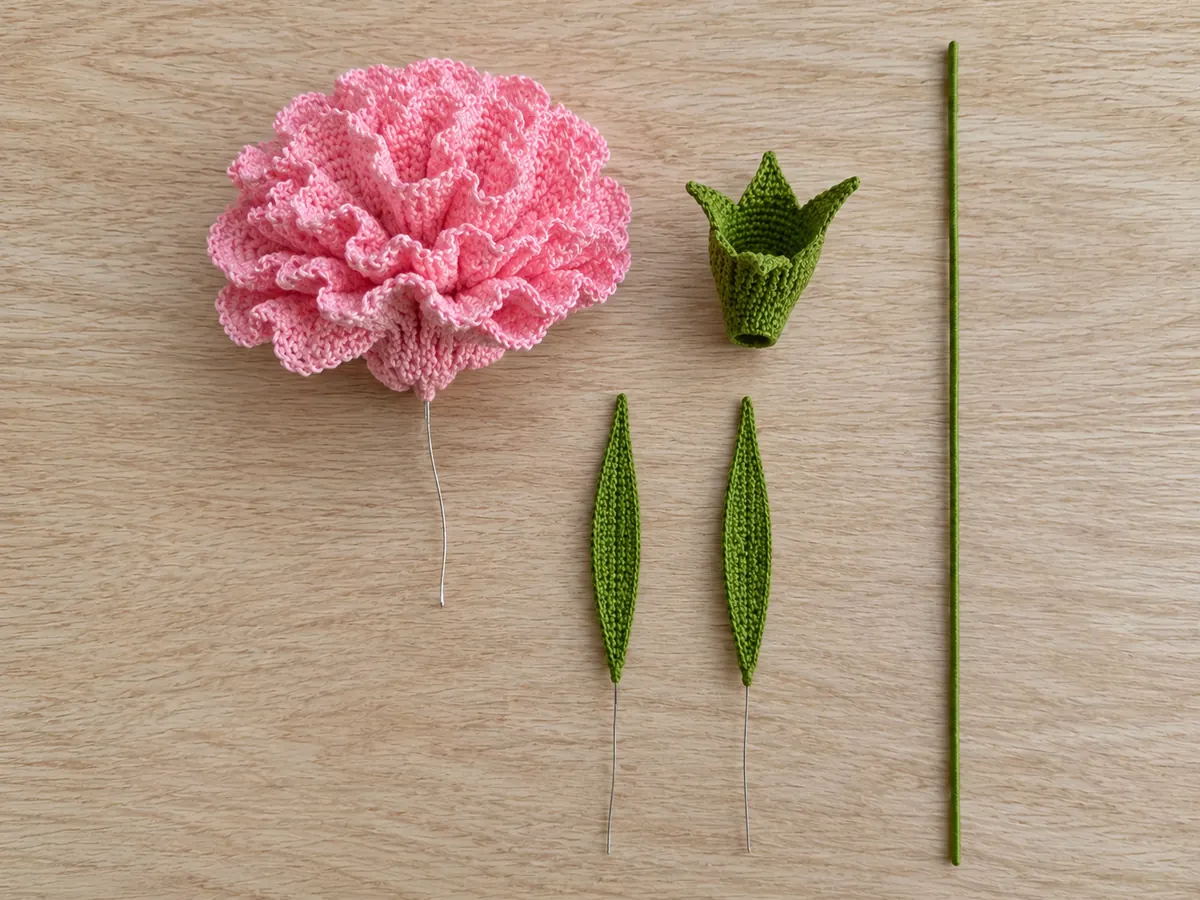
Slide the calyx onto the stem and secure it with tape. Attach the 2 leaves opposite each other approximately 12.7 cm below the calyx. Continue wrapping to the stem end. Sew the calyx to the flower last, as stated by the source.
Check that the calyx hides the intended base area without compressing the ruffles into a hard ball. The leaves should remain separate supported parts rather than being drawn flat against the stem by excessive wrapping tension.
Final inspection and project notes
Inspect the flower-to-stem wire connection, the calyx seam and both leaf supports before display. Keep wire ends contained. The source describes a decorative flower, not a tested toy or a guaranteed wash-resistant arrangement.
Record yarn, hook, the actual tape and the completed dimensions if making more carnations. The batch quantity for 12 flowers does not replace a record of the material used by your own sample. Compare completed pieces with similar tension rather than forcing a larger ruffle into the shape of a smaller one.
The red crochet rose with a stem can join a mixed bouquet. It uses a rolled petal strip and a crocheted tube, whereas this carnation depends on triple-increase rounds and florist-tape assembly. Keep their support and finishing instructions distinct.
Keep the individual and batch measurements separate
The30.5 cm wire belongs at the base of1 flower before its ruffling rounds. The12.7 cm pieces support the individual leaves, and the other12.7 cm reference locates those leaves below the calyx. These measurements have different roles despite sharing a value in2 places. Label them in the project notes rather than cutting every support to1 assumed length.
Lay out the completed flower, calyx and2 leaves before beginning the final wrapping. Check each part against its own count sequence while its base remains accessible. The flower count grows from8 to216, while the calyx grows from10 to15; the parts should not be compared as though they share a circumference. The stem and tape bring them together only after those separate crochet structures are complete.
Emma & Ella
More crochet projects from The Cooking Twins Yarn.
More from Emma & Ella