Red crochet rose with a stem and3 leaves
This red rose begins as a strip with 11 petals of different heights. Rolling the strip makes the flower. A green tubular stem, calyx points and 3 separately crocheted leaves complete the piece. The source gives an approximate overall length of 29 cm, with a flower about 5 cm across and 4 cm high.

By Emma & EllaUpdated
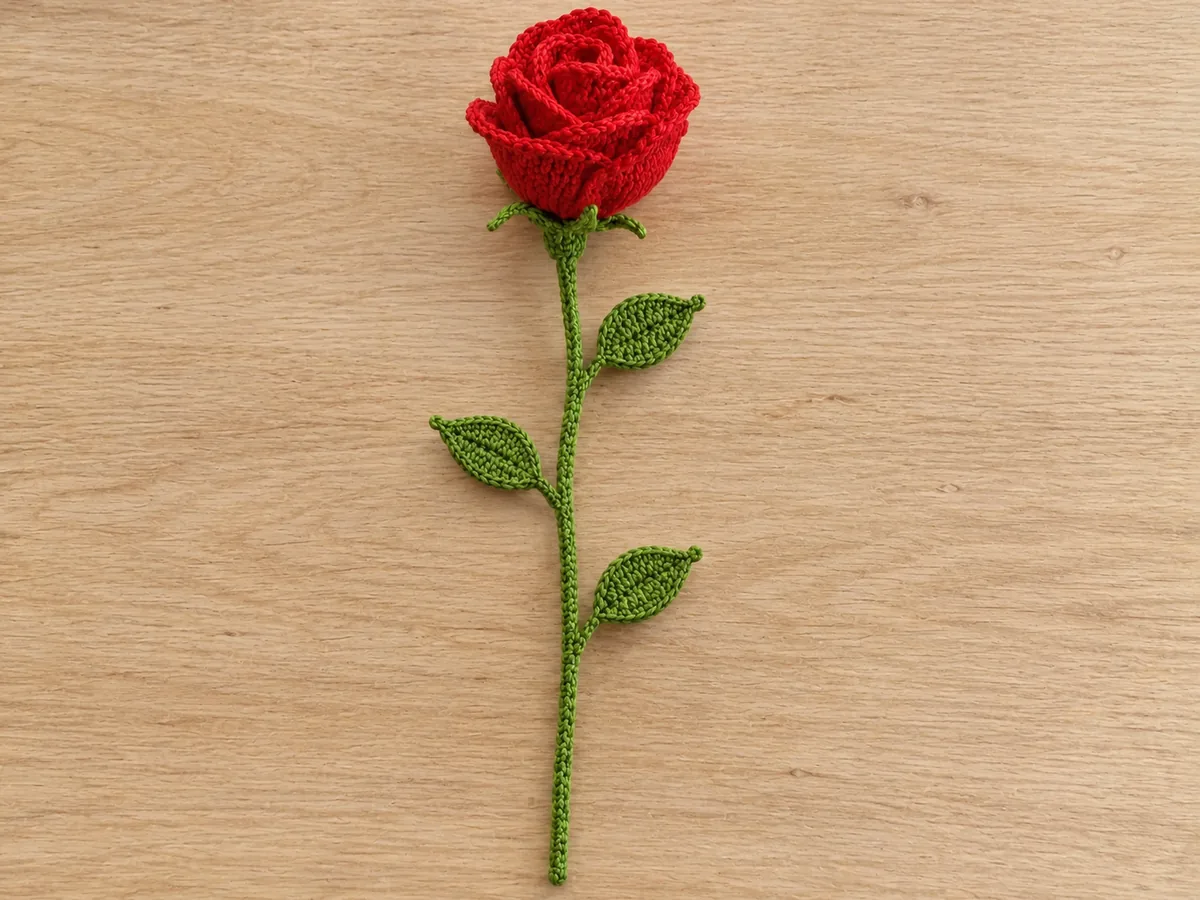
This red rose begins as a strip with 11 petals of different heights. Rolling the strip makes the flower. A green tubular stem, calyx points and 3 separately crocheted leaves complete the piece. The source gives an approximate overall length of 29 cm, with a flower about 5 cm across and 4 cm high.
The petal groups deliberately grow taller toward the end of the strip. They use several different US stitch heights, so keep the terminology visible while working. The stem is a narrow tube supported by both steel wire and a pipe cleaner. The source gives 5 calyx points but does not provide an exact spacing plan for their attachment around the 12-stitch top; that limitation is retained below.
Choose materials and crochet the red strip
Materials and US stitch names
| Item | Source specification |
|---|---|
| Yarn | Red and green cotton |
| Hook | 3 mm |
| Support per rose | 1 steel wire and 1 pipe cleaner |
| Other materials | A little stuffing and a yarn needle |
| Reference dimensions | 29 cm overall; flower 5 cm diameter and 4 cm height |
Ch means chain, sl st means slip stitch, sc means US single crochet, hdc means US half double crochet, dc means US double crochet, tr means US treble and dtr means US double treble. US sc is US single crochet, dc is US double crochet, tr is US treble and dtr is US double treble.
A US double crochet begins with 1 yarn over, a treble with 2 and a double treble with 3. Complete the taller stitches by drawing yarn through 2 loops repeatedly. Do not replace the different heights with 1 uniform tall stitch, as the graded petals depend on that difference.
For the leaf picot, make 3 ch and 1 sl st into the 3rd chain from the hook. This is a small closed tip, not 3 additional ordinary leaf stitches. Basic stitches are collected in the crochet learning section.
Foundation and first 3 rows
- Make 80 ch in red.
- Strip row 1:from the 3rd chain from the hook, work 1 hdc in each remaining chain. Total 78.
- Strip row 2:1 ch, 1 hdc in each of 78 stitches; turn.
- Strip row 3:1 ch, 1 hdc in each of 78 stitches; turn.
The starting chains are outside the 78 working stitches. Count the complete row before beginning the petals. An omitted edge stitch changes the number of positions available for the graded groups and cannot be corrected simply by making a taller final petal.
Shape all 11 petals and roll the flower
Strip row 4: graded groups
Work the tall stitches individually into consecutive stitches. Do not place all the tall stitches of a petal into 1 base stitch. The chains provide the rise and fall, and the final sl st anchors the petal into the next stitch.
- Petal 1:2 ch, 4 dc, 2 ch, 1 sl st.
- Petal 2:2 ch, 4 dc, 2 ch, 1 sl st.
- Petal 3:2 ch, 4 dc, 2 ch, 1 sl st.
- Petal 4:2 ch, 6 dc, 2 ch, 1 sl st.
- Petal 5:2 ch, 6 dc, 2 ch, 1 sl st.
- Petal 6:3 ch, 7 tr, 3 ch, 1 sl st.
- Petal 7:3 ch, 7 tr, 3 ch, 1 sl st.
- Petal 8:4 ch, 7 dtr, 4 ch, 1 sl st.
- Petal 9:4 ch, 7 dtr, 4 ch, 1 sl st.
- Petal 10:4 ch, 7 dtr, 4 ch, 1 sl st.
- Petal 11:4 ch, 8 dtr, 4 ch, 1 sl st.
The groups consume all 78 base positions. The first 3 use 15, then 2 groups use 14, then 2 groups use 16, then 3 groups use 24, and the final group uses 9. Together 15+14+16+24+9=78. The chain rises and falls do not consume extra base stitches.
Roll from the beginning of row 4
Roll the strip starting at the beginning of the petal row. Hold the foundation edge together at the base so that the taller groups form the outer flower. Secure layers as you roll with needle and thread or glue, as allowed by the source.
Check the flower from above and underneath before fixing the final outer end. The source does not prescribe an extra round, a separate flower center or additional petals. The rolled shape should come from the completed 11-group strip.
The violet rose without a stem is another rolled-strip project, but its foundation and petal repeat are different. Do not exchange their strip counts while making a matching arrangement.
Crochet the green stem and 5 calyx points
All 59 stem rounds
Begin in green. The narrow section remains at 6 stitches before widening at the flower end. Keep a round record so that the long unchanged section does not acquire extra or missing rounds unnoticed.
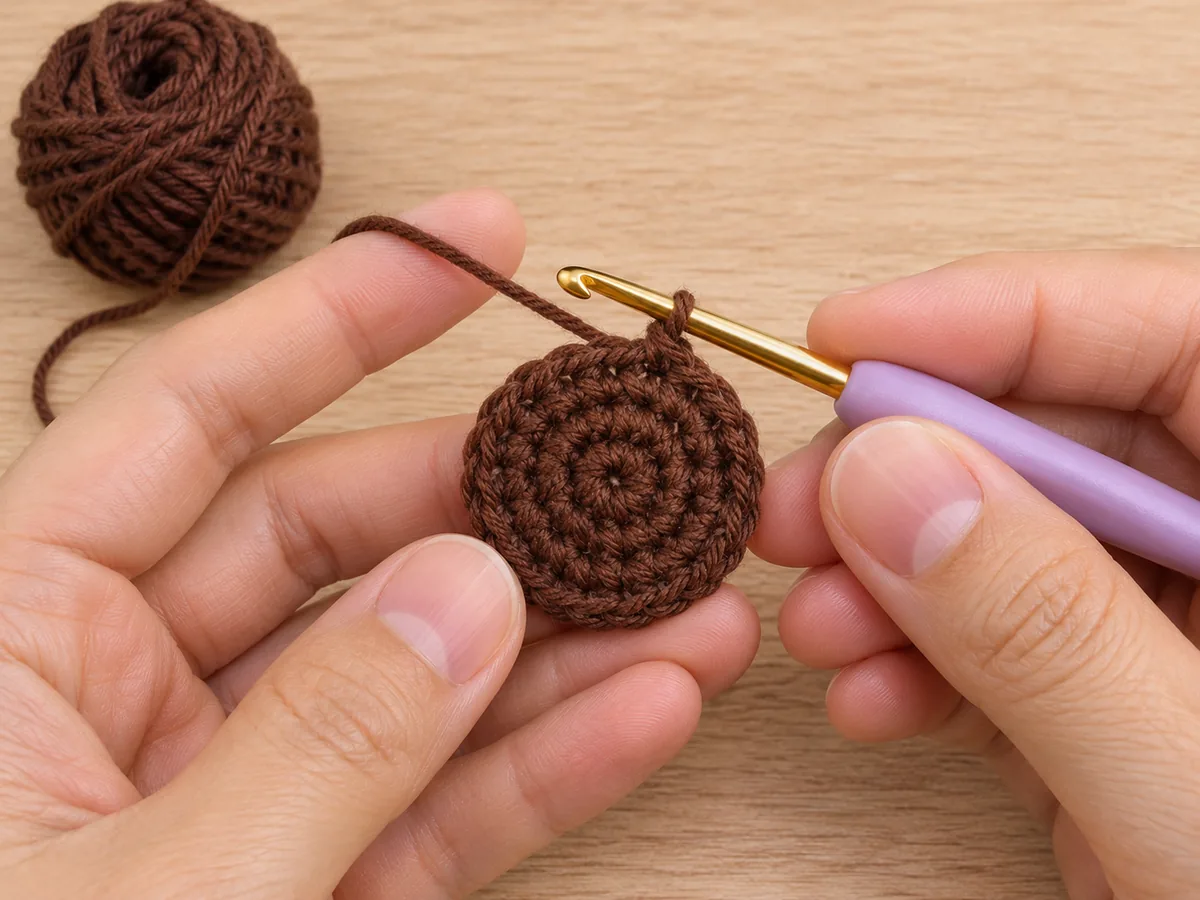
- Stem round 1: 6 sc in a magic ring.
- Stem round 2: 6 sc.
- Stem round 3: 6 sc.
- Stem round 4: 6 sc.
- Stem round 5: 6 sc.
- Stem round 6: 6 sc.
- Stem round 7: 6 sc.
- Stem round 8: 6 sc.
- Stem round 9: 6 sc.
- Stem round 10: 6 sc.
- Stem round 11: 6 sc.
- Stem round 12: 6 sc.
- Stem round 13: 6 sc.
- Stem round 14: 6 sc.
- Stem round 15: 6 sc.
- Stem round 16: 6 sc.
- Stem round 17: 6 sc.
- Stem round 18: 6 sc.
- Stem round 19: 6 sc.
- Stem round 20: 6 sc.
- Stem round 21: 6 sc.
- Stem round 22: 6 sc.
- Stem round 23: 6 sc.
- Stem round 24: 6 sc.
- Stem round 25: 6 sc.
- Stem round 26: 6 sc.
- Stem round 27: 6 sc.
- Stem round 28: 6 sc.
- Stem round 29: 6 sc.
- Stem round 30: 6 sc.
- Stem round 31: 6 sc.
- Stem round 32: 6 sc.
- Stem round 33: 6 sc.
- Stem round 34: 6 sc.
- Stem round 35: 6 sc.
- Stem round 36: 6 sc.
- Stem round 37: 6 sc.
- Stem round 38: 6 sc.
- Stem round 39: 6 sc.
- Stem round 40: 6 sc.
- Stem round 41: 6 sc.
- Stem round 42: 6 sc.
- Stem round 43: 6 sc.
- Stem round 44: 6 sc.
- Stem round 45: 6 sc.
- Stem round 46: 6 sc.
- Stem round 47: 6 sc.
- Stem round 48: 6 sc.
- Stem round 49: 6 sc.
- Stem round 50: 6 sc.
- Stem round 51: 6 sc.
- Stem round 52: 6 sc.
- Stem round 53: Repeat 1 sc, 2 sc in next stitch 3 times. Total 9.
- Stem round 54: 9 sc.
- Stem round 55: Repeat 2 sc, 2 sc in next stitch 3 times. Total 12.
- Stem round 56: 12 sc.
- Stem round 57: 12 sc.
- Stem round 58: Repeat the calyx-point sequence described below 5 times in total.
- Stem round 59: 1 sl st in each of the 12 sc of round 57.
Calyx-point sequence for round 58
- Work 1 sl st.
- Make 4 ch.
- Return along that chain:1 sl st in the 2nd chain from the hook, 1 sc in the 3rd and 1 hdc in the 4th.
- Attach with 1 sl st.
- Work 5 points in total.
The source does not state a separate distribution of those 5 attachment groups across the 12 top stitches. Preserve that gap rather than claiming an exact numbered spacing that is not supplied. Round 59 returns to the 12 sc of round 57 for its slip stitches.
Keep the point-chain stitches distinct from the stem's circular count. The 4-chain branches are worked out and back; they are not a new circular round with 4 extra stem stitches. Check each point's return order before repeating it.
Insert the support and lightly fill the top
Slide the pipe cleaner and steel wire into the stem. Add a little stuffing to the upper region. The source calls for both supports in this rose, not a choice between them. It gives no measured wire length or diameter, so those values are not invented here.
Contain support ends appropriately for the intended decorative use. Inspect the tube before fastening the flower so that a protruding end or missed stitch is not hidden by the upper assembly. Keep the narrow stem from being distorted by overfilling.
Make 3 leaves and attach the flower last
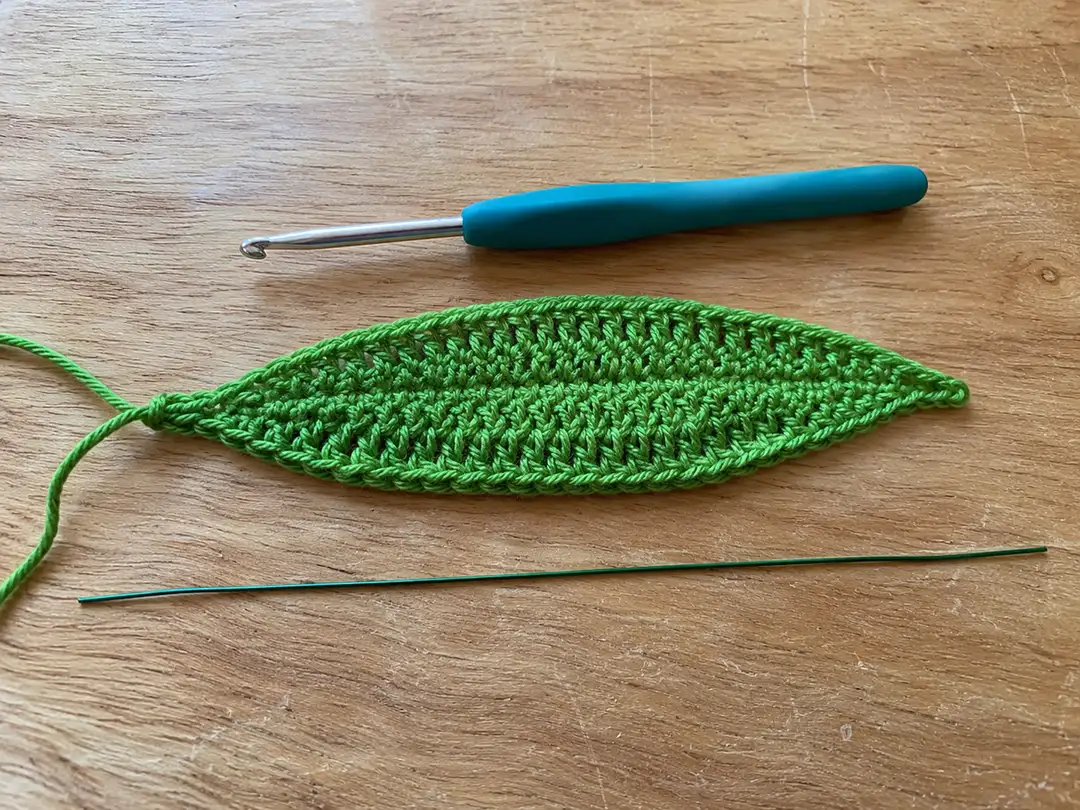
Leaf round 1
- Make 10 ch in green.
- From the 2nd chain, work 3 sc, 4 hdc and 1 sc.
- Work 3 sc into the final chain.
- Along the opposite side, work 1 sc, 4 hdc and 3 sc.
The first side uses 8 positions before the final chain; the opposite side returns along the foundation. Keep the chain flat enough to recognize both sides rather than twisting it into a tube. The completed first round has 19 ordinary stitches.
Leaf round 2
- Work 2 sc into the first stitch.
- Work 2 sc, 4 hdc and 2 sc.
- Into the next stitch, work 1 sc, 1 picot and 1 sc.
- Work 2 sc, 4 hdc and 2 sc.
- Work 2 sc into the next stitch and close the round.
The picot belongs in the stated shared tip position. It does not replace either of the 2 sc surrounding it. The ordinary-stitch sequence makes 22 stitches, with the chain picot counted separately. This calculation is a local check of the written sequence, not an additional source size.
Make 3 leaves in total. Compare their tension and tips before sewing so that a missing half double crochet is not mistaken for a deliberate smaller leaf. The source supplies 1 leaf sequence rather than graded leaf sizes.
Assemble in the stated order
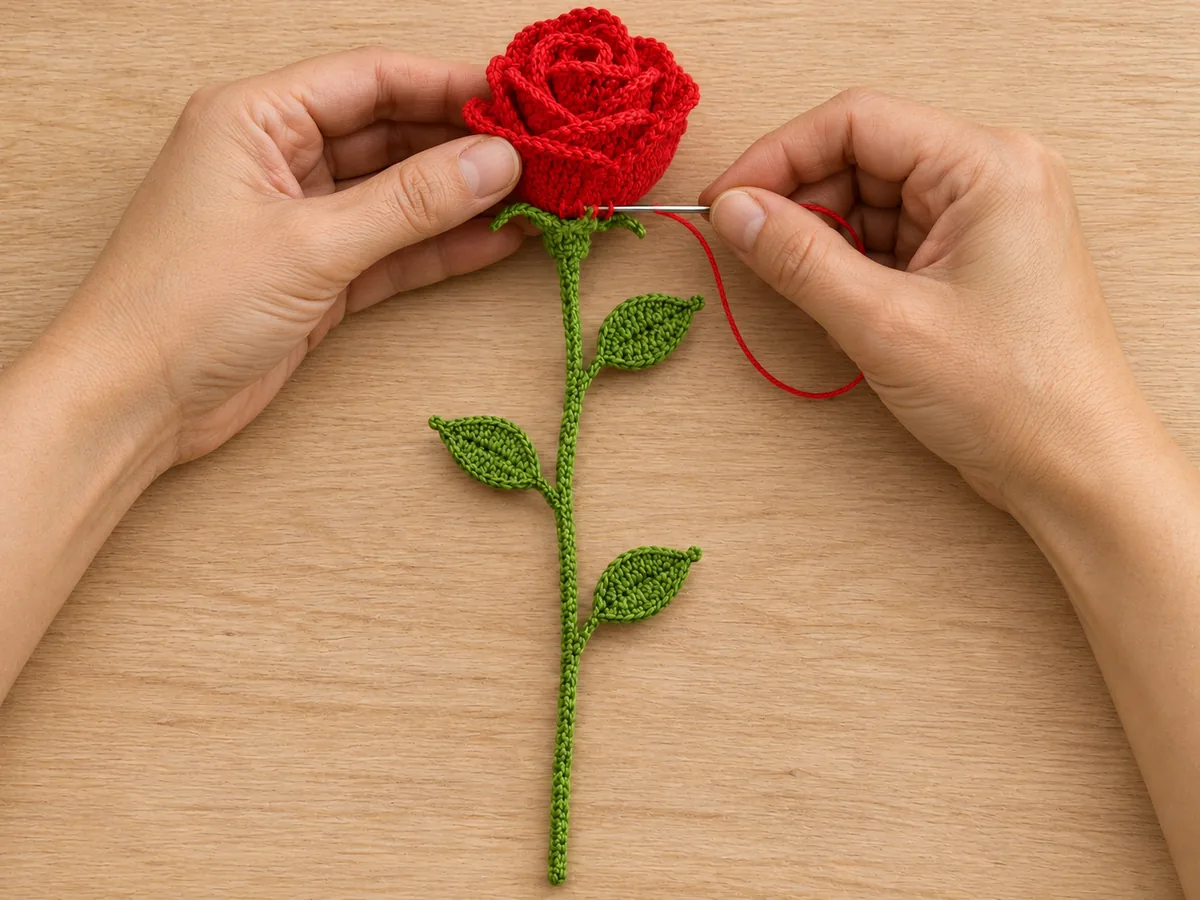
Attach the 3 leaves to the stem first, then sew on the red flower. Check the flower's position against the calyx before securing the final thread. Do not use the flower attachment to pull the upper stem into a hard narrow knot.
Secure yarn ends in suitable stitches and inspect the reverse of each leaf. Keep the rolled layers from unwinding and make sure the supported stem has no exposed end. Follow the actual cotton yarn's care guidance and protect the flower from crushing during storage.
Notes for another rose
Record yarn, hook, the completed stem rounds and your interpretation of the unspecified calyx attachment spacing. Label that spacing as your own practical choice rather than stating it was a numbered source instruction. This helps another version match without hiding the source limitation.
A crochet iris can accompany the rose in an arrangement. It uses separate wired petals rather than a rolled strip. Keep their component counts and supports distinct even when both use green stems and leaves.
Emma & Ella
More crochet projects from The Cooking Twins Yarn.
More from Emma & Ella