Christmas pickle with bobbles
This Christmas pickle is crocheted in one piece, with a slight curve and small raised bobbles. Changes in stitch height through the middle create the bend, while staggered bobble rounds decorate the surface. A ribbon forms the hanging attachment after the crochet is complete.

By Emma & EllaUpdated
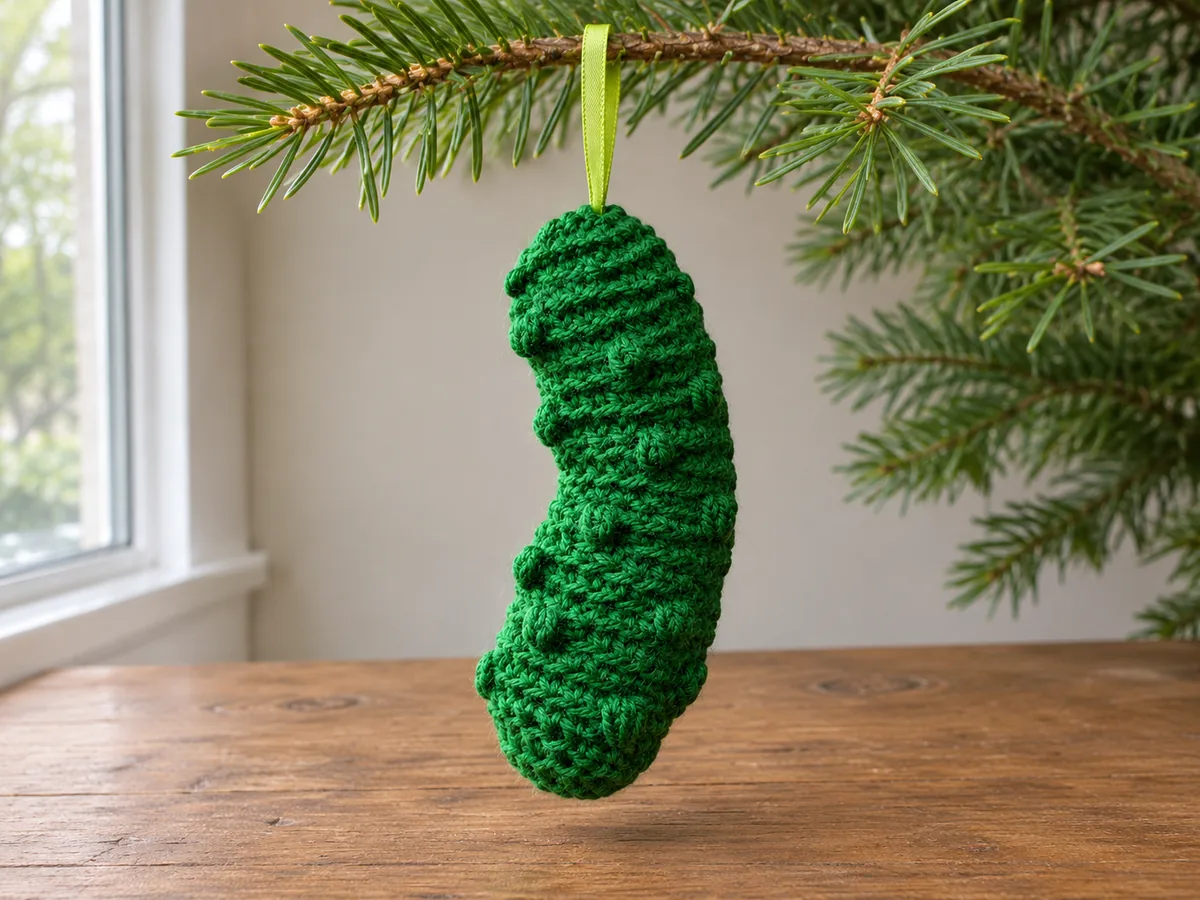
This Christmas pickle is crocheted in one piece, with a slight curve and small raised bobbles. Changes in stitch height through the middle create the bend, while staggered bobble rounds decorate the surface. A ribbon forms the hanging attachment after the crochet is complete.
There are no separate side panels, back seam or individually sewn bobbles. Follow all 26 numbered steps, including the low slip-stitch sections and the source’s unusual final closing instruction. The bobbles use a lower insertion point than the ordinary stitches.
Yarn, dimensions and US back-loop stitches
Materials
The reference height is 5.5 inches, approximately 14 cm. Use less than 220 yards, approximately 201 m, of forest-green worsted yarn, a US size-H crochet hook, a few handfuls of stuffing and a ribbon for hanging. No exact stuffing weight or ribbon length is supplied.
The suggested yarn is 100% wool, but other worsted yarns are explicitly allowed. The less-than-a-ball allowance is material guidance rather than an exact consumption measurement. The source names the hook by its US H marking without an additional millimeter value.
Choose the corresponding marked hook and check the fabric with the actual yarn. No fixed gauge or graded size table is given. The approximately 14 cm length belongs to the example rather than every possible worsted substitute.
US terminology
Sc means US single crochet. Hdc means US half double crochet. Dc means US double crochet. Ch means chain and sl st means slip stitch.
An increase is 2 sc in the same old position. A decrease combines 2 old positions into 1 new sc. For hdc, yarn over, insert and draw up a loop, then yarn over and pull through all 3 loops.
Back-loop rule
Work ordinary round stitches through the back top loop only unless a special instruction says otherwise. It is the farther half of the stitch’s upper V. This leaves small transverse ridges on the visible surface.
The source permits working through both loops as an alternative, with a changed surface effect. That option does not supply a second count sequence. Its general explanation mentions front loops for turned rows, but the pickle itself follows the round instructions below.
For another small decoration, see the little Christmas bell.
Make the bobbles a round below
3 unfinished double crochets closed together
- Find the lower stitch belonging to the next pattern position, 1 round below the current working round.
- Yarn over, insert there and draw up a loop.
- Yarn over and pull through only the first 2 loops, leaving the double crochet unfinished.
- Repeat that unfinished-double crochet action 2 more times in the same lower insertion point.
- With 4 loops remaining, yarn over and draw through all 4.
The 3 double crochets are not completed individually. Completing them separately would make an open fan rather than a compact bobble. This is also not a popcorn made by removing the hook from a set of completed double crochets.
The lower insertion point brings the bobble across the ribbed surface. Draw the loops to similar heights and let the bobble sit on the outside without pulling its closing loop apart. Then return to the normal insertion rule for the following ordinary stitches.
Count a bobble as 1 position
A bobble replaces a sc in the written repeat. It does not add 2 extra circumference stitches. The bobble rounds remain at 18 positions. Keep the lower insertion point and current pattern position distinct so that an extra sc is not added after closing the bobble.
The general source introduction also describes a loose starting knot that may tighten into a ring. The actual pickle pattern begins with 2 ch and 6 sc in the second chain. Follow that specific foundation rather than adding both methods consecutively.
Stagger the decoration
Mark the first stitch of each round and note which bobble arrangement is being worked. Some repeats begin with a bobble; others begin with 4 sc before it. That shift gives staggered bobbles rather than stacking each directly above the previous one.
Another raised ornament is the popcorn-flower Christmas heart, although its stitch construction differs.
Work all 26 pickle rounds
With forest green, make 2 ch. Keep the ordinary stitches in back loops only and use the lower insertion point for bobbles.
- Round 1: 6 sc in the 2nd chain from the hook (6).
- Round 2: Increase in every stitch (12).
- Round 3: Repeat increase and 1 sc 6 times (18).
- Round 4: 18 sc.
- Round 5: Repeat bobble and 5 sc 3 times (18).
- Round 6: 18 sc.
- Round 7: Repeat 4 sc, bobble and 1 sc 3 times (18).
- Round 8: 18 sc.
- Round 9: Repeat bobble and 5 sc 3 times (18).
- Round 10: 18 sc.
- Round 11: Repeat 4 sc, bobble and 1 sc 3 times (18).
- Round 12: 6 sl st, 3 sc, 6 hdc and 3 sc (18).
- Round 13: 6 sl st; repeat bobble and 5 sc twice (18).
- Round 14: 6 sl st, 3 sc, 6 hdc and 3 sc (18).
- Round 15: 6 sl st; repeat 4 sc, bobble and 1 sc twice (18).
- Round 16: 18 sc.
- Round 17: Repeat bobble and 5 sc 3 times (18).
- Round 18: 18 sc.
- Round 19: Repeat 4 sc, bobble and 1 sc 3 times (18).
- Round 20: 18 sc.
- Round 21: Repeat bobble and 5 sc 3 times (18).
- Round 22: 18 sc.
- Round 23: Repeat 4 sc, bobble and 1 sc 3 times (18); stuff lightly afterwards.
- Round 24: Repeat decrease and 1 sc 6 times (12).
- Round 25: 6 decreases (6).
- Round 26: Work the next stitch and the fourth stitch together as the source’s single closing stitch. Finish.
Understand the repeated blocks
Rounds 8–11 repeat rounds 4–7 once. Rounds 16–19 repeat that same complete block, and rounds 20–23 repeat it again. Continue numbering the rounds on the piece rather than restarting the project’s round count whenever the pattern block repeats.
Those last 2 blocks provide 8 full rounds, not a single additional bobble round. Keep each plain round between the bobble arrangements so the surface retains the stated spacing.
Where the bend is formed
Rounds 12–15 create the curve. Round 12 has 6 low sl st, 3 sc, 6 taller hdc and 3 sc, totalling 18. Round 13 retains the 6 sl st and uses 2 bobble repeats across the remaining 12 positions.
Round 14 repeats the mixed-height sequence. Round 15 staggers the 2 bobbles with 4 sc before and 1 sc after each. Replacing those 4 rounds with ordinary sc would preserve the total but remove the intended shaping.
The back-loop rule applies to the ordinary stitches of different heights. Slip stitches can sit very close to the fabric, so identify their tops carefully on the following round instead of accidentally skipping one.
Stuff lightly, secure the unusual close and add a ribbon
Filling and final decreases
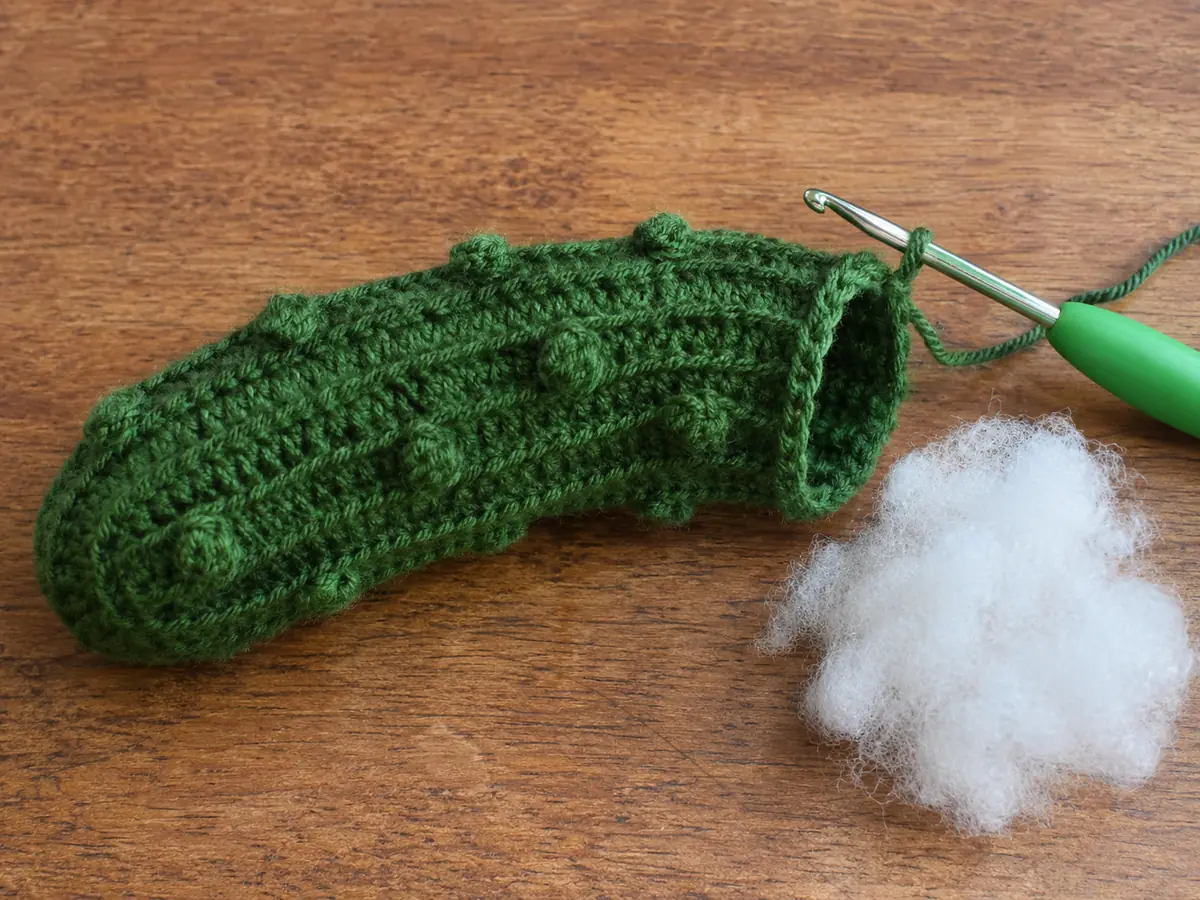
After round 23, add stuffing in small portions through the remaining opening. Keep the curve and bobbles visible. Overfilling can straighten the bend or spread the stitch gaps. The source’s few handfuls is not an exact weighed amount for the individual ornament.
Round 24 reduces 18 to 12 with 6 decreases and 6 ordinary sc. Round 25 reduces 12 to 6 with decreases only. These totals describe the new stitch positions after completing each round.
Final source instruction
The last step says to work the next and fourth stitches together and gives a single closing stitch. Retain that unusual wording. It does not describe another full round of 3 adjacent decreases, and no repeated decrease sequence is added.
The closing connection spans the small remaining opening. Secure the yarn afterwards. If further needle-securing is needed, it is technical finishing of the existing opening rather than an invented round 27. Pass through stable stitch bodies and keep the stuffing contained before hiding the final tail.
Check the surface and curve together
Follow the low slip-stitch section across the middle and compare its position with the taller half-double-crochet section. Both occupy 6 positions in their mixed-height round, but their heights differ deliberately. A tightly worked slip stitch can draw the short side in more strongly without changing the count.
Before the last closure, look for a bobble that has been pulled toward the inside. Ease its body outward carefully while keeping the common closing loop secure. Do not use a sharp pull on that loop as a way to reshape the whole ornament.
When checking a bobble repeat, count the bobble as its single replacement position and then count the following sc separately. The lower insertion point belongs to that same working position. Adding an ordinary sc there afterwards would increase the circumference and shift the next bobbles.
The finished pickle is not joined from 2 halves. Any needle-securing at the tip finishes the stated small closure and should not become a seam running along the curved side. Hide the tail through suitable internal stitch paths rather than across the visible raised details.
For a matching repeat, record the chosen hook’s actual marking and yarn. The source supplies a US H designation without an extra millimeter value, and its sample height remains approximate. Keep those material notes separate from the unchanged 26-round instruction sequence.
Once the ribbon is attached, lift the ornament gently and check how the bend hangs. Keep the attachment away from a loose bobble loop and make sure the closing tip remains secure before hiding any remaining tail.
Ribbon and final checks
Attach a ribbon loop, choosing its length for the intended hanging position. The source gives no fixed length or knot quantity. Secure it through the crochet structure rather than a loose finishing tail or a decorative bobble.
Arrange the bobbles gently without pulling their shared closing loops apart. Their lower attachments are decorative, so use an ordinary structural stitch for the hanging connection. Check the beginning, all 26 steps, surface and closure.
For companion ornaments, see the 5 character baubles. Record the actual yarn and measured length if making another pickle, particularly the tension of the shaping slip stitches and half double crochets.
Emma & Ella
More crochet projects from The Cooking Twins Yarn.
More from Emma & Ella