Colorful crochet bauble cover: 2-piece pattern
This cover uses 2 small round crochet pieces fitted around an existing Christmas bauble. Colored double crochet groups and longer single-crochet stitches create a flower-like center. Straight rounds then bring each half toward the bauble’s middle, where the pieces are sewn together.

By Emma & EllaUpdated
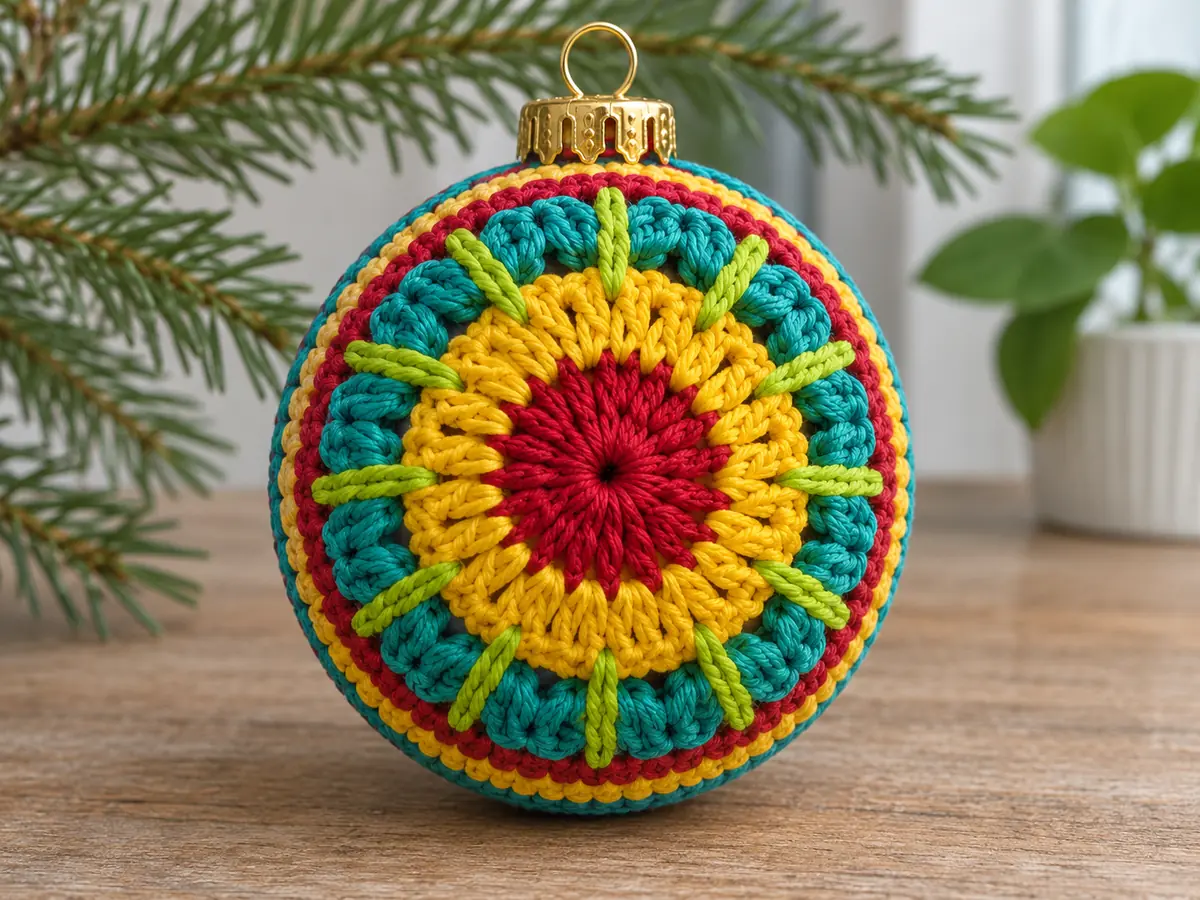
This cover uses 2 small round crochet pieces fitted around an existing Christmas bauble. Colored double crochet groups and longer single-crochet stitches create a flower-like center. Straight rounds then bring each half toward the bauble’s middle, where the pieces are sewn together.
The project is a bauble cover, not a newly stuffed amigurumi ball. It uses no tassels. The original bauble provides both the finished shape and the fitting reference, so have it available while working the halves rather than trying to fit the crochet only after sewing.
Materials, color choices and US long single crochet
Supplies
Use yarn remnants in Christmas colors, a 2.5 mm hook and an existing bauble measuring 7 cm in diameter. The source gives no particular yarn fiber, meter amount, total consumption or separate gauge. The 7 cm bauble is the specific reference form for this cover.
The shown palettes include red, green and yellow, and another combination of turquoise, blue, white and a neutral shade. No compulsory round-by-round color-name sequence is given. Change color before each new round as instructed, recording your own sequence if both halves should match.
You may deliberately make the sides different when using small remnants. That changes the color arrangement without changing the stitch pattern. Compare the yarn thicknesses so that the 2 halves remain compatible in size.
US terms
Ch means chain, sl st means slip stitch, sc means US single crochet, and dc means US double crochet. The initial 3 ch count as the first dc in the named double crochet rounds. The working loop on the hook is not an additional chain.
Round 4 instead begins with 1 ch that does not replace any of its stated sc. Keep the starting rises separate from the counted stitches. The joining sl st connects a round but is not automatically another working stitch in the following round.
Long single crochet
Insert between the 2 double crochets of the lower round, draw up a loop and bring it to the height of the current working round. Yarn over and draw through both loops. Although its insertion point is lower, the stitch closes as a sc: do not make a preparatory yarn over as for a dc.
A loop drawn too short pulls the underlying double crochet pair together and tightens the new round. An excessively long loop hangs loosely on the surface. Match the height of the neighboring stitches. This long stitch is made only at the 12 named arch positions, rather than added as an extra stitch elsewhere.
For another fitted cover, see the patterned bauble cover. This version is fitted specifically to the stated 7 cm bauble.
Rounds 1–3: establish the colored double crochet groups
Round 1
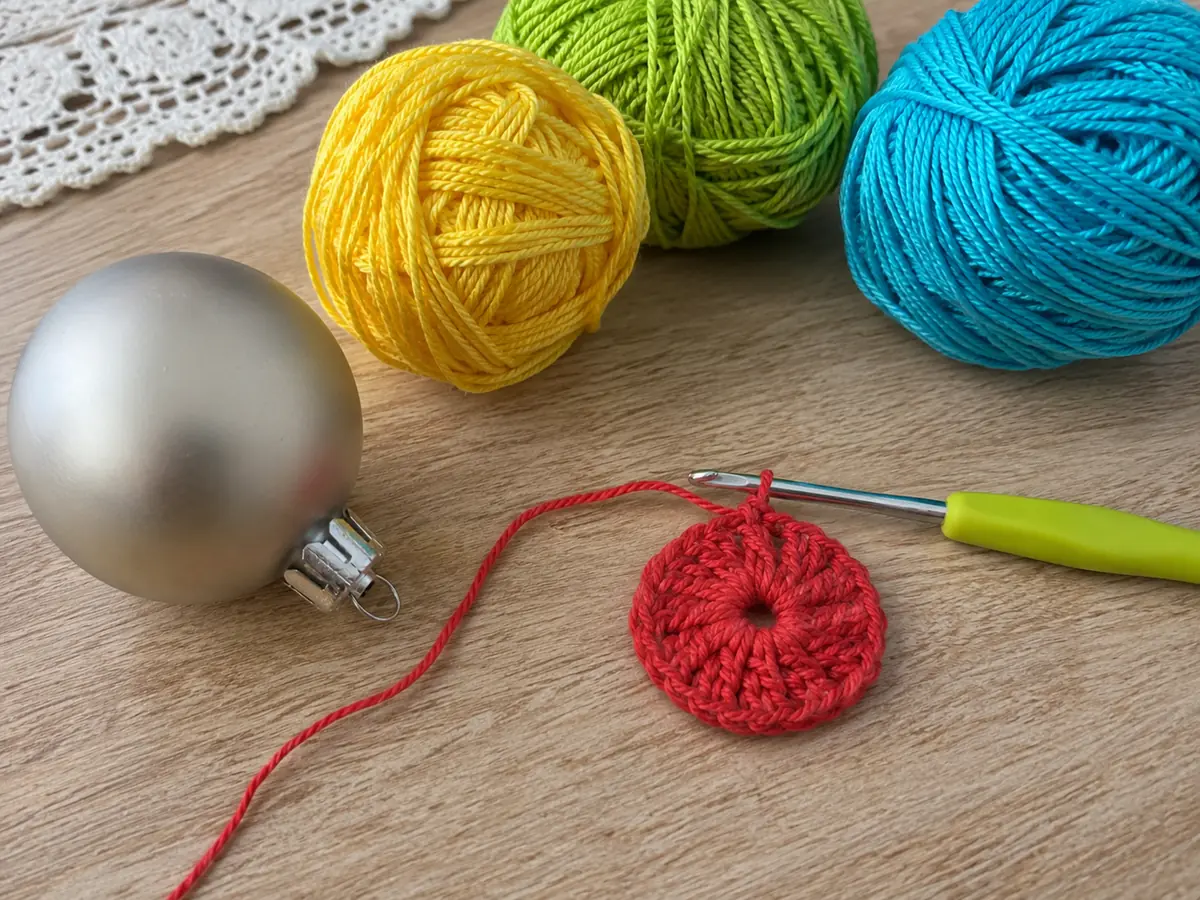
- Round 1: In a magic ring, work 3 ch as the first dc and 11 actual dc.
- Join with sl st into the 3rd starting chain.
- Tighten the ring: 12 double crochet positions.
Close the center before working many further rounds. The bauble should not show through an accidentally loose central ring as a large unintended opening. Ordinary spaces between stitches remain part of the fabric and are not filled with extra double crochets.
Round 2
- Round 2: Change color, preferably during the final pull-through of the preceding round.
- Make 3 ch and 1 dc in the same starting position.
- Work 2 dc in every remaining stitch.
- Join into the 3rd starting chain: 24 dc.
The first pair consists of the starting chain and 1 actual dc. Adding 2 actual dc beside that chain would create 3 positions at the start and spoil the total. Check all 24 positions before changing the grouping in the next round.
Round 3
- Round 3: Change color and move with sl st into a gap between 2 double crochets.
- Make 3 ch and 1 dc in that same gap.
- Make 1 ch and skip 2 stitches.
- Continue with 2 dc in the next gap, 1 ch and skip 2 stitches.
- Join into the 3rd starting chain.
Check 24 dc arranged into 12 pairs, with 12 single-chain arches between them. Count the arches separately from the double crochets. The next round uses each arch position for a long sc, so a missing space would affect the decorative rhythm.
Both new double crochets of a pair enter the same named gap. They are not worked separately into adjacent stitch tops. This change of insertion point contributes to the flower-like center and keeps the pairs separated by their chain spaces.
Rounds 4–7: long stitches and curved sides
Round 4
- Round 4: Change color and make 1 ch.
- Work 1 sc in the same starting position and 1 sc in the next double crochet position.
- At the single-chain arch, work a long sc by inserting between the 2 underlying double crochets.
- Continue with 2 ordinary sc in the next 2 positions and 1 long sc at the next arch.
- Work 12 groups in total.
- Join with sl st into the first sc.
Check 24 ordinary sc and 12 long sc, giving 36 stitches. The source repeat wording contains an initial written section, then a starred section and 10 further repeats of that starred section. The starred section is therefore worked 11 times, alongside the first section, giving 12 groups overall.
The starting chain is not a 37th stitch. Pull every long loop up to the current working height before closing it, keeping the new edge from drawing inward. Do not count the underlying chain again as an extra working position after making its long stitch.
Straight rounds
- Round 5: Change color, make 1 ch and work 1 sc in every stitch. Join into the first sc: 36 sc.
- Round 6: Change color, make 1 ch and work 36 sc. Join into the first sc.
- Round 7: Change color, make 1 ch and work 36 sc. Join into the first sc.
The long stitches of round 4 are now worked through their ordinary stitch tops. Do not insert down into their old lower attachment points again. These straight rounds begin curving the piece around the bauble.
Fit to the bauble’s middle
Place the crochet on the bauble and check whether it reaches the middle. The source permits as many further straight sc rounds as needed for that fitting. Keep 36 stitches in those additional rounds; no further increases are specified.
Distinguish height from circumference when checking a small half. Extra straight rounds add height but do not reliably correct a circumference that already fails to fit the reference bauble. The source does not provide a recalculation table for other bauble diameters.
For another approach to bauble patterning, see the striped and diamond baubles.
Make the second half and sew around the bauble
Second half
Repeat rounds 1–7 for a second half, adding the same straight finishing rounds where needed. Compare the pieces flat and on the bauble. Their edge positions should match without using a tight seam to force a smaller piece against a larger one.
If the halves differ noticeably, check their round quantities and tension before sewing. Keep any personal additional rounds recorded separately from the 7 source rounds, since their number depends on the actual yarn and fitting.
Join and leave the hanging opening
- Place both halves around the bauble.
- Sew their corresponding edge positions together evenly.
- Leave a suitable small opening around the bauble’s hanging attachment.
- Secure and weave in the ends without pulling a dent into the cover.
No numbered seam-stitch sequence or fixed sewing-stitch quantity is supplied. The seam joins the covers and is not another decorative crochet round. Leave the bauble inside during assembly so the halves retain their intended position.
The source allows room for the hanging loop or existing fitting but gives no new chain quantity or loop length. Keep that space appropriate to the actual fitting rather than inventing a universal opening. Do not pull a metal cap sideways with an overly tight seam.
Match the color rings before the last seam section
Position the halves so their ring arrangement looks intentional from both sides. Their centers begin with 12 double crochet positions, the second rounds have 24 and the third rounds reorganise those 24 into pairs. Those quantities describe different stages of the growing fabric, not additional separate layers to sew together.
The 12 single-chain arches are introduced only in round 3. Do not add an extra chain after every stitch in round 1 when making another half. In round 4, each of those 12 arches corresponds to a long sc, maintaining a clear division around the center.
Follow that division if a decorative line appears misplaced. A half can still contain 36 stitches while a long sc has been inserted at the wrong lower point. Count checks confirm the quantity, but checking insertion points confirms the flower-like pattern.
Keep the seam tension consistent around the whole meeting edge. Tightening a short section sharply can create a dent even if the halves fit well elsewhere. Match their edge positions gradually and inspect the bauble as the seam progresses.
When repeating the project with remnants, record both the color order and the actual number of additional straight rounds. The same hook does not guarantee the same height with every yarn. Those fitting notes belong to your execution and do not change the source’s 7-round starting pattern or the 36-stitch straight circumference.
No separate tassel or fringed decoration is added after closing. The hanging arrangement comes from the existing bauble, with the crochet fitted around it. Complete the seam and hide the tails while keeping that original fitting accessible.
Final checks
Hide color tails on the inside while those areas remain accessible. Check the closed centers, 12 arches in round 3, 36 stitches in round 4 and the meeting of both halves at the intended middle. The long stitches should sit between their named lower double crochet pairs, not merely in a convenient neighboring top.
The popcorn-flower Christmas heart provides another colorful ornament. For this cover, the completed construction consists only of the 2 halves, their seam and the room left for the original bauble’s hanging fitting.
Emma & Ella
More crochet projects from The Cooking Twins Yarn.
More from Emma & Ella