Crochet Christmas baubles with stripes and diamonds
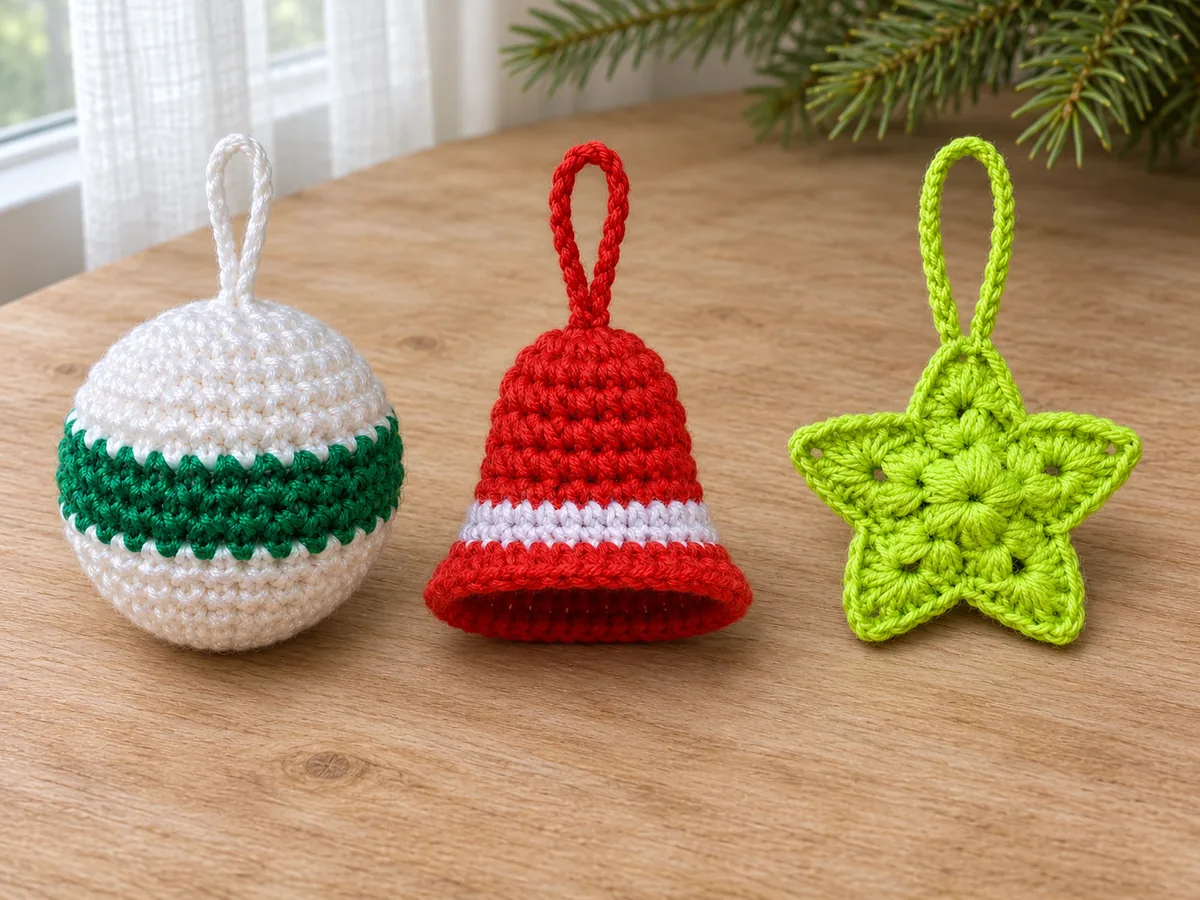
These stuffed Christmas baubles share a 14-round spiral shape. Three complete color arrangements are given: white with a broad green middle band, red-and-white diamonds or lengthwise color areas, and multiple round stripes. A plain version is also possible without changing the shaping.

By Emma & EllaUpdated
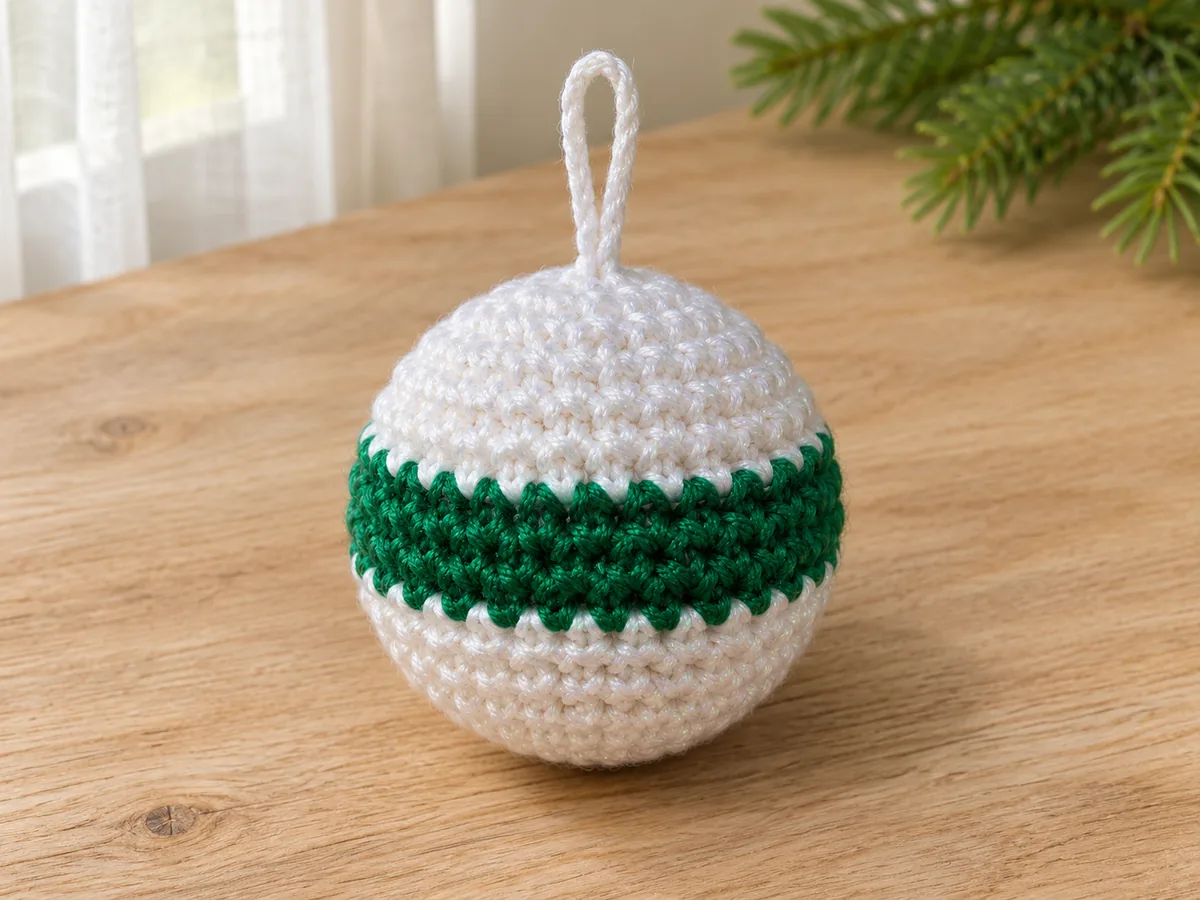
These stuffed Christmas baubles share a 14-round spiral shape. Three complete color arrangements are given: white with a broad green middle band, red-and-white diamonds or lengthwise color areas, and multiple round stripes. A plain version is also possible without changing the shaping.
Prepare the yarn, spiral method and integrated hanging loop
Materials and reference limits
Use light worsted yarn, a 4 mm hook, yarn needle and stuffing. The reference yarns are glittery white, a red marled yarn and green.
No fixed gram amount, tension or finished diameter is supplied. Other remnants of comparable thickness may be used. Matching yarn weight and tension help a set of baubles have similar dimensions.
US stitch glossary
Sc means US single crochet. Ch means chain and sl st means slip stitch. Inc puts 2 sc in the same old position.
For the described dec, insert into the next stitch and collect a loop, then insert into the following stitch and collect another. Draw yarn through all 3 loops to make 1 sc from 2 old positions.
This is the ordinary decrease described by the source, not necessarily an invisible front-loop-only version. Use the specified method consistently within a matching set.
Make the hanging loop before the first ball round
Work 6 ch and join them into a small loop with sl st. Then work 2 ch and 6 sc in the 2nd chain from the hook. Those 6 sc are ball round 1.
The original 6-chain loop remains hanging from the beginning. Do not work the first bauble round around all 6 chains of that loop.
Work the ball in spirals without routine joining slip stitches. Mark the beginning and count actual sc rather than the working loop or marker.
Choose the color version before starting
For diamonds, carry the unused yarn under the new stitches. Whole-round stripes instead change color at the circuit beginning. Those are different yarn-management methods.
Keep a separate note for each version so an interrupted ornament does not accidentally resume with another color plan.
The colorful bauble cover uses another construction from these fully crocheted balls.
Make the white bauble with a broad green band
All 14 basic rounds
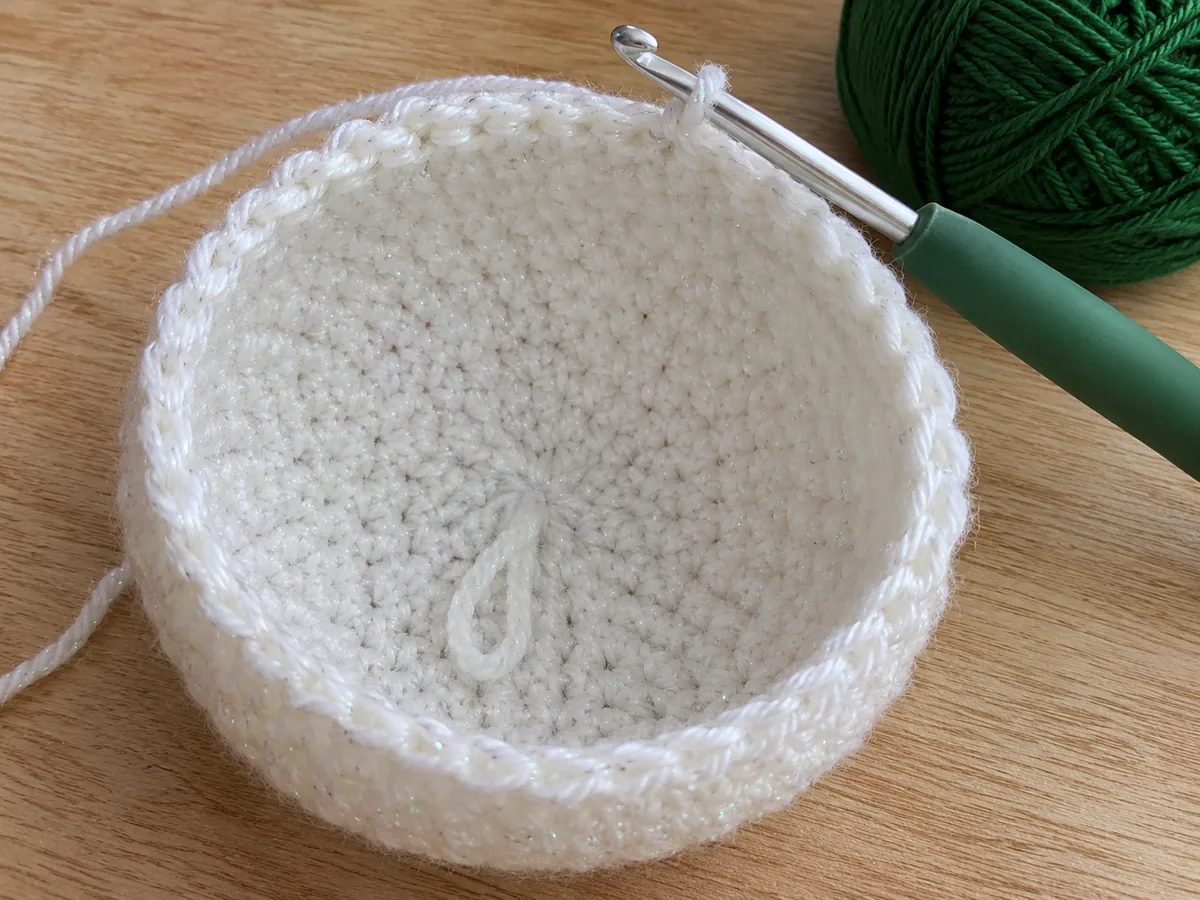
- Round 1: White, make starting loop as described, then 6 sc in 2nd of 2additionalchains: 6.
- Round 2: increase every stitch: 12.
- Round 3: (1 sc, inc)6 times: 18.
- Round 4: (2 sc, inc)6 times: 24.
- Round 5: (3 sc, inc)6 times: 30.
- Round 6: (4 sc, inc)6 times: 36.
- Round 7: Green, 36 sc.
- Round 8: Green, 36 sc.
- Round 9: Green, 36 sc.
- Round 10: White,(4 sc, dec)6 times: 30;bring loop outside.
- Round 11: (3 sc, dec)6 times: 24.
- Round 12: (2 sc, dec)6 times: 18.
- Round 13: (1 sc, dec)6 times: 12;stuff.
- Round 14: 6 dec: 6.
Bring the original loop through after round 10
Insert the hook through the surface beside the center of the first round and pull the existing hanging loop outside. The source specifies the edge of that first round rather than entering its exact central point, to keep the center neat.
The ball is still open and easy to hold at this stage. Turn its right side out and continue the following reductions with the outside correctly oriented.
No second hanging chain is required. Check that you have recovered the original 6-chain loop rather than an unused color end carried inside.
Fill after round 13 and close
Add stuffing in small portions after round 13. Support the sides beneath the green band as well as the center without letting fibers show through the stitches.
No exact stuffing weight is supplied. A single compact wad can leave the poles less supported even if the middle is full.
After the last 6 decreases, secure the yarn and sew the small opening shut. The hanging loop remains at the original starting pole, opposite the final closing seam.
Plain version and shape checks
For a single-color bauble, work all 14 rounds in that color with the same sequence. The green band of the striped version occupies exactly rounds 7–9.
Round 10 is already a decreasing round in white. If the shape appears unusually flat, check the 3 unchanged middle rounds and increasing rounds rather than automatically adding extra circuits.
The source supplies no additional larger basic size. Record actual yarn and dimensions for a matching repeat ornament.
Work the red-and-white diamond color areas
Carry the inactive yarn inside the stitches
Begin in red. From round 3, alternate short red and white sections within each round, carrying the inactive strand under the active stitches.
The repeated red-white pair is worked 3 times in total. The source's star-repeat wording could be misread as another fourth pass, but that would not fit the available stitches or printed totals.
All 14 colorwork rounds
- Round 1: Red, starting loop and 6 sc.
- Round 2: Red, 6 inc: 12.
- Round 3: (Red: 1 sc, inc;white: 1 sc, inc)3 times: 18.
- Round 4: (Red: 2 sc, inc;white: 2 sc, inc)3 times: 24.
- Round 5: (Red: 3 sc, inc;white: 3 sc, inc)3 times: 30.
- Round 6: (Red: 4 sc, inc;white: 4 sc, inc)3 times: 36.
- Round 7: (6 red sc, 6 white sc)3 times: 36.
- Round 8: (6 red sc, 6 white sc)3 times: 36.
- Round 9: (6 red sc, 6 white sc)3 times: 36.
- Round 10: (Red: 4 sc, dec;white: 4 sc, dec)3 times: 30;bring loop outside.
- Round 11: (Red: 3 sc, dec;white: 3 sc, dec)3 times: 24.
- Round 12: (Red: 2 sc, dec;white: 2 sc, dec)3 times: 18;stuff.
- Round 13: Red,(1 sc, dec)6 times: 12.
- Round 14: Red, 6 dec: 6.
Check paired colors against the shaping totals
In round 3, each color section contains 1 sc and an increase, producing 3 stitches. A red-white pair produces 6; 3 pairs make 18.
As the ordinary-sc spacing grows, the same 3-pair arrangement makes 24, 30 and 36. In the middle rounds, each pair contains 6 red and 6 white stitches.
The narrowing reverses that spacing while preserving the paired color structure through round 12. Bring out the original loop after round 10 as in the basic version.
Finish with the stated red pole
Stuff after round 12. End white if following the source's preferred plain pole, then work rounds 13 and 14 entirely red, close and weave in the ends.
The source also allows color changes to continue to the end, but does not give another exact section distribution for those final 12 and 6 stitches. That alternative is not expanded into invented original counts.
Keep carried yarn relaxed
Spread the last few stitches gently before each change and check the inactive yarn has enough length. A short carried strand can make the ball angular despite a correct total.
Do not suddenly tighten that strand after a whole circuit. It should be enclosed within the fabric rather than floating as a long loop across the hollow center.
The colorful Christmas covers offer another ornament project.
Make the multiple-stripe version and review the set
All 14 striped rounds
- Round 1: White, starting loop and 6 sc.
- Round 2: White, 6 inc: 12.
- Round 3: Red,(1 sc, inc)6 times: 18.
- Round 4: Red,(2 sc, inc)6 times: 24.
- Round 5: Red explicitly again,(3 sc, inc)6 times: 30.
- Round 6: Red,(4 sc, inc)6 times: 36.
- Round 7: White, 36 sc.
- Round 8: White, 36 sc.
- Round 9: Red, 36 sc.
- Round 10: Red,(4 sc, dec)6 times: 30;bring loop outside.
- Round 11: White,(3 sc, dec)6 times: 24.
- Round 12: White,(2 sc, dec)6 times: 18;stuff.
- Round 13: Red,(1 sc, dec)6 times: 12.
- Round 14: Red, 6 dec: 6.
Preserve the repeated red instruction
The source again says to change to red in round 5 although round 3 already requested red. That duplicated instruction is not silently reinterpreted as white.
The written list therefore keeps red for round 5. The general explanation prefers 2 rounds per stripe and permits changes every round, but does not prove a specific white correction at that point.
Choosing white there is a personal color variation rather than a confirmed printing repair. Keep the choice in your notes if repeating the same set.
Keep the same shaping across all versions
The shared totals are 6, 12, 18, 24, 30, 36; then 3 unchanged middle rounds; then 30, 24, 18, 12 and 6.
Filling timing differs slightly: the basic bauble is filled after round 13, while diamonds and multiple stripes are filled after round 12. Preserve the sequence for the chosen version.
All grow as 1 spiral form. No separate second half or seam around the equator is needed.
Inspect the hanging pole and closing seam separately
Check the original chain loop where it emerges beside the first-round center, then inspect the final needle closure at the opposite pole.
A neat closing seam does not replace a loose loop connection. Keep the initial loop free from carried yarn and verify that its 6-chain shape has not been accidentally caught into a neighboring stitch.
Compare the middle band heights across a matching set without stretching the ornaments into identical measurements. A missing unchanged round needs correcting rather than compensating with extra stuffing.
When checking the diamond version, trace a complete red-white pair before counting the whole round. The shared base shape has 6 shaping sectors, while the color sequence groups them into 3 paired sectors. Confusing those 2 descriptions can lead to doubling the number of color repeats even though the increase total is unchanged.
The original hanging loop is also independent of those sectors. Moving it outside after round 10 does not add a new stitch or restart the numbered sequence.
Finish and record the actual color arrangements
Secure ends within matching-color areas and inspect the surface from all sides. Do not pull finishing yarn so firmly that it dents an otherwise round ball.
The broad-band version changes entire color sections, diamonds change several times per round, and the third version creates several circular stripes. No embroidered diamond or extra outer cover is needed to make those differences.
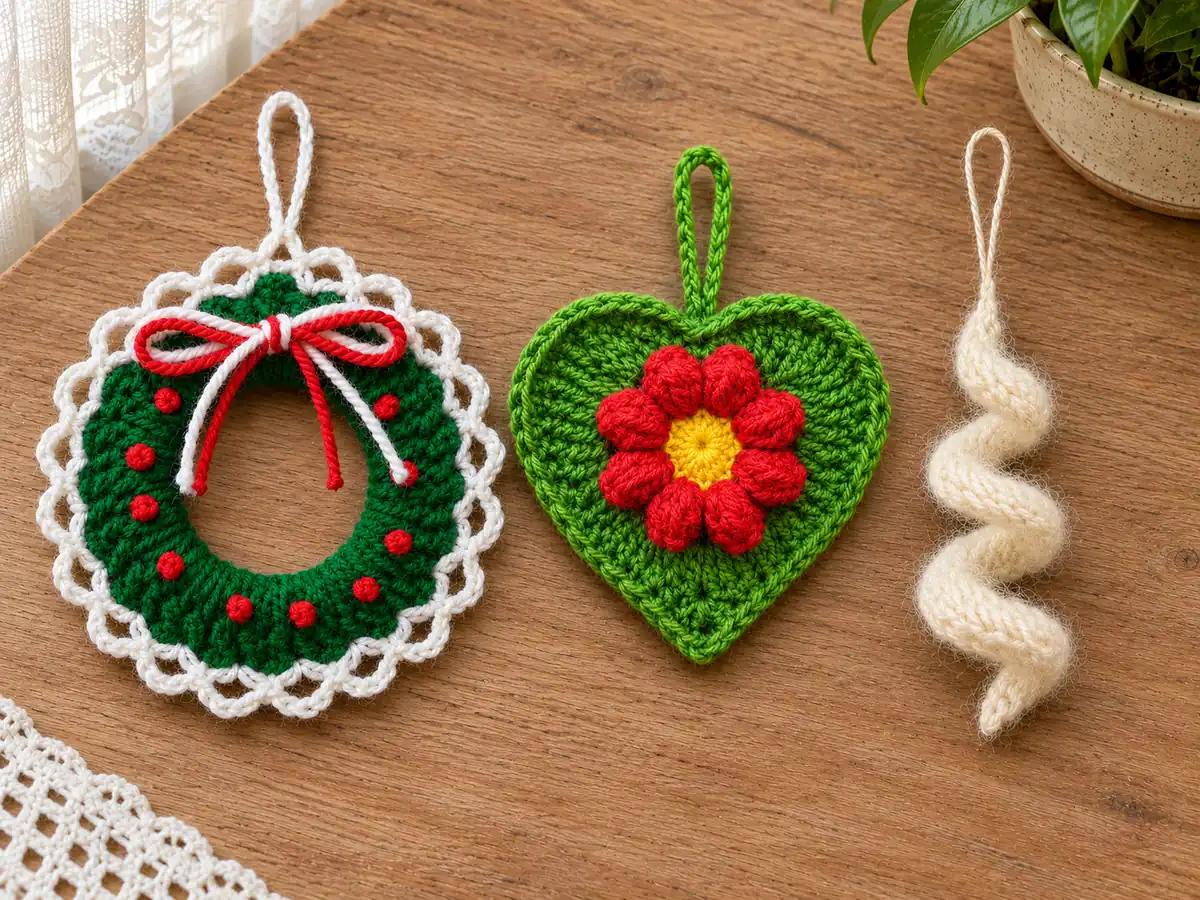
Record actual yarn, hook, color plan and finished size. The small wreath with white edging offers another shape for a coordinated Christmas display.
Emma & Ella
More crochet projects from The Cooking Twins Yarn.
More from Emma & Ella