Narrow geometric filet crochet scarf
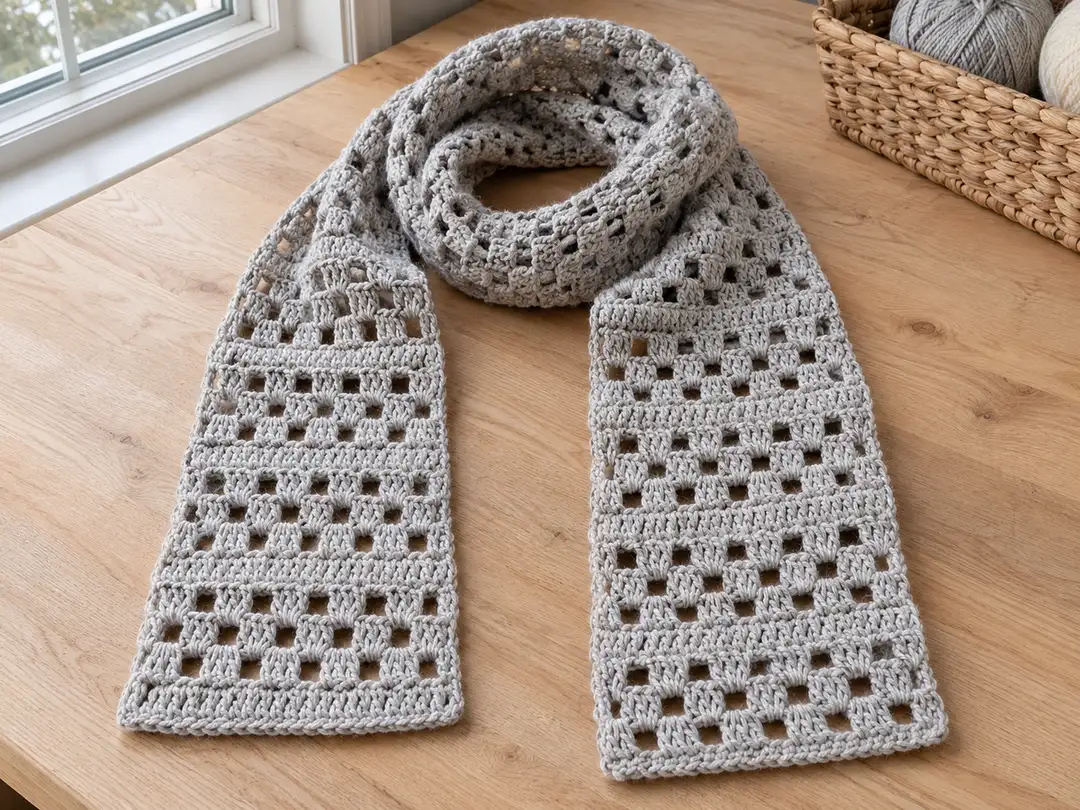
This narrow filet crochet scarf uses a geometric arrangement of open arches, small double crochet groups and joined clusters. It is worked in 6 long rows along the full scarf length. The source example measures approximately 165 × 3.5 cm, making an open band that can be tied loosely at the neck or

By Emma & EllaUpdated
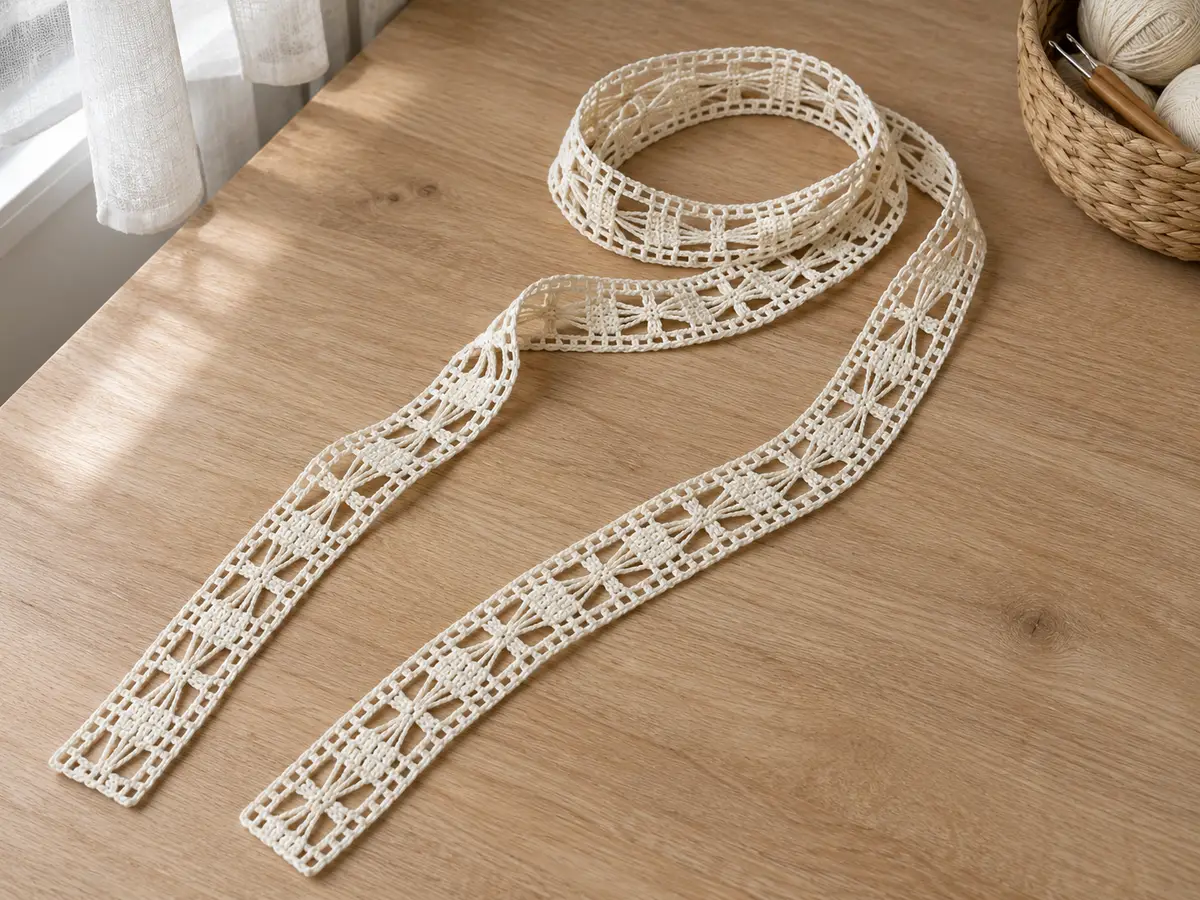
This narrow filet crochet scarf uses a geometric arrangement of open arches, small double crochet groups and joined clusters. It is worked in 6 long rows along the full scarf length. The source example measures approximately 165 × 3.5 cm, making an open band that can be tied loosely at the neck or used as a hairband.
The instructions use US crochet terminology. The 501 foundation positions establish the length. Preserve the difference between ordinary complete double crochets, a 3-double crochet cluster and the small filet group F; they have different insertion points and different roles in the pattern.
Prepare fine yarn and learn the 2 special groups
Materials and complete-pattern sample
Use fine fingering yarn, category 1, preferably cotton or a cotton blend, with a 2.5 mm hook. Prepare scissors, a yarn needle and markers. The source gives no fixed metreage or yarn weight allowance, so no guaranteed consumption is introduced here.
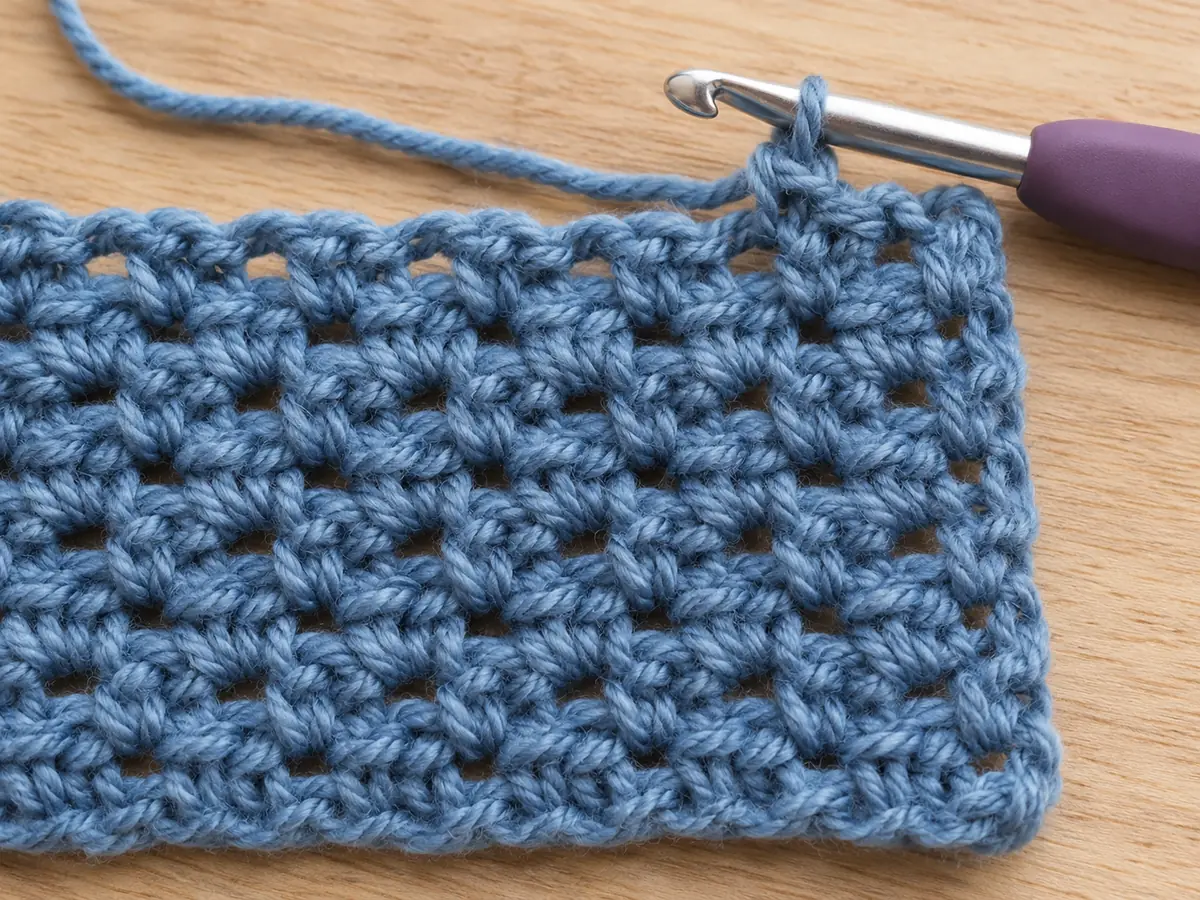
A sample across 37 foundation positions and all 6 pattern rows measures approximately 12 × 3.5 cm. Work the full sample rather than measuring only a chain or the first filet row. The larger arches and later connections affect how the completed fabric lies after blocking.
The scarf is long but only a few rows wide. Additional repeats within a row change its length; adding more rows would change the specified width and arrangement. The complete main sequence here remains 6 rows.
US crochet glossary
Ch means chain, sl st means slip stitch, sc means US single crochet and dc means US double crochet. US sc corresponds to US single crochet, while US dc corresponds to US double crochet. The working loop is not a counted chain. Unless specified otherwise, use both top loops when working into a stitch.
Filet group F
- Work 1 dc into the next old dc.
- Make 1 ch, skipping the old chain between the double crochets.
- Work 1 dc into the next old dc.
- Make 1 ch, again skipping the intervening old chain.
- Work 1 dc into the following old dc.
Group F contains 3 double crochet positions with 2 separate chains between them. The double crochets go into successive old double crochets, not all into a single arch. Keep this small open group distinct from the later closed group of 5 complete double crochets.
3-double crochet cluster
Begin 3 dc in the same insertion point, leaving the final loop of each unfinished. With all 3 partial double crochets on the hook, yarn over and draw through all 4 loops. This closes them together as one cluster.
Unlike a popcorn, this cluster does not begin with several fully completed double crochets that are gathered afterwards. Keep the hook loops controlled so that the final draw-through joins the intended group without tightening the surrounding chain arches.
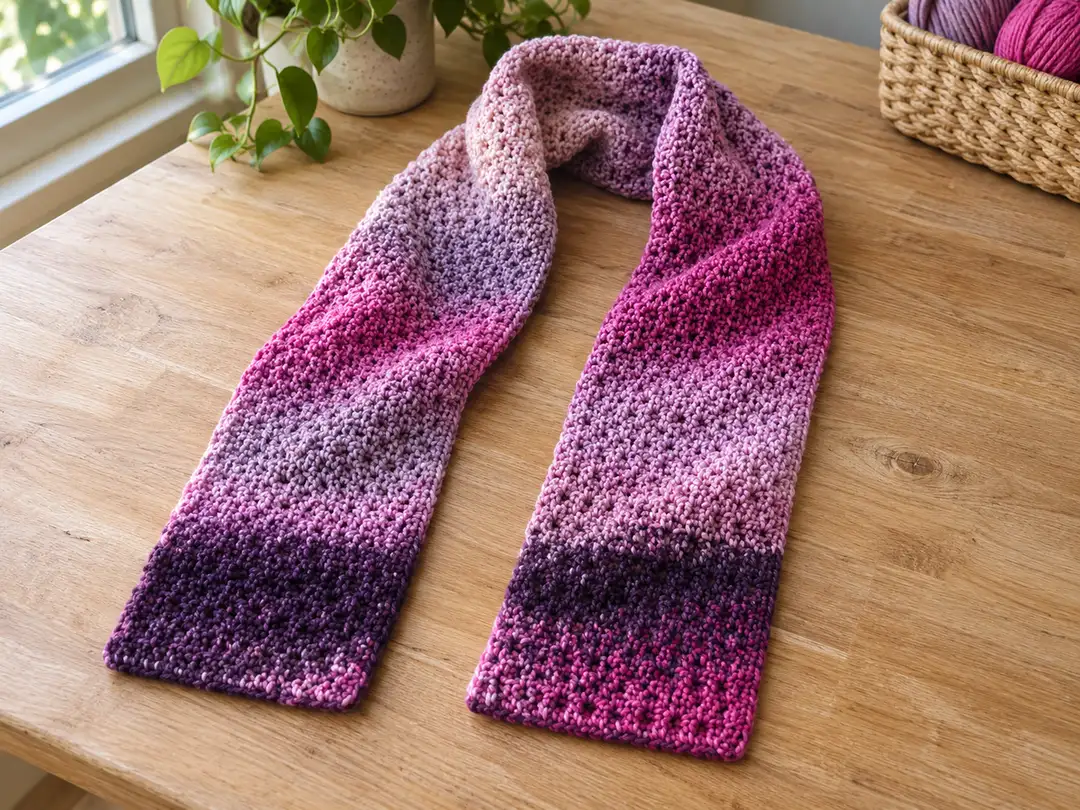
For another fine-textured project, compare the small yarn-over slip-stitch scarf. Its tension and stitch construction are separate.
Make 501 foundation positions and work row 1
Keep the 16-position repeat
Make 501 foundation positions. For another length, change the count in steps of 16, keeping the formula a multiple of 16 plus 5. The full example is 31 × 16 + 5; the 37-position sample is 2 × 16 + 5.
Mark every 50 or 100 positions if helpful. Count actual usable positions along the chosen foundation edge, not the working loop. Keep the edge relaxed while counting, because pulling a cord or chain tight gives a misleading impression of its finished length.
Recommended crochet I-cord foundation
The source recommends a softer I-cord edge, with an ordinary chain offered as an alternative. For the crochet cord, establish 3 live loops on the hook, then follow this sequence:
- Carefully remove the last 2 loops and hold them securely.
- Pull yarn through the remaining loop.
- Replace the first held loop on the hook and pull a new loop through it.
- Replace the second held loop and do the same.
- Repeat this 3-part sequence, keeping the live loops controlled.
Count 501 even insertion positions along the long edge used for the scarf. This cord technique is not a direction to pull through all 3 loops together as one taller crochet stitch.
Ordinary-chain alternative
If using the simpler alternative, make 501 foundation chains. The pattern then uses the foundation positions described below. Keep the foundation count separate from the new beginning chains that represent the first double crochet's height.
Row 1: establish the long filet grid
- Make 3 ch as the first dc, representing the starting foundation position.
- Repeat [1 ch, skip 1 foundation position, 1 dc in the next position] across.
- Turn.
The remaining 500 foundation positions accommodate 250 repeats. The beginning-chain double crochet represents the first position; it is not an instruction to add another double crochet into that same base.
Do not repair a counting error by inserting extra chains somewhere in the long row. That shifts the large arches relative to the filet groups. Return to the last reliable marker and check the affected section.
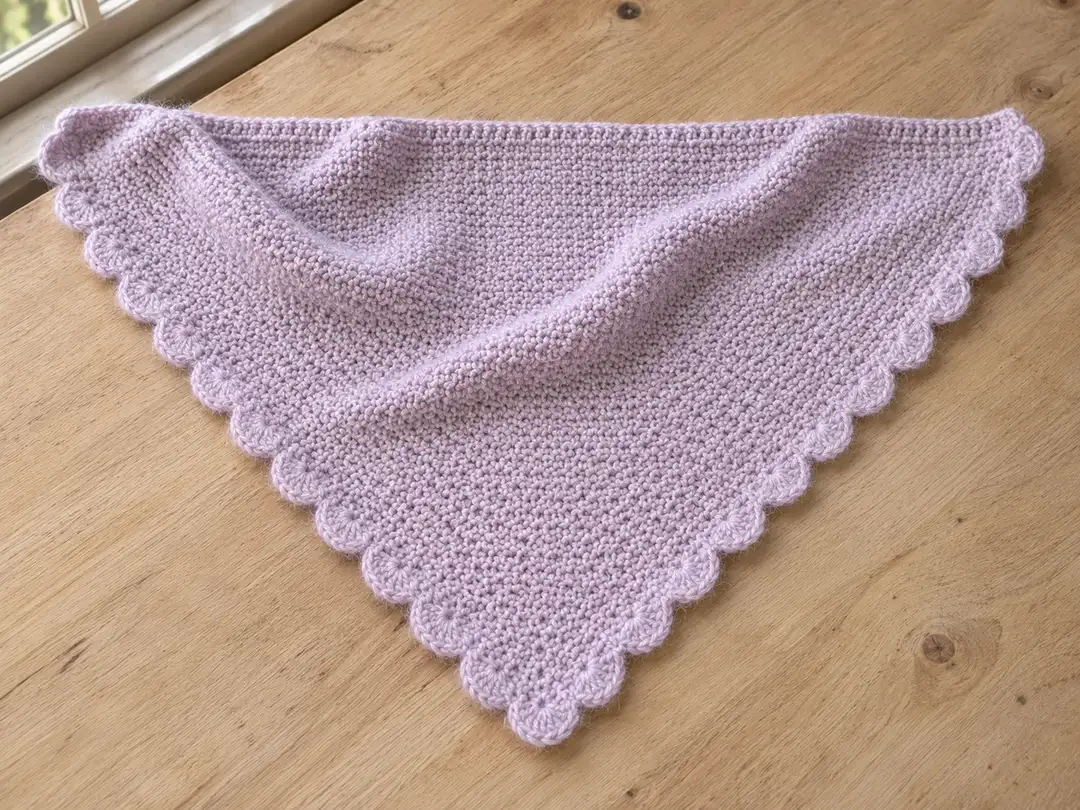
For another shaped project, see the triangular shawl with a shell edging. This narrow filet scarf keeps its long rectangular arrangement.
Work the geometric pattern through rows 2–5
Row 2: large arches and clusters
Begin with 4 ch, representing a dc and 1 ch. Skip an old chain arch, work 1 dc into the next dc, make 1 ch, skip the next chain arch and work 1 dc into the next dc. This establishes the small starting filet group.
Continue repeating: 5 ch, skip 2 old dc, work a 3-dc cluster into the next dc; 5 ch, skip 2 old dc and work group F. Turn after completing the row.
The skipped positions here are old double crochets, not an instruction to count only 2 individual foundation links. Follow the existing filet structure when finding each next cluster or F group.
Row 3: connect around the clusters
Begin with 3 ch as the first dc. Work [1 dc into the next chain, 1 dc into the next dc] twice, making the initial closed group of 5 double crochet positions.
Repeat: 4 ch, 1 sc into the next 5-chain arch, skip the cluster, 1 sc into the following 5-chain arch, 4 ch, then 5 dc across the next F group. Those 5 dc go successively into dc, ch, dc, ch and dc. Turn.
The closed 5-dc group is spread across 5 different old positions. Putting all 5 into one arch would make a shell, which is a different structure. The pair of sc connects the arches on either side of the skipped cluster.
Row 4: form the central 3-sc connection
Make 3 ch as the first dc and work 4 dc into the next stitches. Then repeat: 4 ch, 1 sc into the next arch, 1 sc between the 2 old sc, 1 sc into the following arch, 4 ch and 5 dc into the next closed double crochet group. Turn.
The extra sc between the earlier pair creates 3 sc in the central connecting area. Their middle stitch will be used for the next cluster. Keep the surrounding arches open rather than accidentally joining them into one dense block.
Row 5: reopen the geometric shapes
Begin with 4 ch, skip 1 stitch, work 1 dc, make 1 ch, skip 1 stitch and work 1 dc. Continue with 5 ch, skip the first of the 3 sc and work a 3-dc cluster into the middle sc. Make 5 ch and work group F over the next closed 5-dc group. Repeat and turn.
The second large arch bridges the third sc. The cluster therefore belongs in the middle of the 3-sc section, not in its first or last stitch. This placement makes rows 2 and 5 correspond across the pattern.
Finish each full long row before beginning another. The closed double crochet groups provide useful counting landmarks. A missing arch or extra cluster is easier to correct immediately than after the fine strip has been blocked.
Complete row 6 and open the lace gently
Final filet row
- Make 4 ch as a dc and a chain.
- Skip the next old chain.
- Continue the filet grid of dc with 1 ch between them across the entire length.
- Distribute 2 dc into each 5-chain arch.
- Include the cluster tops and the double crochets of the F groups in the continuous grid.
- Finish with a dc into the final edge stitch.
The last double crochet closes the edge position rather than leaving the scarf ending in an unattached chain arch. Follow the stated distribution through the large arches and existing groups, keeping the single chains between double crochet positions.
Check alignment before weaving in
Lay the completed strip flat. Its foundation and final edges may initially look a little different because they were made by different methods. Gentle blocking can settle the fabric, but a clear displacement in the geometric repeats indicates a count error rather than a finishing problem.
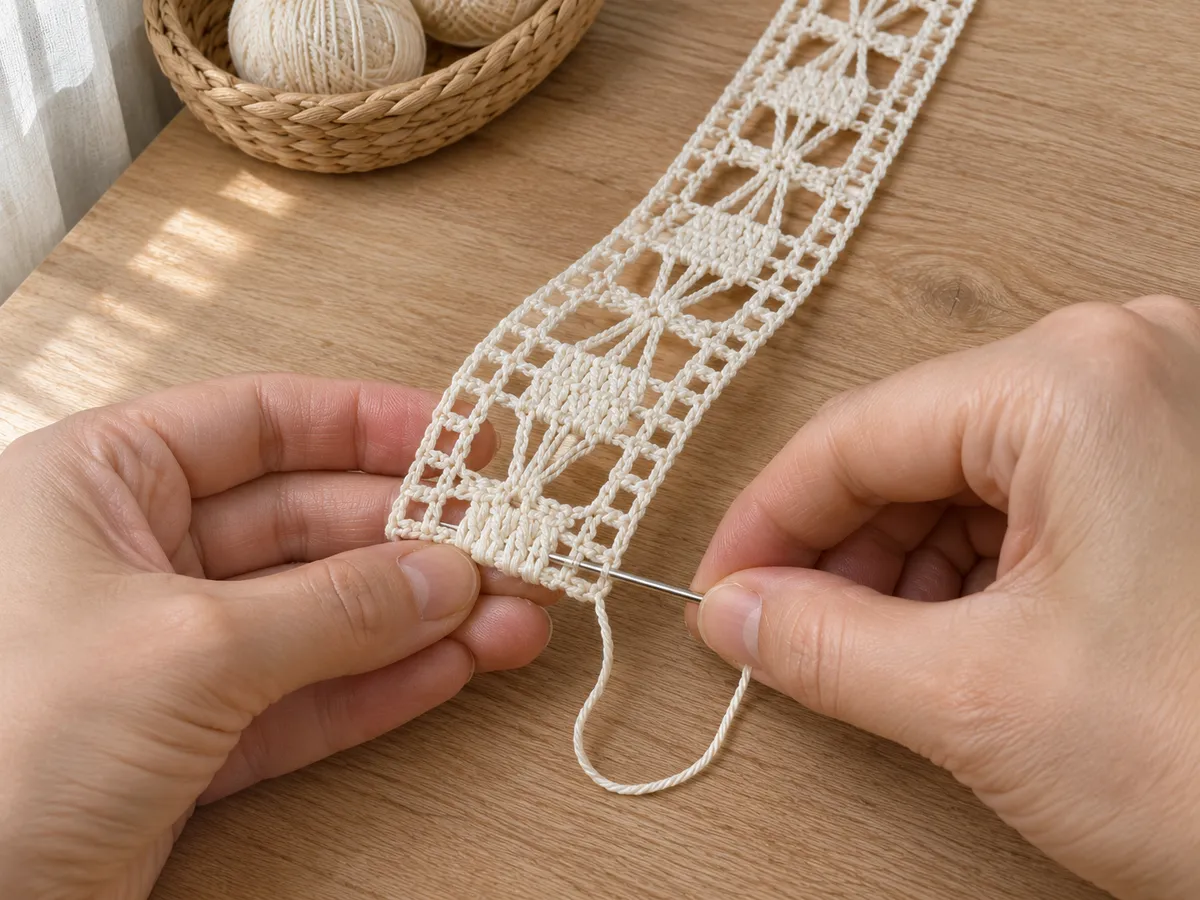
Hide yarn ends along closed double crochet sections or within the foundation edge. Do not carry them visibly across the large open spaces. Use secure changes of direction without pulling the narrow fabric into a gathered section.
Wet-block or steam with care
Dampen and arrange the geometric openings gently. Alternatively, steam cautiously with a suitable cotton cloth between the heat source and the work, keeping a gap. Do not press an iron directly onto the stitches.
The scarf should remain an open, movable band. Let it dry completely before measuring its final length and width. The 6-row sequence is then complete and requires no additional invented border.
For another construction, try the linen-stitch infinity scarf. The source measurements and sample here do not claim a separate physical test of every yarn substitution.
Emma & Ella
More crochet projects from The Cooking Twins Yarn.
More from Emma & Ella