Reversible shell crochet scarf with optional buttons
This reversible shell scarf alternates front-loop and back-loop crochet to create 2 different views of the same fabric. Full shells contain 5 US double crochets, while a smaller 3-double crochet group finishes each row. Optional buttons allow the scarf to be closed into a loop or shorter neck

By Emma & EllaUpdated
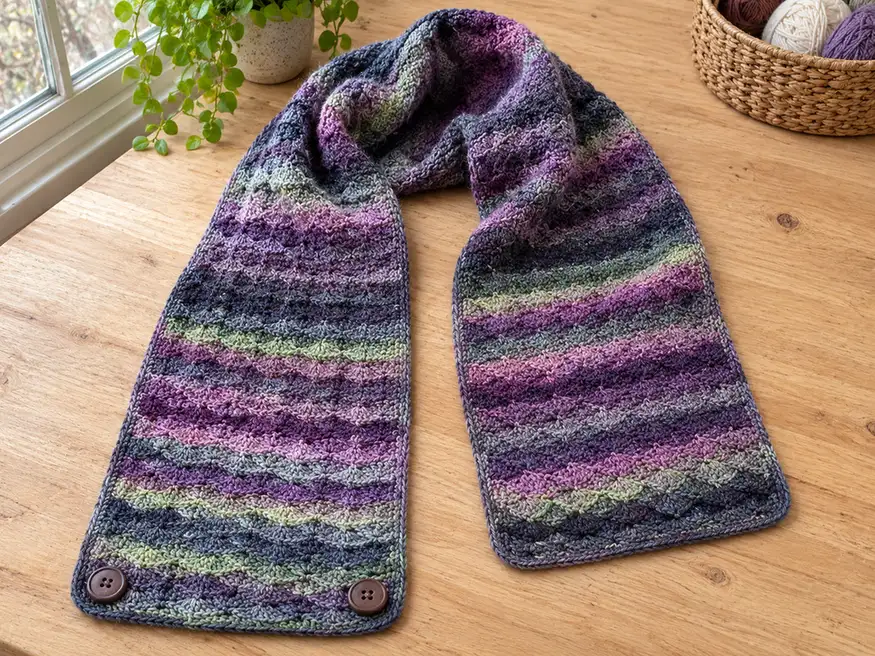
This reversible shell scarf alternates front-loop and back-loop crochet to create 2 different views of the same fabric. Full shells contain 5 US double crochets, while a smaller 3-double crochet group finishes each row. Optional buttons allow the scarf to be closed into a loop or shorter neck warmer.
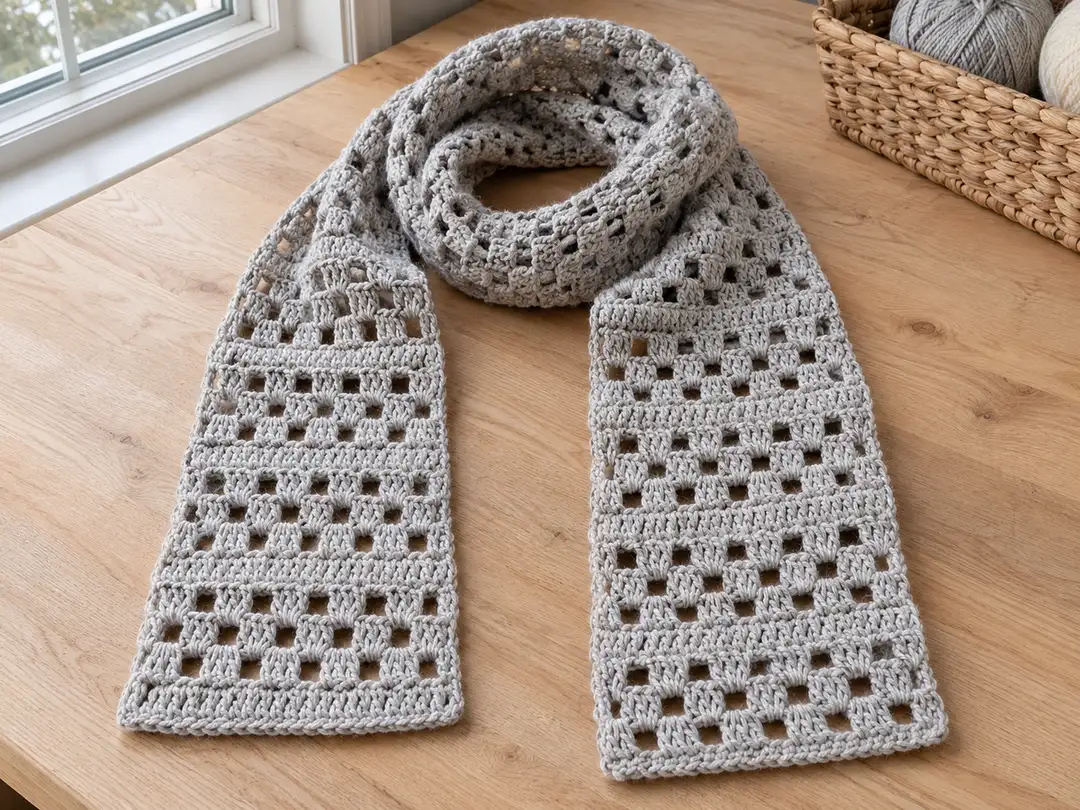
The source's open example is approximately 152 cm long. The instructions use US crochet terminology. Both faces belong to one continuous piece; there are not 2 separate scarves to sew together.
Choose soft yarn and understand the 2 loop placements
Materials and reference limits
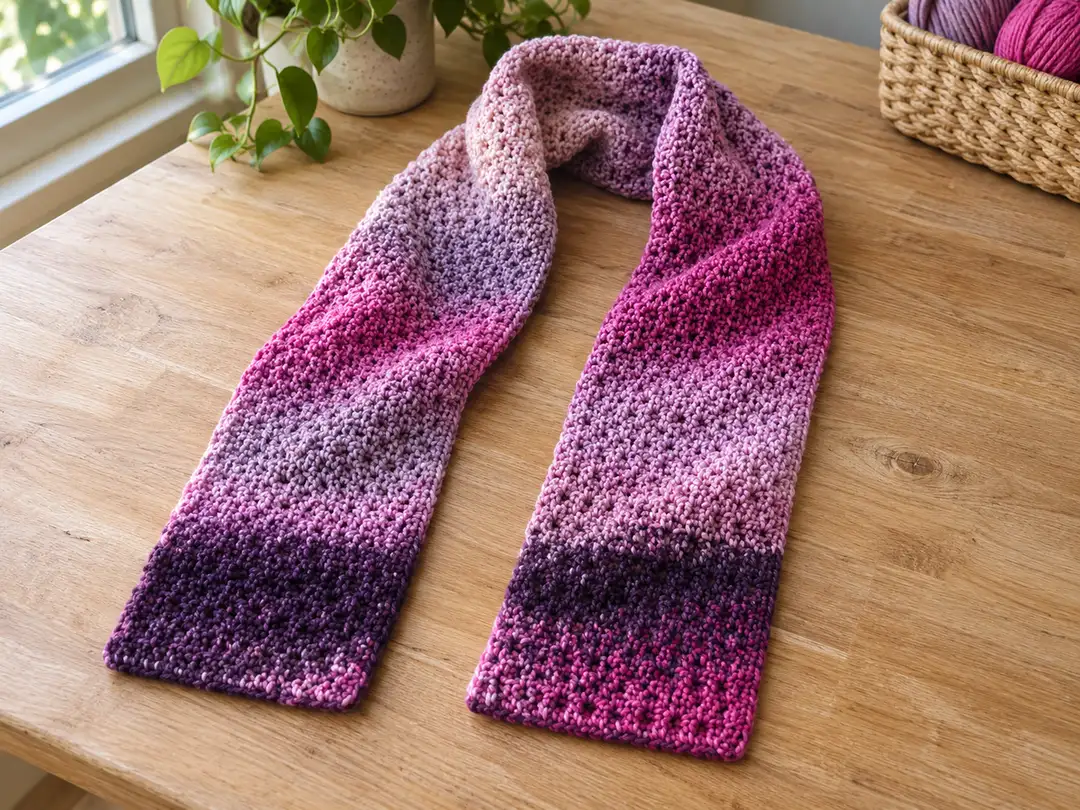
Use 2 balls of soft color-changing yarn, a hook of US size H, usually 5 mm, and a yarn needle. Prepare 2 suitable buttons if you want the optional fastening. The source suggests 1 ball for a shorter neck-warmer version.
No exact yarn weight, metreage, fixed tension or finished width is supplied. Compare the actual length and thickness of replacement yarn rather than choosing by ball count alone. Work a small sample to check that the shells fall softly.
Check the millimeter marking of your hook even when it carries an H label. Without a fixed source tension, another hook size cannot be promised to reproduce the same dimensions mathematically. Assess the width after the foundation and first 2 shell rows.
US crochet glossary
Ch means chain, sl st means slip stitch, sc means US single crochet, hdc means US half double crochet and dc means US double crochet. US sc corresponds to US single crochet, hdc to US half double crochet and dc to US double crochet.
FLO means front loop only and BLO means back loop only. Looking at the top V from your current working side, the front loop is nearer to you and the back loop is further away. Turned rows use the loops as seen from the new working side.
A full shell is 5 complete dc into one specified loop of the same stitch. The half shell at the row end is 3 dc through both loops. These are ordinary completed double crochets, not clusters closed together.
Keep the stabilising edges
The first sc and the final group of 3 dc always use both top loops. Only the inner shells and inner sc change between FLO and BLO. Working every stitch through both loops would retain a shell outline but lose the intended surface effect.
The working loop and the 1-chain turn are not extra pattern positions. Mark the outer stitches if the row ends are difficult to distinguish among the shells. Count the shell groups separately from their internal double crochets.
For another soft fabric, compare the small yarn-over slip-stitch scarf. Its ribs use a different stitch and should not replace these shell instructions.
Work the 28-stitch foundation and front-loop shell row
Row 1: half-double-crochet foundation
- Make 30 ch.
- Begin in the 3rd chain from the hook.
- Work 1 hdc into that chain and each remaining chain.
- Total: 28 hdc.
- Make 1 ch and turn.
The first 2 chains provide the starting height and are not added to the 28 actual hdc. Check the full foundation before beginning the shells. A lost foundation position affects the alternating high and low points throughout the scarf.
Row 2: front-loop shells
- Work 1 sc through both loops of the first stitch.
- Skip 2 stitches.
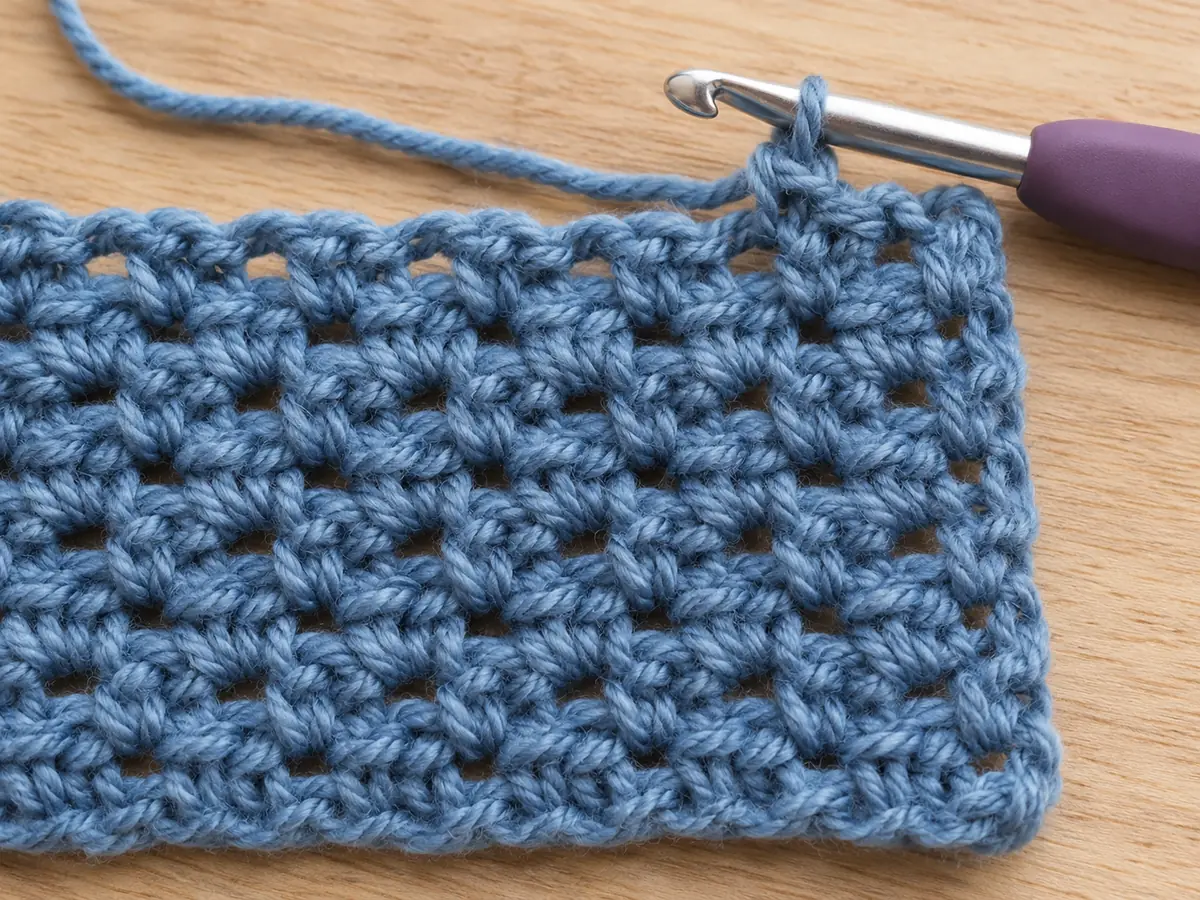
- Work 5 dc FLO into the next stitch.
- Skip 2 stitches and work 1 sc FLO into the next stitch.
- Continue that shell and sc sequence across.
- At the final old stitch, replace a full shell with 3 dc through both loops.
- Make 1 ch and turn.
For this foundation width, there are 4 full shells of 5 dc and a final half shell of 3 dc. The low sc positions sit between the high groups. The full row retains 28 pattern positions when the sc and double crochets are counted together.
In the old 28-stitch row, the first sc occupies position 1. The full shells sit at positions 4, 10, 16 and 22, with the following sc at 7, 13, 19 and 25. The final 3-dc group sits in position 28. This is a count check of the stated skip sequence.
All 5 double crochets of each inner shell enter the same front loop. Do not distribute them across 5 old stitches. The skipped stitches on either side allow the shell to spread, while the next sc anchors the low point.
Check the half shell at the edge
The final 3 double crochets are deliberate. Adding a full 5-dc group there increases the row count and changes the edge. Keep that smaller group through both loops, even in a row whose inner stitches use only the front loops.
Before turning, compare the 4 large groups and the small final group. The turning chain is separate and is not a sixth double crochet in a shell. A marker in the true first and last stitch helps preserve this distinction on the next row.
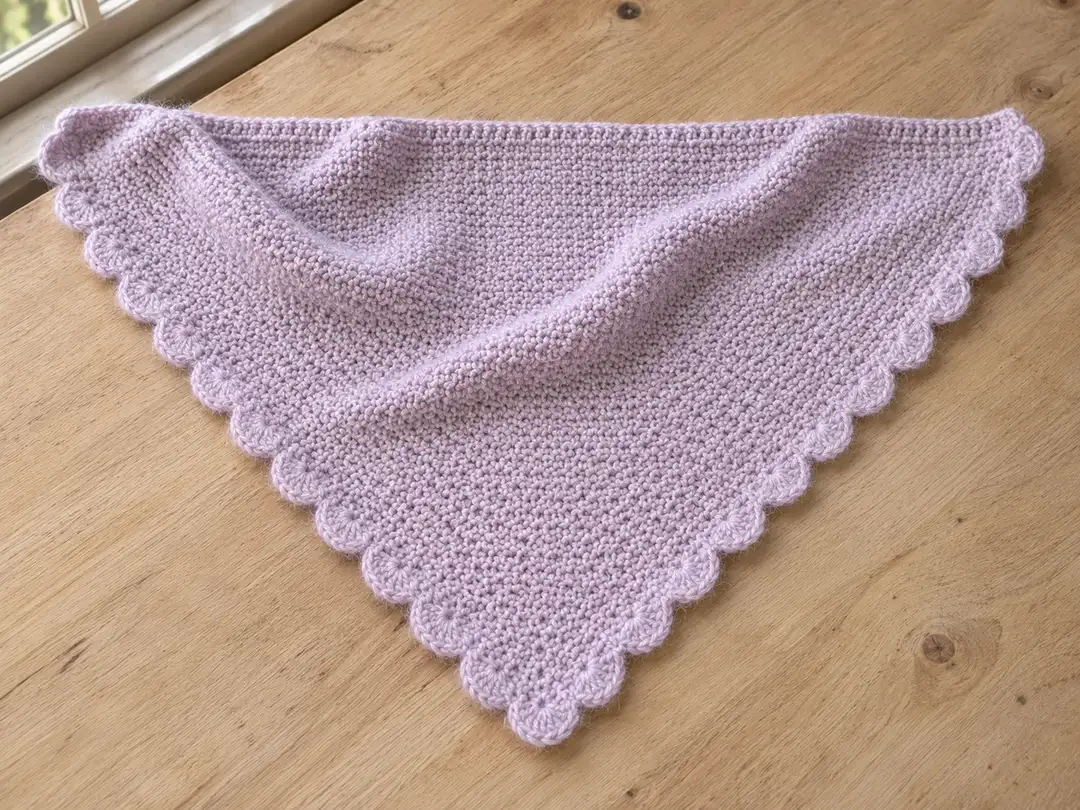
A related shaped project is the triangular shawl with a shell edging. This scarf maintains its narrow rectangular width instead.
Alternate back-loop and front-loop rows to the desired length
Row 3: back-loop shells
- Work 1 sc through both loops of the first old dc.
- Skip 2 stitches.
- Work 5 dc BLO into the next stitch.
- Skip 2 stitches and work 1 sc BLO into the next stitch.
- Continue the same sequence.
- Finish with 3 dc through both loops of the final edge stitch.
- Make 1 ch and turn.
The stitch arrangement stays the same as row 2; only the inner loop placement changes. The beginning sc is worked into the first double crochet of the old half shell after turning. The new shells align with the lower points of the previous row.
Do not place every new shell automatically into the center of an old 5-dc shell. The specified sc and skipped positions create the stagger. Follow the row's counted stitch positions instead of choosing a visually large gap.
Repeat rows 2 and 3
Continue alternating the FLO row and the BLO row until the scarf reaches the required length. First sc and final 3-dc group remain through both loops on every row. They do not change with the inner loop choice.
Color-changing yarn creates the stripes independently of the row pattern. A new color appearing midway through a row is not a signal to switch from FLO to BLO. Keep the sequence recorded even when the colors make the surface lines more or less visible.
After several repeats, compare both faces and both long edges. The unused loops should create the differing surface lines while the width remains even. A missing half shell or an extra edge stitch changes the construction, not merely its appearance.
Choose the length before finishing
The 2-ball open example is approximately 152 cm long. The shorter buttoned neck-warmer version is adjustable and has no separate fixed centimeter length. Check the actual fabric and reserve yarn for the edging before using the final ball completely.
Complete rows or row pairs as appropriate to your planned finish and try the relaxed arrangement without pulling on unsecured loops. A temporary length check is useful before fastening off, especially if the scarf will close with buttons.
Work the half-double-crochet border and optional button fastening
First finishing pass in half double crochets
- For the final row, work 1 hdc across each position of the upper shell edge.
- Make 1 ch at the end and continue with evenly distributed hdc along the first long side.
- Make 1 ch at the next corner and work hdc across the foundation edge.
- Make 1 ch at the next corner and work hdc along the second long side.
- At the starting point, join with an sl st into the 1-chain space.
- Make 1 ch for the following edging round.
Keep that starting chain space identifiable for the stated join. Along the long sides, place hdc evenly through the row ends. A large shell opening is not an instruction to add several border stitches automatically.
The corner chains provide room for direction changes. Let the border follow the existing length without gathering it. The source supplies no fixed long-side pickup total, so check the relaxed edge rather than inserting a newly invented stitch count.
Final front-loop slip-stitch round
Work ordinary sl st through the front loop only of each border stitch. At each corner, work an sl st, make 1 ch and continue along the edge. Join with an sl st, fasten off and weave in the ends.
Keep this low round loose. It uses FLO, unlike a back-loop edging found in some other patterns. Tight slip stitches can pull an otherwise even half-double-crochet border into a firm, gathered outline.
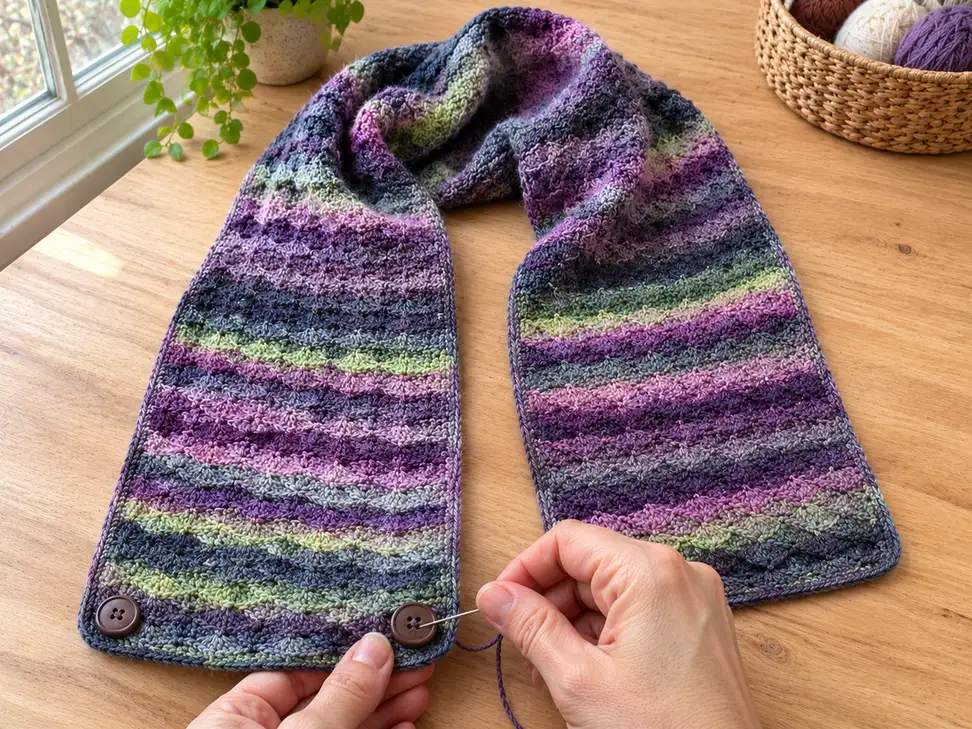
Fit the optional 2 buttons
Lay the scarf in the intended closed shape before sewing. Place one button at each corner of one short end and find suitable existing shell openings at the other end. Test that the buttons pass through and then hold securely without over-stretching those openings.
No separate buttonhole rows are part of the pattern. Do not alter the shell sequence afterwards to create a new large hole. Mark the selected positions and attach each button with secure stitches through a stable edge area.
Keep the ends aligned without an accidental twist merely to reach an easier opening. The different surfaces are visible without twisting the scarf. The open version uses the same complete main fabric and both finishing passes, simply omitting the buttons.
Final checks
Inspect the joins and secured ends, and keep a little matching yarn if a button seam later needs attention. Follow the yarn care instructions and assess the fabric relaxed rather than stretched.
For another joined design, see the linen-stitch infinity scarf. The source dimensions and ball quantities here do not claim a separate physical test of every yarn substitution.
Emma & Ella
More crochet projects from The Cooking Twins Yarn.
More from Emma & Ella