Narrow granny crochet scarf with solid double crochet rows
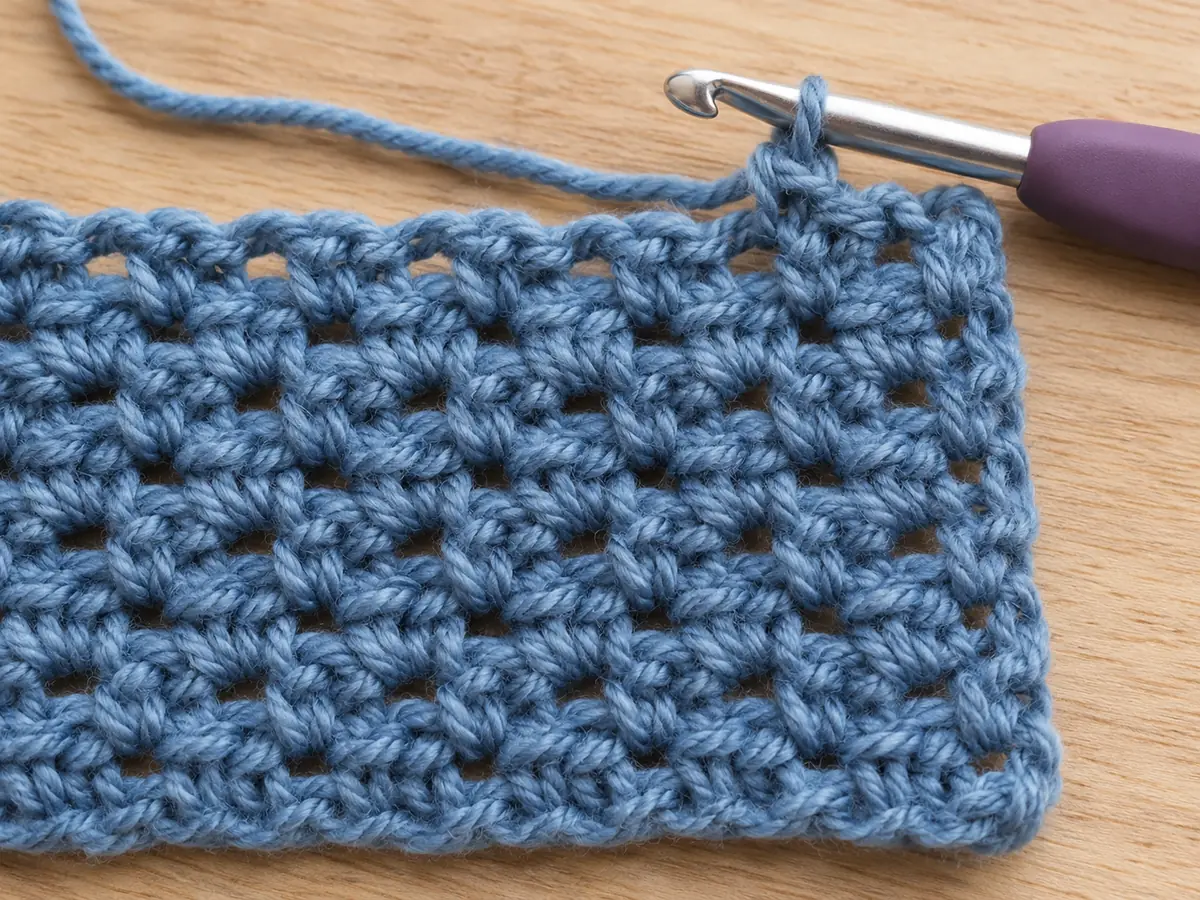
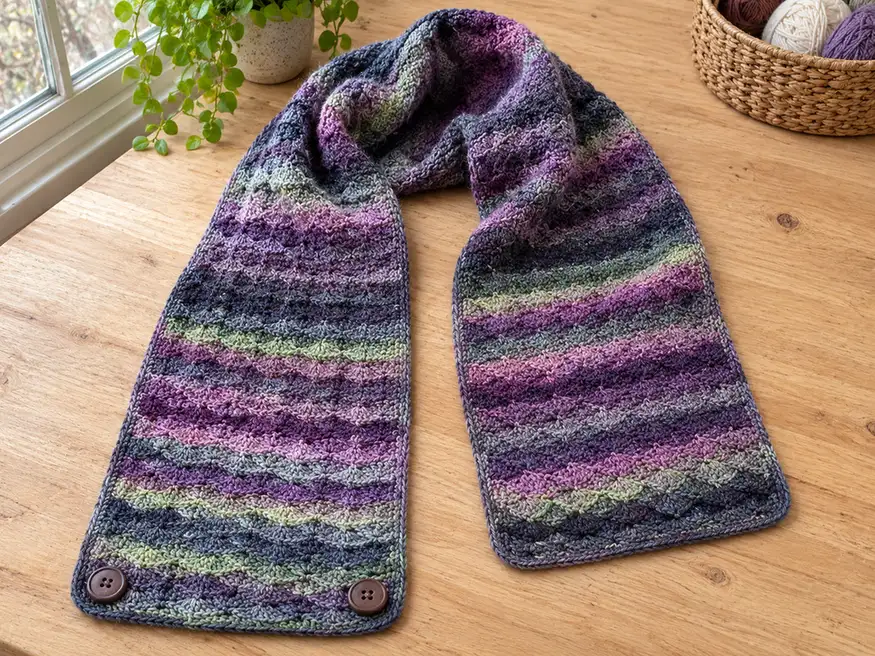
This narrow granny crochet scarf alternates groups of 3 double crochets with solid double crochet rows. Its reference dimensions are approximately 12.7 cm wide and 165 cm long. Repeating the main block changes the length without turning the fabric into a collection of separate squares.

By Emma & EllaUpdated
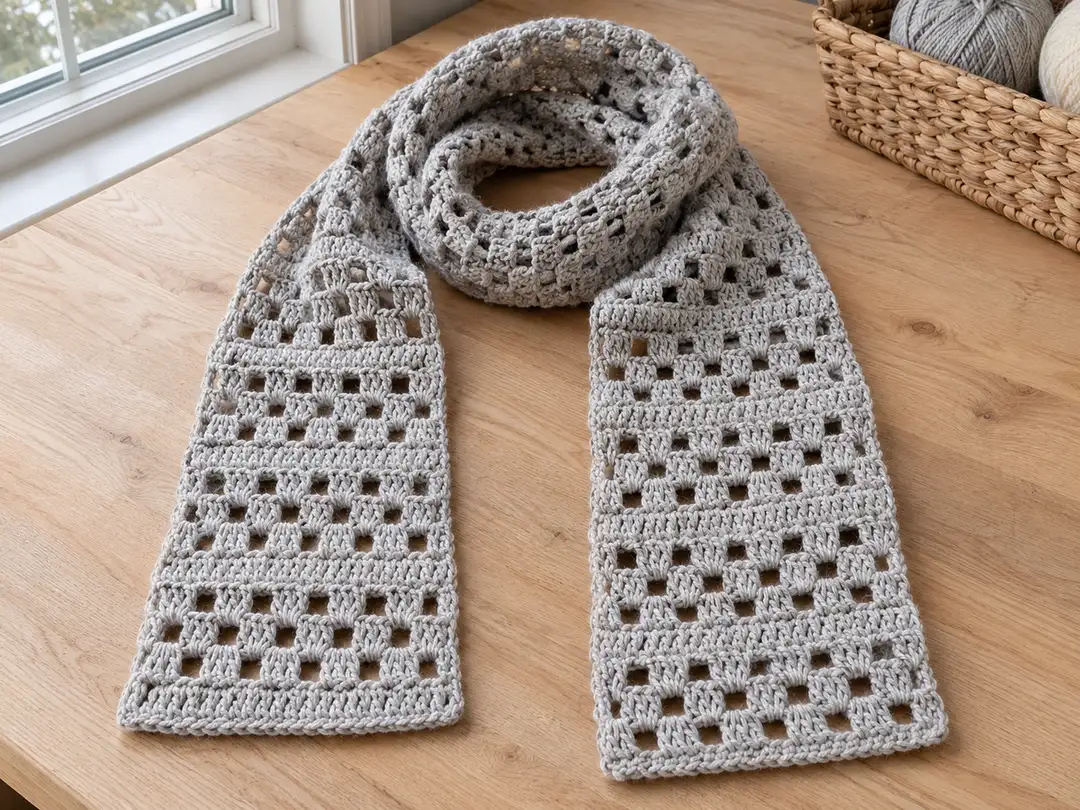
This narrow granny crochet scarf alternates groups of 3 double crochets with solid double crochet rows. Its reference dimensions are approximately 12.7 cm wide and 165 cm long. Repeating the main block changes the length without turning the fabric into a collection of separate squares.
The instructions use US crochet terminology. Some open rows have 5 groups and another has 4 inner groups with individual edge double crochets. The solid rows return to 19 double crochets and provide a useful checkpoint for the whole sequence.
Prepare the yarn and understand complete double crochet groups
Materials and reference tension
| Item | Reference |
|---|---|
| Yarn | Approximately 100 g / 183 m worsted-weight yarn |
| Hook | US size H, usually 5 mm |
| Approximate tension | 15 US dc per 10 cm |
| Finished example | Approximately 12.7 × 165 cm |
| Other tools | Scissors, yarn needle and optional markers |
Check the millimeter size of the hook rather than relying only on its letter. A different tension or a longer scarf may require more yarn. Work the first complete repeat and compare its relaxed width before committing the whole allowance.
The approximate tension relates to the solid double crochet fabric. An open group row can spread differently when pulled. Measure the scarf lying flat instead of stretching the spaces until they appear wider.
US abbreviations and the beginning chain
Ch means chain, sl st means slip stitch, sc means US single crochet, hdc means US half double crochet and dc means US double crochet. US dc corresponds to US double crochet. The main scarf uses dc and chains.
A group is 3 complete dc in the same stated insertion point, except where the edge instructions split a group between a chain replacement and neighboring stitches. It is not a cluster of unfinished double crochets closed together.
The initial 3 ch always count as the first dc in the described double crochet rows. When a beginning group is formed, add only the 2 further double crochets stated. Adding 3 actual double crochets beside the beginning chain would make 4 positions rather than a group of 3.
Use the solid row as a count check
Five groups contain 15 double crochet positions, and their 4 separating chain spaces give 19 positions for a following solid row. Work 1 dc into each relevant chain space there, not another group of 3.
A short row record helps distinguish the 4 different repeat rows. The changes between solid fabric, 5-group rows and the 4-inner-group row are deliberate. They should not be removed merely because the rows look similar.
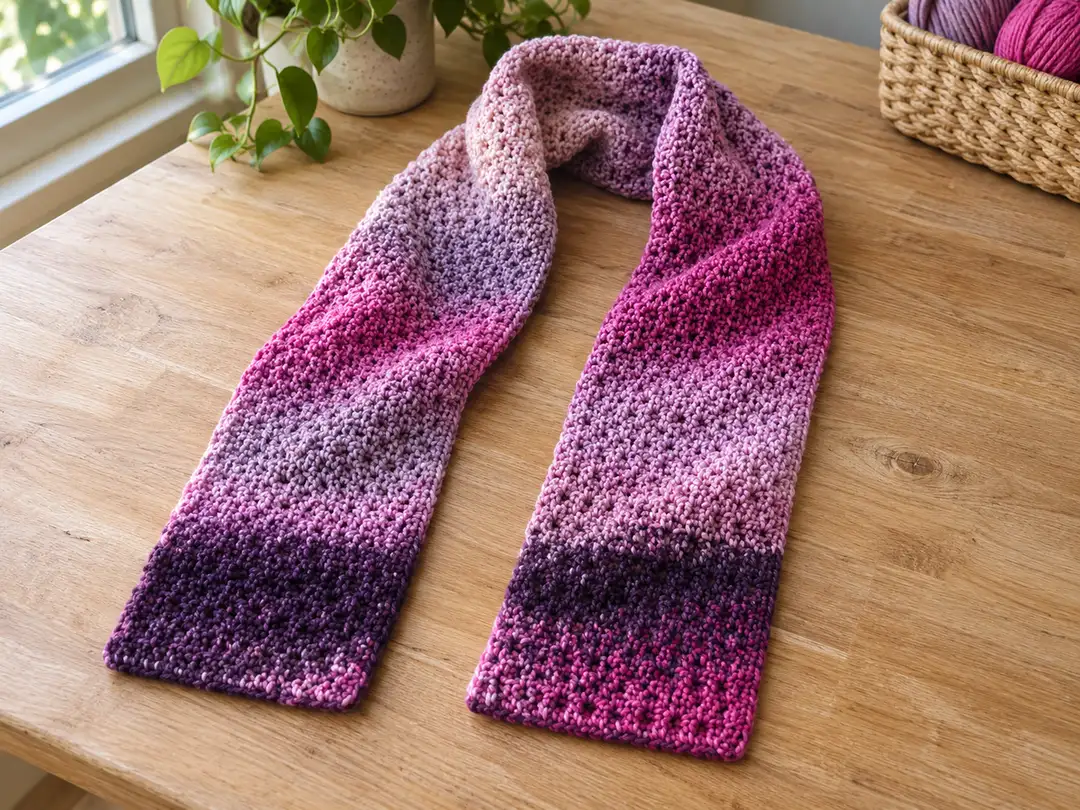
For another ribbed fabric, compare the small yarn-over slip-stitch scarf. Its row counts do not replace the granny arrangement here.
Establish 5 groups and the first solid row
Row 1: the 16-chain foundation
- Make 16 ch.
- Work 2 dc into the 4th chain from the hook. The skipped beginning chains represent the first dc, completing the first group.
- Repeat 3 times: skip 2 foundation chains, make 1 ch and work 3 dc into the next chain.
- Skip another 2 foundation chains, make 1 ch and work 3 dc into the final chain.
The row contains 5 groups. After the first group in the 4th chain, the later groups use the regular spacing along the short foundation through the final chain. Count 15 double crochet positions, including the beginning-chain replacement, and 4 chain spaces between groups.
The new chains between the groups are different from the foundation chains that were skipped. Keep those roles separate when checking the row. A skipped old chain does not itself create a new counted chain space at the top.
Row 2: 19 solid double crochets
- Make 3 ch and turn; these count as the first dc.
- Work 1 dc into each remaining dc and each 1-chain space.
- Finish with 19 dc altogether.
Do not also work another dc into the position replaced by the beginning chain. Each chain space receives one double crochet in this solid row. Putting 3 into a space would widen the fabric and prevent the next group arrangement from fitting.
The source identifies row 2 as the right side. A temporary marker can identify that fabric face if helpful, but no additional crochet step is required. Continue turning and following the pattern rather than keeping that side facing you for every row.
Check the first rectangle
Count the solid row before beginning the main block. Its 19 double crochets are a clearer checkpoint than trying to compare every opening by eye. Mark the top beginning chain if you tend to overlook it at the following row's end.
A different shaped project is the triangular shawl with a shell edging. This scarf retains a narrow rectangular construction.
Repeat rows 3–6 with the specified edge spaces
Row 3: return to 5 groups
- Make 3 ch and turn, then work 2 dc into the next stitch.
- Repeat 3 times: skip 3 old stitches, make 1 ch and work 3 dc into the next stitch.
- Skip another 3 old stitches and make 1 ch.
- Work 2 dc into the next stitch and 1 dc into the 3rd beginning chain of the previous row.
This produces 5 groups. The first edge group is split between the beginning-chain double crochet and 2 dc in the next position. The final group is split between 2 dc and the dc in the old beginning chain. Do not move all these edge stitches into a single space.
The 3 skipped old stitches between inner groups differ from the 2 skipped foundation chains used in row 1. Follow the current row's instruction rather than repeating the foundation spacing automatically.
Row 4: 4 inner groups and the source's extra edge chain
- Make 4 ch and turn. These represent 1 dc and a 1-chain space.
- Work 3 dc into each of the 4 old 1-chain spaces, with 1 ch between the groups.
- After the fourth group, retain the chain included at the end of the source repeat and its additional chain before the final edge dc.
- Work 1 dc into the final edge stitch.
Read literally, that last edge space has 2 chains. The source names a chain within the repeat and then another before the final double crochet. This wording is preserved openly rather than silently dropping one chain.
The row has 4 complete inner groups and an individual dc at either edge. The extra chain changes the edge opening, not the number of granny groups. The following row uses that whole opening as one insertion space.
Row 5: restore 5 groups
- Make 3 ch and turn, then work 2 dc into the first edge space.
- Skip the next old group, make 1 ch and work 3 dc into the following space.
- Repeat that placement for the next 2 inner groups.
- Make 1 ch and skip the final old group.
- Work 2 dc into the last 4-chain beginning space and 1 dc into its 3rd chain.
The 5-group arrangement returns. At the beginning, the edge space is treated as a whole opening even where row 4 left 2 chains. Do not make separate groups into each individual chain of that gap.
The last 2 dc in the edge space and the final dc into the 3rd chain complete the final group. Keep the insertion points explicit: that last dc closes the edge rather than adding an unrelated sixth group.
Row 6: the solid checkpoint
Make 3 ch and turn. Work 1 dc into every remaining dc and each 1-chain space, reaching 19 dc including the beginning-chain replacement. Count before starting another main block.
If the solid row differs from 19, inspect the 2 edge groups and the separating spaces. The open rows need not all contain identical individual chain counts, but they must lead back to the stated solid-row checkpoint.
Continue rows 3, 4, 5 and 6 in that order. A missed solid row or a repeated 4-group row changes the structure, even when the yarn color makes the surface look convincing.
Finish with a matching 5-group end
Plan the final extra row
Repeat the complete 4-row blocks to the required length. Then work row 3 once more as the final row. Its 5 groups match the 5 groups at the beginning of the scarf.
Reserve yarn for this finishing row rather than using the ball until it stops midway through a repeat. Ending after the 4-group row would give differently constructed short ends, which is not the stated finish.
Measure and keep a repeat record
Measure along a long edge with the scarf resting without tension. The approximately 165 cm reference depends on the yarn, tension and number of completed blocks. Add full 4-row repeats for a longer version and record how many you used.
The source does not give one fixed total number of repeats for every yarn. Do not invent an exact row total from the approximate double crochet tension alone, because no separate row gauge is supplied.
Secure the ends without closing the lace
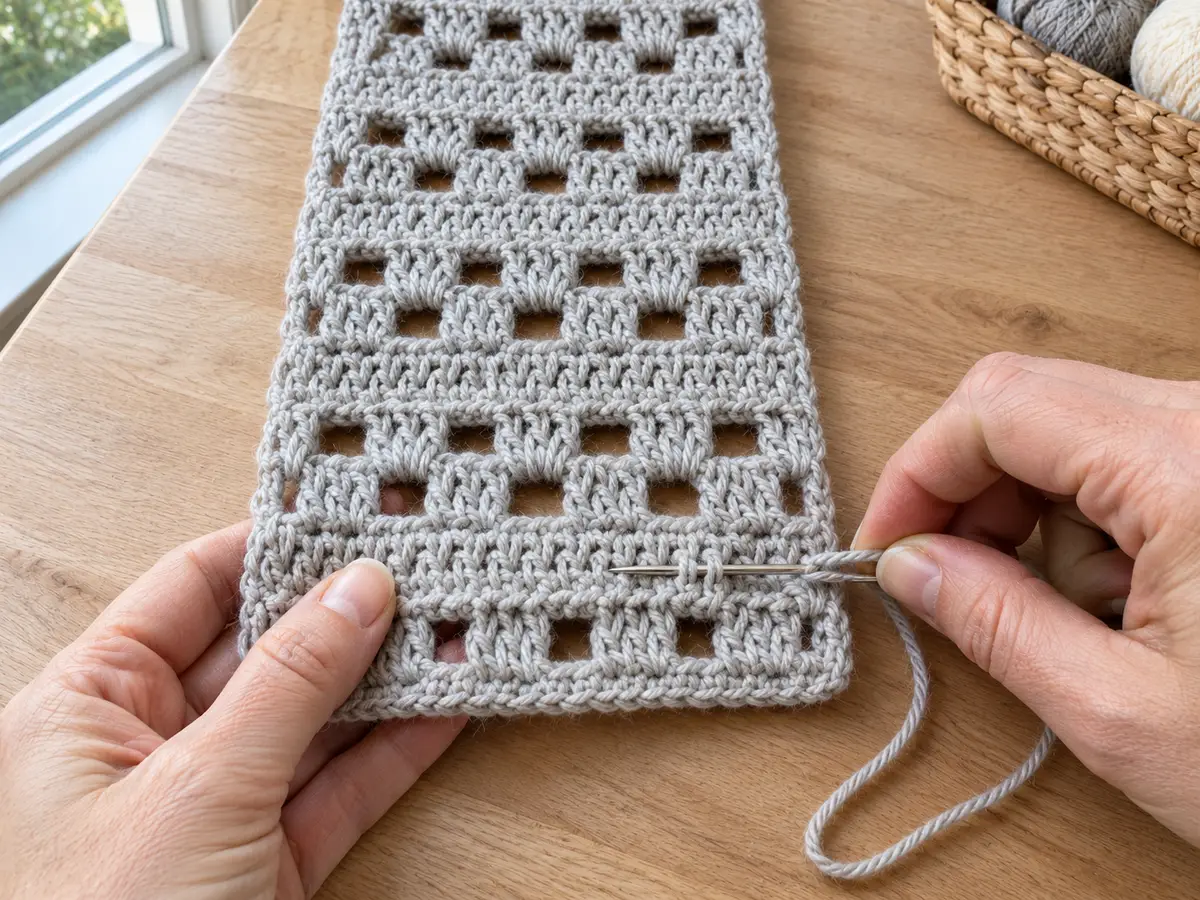
Cut the yarn, draw it through the working loop and weave all tails along the bodies of double crochets. Avoid carrying a tail freely across an open space, where it will show and may pull the opening out of shape.
Change direction through several stable stitches to secure the yarn, without tightening the narrow fabric into a pinch. Lay both long edges flat and compare the matching 5-group ends before any washing or shaping.
Follow the chosen yarn's care instructions if dampening and arranging the scarf. Small tension differences can settle, but blocking cannot supply a missing edge stitch or restore an omitted group. Let the fabric dry completely before judging the final measurement.
No additional border or fringe is part of this basic pattern. For another construction, see the linen-stitch infinity scarf. These references do not establish a separate physical test of every substitution.
Emma & Ella
More crochet projects from The Cooking Twins Yarn.
More from Emma & Ella