
First Apartment Kitchen Shopping Checklist: Buy for Your First Meals
Build your first apartment kitchen shopping checklist around supplied equipment, what you own, your first meals and purchases that can wait.

By Emma & Ella FrostUpdated November 17, 2026

5-Ingredient Dump & Go Crockpot Meals
101 effortless slow cooker recipes for busy families.
View on AmazonAvailable on AmazonA first apartment kitchen shopping checklist should start with what the apartment provides and the meals you expect to make, not a large matching set. Check the actual kitchen, list what you are bringing and separate first-meal purchases from things that can wait. That gives every item a reason to enter the cart.
Use the checklist in three passes: confirm the supplied equipment, cover your first meals and review the gaps after moving in. There is no universal starter budget or required number of gadgets. A shared apartment, a furnished rental and an empty kitchen can begin with very different needs.
First pass: confirm what is actually there

Before ordering, make a short record of the cooking, refrigeration and washing facilities that will be available when you arrive. Confirm the actual arrangement with the appropriate person rather than assuming the listing photo shows everything included. Record anything still unresolved as a question, not as a missing item you must immediately buy.
For supplied appliances, locate the model information and operating instructions. Check what cookware and accessories the actual equipment requires before shopping for them. Do not infer compatibility from a pan's appearance or plan to operate a countertop appliance in a space meant only for storage.
Next, list the suitable items you already own and intend to bring. In a shared kitchen, agree which things are genuinely available to use and which belong to an individual. Having a pan in the apartment does not mean everyone has agreed to share it.
- Supplied: confirmed apartment equipment and included accessories.
- Bringing: items you own, can identify and plan to use.
- Shared by agreement: the particular items another household member has offered.
- Unresolved: a question to confirm before paying for a replacement.
The EPA's shopping questions include whether you need an item, will use it, already own it or can borrow it. Apply those questions before buying a whole collection. Borrowing still requires the owner's agreement and suitable equipment for the intended task.
Build the first-meal list from real tasks
Choose a small set of familiar meals you expect to make after moving. Read their complete recipes or purchased-product directions and note the equipment each actually needs. Include the work between cooking and eating: opening a package, draining an ingredient, measuring it and serving the finished meal.
For example, a meal requiring a saucepan and strainer has a different equipment list from a prepared meal intended for a suitable microwave container. That is a task comparison, not permission to substitute equipment or change the recipe. Keep any uncertain requirement marked for checking.
Use these roles as prompts, crossing out what your selected meals do not require:
- Prepare: an appropriate cutting surface, preparation tools and storage for sharp items.
- Measure: the measuring tools the chosen recipes actually specify.
- Cook: compatible cookware, the required lids and suitable handling tools.
- Open and drain: the opener or strainer needed by the actual packages and recipes.
- Eat and drink: suitable plates, bowls, cups and everyday utensils for your household.
- Put away: suitable food containers with matching lids and retained product instructions.
A bundle is useful only when its contents cover your own gaps. Count pieces by their actual role rather than treating a large piece count as a complete kitchen. Decorative extras do not resolve a missing tool needed for the first dinner.
Make the grocery list a separate part of the plan
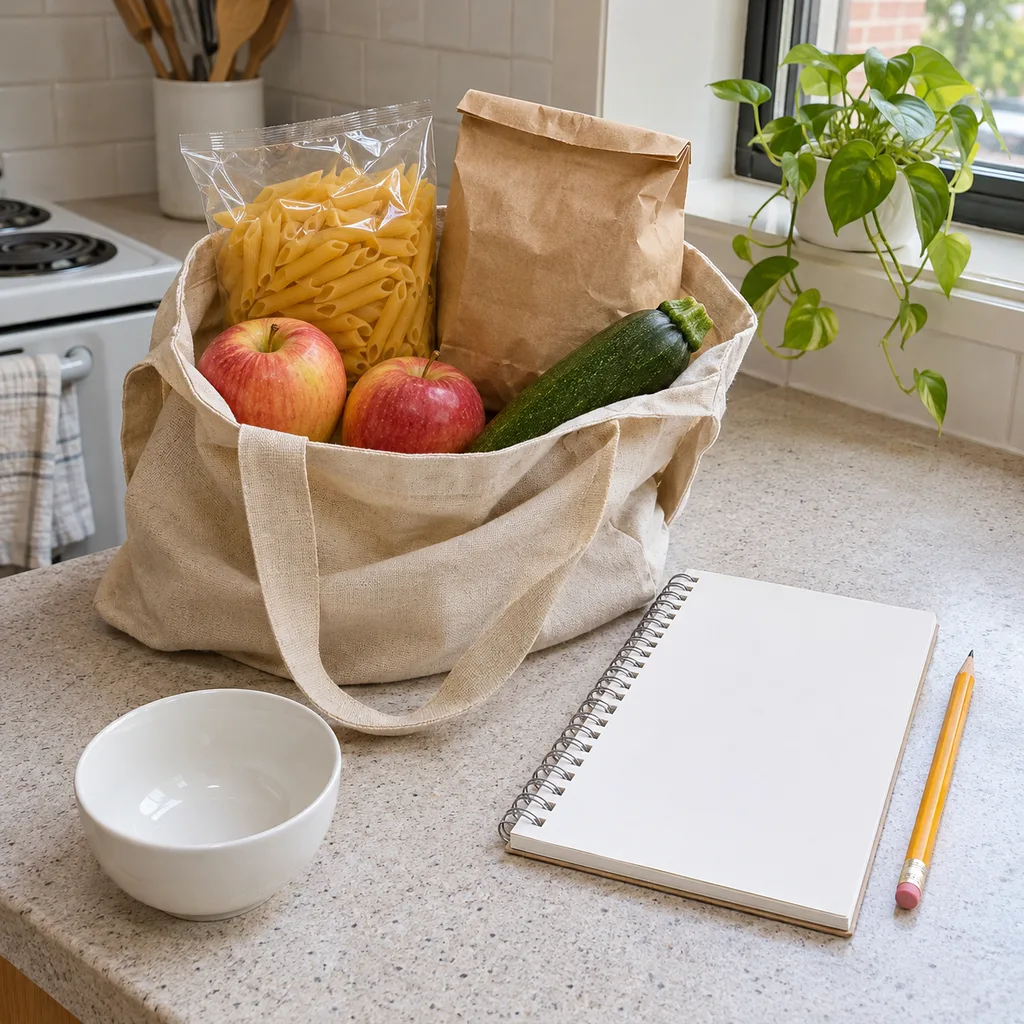
Copy the actual ingredients for the selected meals onto a grocery list, then subtract suitable stock you are bringing. Keep groceries separate from equipment even if you will buy both at the same store. That makes it easier to see whether the cost comes from food, a one-time household purchase or an optional extra.
Include ordinary meals around move-in, not only an imagined first dinner party. Choose quantities from the real meal requirements and your household's plans. Do not buy a large pantry collection simply because every starter list mentions oil, flour or spices; buy the particular ingredients you have an intended use for.
Before collecting perishable groceries, establish their appropriate storage at the apartment. FDA storage guidance advises checking product storage labels and putting foods requiring refrigeration away as soon as you get home. Unpacking kitchen boxes should not become a reason to leave those purchases waiting.
For the package-size and destination questions, our small-kitchen grocery guide covers that separate fit check. Moving into a new place does not create extra refrigerator capacity.
Keep cleaning supplies on their own checklist
Check what you need to wash dishes, manage ordinary cleanup and return tools to storage. Choose supplies appropriate to the actual surfaces and equipment instructions. Do not add unverified cleaning mixtures or assume every material takes the same treatment.
Give those supplies a separate storage destination. FDA advises keeping nonperishable food away from household cleaning products and chemicals. An open cabinet is not automatically a suitable home for both categories.
Keep product directions available after unpacking. A coordinated set of unmarked bottles is not a useful substitute for identifying what each product is and how it is intended to be used.
Mark each purchase buy now, confirm or wait
For each remaining gap, write the task it supports, the actual requirements and its decision. Buy now means it is needed for the confirmed plan. Confirm means a compatibility, ownership or equipment question is still open. Wait means it has no immediate role and can be reconsidered after you use the kitchen.
Check the total against your own available budget before paying. If it does not fit, revise the first-meal plan or defer optional items rather than assuming a particular low-priced bundle is suitable. This checklist does not set a price target or recommend a financing arrangement.
Leave specialty baking pieces, duplicate appliances and hosting collections on the later list unless they have a real immediate purpose. After moving, our small kitchen organization guide can help you assess working and storage space without making a new organizer the first purchase.
Review the gaps after ordinary use
Keep a short note of what interrupted an actual meal: a missing opener, a lid you could not identify or a tool that did not suit the intended task. Check whether the issue calls for finding an existing item, learning its instructions or making a purchase.
Update the same list rather than starting another starter-kit order. The useful first kitchen is one that supports the meals you make, with understandable equipment and a realistic place for each purchase. It does not need to look fully collected on moving day.
Keep good recipes close
Add The Cooking Twins to your preferred sources on Google for more easy dinners, no-bake desserts and kitchen inspiration.
Emma & Ella Frost
A practical resource from The Cooking Twins.
More from Emma & Ella Frost
Comments
Leave a commentShare your question or planning tip below.