
Silicone Baking Mats and Their Uses: Fit, Baking and Care
Learn when a silicone baking mat fits the task, how to check pan compatibility, and what to verify before cleaning and storing your reusable liner.

By Emma & Ella FrostUpdated November 16, 2026

5-Ingredient Dump & Go Crockpot Meals
101 effortless slow cooker recipes for busy families.
View on AmazonAvailable on AmazonA silicone baking mat is a reusable liner, not a replacement for the baking sheet underneath it. Its most useful role is giving an appropriate recipe a nonstick surface while keeping preparation and cleanup manageable. Before putting one in the oven, identify the exact mat, check its instructions, and make sure it fits the pan you intend to use.
This guide to silicone baking mats and their uses focuses on choosing the right task, checking compatibility, and looking after the liner. It does not rank brands or promise that switching liners will improve every batch of cookies. A mat that works for one preparation is not automatically the right surface for another.
Check whether the mat is a baking liner or a work surface
Start with the product information, not the appearance. A flexible silicone-looking surface could be sold for baking, pastry preparation, or another purpose. Printed circles or measurement guides do not, by themselves, establish that it belongs in the oven.
Find the intended uses, compatible equipment, temperature limits, and care instructions for the exact product. Keep that information where you can retrieve it later. If the identity of an old mat is uncertain, ask the manufacturer before using heat rather than borrowing instructions from a similar-looking item online.
As a specific example, the manufacturer's Silpat care sheet, hosted by a restaurant-supply retailer, describes placing its liner on a sheet pan. That is an instruction for that product, not evidence that every silicone work mat is oven-safe.
Match the mat to the pan before adding food
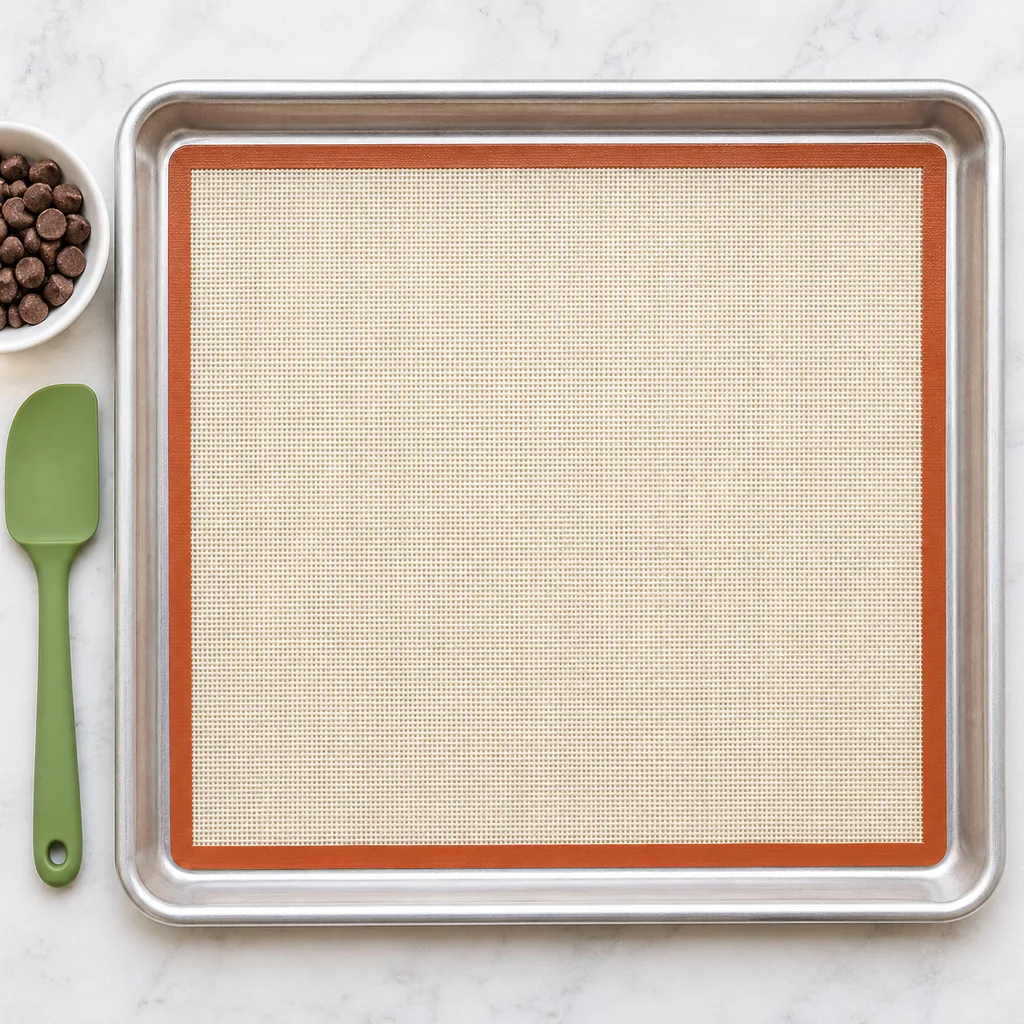
Place a clean, dry mat in the cool pan you plan to use. Check the usable interior rather than the outside dimensions or the pan's general size name. Sloping sides and rounded corners can reduce the flat area available.
The liner should lie as its instructions require without being forced up the sides or folded to fit. If the pairing is wrong, choose a compatible mat-and-pan combination instead of trimming an unidentified liner. A mat is not a cutting board, and changing its shape is not a reliable way to establish compatibility.
Allow space to handle the pan normally. The flexible mat does not turn a hot tray into something safe to lift by its edge. Follow the pan, oven, and mat instructions together, including the appropriate handling equipment.
If the tray is difficult to retrieve from storage, the small-kitchen storage guide explains how to check cabinet openings and the movement needed to remove flat items. Solve that access problem before adding another pan to the stack.
Use it for a recipe that suits a lined baking sheet
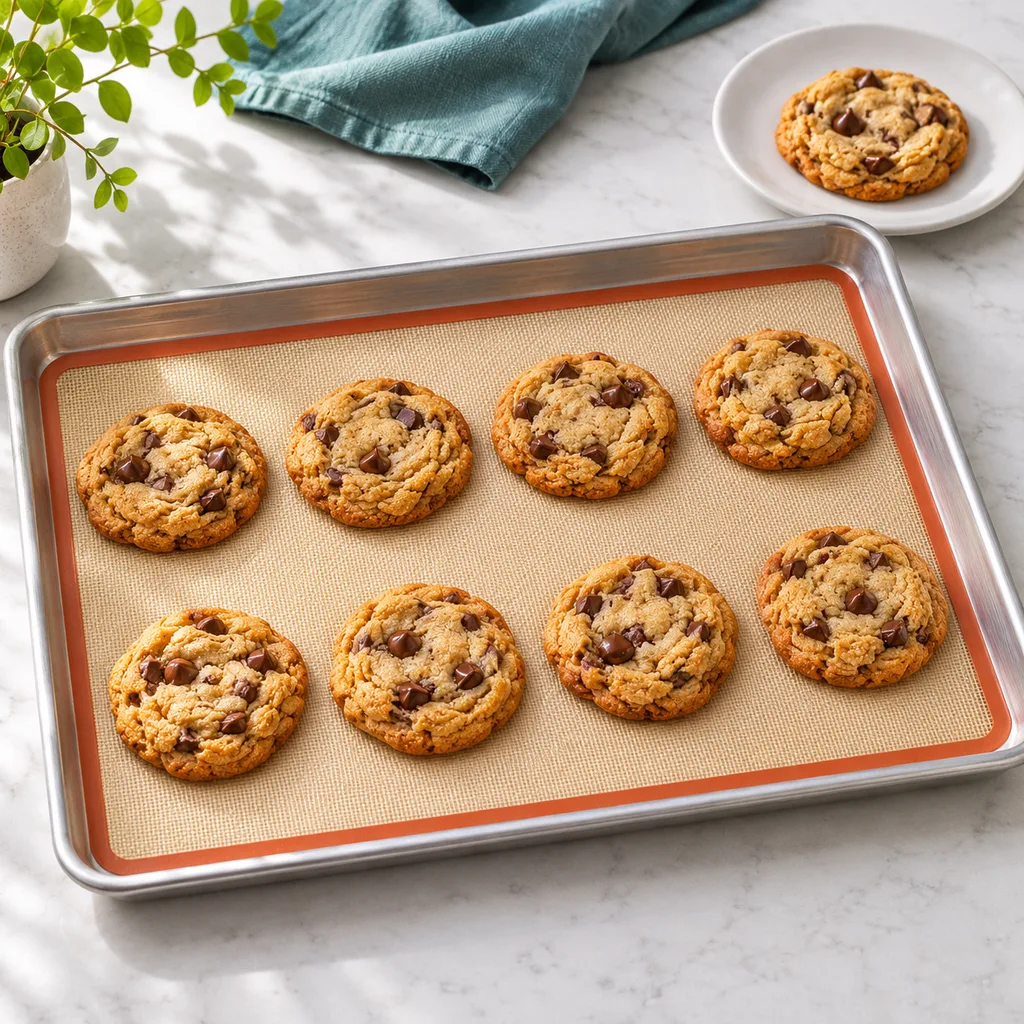
Cookie baking is one practical place to consider a compatible liner when the recipe and mat instructions allow it. Arrange the dough with the spacing the recipe specifies. A mat's decorative circles are not a substitute for the recipe's portion size or spread allowance.
Begin with a recipe whose method you can follow without changing several things at once. Keep its ingredient quantities, pan requirements, oven setting, and doneness guidance intact. If it specifically calls for a different surface, use that surface for the baseline rather than assuming every liner is interchangeable.
For a small baking project, our single chocolate chip cookie recipe provides a separate preparation to read first. Check its method and your equipment instructions before deciding whether your liner belongs in that setup; this guide does not change the recipe.
Do not treat a baking mat as a substitute for a cake pan, a liquid-tight mold, or an appliance accessory with a different job. A rimmed baking sheet and a flexible liner each have their own purpose. The liner alone does not provide the support or containment of a pan.
Keep the recipe surface and heat requirements in view
Read the permitted temperature and appliance use from the instructions supplied with your particular mat. Do not choose a universal limit from a search result. Manufacturer documents can concern different products or versions, and a familiar brand name does not settle which instructions apply to the item in your drawer.
The Silpat technical sheet issued by Maison Demarle warns against contact with direct heat sources, including flames and heating elements. It is a product-specific technical document, not permission to use a different mat under a broiler or in another appliance. Follow your own product's restrictions.
For the same reason, do not transfer a sheet-pan liner into an air fryer, toaster oven, or grill merely because it fits through the opening. Compatibility involves intended use and the appliance instructions, not just dimensions. Leave an uncertain use unresolved until the relevant manufacturer confirms it.
Keep notes if you compare permitted baking surfaces in your own kitchen: the recipe, pan, liner, and result you observed. Change one variable deliberately instead of declaring the mat faulty after changing the dough, pan size, and oven setting together. This is a way to organize your observations, not a report of a test performed for this article.
Clean it according to its own care directions
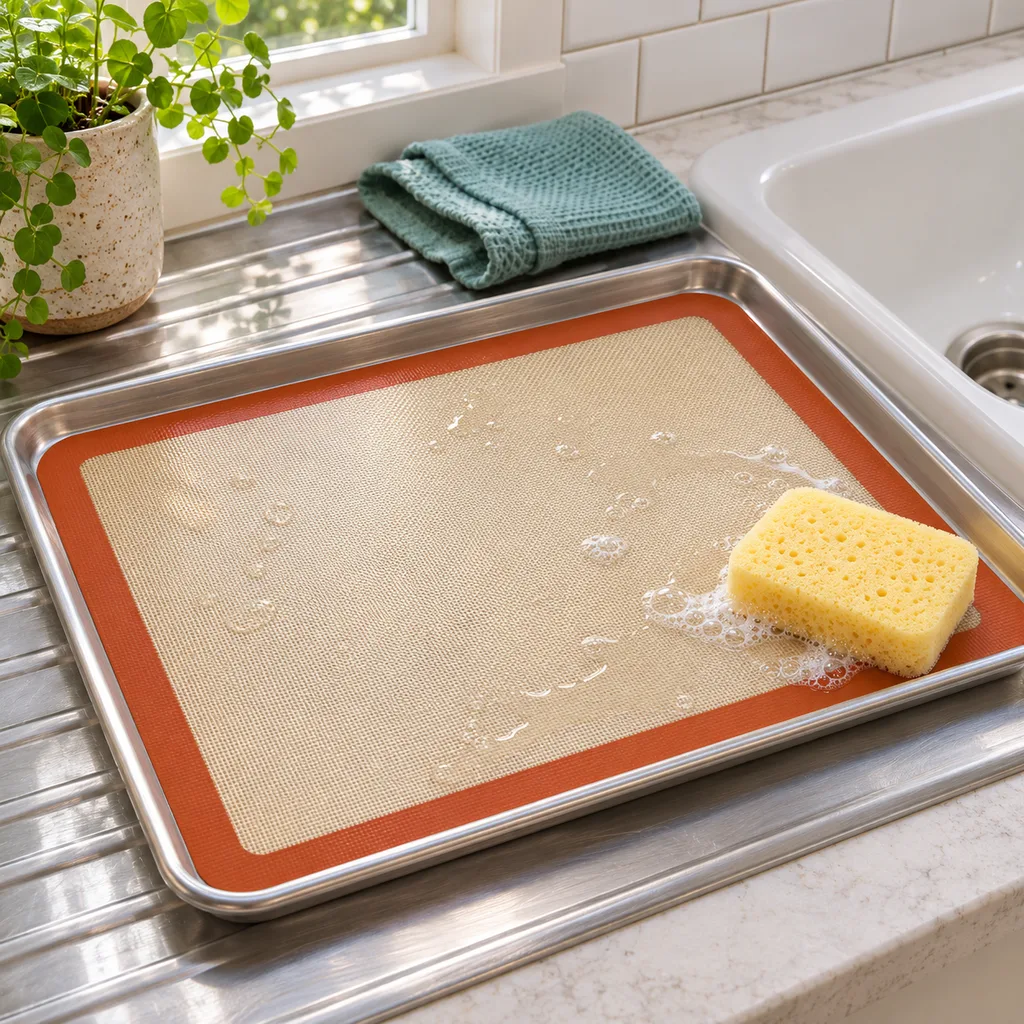
Let the equipment become safe to handle as its instructions require before moving to cleanup. Remove the food with tools appropriate for the liner. Avoid cutting cookies, pastry, or other food directly on it; transfer food to a suitable cutting surface when cutting is needed.
For the product covered by its care sheet, Silpat describes a soft sponge, rinsing, and air drying. Its technical sheet also cautions against aggressive mechanical treatment. Use the directions for your own mat rather than turning a photograph of a sponge into a universal cleaning method.
Check dishwasher permission separately. Do not assume that the care rule for a silicone spatula, a baking mat, and the pan underneath it is the same. If the liner's instructions permit one method and the pan's instructions require another, separate the items for cleaning.
If residue remains, consult the product's troubleshooting guidance before trying an abrasive pad or an improvised chemical mixture. A stain's appearance alone is not a condition assessment. Ask about damage or an uncertain surface rather than covering it with a new layer of food.
Give the clean mat a storage location it can keep
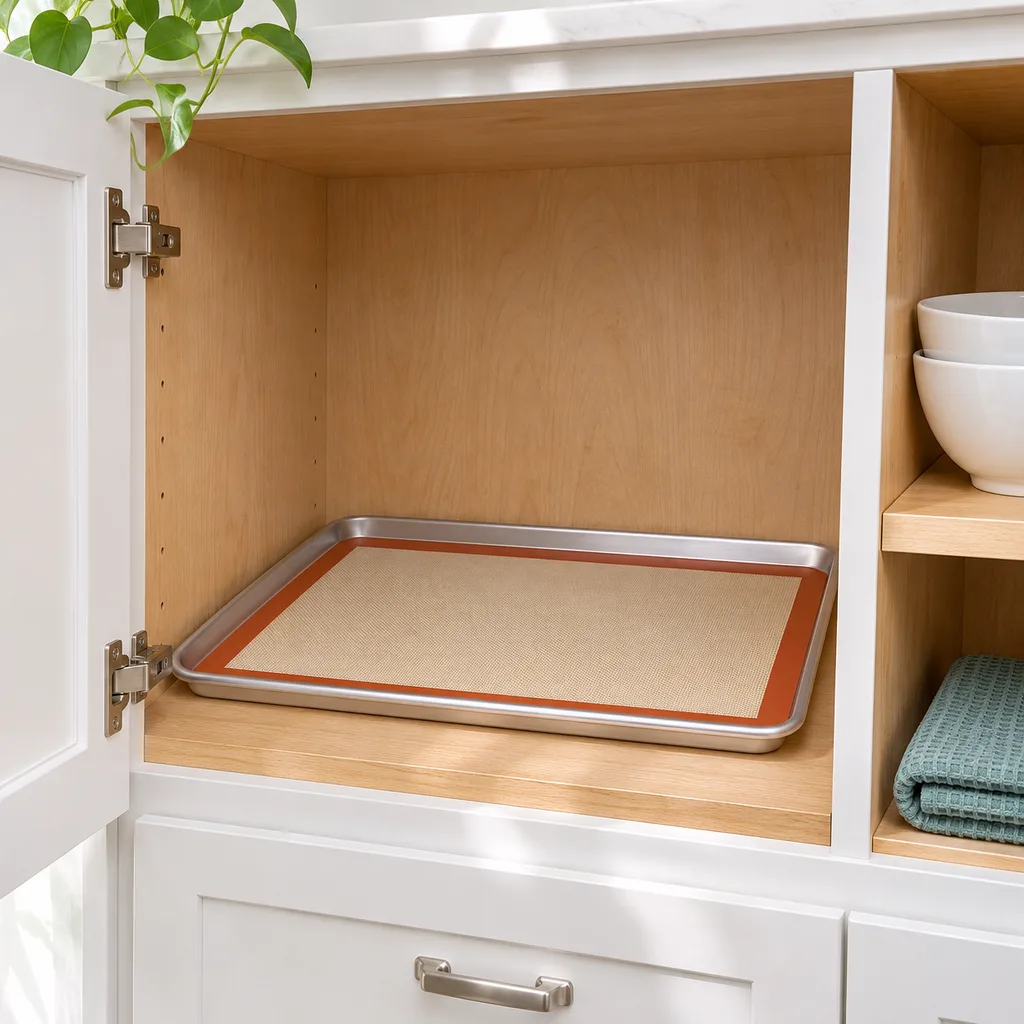
Choose a dry location that follows the mat's storage instructions. Where flat storage is appropriate, an empty compatible tray can provide a defined place without adding another organizer. Leave enough space to remove it without scraping the liner against other tools.
Do not fold a mat into a drawer simply because that is where the baking accessories already live. Check whether the exact product permits rolling or requires another arrangement. Keep sharp implements away from the liner rather than using it as a cushion beneath a mixed pile of tools.
Plan the return journey while the mat is still on the counter. Where will it dry, and where will it go afterward? Our countertop organization guide can help separate temporary baking space from permanent storage, so a drying mat does not become an obstacle to the next meal.
Decide whether a reusable liner fits your baking routine
A mat may be useful when you regularly make suitable sheet-pan recipes and have a workable cleaning and storage routine. It may be less useful if you rarely need that surface, cannot identify the product, or would have to change a recipe that already works well for you.
Before buying another size, list the pans and recipes it would actually serve. An existing recipe-approved lining method may be the simpler choice. Compare complete instructions and compatibility rather than treating a larger set as automatically better value.
The practical checklist is short: identify the mat, pair it with suitable support, choose an allowed use, follow the recipe, and clean and store it as directed. Those decisions matter more than matching accessories or a perfectly styled baking drawer.
Keep good recipes close
Add The Cooking Twins to your preferred sources on Google for more easy dinners, no-bake desserts and kitchen inspiration.
Emma & Ella Frost
A practical resource from The Cooking Twins.
More from Emma & Ella Frost
Comments
Leave a commentShare your question or planning tip below.